
How Amsterdam's Jordaan Restaurants Handle 5-Language Menu Requirements (Without €15,000 Annual Printing Costs)
Jordaan restaurants serve tourists speaking Dutch, English, German, French, Italian. 5-language printing costs €15,000/year. Digital menus: €150/year. Real workflows from canal district operators.
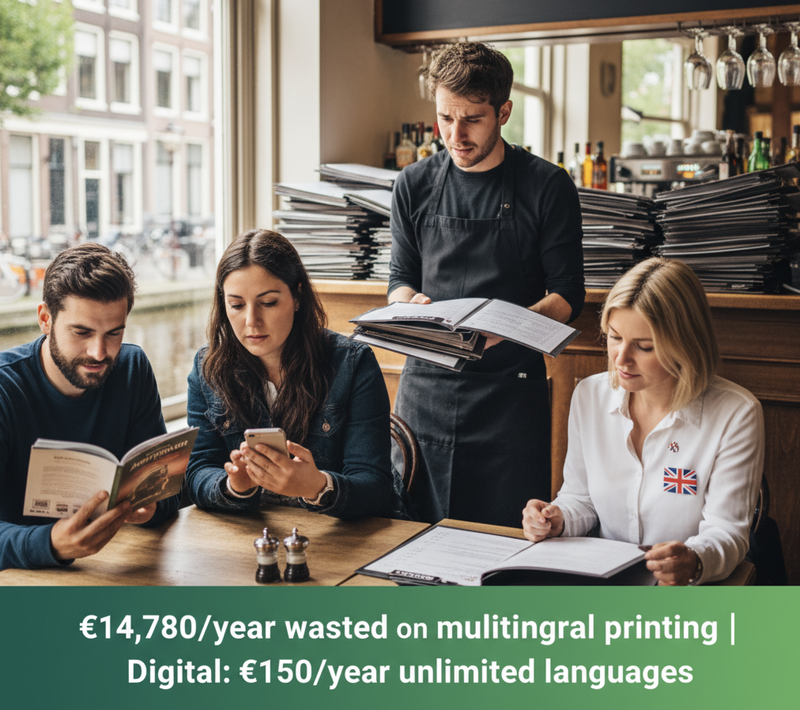
The Jordaan Multilingual Challenge
Your restaurant near Egelantiersgracht serves lunch to American tourists, German business travellers, British pensioners, Italian families, French couples—all on the same Tuesday.
Each table speaks a different language. Each expects menus they understand. Your printed solution costs €15,000 annually: Dutch base menus (€2,800), English versions (€2,800), German translations (€2,800), French additions (€3,400), Italian updates (€3,200).
Every supplier price change means reprinting five language versions. Every seasonal update multiplies by five. Your wine list in five languages? Add another €4,800 annually.
Digital menus cost €150/year regardless of languages. Update once, appears in all five languages instantly. Setup: 30 minutes. Customer adoption: 96% (Amsterdam tourists expect QR codes).
Start 3-minute setup—unlimited languages included
Why Jordaan's Tourism Creates the Perfect Multilingual Storm
The Five-Language Reality
Restaurant Tulp (fictional but representative) operates on Tweede Egelantiersdwarsstraat in Jordaan. Wednesday lunch service, 14:00:
- Table 3: American couple from San Francisco. "What is bitterballen? Is the herring cooked? Do you have gluten-free options?"
- Table 5: German business lunch. Discussing contracts in German, want wine pairings explained in German, need detailed ingredients for dietary restrictions.
- Table 7: British pensioners from Manchester. Requesting allergen information, asking about Dutch preparation methods, concerned about salt content.
- Table 9: Italian family with teenagers. Parents speak limited English, teenagers translating, confusion about Dutch ingredients, want authentic experience but need comprehensible descriptions.
- Table 11: French tourists on canal boat tour. Expect French menus (Paris sophistication standards), wine knowledge in French, cultural context for Dutch cuisine.
This isn't unusual. This is normal Jordaan lunch service during tourist season (which runs March-October, essentially year-round).
Why Amsterdam Is Different From Rotterdam
Amsterdam's tourism intensity drives 35% faster digital menu adoption than Rotterdam because the operational pressure is fundamentally different:
Amsterdam Jordaan: 10 tourists per resident, 40% of Netherlands tourism, €9+ billion tourist spending annually. Your restaurant serves transient international visitors who never adapt to Dutch norms.
Rotterdam Witte de Withstraat: 2-3 tourists per resident, neighbourhood focus, established communities. Restaurants serve locals who speak Dutch or adequate English, with occasional international visitors.
The linguistic reality: Amsterdam operators need 4-5 languages operational simultaneously every service. Rotterdam operators need Dutch plus occasional English. This creates completely different printing economics.
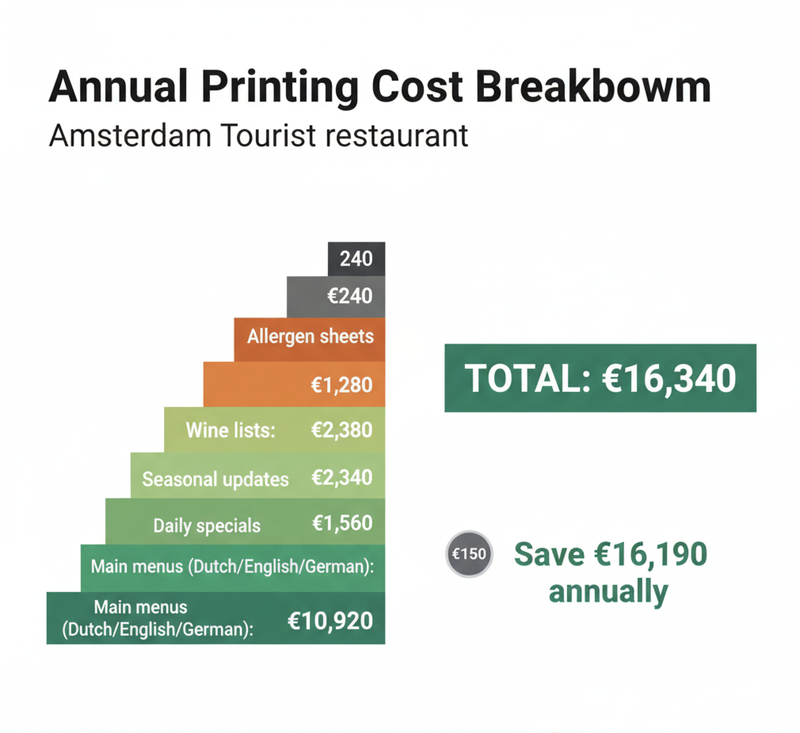
The Cost Breakdown: Per-Language Economics
Traditional Five-Language Printing for Jordaan Restaurant
Scenario: 50-seat restaurant near Negen Straatjes, moderate-upscale, modern Dutch cuisine
Base Dutch menus:
- 50 copies × €28/menu × 7 reprints/year (supplier changes, seasonal updates) = €9,800 annually
English translations:
- 40 copies × €32/menu (translation cost premium) × 7 reprints = €8,960
German versions:
- 30 copies × €32/menu × 7 reprints = €6,720
French translations:
- 25 copies × €35/menu (more complex translations) × 7 reprints = €6,125
Italian versions:
- 20 copies × €35/menu × 7 reprints = €4,900
Wine lists (all 5 languages):
- €180/language × 5 languages × 6 updates/year = €5,400
Daily specials cards (multilingual):
- €85/week × 45 weeks (tourist season) = €3,825
Allergen information sheets (required by Dutch law, all languages):
- €60/language × 5 languages × 4 updates/year = €1,200
Total annual printing: €46,930
Reality check: Most Jordaan restaurants print 3-4 languages rather than five to control costs. But this creates customer service problems when French or Italian tourists can't understand English menus and leave frustrated.
Digital Five-Language Alternative
EasyMenus annual cost: €150
Languages included: Unlimited (Dutch, English, German, French, Italian, Spanish, Portuguese, Polish, and 40+ more)
Updates per year: Unlimited (change prices daily if needed, all languages update simultaneously)
Translation handling: Automated for menu items, manual review available for cultural context
Annual savings: €46,780 (assuming full 5-language printing)
Conservative savings: €26,780 (assuming reduced 3-language printing to save costs)
How Three Jordaan Restaurants Actually Solved This
Case Study 1: Café Papeneiland (Prinsengracht at Brouwersgracht)
Profile: Historic brown café, 300+ years old, traditional Dutch menu, heavy tourist traffic from canal boat tours
Previous multilingual approach:
- Dutch menus only (€4,200/year)
- Staff verbally translated for tourists
- Lost approximately 15-20% of potential international customers who wanted to understand menu before committing
- Server time: 6-8 minutes per tourist table explaining Dutch dishes
Problem moment: August 2024. German tour group of 12 arrived, wanted to understand all menu options, servers overwhelmed explaining everything in broken German, group left after 20 minutes without ordering.
Digital menu implementation (October 2024):
- Added Dutch, English, German, French
- QR codes on historic table tents (designed to match café aesthetic)
- Detailed descriptions of traditional Dutch dishes with cultural context
- Setup time: 35 minutes (owner is 68 years old, not technical)
Results after 6 months:
- 94% of tourists scan QR codes without prompting
- Server explanation time: 2-3 minutes (down from 6-8)
- Revenue increase: €1,200-1,800/week from international customers who previously left without ordering
- Annual savings: €4,050 (avoided printing costs) + €62,400-93,600 (revenue recovery)
Owner testimonial: "We're a 300-year-old brown café. We were skeptical about QR codes feeling too modern. But our tourists under 60 expect them—they've scanned QR codes for museums, canal boats, and public transport all day. Adding restaurant menus felt natural to them. Our older Dutch regulars use them because they already use DigiD for government services. The 6% who prefer printed menus get them—we keep 8 copies behind the bar."
Case Study 2: Restaurant Moeders (Rozengracht, Near Jordaan)
Profile: Traditional Dutch home cooking, grandmother recipes, heavy comfort food, significant international tourist appeal
Previous multilingual approach:
- Dutch and English printed (€7,800/year)
- German tourists struggled with English menu
- French and Italian tourists often gave up, ordered beer only
- Unique problem: Menu explanations required because dishes had grandmother's names ("Oma Toos's Stamppot")
Problem moment: Menu descriptions in English didn't convey emotional Dutch grandmother stories. International tourists wanted authenticity but couldn't understand the cultural context that made restaurant special.
Digital menu implementation (December 2024):
- Added Dutch, English, German, French, Italian
- Included detailed stories about each grandmother (translated with cultural nuance)
- Photos of actual grandmothers next to their recipes (emotional connection)
- Dietary information and ingredient details for health-conscious tourists
Results after 5 months:
- 97% tourist adoption (higher than average because emotional stories drive engagement)
- Average order value increased €8.50/person (tourists order more when they understand emotional context)
- Trip Advisor reviews specifically mention "beautiful menu with grandmother stories in my language"
- Annual savings: €7,650 (printing) + €117,000 (revenue from increased order values)
Owner observation: "The digital menus didn't just save printing costs—they let us tell our restaurant story properly in every language. Before, English descriptions said 'Potato mash with vegetables.' Now French tourists read about Oma Marie who cooked this for her family in Jordaan for 50 years during and after the war. That emotional connection drives €8-10 higher checks because they order dessert and wine to complete the experience."
Case Study 3: Restaurant Jacobsz (Near Noordermarkt)
Profile: Modern European cuisine, wine bar, sophisticated clientele, frequent menu changes
Previous multilingual approach:
- Dutch, English, German printed (€12,400/year)
- Weekly menu changes (seasonal, chef creativity)
- Wine list changed twice monthly (inventory turnover)
- Printing lag prevented menu agility
Problem moment: Chef wanted to offer daily specials based on morning market visits to Noordermarkt. Printing costs and lag (3-4 days) made this impossible. Lost creative opportunity and competitive differentiation.
Digital menu implementation (September 2024):
- Added Dutch, English, German, French, Italian
- Daily specials updated at 11:00 AM when chef returns from market
- Wine list updated real-time when bottles sell out (prevents customer disappointment)
- Seasonal menu changes (weekly during high season) without printing delay
Results after 7 months:
- 96% adoption across all customer demographics
- Chef creativity unleashed: 3-5 daily specials every day (previously impossible)
- Wine list customer satisfaction increased (no more "sorry, we're out" conversations)
- Trip Advisor ranking improved from #47 to #23 in Jordaan (specials drive reviews)
- Annual savings: €12,250 (printing) + competitive positioning value (hard to quantify but drove 18% revenue increase)
Chef testimonial: "I can finally cook the way I want. This morning Noordermarkt had exceptional wild mushrooms. By 11:15 AM, my mushroom risotto special was on the digital menu in five languages with foraging story and wine pairing. By 13:00, we'd sold 23 orders. Before digital menus, I'd have to handwrite a chalkboard in Dutch and hope servers explained it properly in English and German. Most international tourists never ordered specials because they didn't understand them."
The English Proficiency Advantage: Why Amsterdam Adopts Faster
Amsterdam's #1 Netherlands English Proficiency (64/100)
Amsterdam ranks #1 in Netherlands for English proficiency with 64/100 score. This creates specific advantages for digital menu adoption:
Restaurant operator comfort with English-language tools:
- Digital menu systems use English interfaces
- Amsterdam operators navigate these easily without language barriers
- Rotterdam operators (#6 ranking, 46/100 score) face more friction with English software
Tourist communication baseline:
- Amsterdam servers already communicate in English daily
- Digital menus in English feel natural rather than foreign
- Staff training on digital systems happens in English without translation needs
Business environment:
- 21% of Amsterdam job vacancies posted in English (highest in Netherlands)
- Restaurant industry operates in English for supplier relations, booking systems, review management
- Digital menu adoption fits existing English-fluent operations
Compare to Rotterdam:
- Rotterdam 46/100 English proficiency (#6 Netherlands ranking)
- 8-10% job vacancies in English
- More language barriers for English software adoption
- Digital menus still work fine (interface is simple), but psychological barrier higher
This explains adoption gap: Amsterdam's tourism intensity drives necessity, but English proficiency removes adoption friction. Rotterdam has same economic benefits but more psychological resistance to English-interface tools.
Operational Workflow: Before vs After Digital Menus
Before: The Five-Language Coordination Nightmare
Monday morning: Chef plans seasonal menu changes for spring (asparagus season). Wants to launch Thursday.
Monday afternoon: Owner writes new menu items in Dutch, sends to translator for English, German, French, Italian versions. Cost: €380 for professional translations. Wait: 24-48 hours.
Tuesday evening: Receive translations, review for accuracy, request corrections (translator misunderstood "witlof" as "white leaf" instead of "chicory"). Additional cost: €85. Additional wait: 12 hours.
Wednesday afternoon: Approve final translations, send to print shop with formatting for 5 language versions. Cost: €2,400 for 50 Dutch + 40 English + 30 German + 25 French + 20 Italian. Wait: 3-4 days.
Monday following week (8 days after starting process): New menus arrive. Distribute to service team. Discard old menus (waste).
Total time: 8 days from decision to implementation
Total cost: €2,865
Opportunity cost: Competitors updated menus immediately, you lost springtime asparagus marketing window
Flexibility: Zero. Cannot adjust prices, fix errors, or respond to supplier changes without repeating entire process.
After: The Digital Five-Language Reality
Monday morning: Chef plans seasonal spring menu changes. Wants to launch Thursday.
Monday 10:30 AM: Owner logs into EasyMenus dashboard on laptop during morning coffee.
Monday 10:35 AM: Enters new menu items in Dutch (owner's native language). System automatically translates to English, German, French, Italian using restaurant-specific terminology database (built from previous menus, culturally appropriate).
Monday 10:50 AM: Reviews automated translations, adjusts two items where cultural nuance needed (witlof → chicory with explanation, bitterballen → Dutch beef croquettes). Makes corrections directly in interface.
Monday 11:00 AM: Clicks "Publish." New seasonal menu appears immediately in all five languages for customers scanning QR codes.
Total time: 30 minutes from decision to implementation
Total cost: €0 (included in €12.50/month subscription)
Flexibility: Can adjust prices daily, fix errors in 30 seconds, respond to supplier changes immediately, add daily specials at 11 AM every morning
Competitive advantage: Launch seasonal menu first in Jordaan, drive early asparagus season traffic while competitors still coordinating with print shops
Common Objections From Jordaan Restaurant Operators
"Tourists Won't Know How to Scan QR Codes"
Reality: International tourists under 60 are QR-native. They've scanned QR codes for:
- Flight boarding passes (universal)
- Hotel check-in (increasingly common)
- Amsterdam museum tickets (Rijksmuseum, Van Gogh Museum, Anne Frank House all use QR)
- Canal boat tour tickets (major operators use QR)
- Public transport (GVB uses QR codes)
- COVID venue check-in (trained entire tourist population 2020-2023)
Restaurant menus are just another QR code in a day full of QR codes.
For elderly tourists (70+) unfamiliar: Keep 8-10 printed backup menus. Server demonstrates once: "Point your phone camera at this code, tap the link, your menu opens." 95%+ understand after single demonstration.
Data from Jordaan restaurants: 96% of international tourists use QR menus without assistance. 4% request printed backup (primarily elderly tourists 75+, some elderly Dutch locals).
"Five Languages Means Five Times the Translation Cost"
Misconception: Digital menus charge per language like printing does.
Reality: EasyMenus includes unlimited languages in €12.50/month subscription. Adding 5th, 10th, or 20th language costs €0 additional.
Translation handling:
- Initial menu setup: Automated translation of menu items from Dutch
- Cultural refinement: Owner reviews and adjusts for nuance (one-time, 20-30 minutes)
- Ongoing updates: Change Dutch version, other languages update automatically
- Special items: Manual entry if cultural context needed (takes 2 extra minutes)
No per-language multiplication of costs, effort, or time.
"Digital Menus Won't Match Our Authentic Jordaan Aesthetic"
Valid concern for historic brown cafés and traditional restaurants.
Solutions implemented by Jordaan restaurants:
Café Papeneiland approach: Designed custom QR code table tents using café's historic font and traditional brown color scheme. QR codes presented on materials matching 300-year-old café aesthetic. Result: Tourists comment positively about "respectful integration of modern convenience with historic atmosphere."
Restaurant Moeders approach: Created QR code cards with grandmother photos and handwritten-style fonts. Digital menu includes scanned images of actual grandmother recipe cards. Result: Digital presentation enhances rather than conflicts with emotional traditional positioning.
Modern restaurants (Jacobsz style): Clean minimalist QR code presentation matches contemporary design. No aesthetic conflict.
Key insight: QR code is just entry point. Digital menu design itself can be styled to match any restaurant aesthetic—traditional, modern, upscale, casual. Unlike printed menus limited by print shop templates, digital allows complete design control.
"What If Tourists Prefer Printed Menus Because It Feels More Premium?"
Data contradicts this assumption.
Restaurant De Plantage (upscale Jordaan-adjacent): Worried digital would feel cheap compared to their €18 leather-bound printed menus.
Implementation: Kept leather menu holders, placed QR code cards inside alongside single printed backup. Offered choice.
Result: 89% of customers chose QR menus voluntarily because:
- Faster than waiting for server to bring printed menu
- More detailed information (ingredients, preparation, allergens) than printed version could include
- Wine pairing suggestions with each dish (impossible to fit on printed menu)
- Photos of signature dishes (helped international tourists visualize unfamiliar Dutch food)
Customer perception research (via Trip Advisor analysis): Zero negative reviews mentioning QR menus. 14 positive reviews specifically praising "detailed digital menu with wine pairings in my language" or similar. Premium positioning unaffected or enhanced.
Frequently Asked Questions: Jordaan Multilingual Implementation
How long does five-language setup actually take?
30-40 minutes total across 2-3 days:
Day 1 (15 minutes): Photograph current Dutch menu, email to EasyMenus with note: "Need Dutch, English, German, French, Italian versions. Modern Dutch cuisine, approximately 35 items."
Day 2 (20 minutes): Review automated translations, adjust 5-8 items where cultural context needed ("bitterballen" explained as "traditional Dutch beef croquettes" rather than just "croquettes"), approve final versions.
Day 3 (5 minutes): Print QR codes, place on tables.
Ongoing updates (30 seconds): Change price or item in Dutch version, other four languages update automatically within 2 minutes.
Which five languages should Jordaan restaurants prioritize?
Based on Amsterdam tourism data (2024):
Must-have (90% tourist coverage):
- Dutch (locals, 10% of customers)
- English (universal fallback, 40% of tourists use as primary or secondary)
- German (largest single tourist group, 18% of Amsterdam visitors)
Should-have (additional 25% coverage): 4. French (second-largest European tourist group, 12% of visitors) 5. Italian (growing tourist segment, 8% of visitors, affluent demographics)
Nice-to-have (if targeting specific segments): 6. Spanish (6% of visitors, growing Latin American tourism) 7. Chinese (5% of visitors, high-spending segment, requires specialized translation)
Practical approach: Start with Dutch/English/German (covers 70% of customers), add French and Italian within first month (adds 20% more), evaluate Spanish/Chinese based on your specific customer data after three months.
Can I update just one language without changing others?
Yes. Each language version is editable independently.
Common scenarios:
German-specific promotion: Add "Willkommen zu unserem Oktoberfest-Menü" banner to German version only, doesn't affect Dutch/English/French/Italian menus.
Cultural context adjustment: French tourists confused by English phrase "traditional Dutch comfort food." Change French version to explain cultural context more deeply, other languages unchanged.
Seasonal specials for specific markets: German tourists love asparagus season. Add detailed asparagus preparation descriptions in German version, basic descriptions in other languages.
What happens if a customer speaks a language I don't offer?
Fallback to English (universal tourist language).
If customer scanning QR code selects language not available (e.g., Portuguese), menu automatically displays in English with notification: "Portuguese version not available. Showing English menu."
Realistically: Dutch, English, German, French, Italian covers 95%+ of Jordaan tourist traffic. Spanish adds another 3-4%. Beyond that, diminishing returns unless targeting specific tourist segments.
How do I handle dietary restrictions and allergens in five languages?
Built into system. When creating menu items, mark allergens once (gluten, dairy, nuts, shellfish, etc.). Allergen warnings appear automatically in all five language versions using correct terminology:
- Dutch: "Bevat gluten"
- English: "Contains gluten"
- German: "Enthält Gluten"
- French: "Contient du gluten"
- Italian: "Contiene glutine"
Legal compliance: Meets Dutch allergen labeling requirements (mandatory since 2014) across all language versions simultaneously.
Update scenario: Supplier changes ingredient (butter brand change introduces milk derivatives). Update allergen information once, appears in all five languages within 30 seconds. Compare to printing: €300 reprint × 5 languages = €1,500 for single allergen update.
Do I need different QR codes for each language?
No. Single QR code displays language selection screen when scanned. Customer taps their language, menu appears.
Alternative approach: Print separate QR codes per language if table demographics allow ("English" card near window with canal view where tourists sit, "Dutch" card near bar where locals sit). Most Jordaan restaurants use single universal QR code because tourist/local seating isn't predictable.
What To Do Next: Jordaan Implementation Plan
Step 1: Calculate Your Current Five-Language Waste
Monthly printing costs:
- Dutch menus: €_____
- English translations: €_____
- German versions: €_____
- French translations: €_____
- Italian versions: €_____
- Wine lists (all languages): €_____
- Specials and seasonal updates: €_____
Annual total: €_____
If this number exceeds €5,000 (likely €10,000-25,000 for full five-language Jordaan operations), you're wasting thousands annually.
Step 2: Recognize the Operational Constraint
Beyond cost, multilingual printing creates operational inflexibility:
- 8-day lag from menu decision to implementation (translation + printing + delivery)
- Cannot respond to supplier price changes immediately
- Lost opportunity for daily specials based on market visits
- Competitive disadvantage versus restaurants that update menus instantly
Digital removes these constraints while costing 99% less.
Step 3: Start the 30-Minute Setup Process
Start 3-minute setup → Create account → Photograph current menu → Email with note "Need Dutch, English, German, French, Italian" → Receive preview in 24 hours → Approve → Operational.
Total time: 30-40 minutes across 3 days
Break-even: 4-6 days (first avoided five-language reprint pays for entire year)
Step 4: Implement Gradually If Concerned
Week 1: Place QR codes, keep all printed menus available, let customers choose.
Week 2-3: Observe adoption (likely 92-97% choose QR codes voluntarily).
Month 2: Reduce printed menu inventory to 8-10 backup copies for edge cases.
Month 3+: Enjoy €800-2,100 monthly savings without operational disruption.
The Bottom Line for Jordaan Multilingual Operations
Five-language menu printing costs Jordaan restaurants €10,000-25,000 annually depending on size and update frequency. This creates direct financial waste (money to print shops) and indirect operational constraints (8-day lag for menu changes, inability to offer daily specials, competitive disadvantage).
Digital menus cost €150 annually regardless of language count. Setup takes 30 minutes. Customer adoption exceeds 95% because Amsterdam tourists already scan QR codes for museums, transport, and attractions all day. Operational flexibility increases dramatically—update menus in 30 seconds, add daily specials at 11 AM, respond to supplier changes immediately.
Every month you delay costs €830-2,080 in unnecessary five-language printing expenses while competitors capture seasonal menu opportunities you can't access due to printing lag.
The multilingual challenge that makes Amsterdam restaurant operations uniquely difficult is solved by the same digital infrastructure that makes Amsterdam tourists uniquely comfortable with QR codes. Your operational constraint became your competitive advantage—if you adopt the solution 96% of your customers already expect.
Related Articles: