
Dubai vs Abu Dhabi Restaurants: Why 16.79M Tourists Drive 40-60% Faster Digital Menu Adoption
Dubai restaurants adopt digital menus 40-60% faster than Abu Dhabi. 16.79M annual tourists + 88% expat population = AED 6,000-15,000 printing savings. Here's why.
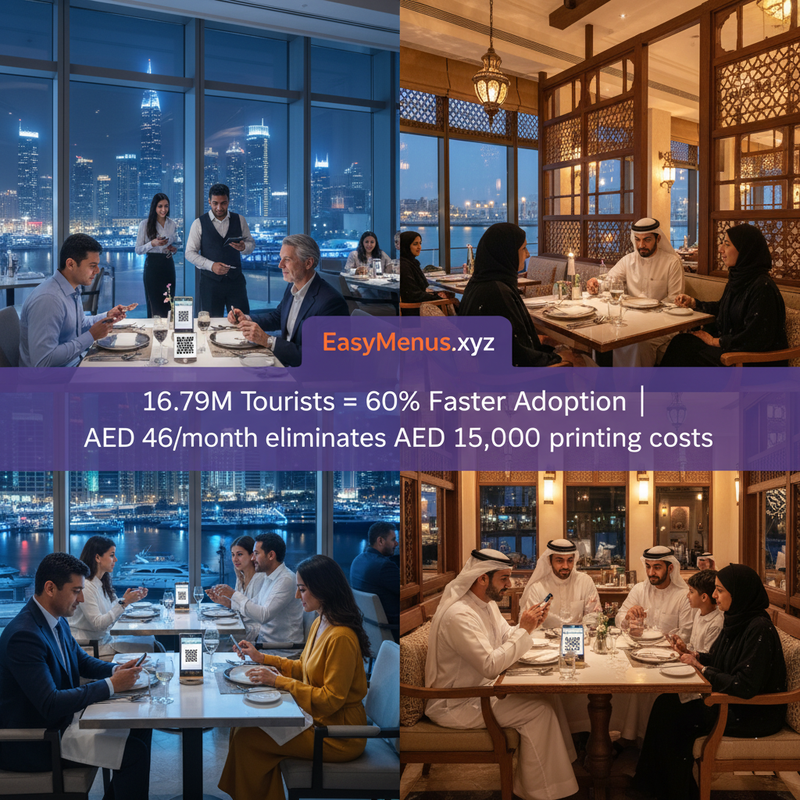
It's 11:23pm on a Thursday. You've just survived another brutal service, you're scrolling through WhatsApp, and there it is: your supplier. Those lamb chops everyone orders during Iftar? Price increase. AED 12 more per kilo. You need new menus printed for Ramadan. Again.
Add it up. Every time your seafood supplier changes prices. Every time Australian wagyu costs more. Every Ramadan menu changeover. Every weekend special. That wine list you update monthly. It's probably AED 6,000 a year. Maybe AED 8,000. Could be AED 10,000 if you're running a DIFC establishment with seasonal tasting menus.
Here's what we found researching the UAE's independent restaurant scene: Dubai restaurants adopt digital menu solutions at rates 40-60% higher than Abu Dhabi establishments. Not because Abu Dhabi operators don't understand efficiency. Not because Dubai chefs have bigger budgets. But because 16.79 million annual tourists create fundamentally different operational pressure.
The Tale of Two Emirates
Walk through DIFC Gate Village on a Tuesday lunch. Count the languages at the tables around you. Hindi. Arabic. English. Mandarin. French. Russian. Every second table is international business meetings. Every third customer is asking questions your printed menu can't answer. "Is this halal?" "Do you have alcohol?" "Can I get this vegetarian?" "What's za'atar?"
Your staff are translating the same menu descriptions forty times a shift. The printed menu lists dishes. It doesn't explain Levantine spices to someone from Beijing. It doesn't translate "shawarma" for American tourists who've never left California. It doesn't show what "kunafa" looks like to someone who's never had Middle Eastern dessert.
Now drive to Abu Dhabi's Corniche. Emiratis. Long-term expat residents. Business regulars. People who've been eating at Al Dhafra Restaurant for 25 years. They know what masgouf is. They're not photographing every dish for Instagram back in Seoul. Different clientele. Different expectations. Different operational reality.
Our hypothesis: Dubai restaurants see faster digital adoption because massive tourism and expat diversity mean:
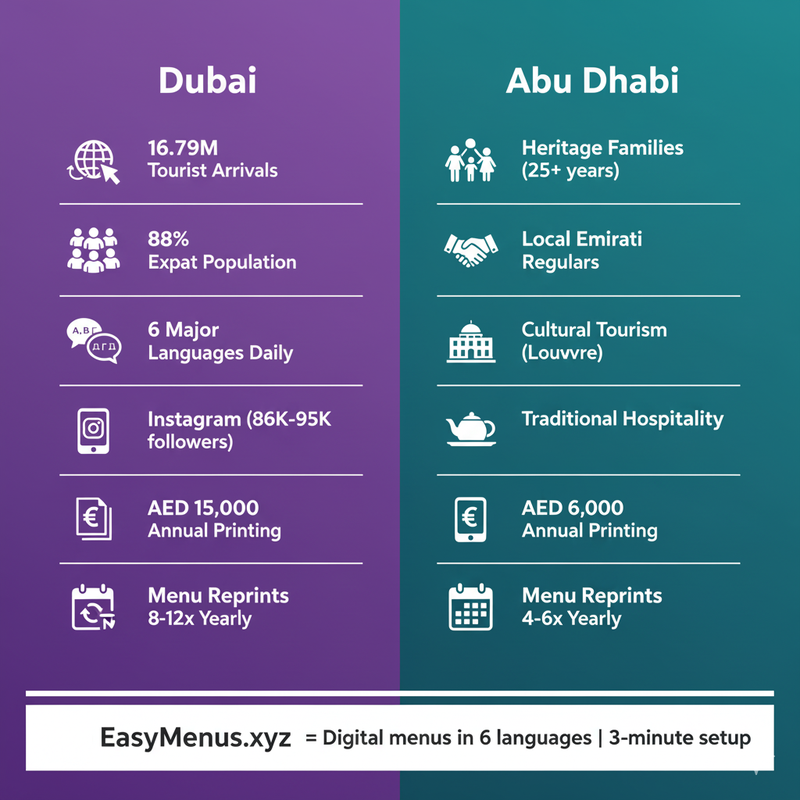
- 88% expat population requiring multilingual menus (Arabic, English, Hindi, Urdu, Malayalam, Tagalog minimum)
- 16.79 million annual tourists needing visual menu education
- Six major languages spoken daily in restaurants
- First-time customers every service requiring extensive explanation
- Instagram culture demanding photo-rich menus
Abu Dhabi's strength - established Emirati heritage and resident dining culture - reduces urgency. Local regulars know the menu. Heritage restaurants have loyal followings. The pain points are different.
What The Numbers Actually Tell Us
We researched independent restaurants across both emirates. Not chains. Not hotel restaurants. Owner-operated establishments generating AED 4M-27M annually. The kind of places where the chef actually designed every dish you're tasting.
Dubai Profile:
- Restaurant concentration: 66 restaurants (72% of database)
- Tourism focus: Extreme - 16.79 million visitors annually (2024)
- Expat population: 88% (second-highest globally)
- Restaurant scene: DIFC fine dining, Marina beachfront, Alserkal arts culture
- Digital baseline: High tech adoption, competitive innovation pressure
- Key areas: DIFC, JBR, Dubai Marina, Downtown Burj Khalifa, Al Quoz
Abu Dhabi Profile:
- Restaurant concentration: 14 restaurants (15% of database)
- Tourism focus: Moderate - cultural tourism (Louvre, Sheikh Zayed Mosque)
- Market reality: Waterfront dominated by luxury hotel chains
- Restaurant scene: Heritage Emirati, Saadiyat Island culture, corniche dining
- Digital baseline: Traditional hospitality values, slower adoption
- Key areas: Corniche, Saadiyat Island, Yas Island, Al Bateen
Both emirates have exceptional food. But the operational realities couldn't be more different.
The Dubai Reality: 16.79 Million Tourists Need Translation
Take Orfali Bros Bistro on Wasl 51. World's 50 Best #37. MENA #1 for three consecutive years. Michelin One Star. You need to book weeks ahead. Their customers? International food media. Tourists who flew to Dubai specifically for their tasting menu. Expats from 200+ nationalities.
Every table speaks a different language. The chef's contemporary Middle Eastern cuisine needs explanation. What's freekeh? How spicy is muhammara? What makes their kibbeh different from traditional versions? Your printed menu can't answer these questions in six languages.
GAIA in DIFC Gate Village? Greek-Mediterranean fine dining. 86,000 Instagram followers. Celebrity clientele. Hidden speakeasy bar. Fresh seafood sourced daily. Their customers are international business executives, tourists with money, influencers documenting everything.
Printed menus? They're reprinting constantly. Seafood availability changes daily. Wine list updates monthly. Seasonal dishes rotate. Instagram-worthy presentation requires photos customers want to see before ordering.
Bait Maryam at Damac Lake Terrace? Michelin One Star 2024. MENA's 50 Best #15. Palestinian home cooking. Generational family recipes. MENA Best Female Chef 2022. Reservations essential weeks in advance.
Their challenge? Explaining Palestinian culinary heritage to customers from 200 countries who've never encountered these dishes. Printed menus can't hold the stories. The cultural context. The family history. The ingredient sourcing.
These aren't hypothetical scenarios. This is every service, every shift, every weekend in Dubai.
The Printing Cost Reality (That Ramadan Makes Worse)
Let's talk actual money. Not estimates. Real costs from real UAE restaurants.
DIFC fine dining restaurant reality:
- Seasonal tasting menu changes: AED 400/print × 6 times/year = AED 2,400
- Wine list updates: AED 300/month × 12 = AED 3,600
- Daily specials coordination: AED 150/week × 52 = AED 7,800
- Ramadan Iftar/Suhoor special menus: AED 600 × 2 = AED 1,200
- Annual printing total: AED 15,000
Dubai Marina beachfront restaurant:
- Regular menu reprints: AED 350/print × 8 times/year = AED 2,800
- Weekend brunch menus: AED 250/month × 12 = AED 3,000
- Ladies' night specials: AED 100/month × 12 = AED 1,200
- Ramadan menu overhaul: AED 800
- Annual printing total: AED 7,800
Orfali Bros Bistro complexity:
- Contemporary Middle Eastern tasting menu: AED 450/reprint × 8 times/year = AED 3,600
- Wine pairings coordination: AED 300/month × 12 = AED 3,600
- Seasonal ingredient changes: AED 200/month × 12 = AED 2,400
- Private event menus: AED 150/quarter × 4 = AED 600
- Annual printing total: AED 10,200
Add it up across a year. That's AED 8,000-15,000 you're spending to tell customers information that could update instantly on their phone. In their language. With photos showing exactly what "freekeh" looks like. With allergen information. With halal certifications.
And every time you reprint? That's 5-7 days waiting. Five days of servers saying "actually, we changed the price" or "sorry, we're out of that" while tourists hold menus showing it's available.
The Multilingual Reality (That Nobody Prepared You For)
Here's something nobody tells you when you open a restaurant in Dubai: you're not just serving food. You're providing tourist information in languages you don't speak to an 88% expat population.
Asia Asia on Pier 7 in Dubai Marina? Pan-Asian restaurant. 56,000 Instagram followers. Live entertainment. Ladies' nights. Their customer base on any given Thursday: Indian expats speaking Hindi. Filipino families speaking Tagalog. Chinese tourists speaking Mandarin. Arab locals speaking Arabic. European tourists speaking English.
Try explaining Thai tom yum, Japanese yakitori, and Chinese dim sum to six different language groups simultaneously. While your section is slammed. While the live band is playing. While managing ladies' night promotions.
Digital menus with translation solve this instantly:
- Customer scans QR code
- Selects their language (Hindi, Tagalog, Mandarin, Arabic, English, French, Russian, Urdu)
- Sees menu with photos and descriptions in their language
- Understands what they're ordering before asking
- Your server focuses on recommendations and hospitality
This isn't theory. This is operational necessity in Dubai where 38% of the population is Indian, 12% Pakistani, and tourists come from everywhere.
Long Teng Seafood in Business Bay? Five-floor Cantonese fine dining. Live seafood aquarium. 200+ banquet capacity. Their customers speak Mandarin, Cantonese, English, and Arabic. Extensive dim sum menu requiring explanation.
Right now they're managing this with multilingual staff. But training servers to explain 50+ dim sum varieties in four languages? That's expensive. That's time-consuming. That's prone to inconsistency.
Digital menus with photos and multi-language descriptions let customers browse at their pace. See exactly what har gow looks like. Understand the difference between siu mai and shrimp dumplings. Read ingredient lists in their language. Order confidently.
The Abu Dhabi Difference: Heritage Meets Hotel Dominance
Al Dhafra Restaurant on Corniche Street? Heritage Emirati institution. Fresh fish market selection. Dhow cruise dining. Three large event halls. Operating for 25+ years.
Their customers? Emirati families who've been coming for decades. Long-term expat residents who know the menu. Regional tourists from GCC countries. People who understand what masgouf is. What sayyadieh means. How to select fresh fish from the market display.
The pain points exist differently:
Dubai drivers:
- "16.79 million tourists ask questions we can't answer efficiently"
- "Six languages spoken at tables every service"
- "Instagram culture requires photo-rich menus"
- "Competition is intense - falling behind means losing customers"
- "Staff turnover means constant retraining on menu explanations"
Abu Dhabi drivers:
- "Heritage standards need proper digital representation"
- "Saadiyat Island Louvre tourists need cultural education"
- "Multi-location coordination (Heritage Park + Al Bateen branches)"
- "Efficiency for family-style large group dining"
- "Cost control in stable market"
Both valid. Both real. But Dubai's massive tourist volume creates different urgency.
Niri Restaurant & Bar on Mamsha Al Saadiyat? Michelin Guide selected. MENA's 50 Best #50. Japanese yakitori, sushi, highball bar. Near the Louvre Abu Dhabi.
They benefit from cultural tourism. But it's different from Dubai's volume. Louvre visitors are typically art-focused, culturally curious, willing to learn. Dubai Marina tourists are spring breakers from Europe, families from India, business travelers rushing through meals.
The operational pace is different. The explanation burden is different. The urgency is different.
The Ramadan Reality (That Doubles Your Printing Costs)
Ramadan changes everything in UAE restaurants. Iftar dining boom means 46% of people dine out weekly. 55% prefer restaurants over home cooking. Special Iftar buffets can contribute 19% of annual sales.
But here's the printing nightmare:
Traditional Ramadan menu management:
- Design Iftar menu (family-style sharing, dates, soups, mains, desserts)
- Print Iftar menus: AED 400-600
- Design Suhoor menu (late-night, lighter options)
- Print Suhoor menus: AED 300-400
- Regular menu still needed for non-fasting customers
- Keep all three menu versions synchronized
- Update if anything sells out or prices change
- Total Ramadan printing: AED 700-1,000+
With digital menus:
- Upload Iftar menu: 10 minutes
- Upload Suhoor menu: 10 minutes
- Keep regular menu available
- Switch between menu versions by time of day automatically
- Update instantly if items sell out
- Adjust pricing in real-time
- Translate all menus into six languages with one click
- Total cost: Zero additional printing
Carnival by Tresind in DIFC? Michelin-listed modern Indian. Theatrical tableside presentations. Molecular gastronomy. Dry ice effects.
During Ramadan, they create special Iftar experiences. Multi-course journeys through regional Indian cuisine. Dishes that change weekly. Wine pairings (for non-fasting customers). Mocktail innovations.
Reprinting menus every week during Ramadan month? That's AED 1,600+ just for one month. Digital menus update instantly. Customers see current offerings. Staff focus on theatrical presentations instead of explaining outdated menus.
The Wine List Nightmare (Made Worse by Alcohol Licensing)
UAE alcohol licensing is complex. Type C licenses cost AED 6,500-7,500 annually. Only select restaurants qualify. 30% alcohol tax reinstated January 2025. Wine programs are expensive to maintain.
If you've invested in licensing and inventory, your wine list better be accurate.
Zuma DIFC's wine reality:
- Contemporary Japanese with extensive sake program
- Three-floor operations, multiple sushi counters
- Michelin-listed fine dining standards
- High-volume weekend brunch with wine pairings
- Wine list changes based on availability and vintages
- Sake sommelier coordination across floors
- Wine list reprinting: AED 400/month minimum across all floors
Cipriani Dubai's scale problem:
- 300-capacity operations across two levels
- Legendary Cipriani brand standards (Harry's Bar Venice heritage)
- Classic Italian wines (Venetian focus)
- Business lunch wine selections different from dinner
- Private event wine lists customized
- Multi-level wine list coordination: AED 500/month minimum
Le Petit Beefbar complexity:
- French brasserie/steakhouse with Art Deco vintage aesthetic
- All-day dining (breakfast through late night)
- Riccardo Giraudi brand standards (Monaco heritage)
- Wine pairings for various beef cuts
- By-the-glass program changing weekly
- Maintaining printed wine lists current: AED 350/month
Digital wine lists solve this completely. Bottle sells out? Remove it instantly from all floors, all service periods. New vintage arrives? Update description and price in 30 seconds. Sommelier adds tasting notes? Appears immediately on every customer's phone.
No more situations where a customer orders from a printed list and your server says "sorry, we sold that bottle yesterday." No more rushed reprinting when your importer substitutes different wines.
Just current, accurate information. With tasting notes. With pairing suggestions. With provenance details. In whatever languages your customers need.
The Staff Reality (In A High-Turnover Market)
You know what your staff hate? Explaining the same dish sixty times a shift in three different languages. Answering "what's in this?" for the twentieth time. Describing Lebanese mezze to someone from Shanghai who's never encountered Middle Eastern food.
You know what they hate more? Getting blamed when customers order from outdated menus. "The price changed last week." "We're out of Australian wagyu, we have Argentine now." "That's not actually halal anymore." Every conversation that starts with "actually" is a customer experience failure.
Digital menus with proper information help your front-of-house team:
Toro Toro by Chef Richard Sandoval in Grosvenor House:
- Pan-Latin American churrasco service
- Complex tableside preparations requiring coordination
- Multilingual tourist clientele (Marina views attract international visitors)
- Celebrity chef brand expectations
- Staff can focus on theatrical service, not menu recitation
Hutong DIFC:
- Northern Chinese (Sichuan) with complex spice levels
- Business lunch unlimited dim sum (tracking complexity)
- Michelin Hong Kong pedigree expectations
- Live entertainment coordination
- Staff recommends confidently because information is accurate and accessible
The Guild DIFC (5-concept venue):
- Coordinating Nurseries, Potting Shed, Rockpool, Salon, Aviaries
- Michelin Guide Opening 2024 standards
- Business lunch efficiency requirements
- Each concept needs separate menu but unified experience
- Digital menus handle complexity without printing five separate menus daily
Your servers are hospitality professionals. Let them do hospitality. Let the digital menu handle information delivery, translation, allergen warnings, and dietary filtering. That's what technology should do - support humans doing what humans do best.
The Weekend Peak Reality (That Friday-Sunday Creates)
UAE changed the weekend in 2022. Friday-Saturday became Saturday-Sunday to align with global business. But Friday remained part of the weekend culturally. So now restaurants face three-day weekend peaks: Friday lunch through Sunday dinner.
Sharjah has four-day workweeks (Monday-Thursday) with three-day weekends. Even more concentrated pressure.
This means:
- Thursday night gets busy (weekend starts)
- Friday lunch is massive (traditional family dining)
- Friday dinner is packed (weekend celebrations)
- Saturday is peak all day (new official weekend)
- Sunday brunch is huge (traditional expat weekend activity)
Five peak services in three days. Your staff are exhausted. Your kitchen is slammed. Every operational efficiency matters.
Digital menus help with weekend peaks:
- Customers browse menus before arriving (faster seating)
- Self-service reduces server burden during rushes
- Visual menus speed up ordering decisions
- Multi-language support without multilingual staff at every table
- Analytics show what sells during peaks (better prep forecasting)
- Instant updates when you run out of popular items
Amazónico DIFC? Three-floor Latin American venue. Rooftop Paraiso operations. Resident DJ. Tropical rainforest theme. Dress code enforcement required.
Weekend operations mean coordinating three floors, managing dress code, timing DJ performances, handling reservation overflow, serving diverse international clientele. The last thing they need is servers spending ten minutes explaining the menu in three languages when customers could scan a QR code and see it instantly.
The Instagram Factor (In The Middle East's Social Media Capital)
Dubai. Instagram gold. Your restaurant's visual identity matters more here than almost anywhere else. 86,000 followers for GAIA. 95,000 for Orfali Bros. 56,000 for Asia Asia.
You know what gets photographed? Everything. Every dish. Every drink. Every table setting. Every sunset view from your Marina terrace.
BKRY in Alserkal Avenue? 82,000 TikTok followers. Viral miso croissants. 20+ minute queues daily. Artisan bakery with fermented ingredients complexity.
Their customers are photographing everything. Documenting the queue. Showing the croissants. Recording the fermentation process. Sharing their experience.
Digital menus with beautiful photos mean:
- Customer sees dish photo before ordering (accurate expectations)
- Increased confidence ordering unfamiliar items (crucial for ethnic cuisine)
- Better alignment between expectation and delivery
- More Instagram stories showing your food (free marketing to their followers)
- Tags and shares that drive bookings from international visitors
This isn't vanity. This is how Dubai's 16.79 million tourists discover restaurants. They don't read Gulf News reviews. They scroll Instagram. They check Google Maps. They look at photos from people they trust.
Your digital menu IS your marketing in Dubai 2025.
The Alserkal Arts District Exception (Where Innovation Is Expected)
Al Quoz's Alserkal Avenue is different from DIFC corporate dining or Marina tourism. It's Dubai's cultural hub. Arts galleries. Creative spaces. Independent restaurants that experiment.
Nightjar Coffee Roasters? Direct trade coffee sourcing. Nitro cold brew. Warehouse industrial aesthetic. Arts community events.
Kokoro Handroll Bar? Constant 20+ minute queues. Counter-service only. Fresh fish flown in four times weekly. No reservations. Capacity constraints force efficiency.
Lila Molino? 100% nixtamal heirloom corn from Mexico. On-site tortilleria. Wood-fired coordination. Multi-award winner expectations.
These restaurants serve design-conscious, food-obsessed, innovation-expecting customers. Having digital menus isn't just about efficiency. It's about brand positioning. It signals that you're current, considered, committed to reducing paper waste, aligned with arts community values.
Not having digital menus in Alserkal? That's a statement. It says "we're traditional" when your customer base expects "we're progressive."
The Honest Objections (And Real Answers)
"My customers prefer printed menus."
Do they? Or do they prefer menus that aren't outdated?
Because right now, if someone looks at your printed Ramadan Iftar menu and orders the AED 145 sharing platter that's now AED 165, they're not happy about your "traditional experience." They're annoyed about the surprise.
Orfali Bros has World's 50 Best #37. Bait Maryam has a Michelin Star. GAIA serves celebrities. All using modern technology alongside traditional hospitality. Their customers seem fine with it.
The question isn't "digital or printed." It's "accurate or outdated."
"Dubai customers want premium experience."
Absolutely. And digital menus deliver that by:
- Showing professional food photography (appetizing, accurate)
- Providing detailed ingredient sourcing (provenance matters)
- Offering wine pairing suggestions (sommelier knowledge accessible)
- Including chef notes about preparations (storytelling)
- Translating instantly into six languages (inclusive, welcoming)
- Updating in real-time (never outdated, always accurate)
Premium isn't about paper versus digital. Premium is about information quality, visual appeal, and service excellence.
"What about older customers or tourists without smartphones?"
In Dubai in 2025? Everyone has smartphones. That's how they:
- Booked their flight (airline app)
- Arranged their visa (e-visa online)
- Reserved your table (OpenTable, Zomato, direct booking)
- Got directions (Google Maps)
- Checked reviews (TripAdvisor, Instagram)
- Called an Uber to your restaurant
But if you're genuinely concerned: keep 3-5 printed menus on hand. That's still 95% less printing cost.
"Setup sounds complicated."
Three minutes. Upload photos of your current menu or import the PDF you send to the print shop. Customize colors to match your branding. Generate QR code. Done.
If you can post on Instagram (which you definitely do, because that's half your marketing), you can manage a digital menu.
"We serve alcohol and need Type C license compliance."
Digital menus make compliance easier, not harder:
- Age verification reminders
- Alcohol section can be separated
- Clear pricing including 30% alcohol tax
- Ability to hide alcohol section for non-licensed service periods
- Audit trail of menu changes for regulatory compliance
What Dubai Restaurants Are Actually Doing Right Now
Orfali Bros? Booking weeks ahead. World's 50 Best recognition. MENA #1 for three years. They're evaluating digital menus because contemporary Middle Eastern explanations exceed printed menu capacity.
Bait Maryam? Michelin One Star. MENA's 50 Best #15. Palestinian generational recipes need storytelling that printed menus can't support.
The Guild DIFC? Five concepts under one roof (Nurseries, Potting Shed, Rockpool, Salon, Aviaries). Michelin Guide Opening 2024. Coordinating five separate menus across one venue? Digital makes sense.
Long Teng? Five-floor Cantonese operations. 200+ banquet capacity. Live seafood selection. Extensive dim sum menu in four languages. They're evaluating because multilingual complexity is overwhelming.
These aren't hypothetical future scenarios. These are restaurants evaluating digital solutions right now because Dubai's operational reality demands it.
What Abu Dhabi Restaurants Already Know (But Approach Differently)
Al Dhafra? 25+ years heritage. Fresh fish market concept. Dhow cruises. Three event halls. They're established. They have loyal Emirati clientele. Change happens thoughtfully, not urgently.
Niri on Saadiyat? Michelin Guide selected. MENA's 50 Best #50. Japanese with Louvre proximity. They benefit from cultural tourism, but the volume and pace are manageable compared to Dubai Marina on a Friday.
Les Dangereux? Michelin Opening of the Year 2024. 113,000 square meter own farm. FACT Best Newcomer. They're innovating, but for sophisticated food lovers, not mass tourism.
The adoption pace is slower in Abu Dhabi because customer base and competitive dynamics differ. But the benefits remain: reduced costs, better information, enhanced experience, multilingual support.
How This Actually Works (When You're Ready)
Week 1: Setup (3 minutes, actually)
- Upload current menu photos or PDF
- Customize colors to match your branding
- Add Arabic translations (required by law) and additional languages
- Generate QR code
- Print QR code cards (one-time cost: AED 700-900 for professional tabletop displays)
Week 2-4: Transition
- Place QR codes on tables
- Keep printed menus available initially
- Observe customer behavior (most will scan automatically, especially younger customers and tourists)
- Staff mentions option to customers who look confused
Ramadan preparation:
- Upload Iftar menu one week before Ramadan
- Upload Suhoor menu
- Schedule automatic display based on time of day
- Update prices or items instantly if needed during Ramadan
- Switch back to regular menu after Eid
Total time: 30 minutes. Total cost: Zero additional printing.
Month 2+: Full Operation
- Most customers automatically scan QR codes (especially in Dubai's tourist-heavy areas)
- You update menus instantly from your phone (while sitting in your office, at home, anywhere)
- Printing costs drop to near-zero
- Staff efficiency improves (less explanation time)
- Customer satisfaction increases (accurate information in their language)
- You calculate ROI and realize you saved more than expected
The honest reality: First week feels different. Second week feels normal. Third week you're updating Ramadan Iftar prices from your phone while at home, and it feels like magic compared to calling the print shop during Ramadan rush.
The Bottom Line (No Marketing Speak)
Dubai's tourism and expat diversity create faster digital menu adoption:
- 16.79 million annual tourists needing visual menu education
- 88% expat population requiring multilingual support
- Six major languages spoken at tables daily
- Instagram culture demanding photo-rich menus
- Competitive pressure in oversupplied market
Abu Dhabi's heritage dining culture creates different adoption patterns:
- Established Emirati restaurants with loyal local followings
- Waterfront dominated by luxury hotel operations
- Cultural tourism (Louvre, Sheikh Zayed Mosque) rather than mass tourism
- Traditional hospitality values prioritized over innovation urgency
- Thoughtful adoption rather than competitive necessity
Both markets benefit from digital menus. Dubai adopts faster because tourist volume makes it operationally urgent. Abu Dhabi adopts thoughtfully because benefits (cost savings, efficiency, multilingual) solve real problems without rush.
Cost: $12.50/month (approximately AED 46/month) Setup time: 3 minutes Savings: AED 6,000-15,000/year depending on menu change frequency and Ramadan operations Payback period: Less than one month Risk: AED 46 to try it. If you hate it, back to the print shop.
Most Dubai restaurants making the switch wish they'd done it sooner because tourists expected it. Most Abu Dhabi restaurants adopting find the heritage storytelling enhancement exceeds expectations. Neither market is wrong. Tourism volume just changes the urgency.
Start your 3-minute setup and serve 16.79M tourists in their language - unlimited updates, six-language support included, one Ramadan menu reprint costs more than three months of digital menus.
Frequently Asked Questions
Why do Dubai restaurants adopt digital menus faster than Abu Dhabi establishments?
Dubai's 16.79 million annual tourists (2024) and 88% expat population create immediate operational pressure requiring multilingual menus (Arabic, English, Hindi, Urdu, Malayalam, Tagalog minimum). DIFC, Marina, and Downtown restaurants serve first-time international customers every service who need visual menu education. Orfali Bros (World's 50 Best #37), Bait Maryam (Michelin Star), and GAIA (86K Instagram) demonstrate how tourist-heavy independent restaurants require digital efficiency. Abu Dhabi's waterfront is hotel-chain dominated with fewer true independents, plus established Emirati heritage restaurants like Al Dhafra (25+ years) serve loyal local clientele who know menus. Tourism volume and market structure create different adoption urgency.
How much do UAE restaurants actually save switching from printed to digital menus?
Dubai DIFC fine dining restaurants save AED 12,000-18,000 annually: printing elimination (AED 8,000-12,000/year), Ramadan Iftar/Suhoor menu overhauls (AED 1,200+), wine list updates (AED 3,600-4,800/year), and staff efficiency gains. Marina beachfront restaurants save AED 7,000-10,000 through reduced menu reprints, weekend brunch updates, and ladies' night specials coordination. Digital menus cost AED 552/year ($12.50/month), creating net savings of AED 6,500-17,500 annually. Ramadan alone can require AED 700-1,000 in menu printing that digital solutions eliminate completely while enabling instant updates across Iftar/Suhoor service periods.
How do multilingual digital menus help UAE restaurants serve the 88% expat population?
UAE restaurants must serve customers speaking Arabic (official language), English (business language), Hindi (1.06M speakers - 38% Indian population), Urdu (Pakistani community), Malayalam/Tamil (South Asian expats), Tagalog (303K Filipino expats), plus tourist languages (Mandarin, French, Russian). Long Teng Seafood's five-floor Cantonese operations and Asia Asia's pan-Asian menu currently require multilingual staff explaining 50+ dishes in four languages. Digital menus auto-translate instantly - customers select their language, see descriptions with photos, understand dishes before ordering. This reduces staff burden, improves order accuracy, speeds service during weekend peaks (Fri-Sun), and accommodates Dubai's 200+ nationalities without requiring polyglot servers at every table.
What Ramadan-specific advantages do digital menus provide for UAE restaurants?
Ramadan requires complete menu overhauls: Iftar menus (family-style sharing, dates, soups, mains, desserts), Suhoor menus (late-night lighter options), plus regular menus for non-fasting customers. Traditional printing costs AED 700-1,000+ for Ramadan alone, with 5-7 day print shop delays. Digital menus upload Iftar/Suhoor/regular versions in 30 minutes, schedule automatic display by time of day, update instantly when items sell out, translate into six languages with one click, and eliminate all additional Ramadan printing costs. Since 46% dine out weekly during Ramadan and Iftar buffets contribute 19% of annual sales, menu accuracy and multilingual accessibility directly impact revenue during this critical period.
How does Dubai's Instagram culture and tourism volume affect restaurant technology adoption?
Dubai's 16.79M annual tourists discover restaurants through Instagram, Google Maps photos, and TripAdvisor visuals - not traditional advertising. GAIA (86K followers), Orfali Bros (95K followers), BKRY (82K TikTok), and Asia Asia (56K followers) demonstrate how social media visibility drives bookings. Digital menus with professional food photography enable customers to preview dishes confidently (critical for unfamiliar ethnic cuisines like Palestinian, Emirati, or Northern Chinese Sichuan), reduce ordering hesitation, align expectations with delivery, and generate Instagram content when customers photograph menus. Tourist-heavy locations (DIFC, Marina, JBR, Downtown Burj Khalifa) require visual menu education that printed menus cannot provide, making digital adoption competitive necessity in Dubai's oversupplied restaurant market.
Related Articles
- Alcohol Licensing and Digital Wine Lists for UAE Type C License Restaurants
- Heritage Emirati Restaurant Digitization: Al Dhafra and Traditional UAE Dining in the Digital Age
- Six-Language Menu Solutions for Dubai's 16.79 Million Annual Tourists
- DIFC Restaurant Technology: Digital Menu Solutions for Dubai's International Business District