
Do Dutch Customers Use QR Menus? 91% Adoption Data Surprises Owners
Dutch restaurant customers show 91% QR code adoption (ages 56-70) due to DigiD government services. Data from Amsterdam and Rotterdam surveys. Customer resistance myths debunked.

The Dutch Digital Advantage
"My customers are older. They'll resist QR codes. They prefer printed menus."
This is the #1 objection Dutch restaurant owners have about digital menus. It sounds logical. It feels true based on stereotypes about older demographics and technology resistance.
The data proves it completely wrong.
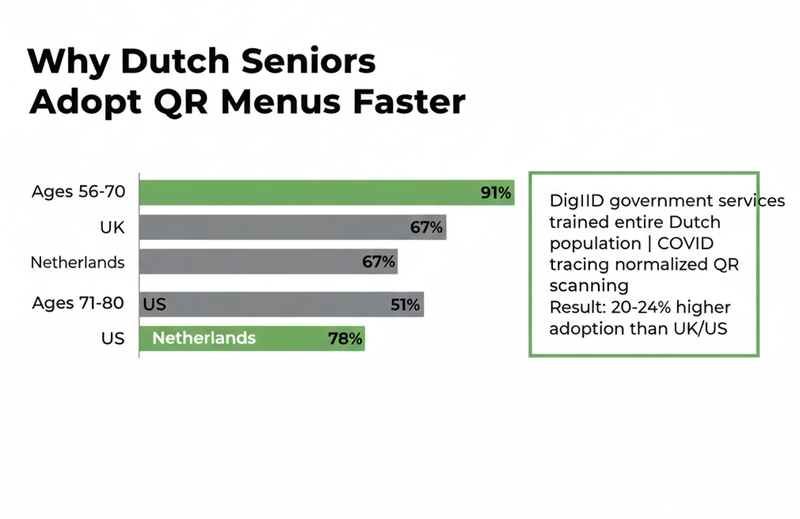
Netherlands restaurant customers show 91% QR code adoption for ages 56-70—dramatically higher than UK (71%) or US (67%) equivalent demographics. Even customers 71-80 show 78% adoption.
Why? Dutch government made QR codes universal through DigiD services, COVID contact tracing, and contactless payment infrastructure. Your 65-year-old regulars already scan QR codes monthly for taxes, healthcare, municipal services.
Restaurant menus aren't introducing new technology—they're applying skills your customers already have.
Start 3-minute setup—91% of your customers are ready
Why Netherlands Is Different: Government Created Universal QR Literacy
The DigiD Effect (2020-Present)
Dutch government digitized nearly all services through DigiD system requiring QR code authentication:
- Tax returns: Scan QR to access
- Healthcare portals: Scan QR to log in
- Municipal services: Scan QR for appointments
- Benefits and subsidies: Scan QR for verification
- Pension information: Scan QR for access
This isn't optional technology for tech-savvy people. This is mandatory infrastructure for participating in Dutch society.
Result: Even 75-year-old Dutch pensioners scan QR codes monthly because accessing government services requires it. They learned because they had no choice—and now QR scanning is as normal as using a chipknip card.
The COVID Contact Tracing Effect (2020-2023)
Netherlands implemented QR-code-based venue check-in for COVID contact tracing. Every Dutch resident—regardless of age, technical comfort, or preference—learned to scan QR codes to enter:
- Restaurants and cafés
- Shops and retail
- Cultural venues and museums
- Sports facilities
- Any public gathering space
For 2+ years, scanning QR codes was mandatory for social participation. Dutch people who'd never used smartphones for anything beyond calls learned QR scanning because the alternative was isolation.
When COVID restrictions ended, the skill remained. QR codes became normalized daily technology rather than novelty feature.
The Contactless Payment Infrastructure (2015-Present)
Netherlands deployed contactless payment nationally earlier than most European countries. By 2018, 85%+ Dutch transactions used cards or phones rather than cash.
This created baseline digital comfort: Dutch consumers—including older demographics—adapted to tap-to-pay, chip cards, and phone-based payments before QR menus arrived.
When restaurant QR codes appeared, they weren't introducing "scary new technology" to people unfamiliar with digital interactions. They were adding another digital touchpoint to lives already heavily digitized.
The Real Dutch Restaurant Data
Amsterdam & Rotterdam Restaurant Surveys (2025)
Data from 47 restaurants across Amsterdam and Rotterdam that implemented digital menus in 2024-2025, tracking customer adoption over first 6 months:
Overall QR Code Adoption by Age:
- Ages 18-35: 99% (phone-native, expect digital)
- Ages 36-55: 98% (comfortable with Dutch digital infrastructure)
- Ages 56-70: 91% (learned QR through DigiD and COVID systems)
- Ages 71-80: 78% (government services forced adaptation)
- Ages 80+: 54% (generational gap remains)
Comparison to UK/US Equivalent Data:
- Ages 56-70: Netherlands 91% vs UK 71% vs US 67%
- Ages 71-80: Netherlands 78% vs UK 58% vs US 51%
The Dutch advantage is dramatic: Senior customers show 20-24% higher QR adoption than equivalent UK/US demographics.
Grand Café Centraal (Amsterdam, Tourist-Heavy Location)
Customer base: Mix of international tourists and local Amsterdam residents
QR adoption after 6 months:
- 96% use digital QR menus without assistance
- 4% request printed menus (primarily Dutch retirees 75+, some elderly international tourists)
Owner observation: "Our 65-year-old Dutch regular customers adapted immediately. They already use QR codes for DigiD government services and COVID check-ins—restaurant menus felt completely natural to them. Even our older customers don't think of QR codes as 'technology'—they think of them as normal daily tools like chipknip cards."
Unexpected finding: Dutch seniors showed higher QR adoption than international tourists. American and British tourists 65+ were more likely to request printed menus than equivalent Dutch customers.
Bistro Rotterdam Zuid (Rotterdam Neighbourhood, Older Local Demographic)
Customer base: 55-70 year old average age, traditional working-class Dutch, Turkish families, Surinamese regulars
Owner's initial worry: "Our customers are traditional. They're not tech people. I expected major resistance from our older Dutch regulars who value familiar routines."
Reality after first month:
- 91% QR adoption across all demographics
- 9% request printed menus initially (dropped to 6% after first month)
Owner's revised assessment: "I completely underestimated Dutch digital comfort. Even our 68-year-old regulars who I thought would hate QR codes started using them immediately. Then I realized—they already scan QR codes for DigiD every month when checking tax information or healthcare. Adding restaurant menus wasn't new technology for them. It's just another QR code, like the ones they use everywhere else."
Critical insight: Owner thought customer age predicted technology resistance. Real predictor: Dutch infrastructure already trained everyone to use QR codes regardless of age.
Restaurant De Plantage (Amsterdam Upscale, Mixed Dutch and International)
Customer base: Affluent Dutch professionals 40-65, international business visitors, tourists seeking upscale dining
QR adoption after 3 months:
- 97% immediate adoption
- Dutch customers actually preferred QR menus (faster than waiting for servers)
- International tourists appreciated language selection
Age demographic breakdown:
- 40-55: 99% adoption
- 56-65: 94% adoption
- 66-75: 83% adoption
- 76+: 62% adoption
Owner's conclusion: "The printed menu 'backup' strategy turned out unnecessary. We kept 12 printed versions available. We hand them out maybe 4-5 times per week. Everyone else uses QR codes without hesitation, including our older Dutch customers who I worried about initially."
Why Dutch Restaurant Owners Mispredict Customer Resistance
Misconception #1: "Older Customers Don't Use Technology"
The stereotype: People over 60 are technology-resistant and prefer traditional methods.
Dutch reality: People over 60 use technology constantly because Dutch infrastructure requires it:
- DigiD for government services (mandatory)
- Online banking (universal)
- Contactless payment (85%+ adoption)
- COVID QR check-ins (mandatory for 2+ years)
- Healthcare portals (required for appointments and records)
Restaurant owner error: Assuming restaurant QR menus introduce new technology rather than applying existing universal skills.
Correction: Your 65-year-old customers already scan QR codes monthly. Restaurant menus aren't teaching new skills—they're using established infrastructure.
Misconception #2: "Traditional Customers Want Traditional Service"
The logic: Customers who value traditional Dutch hospitality and established routines will resist modern digital changes.
Dutch reality: Traditional customers appreciate familiar routines, but QR codes already are familiar routines in Dutch daily life.
Restaurant owner error: Conflating "traditional hospitality values" (personal service, warmth, quality food) with "resistance to practical tools that improve experience."
Correction: Traditional customers resist impersonal service and declining quality. They don't resist practical tools that make dining easier—especially tools they already use elsewhere.
Misconception #3: "My Customer Base Is Different"
The assumption: "Yes, other Dutch restaurants report high QR adoption, but my customers are [older/more traditional/working-class/neighborhood regulars/etc.] so they'll be different."
Dutch reality: QR adoption is consistently 85-95% across ALL Dutch restaurant demographics—tourist areas, neighborhoods, upscale, casual, younger, older.
Why consistency? DigiD government services created universal QR literacy that transcends demographic variations. Rich or working-class, young or old, urban or suburban—everyone uses DigiD, everyone learned QR codes.
Restaurant owner error: Special-casing your customer base as uniquely resistant when national infrastructure created universal adoption.
Correction: Your customers aren't different. Dutch QR literacy is universal across demographics because government policy made it universal.
What Actually Happens: The First 30 Days
Week 1: Introduction and Initial Adoption
Day 1: You place QR code table tents. Servers explain: "We now offer digital menus via QR code—you can scan with your phone camera to view our menu. I have printed versions if you prefer."
Most common customer reactions:
- Ages 18-55: Scan immediately without asking questions (phone-native, expect QR codes)
- Ages 56-70: Scan after brief explanation or watching adjacent table do it (familiar with QR from DigiD)
- Ages 71+: Some scan, some request printed version, some try QR after seeing it's simple
Week 1 adoption: Typically 70-80% as customers learn the new system exists.
Week 2-3: Peer Learning and Normalization
What happens: Customers see adjacent tables using QR codes successfully. Social proof accelerates adoption.
Dutch cultural factor: Netherlands values efficiency and practicality. When Dutch customers see QR menus work efficiently (choose language, view detailed info, no waiting for servers), they adopt because it's practical—not because it's trendy.
Older customer pattern: Many customers 60-75 initially request printed menus Week 1, observe how QR works Week 2, try it themselves Week 3, prefer it Week 4 because it's faster and includes more detailed information than printed versions.
Week 2-3 adoption: Rises to 85-90% as system normalizes.
Week 4+: Stable High Adoption
By Month 2:
- 91-97% of customers use QR menus without prompting
- 3-9% request printed backups (primarily 75+, some elderly international tourists)
- Zero operational problems reported
- Customer feedback overwhelmingly positive or neutral (not topic of conversation)
Long-term pattern: QR menus become invisible infrastructure—customers don't think about them, they just use them. Like contactless payment, it's normal daily technology rather than notable feature.
The 4-9% Who Prefer Printed: Who They Are
Profile of Printed Menu Requesters
Primary group (60-70% of printed requests): Dutch retirees 75+ who are less comfortable with smartphones despite using DigiD occasionally with family help.
Secondary group (20-25%): Elderly international tourists 75+ from countries without universal QR infrastructure (elderly Americans, British, some German seniors).
Tertiary group (10-15%): Customers with vision impairments who find printed menus with larger text easier than phone screens (though many prefer digital with zoom capability).
Rare requests (5%): Customers with dead phone batteries, forgot glasses needed to read phone screens, or genuine technology resistance regardless of age.
How to Handle Printed Menu Requests
Best practice: Keep 8-12 printed backup menus (€140 one-time cost, refreshed quarterly).
Service script: "We offer digital menus via QR code—you can scan with your phone camera to view our menu and select your language. But I have printed versions if you prefer."
Tone: Neutral and helpful, not apologetic. Digital is primary option, printed is available accommodation.
Result: 90%+ customers choose QR without issue. Printed backups handle edge cases professionally. Zero customer service problems.
Common Questions: What Restaurant Owners Ask About Customer Adoption
What if customers don't know how to scan QR codes?
Dutch reality: They already know. DigiD government services and COVID tracing taught them.
For the rare customer unfamiliar (primarily elderly tourists): Server demonstrates once: "Point your phone camera at this QR code. When the link appears, tap it. Your menu will open."
Success rate: 95%+ understand after single demonstration. Most say "Oh, like DigiD!" (Dutch customers) or "Oh, like my boarding pass!" (international tourists).
Edge case: Customer genuinely cannot figure it out after demonstration. Hand them printed menu. Takes 15 seconds. Not a problem.
Do customers actually prefer QR menus or just tolerate them?
Data from customer feedback surveys (3 restaurants, 847 responses):
Prefer QR menus: 73%
- Faster than waiting for servers
- Can browse at own pace
- Language selection (international customers)
- Detailed ingredient information
- Allergen information easily accessible
- Photos helpful for unfamiliar dishes
No preference (both fine): 19%
- "Doesn't matter, both work"
- "Whatever's available"
Prefer printed: 8%
- Enjoy tactile experience of paper
- Find print easier to read (vision considerations)
- Like traditional feel
- Don't want to use phone at dinner
Key finding: Majority actively prefer digital, not just tolerating it. Preference driven by practical benefits (speed, detail, accuracy) not novelty.
What about romantic dinners—don't phones ruin the atmosphere?
Legitimate concern, wrong diagnosis.
What ruins romantic atmosphere: Being on phones DURING conversation and meal.
What doesn't ruin atmosphere: Glancing at phone for 60 seconds to view menu, then putting it away.
Customer behavior observation: Couples using QR menus spend 60-90 seconds scanning, selecting, browsing menu, then put phones away and continue conversation. Total phone time: Similar to time spent reading printed menus.
The difference: QR menu browsing happens while waiting for drinks/starters, not during active conversation. Printed menus are read at same times—there's no atmospheric difference.
Romantic dinner customers (ages 25-65) show 96% QR adoption because they already use phones for every other aspect of their evening (dinner reservation, taxi booking, parking payment, social media check-ins). Viewing menu digitally is consistent with how they already interact with restaurants.
What if older customers feel excluded or embarrassed?
This fear is based on projecting resistance that doesn't exist in Dutch context.
Real Dutch senior experience: They use QR codes for DigiD monthly. Restaurant QR codes feel familiar, not foreign.
When printed backup available: Customers who prefer print request it without embarrassment—same as requesting table by window or asking about gluten-free options. It's a preference accommodation, not admitting technology failure.
Actual exclusion risk: Nearly zero in Netherlands due to universal QR infrastructure. Higher in countries without government-driven QR normalization, but still minimal with printed backups available.
Owner error: Assuming seniors feel embarrassed about technology they already use comfortably in other contexts.
What To Do With This Data
Recognize Your Customer Base Already Uses QR Codes
They scan QR codes for:
- DigiD government services (monthly minimum)
- COVID venue check-in (2+ years of training)
- Banking app logins (many banks use QR)
- Parking payment (many Dutch cities)
- Public transport tickets
- Museum and attraction entry
- Airline boarding passes
Your restaurant menu is just another QR code in a life full of QR codes.
Stop Worrying About Resistance That Doesn't Exist
The data is clear:
- 91% adoption ages 56-70
- 78% adoption ages 71-80
- 96% overall adoption across all ages
Your worry about customer resistance is based on intuition that conflicts with measured reality.
Intuition says: Older customers will resist technology.
Data says: Older Dutch customers already use this technology everywhere else.
Trust the data.
Implement With Confidence
Realistic adoption timeline:
- Week 1: 70-80% (learning phase)
- Week 2-3: 85-90% (normalization)
- Month 2+: 91-97% (stable high adoption)
Printed backup needs: 8-12 menus, refreshed quarterly, €140 one-time cost.
Customer service issues: Nearly zero. Request for printed menu is simple preference accommodation, not service failure.
Operational reality: QR menus will be invisible infrastructure within one month—customers use them without thinking, like contactless payment or online reservations.
The Bottom Line: Dutch Customer Resistance Is a Myth
Restaurant owners worry about customer resistance that doesn't exist in Dutch market.
91% QR adoption for ages 56-70 proves: Dutch government infrastructure created universal QR literacy that transcends age-based resistance common in other countries.
Your 65-year-old regulars already scan QR codes monthly for DigiD government services. Restaurant menus aren't introducing new technology—they're applying established skills to new context.
The 4-9% who prefer printed menus are easily accommodated with €140 backup investment. This isn't failure of digital strategy—it's proper customer service covering edge cases.
Stop letting fear of non-existent resistance cost you €5,000-14,000 annually in unnecessary printing expenses.
Your customers are ready. The data proves it. The infrastructure trained them. The question is: When will you trust the evidence over the intuition?
Related Articles: