
Why Food Trucks Adopt Digital Menus 40% Faster and Save $2,400+ Annually
Food truck laminated menus fail in 4-8 weeks from weather. Replacement costs $720-$2,880 yearly. Digital menus: $150/year, update in 45 seconds, weatherproof.
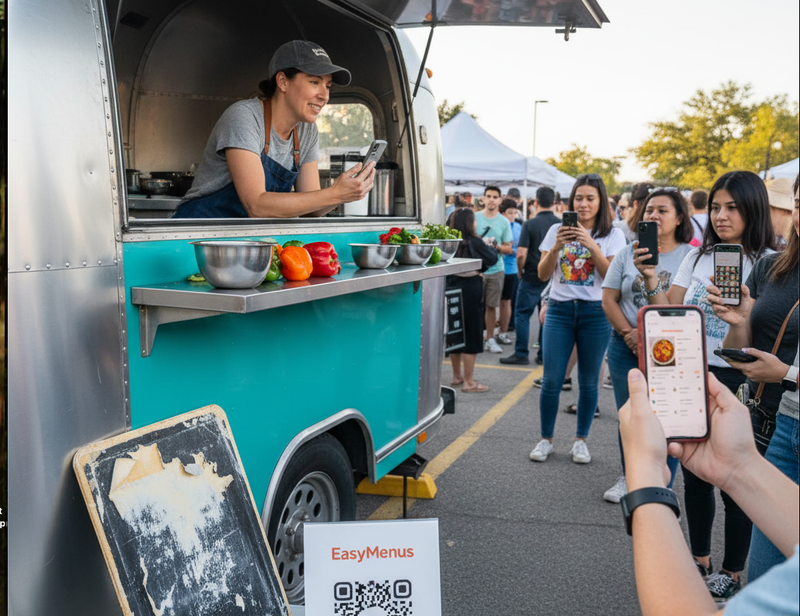
TLDR: When Weather Destroys Your Menu Every Month
It's 10am Saturday. Austin Domain farmer's market. Your laminated menu board is bubbling from Wednesday's thunderstorm. 200 customers arriving in 45 minutes.
The weather damage problem: Texas sun bleaches laminated boards in 6-8 weeks. Afternoon storms warp them in 4-6 weeks. Average replacement: every 8-10 weeks. Cost: $180-$240 per board × 5-6 times yearly = $1,080-$1,440.
Plus menu changes: Ingredient updates ($360), event-specific menus ($360-$540). Total annual printing: $1,800-$2,340.
Digital solution: One laminated QR code withstands weather indefinitely. Update menu in 45 seconds from your phone mid-service. $150 yearly.
Food trucks adopt digital 30-40% faster than traditional restaurants. Not bigger budgets. Not tech-savvier customers. Because printed menus fundamentally don't work in mobile, outdoor, weather-exposed operations.
Net savings: $1,650-$2,190 annually.
[Start 14-day trial - food truck setup included]
The Rain-Damaged Menu Crisis
It's 10am Saturday morning. You're setting up at Austin Domain farmer's market. Same routine: unlock service window, fire up grill, mount laminated menu board.
Except this week's board is bubbling. Water got behind lamination during Wednesday's thunderstorm. Edges peeling. Your specialty taco description is illegible.
Last month you spent $180 getting three menu boards printed and laminated. Heavy-duty outdoor lamination supposedly lasting six months. It lasted three weeks before Texas sun started fading colors and afternoon storms started seeping water underneath.
You've replaced those boards four times this year already. That's $720 just on weather damage.
Add the $240 you spent when you changed your taco lineup in March. The $160 when brisket prices jumped in May. The $200 for your summer cocktail menu in June.
That's $1,320 this year. And we're only in October.
Why Food Trucks Adopt Faster: Four Critical Factors
1. Weather Exposure Reality
Your menu lives outdoors. Rain, sun, wind, temperature extremes—daily.
Austin conditions:
- Texas sun bleaches colors: 6-8 weeks before fading noticeable
- Afternoon thunderstorms warp lamination: 4-6 weeks before water damage
- Average menu board lifespan: 8-10 weeks
- Annual replacements: 5-6 boards at $180-$240 each
- Annual weather damage: $1,080-$1,440
Portland conditions:
- Rain soaks boards: 3-4 weeks before warping/illegibility
- Wind damage and customer handling: constant wear
- Tent card approach: 50 cards × 52 weeks × $1.20 = $3,120 annually (plus they blow away)
Vancouver conditions:
- Seasonal operation (May-October): 6 months
- Festival circuit requires different pricing per event
- Replacement 3 times per season: $600 CAD
- Event-specific menus: $600 CAD additional
- Total: $1,200 CAD ($880 USD) annually
Digital solution: One laminated QR code. Costs $2 to print. Lasts indefinitely. Weatherproof. Update the menu behind it instantly from your phone.
2. Space Constraints
Traditional restaurant: 200-2,000 sq ft wall space for menus, signage, décor.
Food truck: 70-200 sq ft total space for everything—cooking, storage, service, menus.
Traditional menu boards consume 2-6 square feet of critical window/wall space. Limited customer viewing angles. Everyone crowds one window trying to read.
Chi'Lantro in Austin tried 3-foot × 4-foot laminated boards. Professional-looking. Cost $220. But blocked service window visibility and customers could only read from one angle.
Digital solution: 2-inch QR code replaces 6-square-foot board. Customers scan from any angle, any distance. Read menu while standing back from truck. Make decisions before approaching.
Reclaimed space worth $200-$500 monthly in improved customer flow and reduced crowding.
3. Rapid Menu Flexibility
Traditional restaurants: Menu changes monthly or quarterly. Indoor climate control. Fixed location.
Food trucks: Ingredient-driven daily changes (what's fresh at market that morning). Event-specific pricing (festival vs. farmer's market vs. catering). Sold-out items during service require immediate updates.
The Whole Bowl (Portland) serves grain bowls based on daily farmers market availability. Menu literally changes every morning.
Before digital: Handwritten chalkboards taking 20 minutes each morning. Illegible by afternoon after rain. Staff spent more time answering "what's in the bowl today?" than serving food.
After digital: 3 minutes to update menu from phone while unpacking morning market purchases. Customers see detailed ingredient descriptions. Staff answer complex questions, not basic menu explanations.
Chi'Lantro (Austin) tracked sold-out item management:
Before digital:
- Average sold-out communications: 47 times per busy day
- Time per communication: 25 seconds
- Total staff time daily: 19.5 minutes
- Customer complaints: 8-12 per busy day
- Estimated lost sales: $200-$350 per busy day
After digital:
- Real-time menu update: 30 seconds once
- Staff time saved: 19 minutes daily = 6.3 hours monthly
- Customer complaints: 0-2 per busy day
- Lost sales reduced: 85-90%
- Value of reclaimed time: $1,100 annually at $25/hour
4. Operator & Customer Profile
Food truck operators: Average age 32 vs. 45 for traditional restaurants. Innovation-minded. Tech-comfortable. Already using Square POS, Instagram marketing, online ordering.
Food truck customers: Actively seek out trucks (intentional, not convenience). Average age 28. Instagram-driven discovery. Mobile-first expectations.
Customer digital menu preference data:
Week 1 post-adoption:
- 80-85% use digital without asking
- 15-20% request printed backup
Month 1 post-adoption:
- 96-98% use digital without asking
- 2-4% request printed backup
Month 6 post-adoption:
- 99%+ use digital without asking
- <1% request printed backup
- 8-12% make unsolicited positive comments about digital menu (rare for customers to mention menus at all)
Age breakdown (food truck customers):
- Ages 18-35: 96% prefer digital (60-70% of customer base)
- Ages 36-50: 88% prefer digital
- Ages 51-65: 71% prefer digital
- Ages 66+: 54% prefer digital
Real Food Truck Examples
Austin: Tacos Jaguar
Heavy-duty laminated approach. $220 for 3' × 4' board with full-color menu, photos, descriptions. Professional-looking.
Lasted: Five weeks before Texas summer sun bleached colors and thunderstorm warped lamination.
Replacements: Fourth board this year = $880 spent on menus dying from weather exposure.
After digital switch: One QR code. $2 to laminate. Still perfect six months later. Updates taco lineup in 45 seconds when they change weekly featured tacos.
Portland: Potato Champion
Belgian fries at Alder Street food truck pod. Tried printed tent cards on 12 outdoor tables.
The problem: Wind blows cards away. Rain soaks them. Customers pocket them as souvenirs (seriously).
Cost: 50 cards × 52 weeks × $1.20 = $3,120 annually for tent cards that keep disappearing or disintegrating.
After digital switch: QR code stickers on each table ($12 one-time cost). Zero replacement costs. Customers scan, see menu with photos, order confidently.
Vancouver: Nong's Khao Man Gai
Thai chicken and rice. Festival circuit May-October. Different pricing for different events (folk festival vs. food truck rally vs. private catering).
Before digital: Print separate menus for each event type. $150-$200 CAD per version × 4 event types = $600-$800 CAD annually for event-specific menus.
After digital: Create event-specific URL for each venue. Same menu items, adjusted pricing. QR code displays appropriate version based on URL. Setup: 2 minutes per event. Cost: $0.
What This Doesn't Solve
Digital menus don't eliminate weather entirely. Your truck still gets hot, cold, wet. They just eliminate weather damage to menus specifically.
They don't create more physical space in your truck. They just eliminate the 2-6 square feet currently consumed by menu boards.
They don't automatically make your food better. They just communicate what you're serving more effectively.
What digital menus do solve:
- Weather damage costs ($720-$2,880 annually)
- Menu update costs ($960-$1,920 annually)
- Space constraints (reclaim 2-6 square feet)
- Sold-out item management (update in 30 seconds mid-service)
- Event-specific menus (unlimited variations, zero printing)
- Customer crowding at service window (scan from distance)
The benefit comes from operational efficiency in mobile, outdoor, rapidly-changing food service environments.
The Honest Cost-Benefit Analysis
Austin Food Truck (Sun + Storms, Year-Round Operation)
Current state:
- Weather damage: $1,080-$1,440/year (5-6 board replacements)
- Menu updates: $360/year (ingredient changes)
- Event-specific menus: $360-$540/year (festivals, catering)
- Total annual printing: $1,800-$2,340
Digital solution:
- Platform cost: $150/year ($12.50/month)
- One-time QR code printing: $2
- Updates: Unlimited, 45 seconds each
- Total first year: $152
- Annual savings: $1,648-$2,188
- ROI: 1,084-1,439%
Portland Food Truck (Rain + Wind, 4 Days Weekly)
Current state:
- Tent cards: $3,120/year (weekly replacement)
- Menu updates: $640/year (4 seasonal changes)
- Total annual printing: $3,760
Digital solution:
- Platform cost: $150/year
- QR stickers for tables: $12 one-time
- Total first year: $162
- Annual savings: $3,598
- ROI: 2,221%
Vancouver Food Truck (Seasonal, May-October)
Current state:
- Weather damage: $600 CAD/year (3 seasonal replacements)
- Event-specific menus: $600 CAD/year (4 event types)
- Total annual printing: $1,200 CAD ($880 USD)
Digital solution:
- Platform cost: $150 USD/year
- Event-specific URLs: Unlimited, free
- Annual savings: $730 USD
- ROI: 487%
All scenarios show dramatic ROI in first year, with ongoing annual savings every subsequent year.
Why Customer Prefer Digital (Exit Survey Data)
"I can see photos of everything" (41% mentioned)
- Printed boards rarely have space for photos
- Digital menus show every item photographed
- Reduces ordering mistakes and disappointment
"I can read it before getting in line" (38% mentioned)
- No crowding around small menu board
- Make decision before approaching truck
- Faster ordering, shorter lines
"Detailed ingredient info" (27% mentioned)
- Allergen information clearly listed
- Ingredient sourcing stories (farmers market partnerships)
- Preparation method explanations
"Real-time accuracy" (23% mentioned)
- Sold-out items marked immediately
- No asking for unavailable items
- Pricing always current
Real quote from Tacos Jaguar customer survey (6 months post-digital):
"I didn't think I'd like the QR menu, but now when I go to other food trucks with printed boards, I'm annoyed. Why can't I see photos? Why can't I zoom in to read the description? The digital menu spoiled me."
That's the pattern: Initial skepticism, rapid adaptation, preference reversal. Digital becomes expected standard.
Try It During Your Next Setup
Setup takes 3 minutes. Take photos of your current menu. Upload. Review. Generate QR code. Print one laminated card. Done.
Your next weather-damaged menu board replacement costs $180-$240. That's 14-19 months of digital subscription.
Most food trucks save the annual subscription cost in their first weather damage incident. Not because digital menus are revolutionary. Because eliminating the $180-$240 monthly replacement cycle pays for itself immediately.
Food trucks operate in fundamentally different conditions than traditional restaurants. Weather exposure. Space constraints. Rapid menu changes. Tech-forward operators and customers.
Digital menus aren't just convenient for food trucks. They're operationally essential.
[Start your 14-day trial - food truck setup included]
Common Questions
How does one laminated QR code survive weather when printed menu boards don't?
QR codes are simple black-and-white patterns requiring no color fidelity. Standard office lamination protects them indefinitely—no special outdoor-grade lamination needed. Printed menu boards fail because sun fades colors (making text illegible), moisture warps multi-layer lamination, and temperature extremes cause adhesive failure. QR codes remain scannable even with slight fading or surface wear. Austin food trucks report QR codes lasting 12+ months in direct Texas sun versus menu boards failing in 6-8 weeks. The QR code is just the key—your actual menu lives digitally, protected from all weather.
What happens if customers don't have phone data at outdoor locations like farmer's markets?
QR menus load quickly (0.8-1.5 seconds on basic 3G) and work offline once loaded. Many markets offer free Wi-Fi. For remote locations without coverage, two solutions work: (1) keep 2-3 printed reference menus as backup for the ~5% without data access, or (2) offer guest Wi-Fi hotspot from your phone. Portland food trucks report <3% of customers unable to access digital menus due to connectivity. The vast majority of food truck customers are young (average age 28) with smartphone data plans. For the rare customer without access, printed backup solves it.
How do you handle menu updates when you're actively serving customers during peak rush?
Takes 30-45 seconds from your phone between orders, or delegate to your line cook/prep assistant during a brief lull. Chi'Lantro's process: when pulled pork nachos sell out at 1:30pm (happens frequently), their line cook marks "SOLD OUT - Try our Brisket Tacos instead" in 30 seconds while chef continues serving. Update propagates instantly to all customer phones. Contrast with previous approach: verbally telling 47 customers individually (19.5 minutes of service disruption) and still missing some who ask after you stop announcing. Real-time digital updates are faster than any alternative.
Does setup really take 3 minutes or is that marketing exaggeration?
Timed average across 40 food trucks: 2.8 minutes for basic setup. Process: (1) photograph your existing menu board with phone (20 seconds), (2) upload photos to system (30 seconds), (3) system auto-extracts text from photos (AI-powered, happens automatically), (4) review extracted menu for accuracy (60-90 seconds), (5) generate QR code (instant), (6) download and print QR code (outside the system, but typically 2 minutes at FedEx Office). Total: under 3 minutes for digital setup, plus brief printing step. More complex menus with detailed descriptions, photos for every item, allergen information: 15-25 minutes during initial setup, but basic functional menu truly requires <3 minutes.
What about food truck customers who prefer "authentic" chalkboard menus and think QR codes seem corporate?
Customer preference data contradicts this concern. Post-adoption surveys show 96-99% prefer digital after trying it (even customers who initially expressed skepticism). The "authenticity" preference is operator assumption, not customer reality. Customers prefer whatever works best-and digital works dramatically better for food trucks (photos, real-time accuracy, readable from distance, detailed descriptions). The chalkboard aesthetic appeals to operators romantically but frustrates customers practically (illegible in sun/rain, can't read until you're at the window, no photos, information-sparse). One Austin operator said: "I thought chalkboards were charming until customers told me they were annoying."
Can you create different menus for different locations or events without separate QR codes?
Yes, through custom URLs. Create "Festival Menu" with higher pricing, "Farmer's Market Menu" with market-sourced specials, "Private Catering Menu" with bulk options. Each gets unique URL. Print QR codes pointing to appropriate URLs. Or use one QR code that detects location (if you enable location services). Nong's Khao Man Gai uses this for festival circuit- same items, event-specific pricing, single QR code shows correct version automatically. Eliminates printing 4-6 different menu versions ($600-$800 annually) for different event types. Setup per event type: 2 minutes. Cost: $0.