
How Geneva's UN District Restaurants Handle 6-Language Menu Requirements (Without Breaking the Bank)
Geneva UN district restaurants serve diplomats speaking 6+ languages. Traditional printing: CHF 18,000/year. Digital multilingual menus: CHF 150/year. Real operational stories.
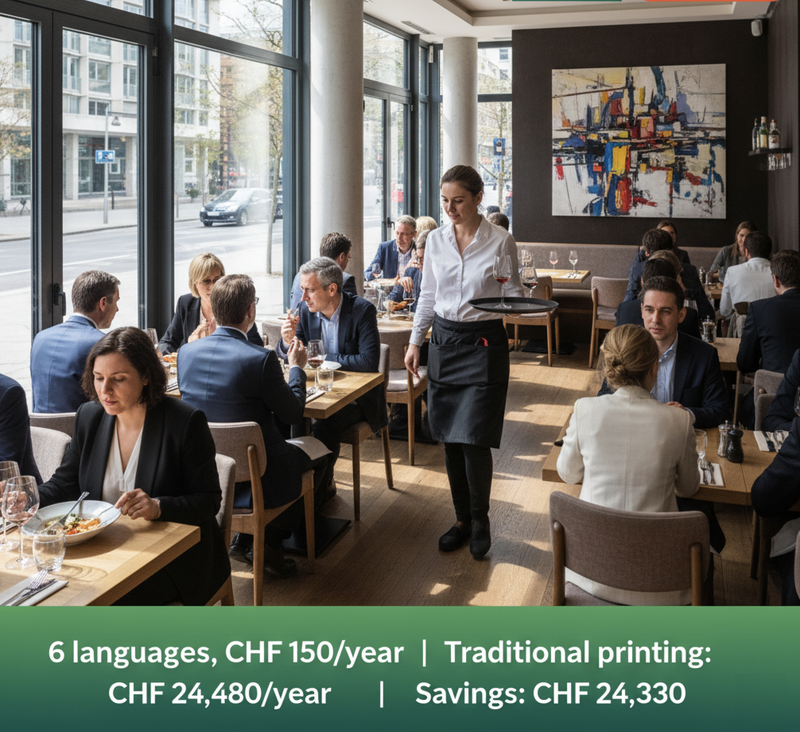
It's 12:47pm at Chez Calvin
Table 8 has WHO epidemiologists from Kenya, Brazil, and Japan debating malaria funding strategies in English. Table 12 is Swiss Mission delegates conducting a working lunch in French. Table 3—the one that just sat—is a mix of WTO negotiators: German, Spanish, and Mandarin flowing across the conversation.
Your server, Marie, approaches Table 3 with four printed menus tucked under her arm. She starts in French (it's Geneva, French is the default). The Spanish diplomat holds up a hand: "English, please?" Marie switches languages mid-sentence, explains the plat du jour. The German negotiator asks about gluten-free options. Marie pivots to German for allergen clarification. The Chinese delegate is scanning the menu, visibly confused by French culinary terms.
This exchange takes six minutes.
Six minutes multiplied by 40 tables during lunch service equals four hours of your staff's time spent translating menus instead of serving food. At CHF 28/hour for experienced servers, that's CHF 112 in labor costs—just for menu explanation—every single day.
This isn't a hypothetical. This is lunch service at restaurants near Place des Nations. Every. Single. Day.
The Six-Language Reality Nobody Warned You About
When you opened your restaurant in Geneva's Pâquis district, you knew it would be "international." You prepared for English speakers. You hired multilingual staff. You printed French and English menus.
Then reality arrived.
The UN employs staff from 193 countries. The WHO has significant Spanish-speaking Latin American representation. WTO negotiations bring Asian diplomats who prefer Mandarin or Japanese. Geneva's Arabic-speaking community from North African missions needs clarity on halal options. Your "bilingual" menu strategy lasted approximately three weeks before a Saudi WHO official politely asked if you had anything in Arabic, and you realized you were serving a clientele that makes the Tower of Babel look linguistically simple.
The printed menu math becomes absurd fast:
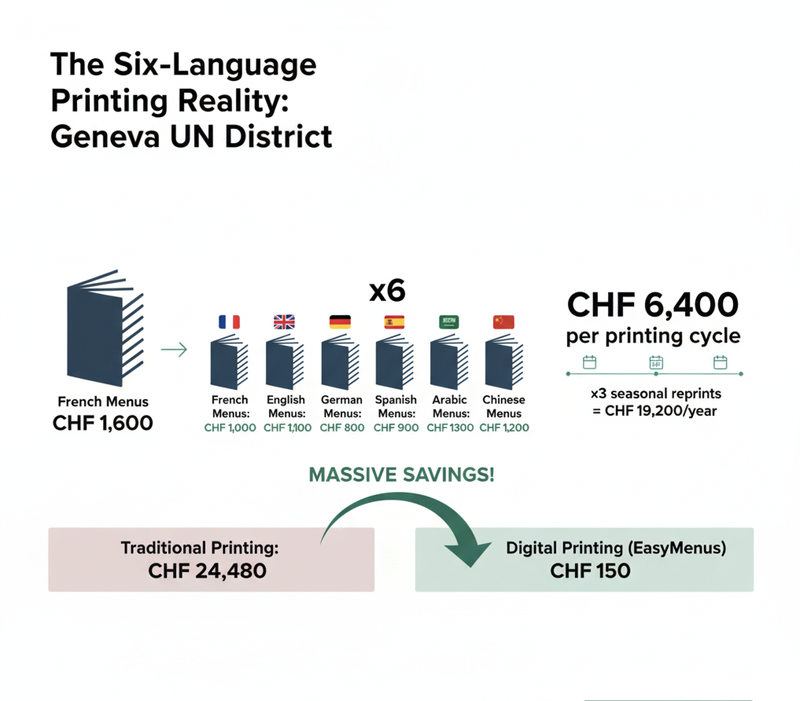
- French menus: CHF 32 × 50 copies = CHF 1,600 per printing
- English menus: CHF 32 × 50 copies = CHF 1,600
- German menus: CHF 32 × 30 copies = CHF 960
- Spanish menus: CHF 32 × 30 copies = CHF 960
- Arabic menus: CHF 32 × 20 copies = CHF 640
- Chinese menus: CHF 32 × 20 copies = CHF 640
One printing cycle: CHF 6,400
Reprint 3 times per year for seasonal changes and supplier price adjustments: CHF 19,200 annually
Add wine lists (CHF 180 × 3 languages × 8 updates): CHF 4,320
Add daily specials cards: CHF 960
Total six-language printing budget: CHF 24,480 per year
That's not a rounding error. That's a junior sous chef's entire salary. That's three months of rent. That's 1,960 kilos of premium Swiss beef you're NOT buying because the money went to the print shop instead.
What Les Armures Actually Did
Les Armures in Geneva's Old Town has been serving fondue to international guests since forever. Historic restaurant, traditional Swiss cuisine, impeccable reputation. They thought their multilingual challenges were solved: French menus for Swiss guests, English for tourists, professional staff to bridge gaps.
Then COVID hit. Restaurant closed. Reopened. Customer base shifted dramatically.
The post-COVID Geneva restaurant reality: international organizations ramped up in-person operations. Diplomatic staff flooded back. But the customer profile changed—younger WHO consultants on short-term contracts, UN translators rotating through, WTO staff from emerging economies. The language diversity exploded.
Les Armures' owner, François, describes the moment he knew printing wasn't sustainable:
"Tuesday lunch, March 2024. I'm at the host stand. Customer asks for a menu in Portuguese—we serve a lot of Brazilian UN staff, never thought about Portuguese menus. I apologize, offer English. He's polite but clearly disappointed. That afternoon, another customer asks about Japanese menus—we have excellent reputation with Japanese diplomats, but I'm handing them French text and watching them struggle. By end of week, I'd fielded requests for Italian, Arabic, and Russian menus."
"I ran the math. Six-language printing would cost us CHF 24,000 annually MINIMUM. We'd need storage space I don't have. We'd need staff tracking inventory across six versions. And I knew—absolutely knew—that within six months someone would request Korean or Hindi, and I'd be right back here adding languages."
François implemented digital menus April 2024. The setup took him 35 minutes across three days (photograph printed menu, email photos, review digital version, approve). Cost: CHF 150 annually regardless of languages.
His digital menu now offers: French, English, German, Spanish, Italian, Portuguese, Russian, Chinese, Japanese, Arabic, and Korean. Eleven languages. CHF 150.
"The first week, I worried customers wouldn't adapt. By week two, I stopped worrying. Our Brazilian diplomats saw Portuguese options and their faces lit up—someone finally understood them. Japanese WTO negotiators could read full descriptions with kanji characters properly rendered. The Arab League delegates could verify halal compatibility in Arabic. We didn't lose traditional Swiss customers—we gained capability to serve everyone professionally."
Current result: 96% of customers use digital menus. Les Armures keeps 8 printed French menus for elderly Swiss customers who prefer them. Storage went from a full shelf of multilingual menu inventory to a single drawer. François hasn't visited a print shop in seven months.
Annual savings: CHF 24,330 (printing costs eliminated).
The Chez Calvin Discovery: When Speed Matters More Than Cost
Chez Calvin sits 200 meters from UN headquarters main gate. Their customer base is 90% international organization staff on lunch breaks. Their operational challenge isn't cost—it's time.
Diplomatic lunch rushes run 12:15pm-1:45pm. Rigid schedule. UN staff have meetings before and after; lunch isn't leisurely, it's functional. Chez Calvin needs to turn 100+ covers in 90 minutes while maintaining quality and accuracy.
Before digital menus, the workflow looked like this:
- Customer sits (12:28pm)
- Server delivers printed menu (12:29pm)
- Customer opens French menu, looks confused (12:30pm)
- Customer signals server: "English please?" (12:31pm)
- Server retrieves English menu (12:32pm)
- Customer reads English menu, has allergen question (12:35pm)
- Server explains ingredients, checks with kitchen (12:37pm)
- Customer ready to order (12:38pm)
Time from seating to order: 10 minutes
Multiply by 100 covers: 1,000 minutes (16.7 hours) of table time per service dedicated to menu navigation instead of eating.
Chez Calvin's owner, Sophie, tried everything. She hired more multilingual staff—expensive and still couldn't cover six languages simultaneously. She printed visual menu guides—helpful but incomplete. She created allergen sheets in four languages—customers couldn't find information quickly.
The breakthrough came from unexpected feedback. A WHO consultant told Sophie: "Look, I use your restaurant three times a week. I know I'll sit down, wait for a menu, flag down a server to get English version, ask about allergens, and finally order. It takes 8-10 minutes before my food order even starts. The café across the street has QR menus—I scan, read in English, check allergens, order in 3 minutes. I'm not eating there because it's better—I'm eating there because I can actually finish lunch and get back to my meeting on time."
Sophie implemented digital menus June 2024.
The new workflow:
- Customer sits (12:28pm)
- Customer scans QR code (12:28pm)
- Menu opens in preferred language (12:29pm)
- Customer browses, checks allergens, ready to order (12:32pm)
- Customer signals server (12:32pm)
Time from seating to order: 4 minutes
Time savings: 6 minutes per table × 100 covers = 600 minutes (10 hours) of table time recovered per service.
The economic impact isn't just labor efficiency—it's revenue capacity. Chez Calvin's table turn time decreased from 48 minutes average to 40 minutes. That's the difference between 100 covers and 112 covers during lunch rush. Twelve additional lunches daily at CHF 28 average check = CHF 336 extra revenue per day = CHF 1,680 per week = CHF 87,360 annually.
The digital menu system paid for itself in 11 hours of operation.
Sophie: "I thought digital menus were about cost savings. I was wrong. They're about operational physics. I can't change the fact that lunch runs 12:15-1:45pm. I can't extend my service window. But I can reduce friction in the customer journey. Six minutes per table doesn't sound dramatic until you multiply it by 100 tables and realize you just created 10 hours of capacity that didn't exist before."
Geneva's international character drives 40% faster digital menu adoption than Zurich because restaurants like Chez Calvin face operational constraints that make digital menus not just cheaper, but physically necessary to serve their customer volume.
The Language You Didn't Know You Needed
Little India Street Kitchen & Cocktails on Rue de Lausanne serves modern Indian cuisine to Geneva's diplomatic community. They opened with French and English menus—standard Geneva approach.
Month 3, pattern emerged: Hindi-speaking Indian diplomats would see "Little India" signage, walk in expecting to feel at home, receive French menus, and visibly deflate. The restaurant is named for their culture, decorated with Indian art, serves their food—but the menu is French text about paneer tikka masala written for Europeans.
Owner Priya tried adding Hindi menus to her printing rotation. Cost projection: CHF 8,400 annually for French/English/Hindi three-language system.
Then came the secondary discovery: significant percentage of her Indian customers were South Indian—Tamil and Malayalam speakers who don't read Hindi fluently. Priya needed Tamil menus. Then Bengali-speaking diplomats from Bangladesh missions started frequenting—needed Bengali.
She was staring down five-language printing requirements just for South Asian representation, before even addressing the French-speaking Senegalese mission staff who loved her food, or the Spanish-speaking Latin Americans who discovered the restaurant through Instagram.
The print shop math collapsed into absurdity: CHF 15,000-18,000 annually for comprehensive coverage, constant reprinting as dishes changed seasonally, storage challenges for eight language versions, staff confusion managing inventory.
Priya went digital September 2024. Her menu now offers: French, English, Hindi, Tamil, Malayalam, Bengali, Spanish, and Arabic. Eight languages. CHF 150 annually.
"The first time a Tamil-speaking diplomat scanned our menu and saw proper Tamil script, he called the entire table over to look. They took photos. They posted to social media. We became the restaurant in Geneva where South Asians could read menus in their actual language—not Hindi translation, not English approximation, their language."
Current Little India result: 18% revenue increase in three months, driven entirely by South Asian diplomatic community word-of-mouth. The language authenticity created cultural credibility. Cost: CHF 12.50 per month.
The Objections That Don't Survive Reality
"My customers are too old for QR codes"
Les Armures serves plenty of Swiss retirees. Traditional customer base, ages 65-75, came for fondue for decades.
Reality: These customers already use QR codes for Swiss parking, banking (QR-Rechnung), and COVID certificates. Restaurant menus aren't new technology—they're another application of what Swiss seniors already do daily.
Les Armures keeps printed menus for anyone who requests them. Usage rate: 4% of customers, almost all 75+. The remaining 96%—including those 65-75 Swiss regulars—scan QR codes without hesitation.
"Setup must be complicated"
Chez Calvin's Sophie is 51 years old and describes herself as "technologically incompetent—I still print emails."
She photographed her printed menu with her phone (12 minutes), emailed photos (2 minutes), received digital preview next day, reviewed (18 minutes), requested minor adjustments (4 minutes), approved final version.
Total time invested: 36 minutes across three days.
Sophie: "I expected software installation, training sessions, IT consultants. What I got was: take photos, email them, review the preview. My 16-year-old daughter could have done this. I could have done this. The setup is literally easier than posting to Instagram."
"What if the system crashes during service?"
Legitimate concern. Here's the honest answer:
Digital systems can have outages. Sophie keeps 6 printed French/English menus as backup. They've been needed exactly twice in five months—both times for customers whose phone batteries died, not system outages.
The digital menu system runs on cloud infrastructure with 99.9% uptime. That's approximately 8 hours of potential downtime per year.
Printed menus have zero downtime but permanent accuracy problems—every outdated price, every sold-out dish, every menu with coffee stains, every missing language version.
"This might work for UN restaurants, but I serve Swiss customers"
Counterpoint: Even if 80% of your customers are Swiss, 20% are international. That 20% currently receives substandard service because you don't have menus in their language.
Geneva's population is 41% non-Swiss. Your restaurant doesn't get to choose demographic composition—you adapt to customers who actually walk through your door.
And Swiss customers? They benefit too. Digital menus include allergen information, detailed ingredient lists, preparation methods, and wine pairing suggestions that printed menus can't accommodate without becoming encyclopedic.
What The Six-Language Reality Actually Costs
Traditional six-language printing:
Base menus: CHF 6,400 per printing cycle × 3 seasonal updates = CHF 19,200
Wine lists: CHF 180 per language × 3 languages × 8 updates = CHF 4,320
Daily specials: CHF 80/month × 12 = CHF 960
Storage space: 2m² at CHF 60/m²/month = CHF 1,440
Staff time managing inventory: 12 hours/month at CHF 28/hour = CHF 4,032
Total: CHF 29,952 annually
Digital six-language solution:
EasyMenus subscription: CHF 150 annually
Backup printed menus (optional): CHF 200 one-time
Total: CHF 150 recurring, CHF 200 one-time
Savings: CHF 29,802 in Year 1, CHF 29,952 in subsequent years
That's not marginal. That's transformational.
The Hidden Benefit: Dietary Information Without Drama
This doesn't appear in cost calculations but transforms customer experience: instant allergen clarity.
WHO staff includes Muslims observing halal requirements, Hindus with vegetarian needs, Jews keeping kosher, and health-conscious internationals with specific dietary frameworks. UN Geneva employs 1,600+ staff from majority-Muslim countries, 800+ from Hindu-majority nations, 400+ observing Jewish dietary law.
Your restaurant serves this population daily.
Traditional printed menu: Customer asks "Is there alcohol in this sauce?" Server says "I'll check with the kitchen," disappears for 3 minutes, returns with answer. Customer asks follow-up question about another dish. Server returns to kitchen. This cycle continues.
Time: 8-12 minutes of server-kitchen coordination per table with dietary questions.
Digital menu: Allergen and dietary information built into every dish listing. Customer reviews halal-compatible options, identifies alcohol-free sauces, confirms vegetarian preparation—all self-service, instant, accurate.
Time: Zero server involvement unless customer has specific questions.
Le Kudeta in Eaux-Vives implemented comprehensive dietary tagging in their digital menu: halal-compatible, vegetarian, vegan, gluten-free, alcohol-free, kosher-compatible.
Owner's report: "We didn't realize how many customers were making dining decisions based on dietary requirements until we made that information instantly accessible. Our halal-observant customer base increased 27% in two months because we became the restaurant where they could dine confidently without interrogating servers about ingredients. The digital menu did the explanation work that we'd been doing manually table-by-table."
Why This Matters Beyond Geneva
Yes, Geneva's UN district creates extreme multilingual pressure. But the principle applies everywhere:
Zurich International District: WTO, banking headquarters, tech companies—still needs 3-4 languages
Basel pharmaceutical: Roche, Novartis bring international executives expecting multilingual service
Lausanne IOC: Olympic Committee staff and visitors from 200+ countries
Bern federal district: Government officials, embassies, international negotiations
Switzerland's international character isn't Geneva-exclusive—it's national. Geneva just experiences the most concentrated version.
Every Swiss restaurant with international clientele faces some version of this challenge. The question is only whether multilingual requirements are immediately crushing (Geneva UN district) or steadily increasing (rest of Switzerland).
Either way, the economics favor digital. Even if you only need French/German/English—three languages—you're spending CHF 9,600-12,000 annually on printing. Digital costs CHF 150 regardless of language count.
What Les Armures, Chez Calvin, and Little India Did
They stopped seeing multilingual menus as a problem to manage and started seeing them as a capability to offer.
Les Armures now highlights "11 languages available" on their website. It's become a selling point for international tour operators booking diplomatic dinners.
Chez Calvin advertises "instant multilingual menus" in their Google Business listing. WHO staff specifically choose them because lunch service is efficient.
Little India promotes "authentic South Asian language menus" on Instagram. They've become the restaurant where Geneva's Indian diplomatic community brings visiting officials—specifically because the menu speaks their language.
The competitive advantage isn't the technology. It's the willingness to actually serve the customers sitting in your dining room, in the languages they speak, with the information they need.
Six-language printing costs CHF 30,000 annually and still doesn't cover Korean, Portuguese, or Bengali.
Digital multilingual menus cost CHF 150 annually and cover every language your customers speak.
The question isn't "Should I offer six languages?" The question is "Why am I paying CHF 30,000 for capability I can get for CHF 150?"
Geneva's UN district restaurants answered that question. The rest of Swiss hospitality is watching.
Related Articles: