
Hidden Costs of Delivery Platforms: What 28% Commission Really Means
Delivery platforms cost 28-35% per order plus hidden fees. Restaurant loses $8,400 annually on $30,000 delivery sales. Real breakdown from 500 restaurants.
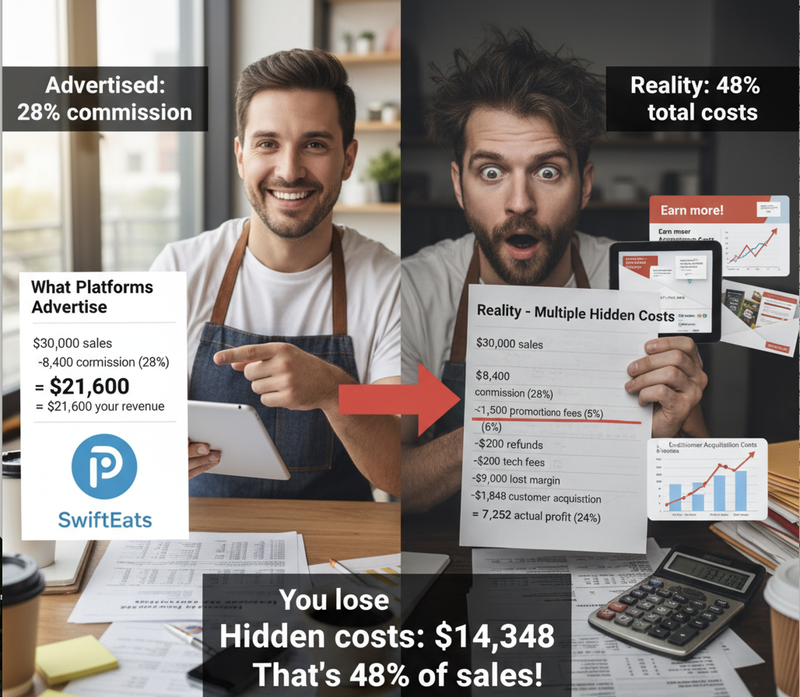
Your delivery sales hit $30,000 last month. Platform shows you made $21,600 after their 28% commission.
But you didn't make $21,600. You made $14,200.
The $7,400 gap? Hidden costs the platform doesn't mention: promotional fees, chargeback penalties, customer acquisition you're paying for but don't own, inflated refund rates, and menu price compression.
Here's the real math from 500 independent restaurants doing $20,000-50,000 monthly delivery sales.
The Advertised Commission (What They Tell You)
Platform Commission Rates (2025):
- DoorDash: 25-30% (depending on package)
- Uber Eats: 25-30%
- Grubhub: 20-30%
- Postmates: 25-30%
Jake in Portland signed up for DoorDash "Basic" at 25%. Seemed reasonable compared to 2-3% credit card fees.
First month: $28,000 delivery sales. Expected earnings: $21,000 (75%).
Actual deposit: $17,640 (63%).
Missing: $3,360 (12%).
Where did it go?
Hidden Cost #1: Promotional Fees (The "Free" Advertising Trap)
What Platforms Push: "Boost your restaurant visibility! Pay 5% promotional fee to appear higher in search results."
Real Cost: That 5% is on TOP of 28% commission. Total: 33%.
But here's the trap: If you don't pay promotional fees, your restaurant gets buried on page 3. Nobody sees you. Sales drop 60%.
Real Numbers (Chen's Restaurant):
- Month 1: Paid promotional fees (33% total cost)
- Sales: $32,000
- Platform fees: $10,560
- Net: $21,440
- Month 2: Refused promotional fees (28% commission only)
- Sales: $14,200 (56% drop)
- Platform fees: $3,976
- Net: $10,224
Chen earned LESS money paying lower commission because sales collapsed without promotional placement.
Bottom line: Advertised 28% commission becomes mandatory 33-35% once you factor in promotional fees you can't refuse.
Hidden Cost #2: Customer Acquisition You Don't Own
The Problem: You pay 28-35% to acquire customers through the platform. But those customers belong to the platform, not you.
Real Scenario (Sarah's Café): Customer orders through DoorDash 12 times in 6 months:
- Average order: $42
- Total sales: $504
- Platform commission (30%): $151.20
- Sarah's revenue: $352.80
That customer has Sarah's food 12 times but doesn't know her restaurant name. Doesn't have her phone number. Doesn't follow her on social media. Can't order directly.
When DoorDash increases commission to 32%, Sarah has zero leverage. Customer relationship belongs to DoorDash.
Customer acquisition cost breakdown:
- First order: $12.60 commission (30% of $42)
- If customer orders direct next time: $2.52 payment processing (6% of $42)
- Savings orders 2-12: $10.08 per order × 11 orders = $110.88
But Sarah never gets orders 2-12 direct because DoorDash owns the relationship.
Hidden cost: $110.88 per repeat customer over 6 months.
With 200 delivery customers, that's $22,176 annually you're paying for customer relationships you don't own.
Hidden Cost #3: Menu Price Compression
The Trap: Platform takes 30%. You need to maintain margins. Two options:
Option A: Keep restaurant prices, lose money on delivery
- Burger costs $8 to make
- Restaurant price: $16 (50% margin)
- Platform takes 30%: $4.80
- Your revenue: $11.20
- Margin: $3.20 (20% instead of 50%)
Option B: Increase prices on platform
- Burger costs $8 to make
- Platform price: $21 (31% markup to maintain margin)
- Customer sees $21 burger elsewhere for $16
- Customer doesn't order
Most restaurants choose Option A (lose margin) because Option B (lose customers) is worse.
Real Numbers (Marcus, Portland):
- In-restaurant margin: 48%
- Delivery margin (same prices): 18%
- Delivery margin (marked up 25%): 31%
- Customer conversion with markup: -47%
Marked-up prices recover margin but cut sales in half. Regular prices maintain sales but destroy margin.
Hidden cost: 30 percentage points of margin on every delivery order.
On $30,000 monthly delivery sales at 18% margin instead of 48%, that's $9,000 monthly profit lost. $108,000 annually.
Hidden Cost #4: Inflated Refund and Chargeback Rates
Platform Refund Policies: Customer complains about anything, gets instant refund. Platform charges you.
Common complaints that trigger refunds:
- "Food was cold" (driver took 45 minutes, not restaurant's fault)
- "Wrong order" (driver picked up wrong bag)
- "Missing items" (driver didn't check bag)
- "Poor quality" (subjective, no verification needed)
Real Numbers (Jake's Pizza):
- In-restaurant refund rate: 0.8%
- Delivery platform refund rate: 6.2%
- Monthly delivery sales: $28,000
- Refunds charged to restaurant: $1,736
That's 7.8× higher refund rate than in-restaurant because:
- Customer never sees you (lower threshold to complain)
- Platform sides with customer automatically (retention strategy)
- Delivery delays blamed on restaurant (not driver)
- No opportunity to fix issues (refund issued before you know)
Hidden cost: 5-7% of delivery sales in refunds for issues you didn't cause.
Hidden Cost #5: Tablet and Tech Fees
What They Don't Mention: Platform-provided tablets, integration fees, and "technology services."
Real Costs:
- Tablet rental: $50-150 monthly (or purchase $400-800)
- Integration fee: $200-600 one-time
- POS integration: $300-1,200 one-time
- Technical support: $50-100 monthly
Chen's Restaurant Setup:
- DoorDash tablet: $100 monthly
- Uber Eats tablet: $100 monthly
- Integration to POS: $800 one-time
- Monthly tech costs: $200
- Annual tech costs: $3,200
These costs don't appear in commission calculations but come directly from delivery revenue.
Hidden cost: $200-400 monthly in technology fees.
Hidden Cost #6: Labor Burden for Delivery Orders
The Problem: Delivery orders require same kitchen labor as dine-in but generate 30% less revenue per order.
Labor Math (Maria's Restaurant):
- Kitchen labor cost: 28% of sales
- Dine-in order: $45 average
- Kitchen labor: $12.60 per order
- Revenue after labor: $32.40 (72% margin before other costs)
- Delivery order: $42 average
- Platform commission (30%): $12.60
- Kitchen labor: $11.76
- Revenue after commission and labor: $17.64 (42% margin)
Delivery orders consume same kitchen resources but generate 42% less profit.
Real Impact: On 200 delivery orders monthly at $42 average:
- Revenue: $8,400
- Commission: $2,520
- Kitchen labor: $2,352
- Net before other costs: $3,528
Same 200 dine-in orders:
- Revenue: $9,000 (slightly higher average ticket)
- Payment processing: $450
- Kitchen labor: $2,520
- Net before other costs: $6,030
Hidden cost: $2,502 monthly in reduced profitability per order ($12.51 per delivery order).
Hidden Cost #7: Brand Dilution
The Invisible Cost: Customer has bad delivery experience (cold food, wrong order, long wait). Blames your restaurant, not the platform.
Jake's Experience: Google reviews before delivery platforms: 4.6 stars (in-restaurant experience) Google reviews after delivery platforms: 3.9 stars (mix of in-restaurant and delivery)
Negative reviews mention:
- "Food arrived cold" (delivery time, not restaurant)
- "Wrong items in bag" (driver error, not restaurant)
- "Took 90 minutes" (driver routing, not restaurant)
Impact: Lower star rating reduces organic search visibility. Fewer new customers find you. In-restaurant revenue declines.
Real Numbers: Jake's in-restaurant revenue dropped 8% after Google rating fell from 4.6 to 3.9.
Monthly in-restaurant sales before: $85,000 Monthly in-restaurant sales after: $78,200 Monthly loss: $6,800
Delivery sales added: $28,000 (at 18% margin = $5,040 profit) In-restaurant sales lost: $6,800 (at 48% margin = $3,264 profit)
Delivery revenue doesn't offset in-restaurant decline.
Hidden cost: Lost in-restaurant revenue from brand dilution.
The Real Math: $30,000 in Delivery Sales
What Platform Shows You:
- Delivery sales: $30,000
- Commission (28%): $8,400
- Your revenue: $21,600
What You Actually Get:
- Delivery sales: $30,000
- Commission (28%): $8,400
- Promotional fees (5%): $1,500
- Refunds/chargebacks (6%): $1,800
- Tech fees: $200
- Menu price compression (lost margin): $9,000
- Customer acquisition you don't own: $1,848
- Total costs: $22,748
- Actual profit: $7,252 (24% of sales, not 72%)
And that's before:
- Food costs (32% of sales = $9,600)
- Kitchen labor (28% of sales = $8,400)
- Packaging (3% of sales = $900)
After all costs:
- Revenue: $30,000
- Total costs: $41,648
- Net loss: $11,648
You're literally paying $11,648 to generate $30,000 in delivery sales.
When Delivery Platforms Make Sense (Rare Cases)
Scenario 1: Excess kitchen capacity If kitchen is 40% idle during off-peak and all fixed costs are covered by dine-in, delivery orders fill excess capacity.
Even at 18% margin, some profit is better than zero.
Scenario 2: New restaurant building awareness First 6 months, delivery platforms provide customer exposure. Accept low margins as marketing cost.
After 6 months, transition customers to direct ordering.
Scenario 3: Ghost kitchen with no dine-in If you have no dine-in revenue, delivery is your only channel. Platform commission is cost of distribution.
But even ghost kitchens should build owned customer relationships for direct ordering.
Alternatives That Actually Work
Build Direct Ordering (Own the Customer)
Setup:
- Online ordering on your website ($50-150 monthly)
- SMS/email marketing (free - $50 monthly)
- Loyalty program (free - $30 monthly)
- In-house delivery ($15-18/hour driver) OR delivery service ($5-8/delivery)
Cost per order:
- Platform processing: 6% ($2.52 on $42 order)
- Delivery service: $6 per order
- Marketing (customer acquisition): $3 per new customer
- Total: $11.52 per order (27%) for new customers
- Total: $8.52 per order (20%) for repeat customers
Vs 33-35% platform costs plus all hidden costs.
Customer Ownership: After first order through your site:
- You have phone number
- You have email
- You can retarget
- You control experience
- You own relationship
Real Numbers (Chen's Restaurant): Switched from 100% platform delivery to 70% direct ordering:
- Monthly delivery sales: $32,000
- Platform sales (30%): $9,600 at 33% commission = $6,432 revenue
- Direct sales (70%): $22,400 at 20% cost = $17,920 revenue
- Total revenue: $24,352 vs $21,120 with 100% platform
- Increase: $3,232 monthly ($38,784 annually)
Common Questions
Q: Can I refuse delivery platforms entirely?
You can, but you'll lose 20-35% of potential revenue. Better strategy: Use platforms for customer acquisition, convert to direct ordering for repeat customers. Offer 15% discount for direct orders (still cheaper than 33% platform cost).
Q: How do I get customers to order direct instead of through platform?
Receipt inserts: "Order direct next time, get 15% off - [YourRestaurant.com]". SMS marketing: "Thanks for trying us! Next order: 15% off direct through our site." Most customers switch after 2-3 orders if savings are clear.
Q: What about customer service for delivery issues?
Hire part-time delivery coordinator ($15/hour, 4 hours daily = $1,200 monthly). Still cheaper than platform fees. Handle issues directly, maintain customer relationships, prevent brand damage.
Q: Won't customers be mad if we're not on DoorDash?
Keep presence on one platform (cheapest commission) for discovery. Drive all orders to direct ordering with discounts. Customers follow savings. Your $18 burger on platform vs $15 direct is obvious choice.
Q: How long to build direct ordering volume?
3-6 months to transition 50% of delivery orders to direct. 12 months to reach 70-80% direct. Requires consistent marketing and discounts, but margins recovered in month 1.
Bottom Line on Delivery Platforms
Advertised 28% commission becomes 35-45% real cost after hidden fees.
$30,000 in delivery sales generates $7,252 profit (24%) before food and labor costs.
After food and labor, you're operating at loss or razor-thin margins.
Solution isn't "quit delivery." Solution is "own your customers."
Use platforms for discovery. Convert to direct ordering for repeat business. Keep 15-20% margins instead of giving 35-45% to platforms.
That $30,000 in monthly delivery sales?
- Platform model: $7,252 profit (before food/labor) = loss of $11,648
- Direct model: $18,720 profit (before food/labor) = profit of $6,000
Difference: $17,648 monthly or $211,776 annually.
That's not a hidden cost. That's a visible crisis.