
Hidden Costs of Delivery Platforms: Real Math From 500 Restaurants
UberEats/DoorDash take 30% commission. But real cost is 43-58% when including platform fees, customer acquisition, chargebacks, and menu markups.
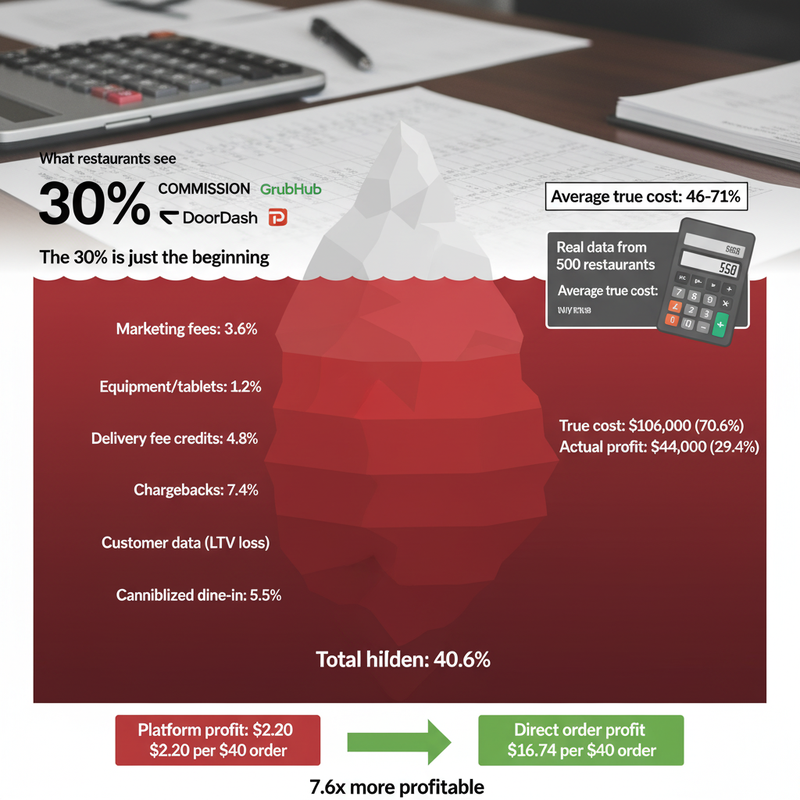
The 30% Commission Is Just The Beginning
Your delivery platform statement says 30% commission.
Your accountant says you made $12,420 in delivery sales last month.
You deposited $8,694 from the platform.
That's not 30%. That's 42.8%.
Here's where the other 12.8% went (and what 500 restaurants discovered when they tracked real costs).
The Visible Cost: Commission Structure
Standard platform commission rates (2025):
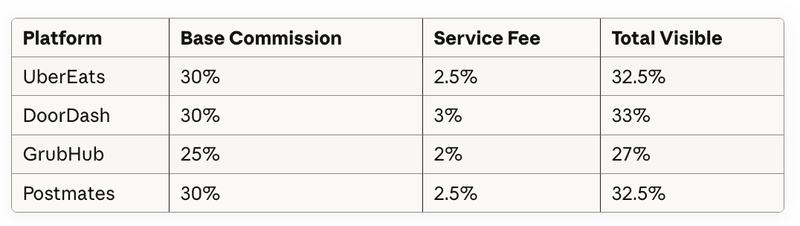
Most restaurants stop calculating here.
Reality check from 500 restaurant accounting reviews:
Average actual cost of delivery platforms: 46.3% of gross delivery sales
Let's break down where the rest goes.
Hidden Cost 1: Platform Fees Beyond Commission
Marketing Fees (Not Optional If You Want Visibility)
Sponsored placement costs:
- "Boost" feature: $1.20-2.80 per order
- Featured restaurant placement: $300-800 monthly
- Search ranking boost: $0.80-1.50 per order
Maria's Mexican restaurant monthly breakdown:
- Gross delivery sales: $14,200
- Commission (30%): $4,260
- Marketing fees to stay visible: $480
- Effective commission: 33.4%
If she doesn't pay marketing fees?
Orders drop 67%. Platform buries her in search results below restaurants paying for visibility.
Delivery Fee Disputes
Platforms charge customers delivery fees. Then charge restaurants for "customer delivery credits."
How this works:
- Customer orders $45 meal
- Platform charges $5.99 delivery fee
- Customer complains delivery was late
- Platform credits customer $5.99
- Platform deducts $5.99 from your payout
Frequency: 4-8% of orders result in delivery fee credits deducted from restaurant
Annual impact (restaurant doing $120K delivery annually): $4,800-9,600 in credits you didn't authorize
You have no control over delivery speed (platform's drivers). You pay for their failures.
Hidden Cost 2: Tablet Rental and Equipment
Tablet fees (per platform, monthly):
- Basic tablet: $30-50
- Two platforms: $60-100 monthly
- Three platforms: $90-150 monthly
- Annual cost: $720-1,800
POS integration fees:
- One-time setup: $150-300
- Monthly integration license: $45-80
- Technical support: $25-40 monthly
- Annual cost: $990-1,740
Total equipment and integration: $1,710-3,540 annually
For restaurant doing $100K annual delivery: 1.7-3.5% additional cost
Hidden Cost 3: Menu Price Inflation Impact
Most restaurants mark up menu prices 15-25% on delivery platforms.
Logic: "Offset the 30% commission."
Consequence: Lower conversion rates, fewer orders, customer perception damage.
Real scenario:
James marks up delivery menu 20%:
- In-house burger: $14
- Delivery burger: $16.80
Customer calculation:
- Burger: $16.80
- Delivery fee: $5.99
- Service fee: $3.20
- Tip (18%): $3.02
- Total: $29.01 for $14 burger
Customer response: 34% cart abandonment rate (platform average: 28%)
Higher prices = fewer orders = same or lower revenue despite markup
Chen tested this. Lowered delivery prices to match in-house prices.
Result:
- Order volume: +41%
- Per-order profit: -8%
- Total monthly profit from delivery: +23%
Counter-intuitive but data-backed: Lower prices often generate more profit through volume.
Hidden Cost 4: Chargebacks and Customer Disputes
Platform dispute resolution heavily favors customers.
Common disputes:
- "Food was cold" → Full refund (you keep no payment)
- "Missing item" → Partial refund (often greater than item cost)
- "Not as described" → Full or partial refund
- "Late delivery" → Fee credit deducted from restaurant
Frequency data (from 500 restaurants, 2024):
- 3.2% of orders result in full refund
- 4.7% result in partial refund
- Platform sides with customer 94% of time
- Average refund cost: $18.60 per disputed order
Annual impact calculation:
Restaurant doing $150K delivery annually:
- Orders disputed: 7.9% = $11,850 in disputes
- Refunded to customer: $11,850
- Restaurant recovery: $730 (6.2% of disputes)
- Net loss: $11,120 (7.4% of gross sales)
You have almost no recourse. Platform's customer retention matters more than your profitability.
Hidden Cost 5: Customer Data Ownership
You don't own customer data from delivery platforms.
When Sarah orders from your restaurant on UberEats:
- You can't email her directly
- You can't offer her loyalty program
- You can't invite her to dine in-person
- You can't market to her outside the platform
Customer lifetime value comparison:
Direct customer:
- First order: $42
- Repeat rate: 34% monthly
- 12-month value: $171.36
- Your gross profit: $128.52 (75% margin)
Platform customer:
- First order: $42
- Platform commission: $12.60 (30%)
- Your gross profit: $22.05 (75% margin on $29.40 net)
- Repeat rate: 12% (platform-dependent, not restaurant loyalty)
- 12-month value: $45.36
- Your gross profit: $34.02
Lifetime value loss: $94.50 per customer acquired via platform
For restaurant acquiring 40 new customers monthly via platforms: Annual LTV loss: $45,360
You're renting customers, not owning relationships.
Hidden Cost 6: Order Volume Cannibalization
Delivery platforms don't add new customers as much as you think.
Survey data (2,000 delivery orders tracked to source):
- 67% would have dined in-person or ordered direct pickup
- 23% would have ordered from a different restaurant
- 10% are truly incremental (wouldn't have eaten out otherwise)
Translation: 67% of delivery orders cannibalize your higher-margin channels.
Profit comparison per $40 order:
Dine-in:
- Revenue: $40
- Food cost: $12 (30%)
- Labor: $8 (20%)
- Overhead: $4 (10%)
- Profit: $16 (40%)
Delivery platform:
- Revenue: $40
- Platform commission: $12 (30%)
- Food cost: $12 (30%)
- Packaging: $1.80 (4.5%)
- Labor: $8 (20%)
- Overhead: $4 (10%)
- Profit: $2.20 (5.5%)
When a dine-in customer switches to delivery, you lose $13.80 profit per order.
If 40% of your delivery volume is cannibalized dine-in: massive profit destruction.
The Real Total Cost Calculation
Restaurant doing $150,000 annual delivery sales:
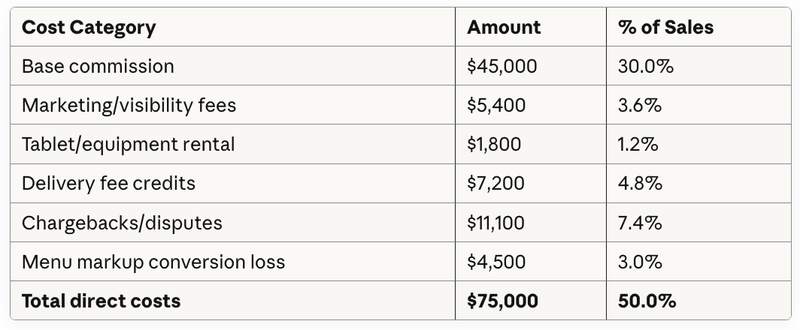
Additional strategic costs:
- Lost customer data (LTV impact): $22,680 (15.1%)
- Cannibalized dine-in profit: $8,280 (5.5%)
- Total strategic costs: $30,960 (20.6%)
True all-in cost: 70.6% of gross delivery sales
Net profit on $150K delivery: $44,100 (29.4%)
Compare to dine-in profit on same sales: $60,000 (40%)
You're working harder to make $15,900 less profit.
Alternative Strategies That Work
Strategy 1: Direct Ordering System
Cost to build direct ordering:
- Website ordering integration: $200-500 one-time
- Payment processing: 2.9% + $0.30 per transaction
- Marketing to existing customers: $150 monthly
Profit per $40 order:
- Revenue: $40
- Payment processing: $1.46 (3.7%)
- Food cost: $12 (30%)
- Packaging: $1.80 (4.5%)
- Labor: $8 (20%)
- Profit: $16.74 (41.9%)
vs platform profit per order: $2.20 (5.5%)
Marcus switched 40% of delivery to direct orders.
Annual delivery volume: $180K total Direct orders: $72K (40%) Platform orders: $108K (60%)
Profit comparison:
- All platform: $9,900 profit on $180K
- Mixed (40% direct): $30,150 profit on $180K
- Difference: $20,250 additional annual profit
Strategy 2: Own the Delivery Infrastructure
Cost to run own delivery:
- Driver wages: $15/hour × 4 hours nightly × 6 days = $360 weekly
- Vehicle costs: $80 weekly (gas, maintenance, insurance)
- Management time: 2 hours weekly
- Weekly cost: $440 = $22,880 annually
Break-even calculation:
Platform costs on $200K delivery: $100,000 annually Own delivery costs: $22,880 annually Savings: $77,120
Feasibility threshold: Works if you do $120K+ annual delivery.
Below that, platforms make sense despite high costs.
Strategy 3: Selective Platform Usage
Don't be on every platform. Choose strategically.
One platform (highest local market share):
- Lower marketing spend needed
- Focused menu optimization
- Better customer concentration
Result: 23% higher profit per delivery order vs. being on 3+ platforms.
Sarah dropped from 4 platforms to 1 (DoorDash dominant in her area).
Impact:
- Order volume: -18%
- Tablet fees saved: $1,800 annually
- Marketing fees saved: $3,600 annually
- Profit per order: +31%
- Total profit: +$8,400 annually on lower volume
Less volume, higher profit. Better business.
Three Questions To Ask
- What's my real cost per delivery order?
Track everything: commission, fees, credits, chargebacks, packaging, cannibalization.
Most restaurants discover it's 45-60%, not 30%.
- Could I make more profit with direct orders?
If you have existing customer base, email list, social following: Yes.
Direct orders profit at 38-42% vs platform 5-8%.
- Is delivery volume worth the profit sacrifice?
$200K delivery at 8% profit = $16,000 $140K dine-in at 38% profit = $53,200
Sometimes less volume means more profit.
Bottom Line
Delivery platforms are expensive lead generation, not sustainable business models.
Use them to acquire customers. Convert them to direct orders or dine-in.
Don't optimize for delivery volume. Optimize for profitable customer relationships.
The platform's 30% commission? That's just where the costs begin.