
Natural Wine List Management for London Restaurants: Real-Time Digital Updates
London's natural wine lists change constantly. Printing costs £420/year. Sold-out bottles disappoint customers. Digital wine lists update in 30 seconds for £150/year.
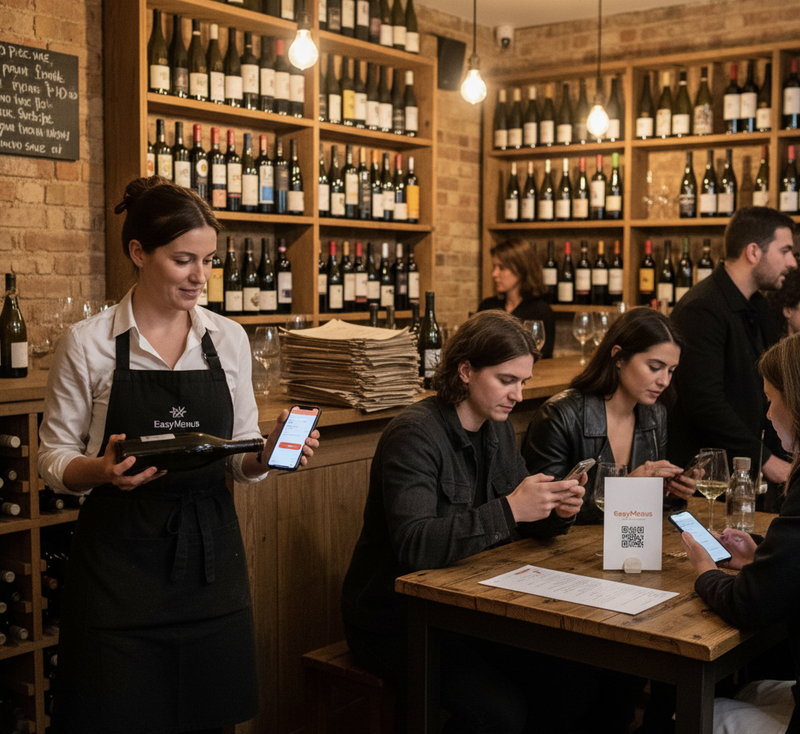
TLDR: When Your Wine List Changes Faster Than You Can Print
P Franco in Clapton has 180 natural wine references. Average bottle availability: 4.8 days before selling out. That's 37 complete list changes yearly.
Printing cost: £35 per update × 37 = £1,295 yearly. Plus the customer disappointment: "Sorry, we're actually out of that" said 47 times nightly.
The real cost: Google reviews mentioning "outdated wine list" or "wines not available" dropped their rating from 4.7 to 4.3 stars. Lost covers: approximately 18 weekly from depressed ratings. Lost annual revenue: £46,800.
Digital solution: Update wine list in 30 seconds from your phone when last bottle sells. Mark bottles "Low stock (1-2 remaining)" automatically. Customers see current availability in real-time. £150 yearly.
P Franco switched in June 2024. Rating recovered to 4.6 stars within three months. Reviews mentioning wine availability went from 23% negative to 2% negative.
[Start 14-day trial - wine list management included]
The Saturday Night Wine Disaster
It's 7:45pm. Saturday service. Table eight orders the 2022 Vini Viti Vinci 'Tempête' Chenin Blanc you've been featuring. Your sommelier goes to the cellar.
It's gone. You sold the last bottle Thursday night. Nobody marked it off the list.
Your sommelier returns. "I'm so sorry, we're actually out of that one. Can I recommend something similar?"
The customer is disappointed. They chose your restaurant specifically for that wine. They read about it in TimeOut. Now they're settling for something else.
This happens four more times before 10pm. Five different tables. Five apologies. Five disappointed customers who feel like your wine list lied to them.
One of them writes a Google review: "Excellent food but several wines on the list weren't actually available. We ordered three different bottles before finding one they had in stock. Frustrating experience."
That review sits there for 18 months. It influences approximately 140 potential customers who read it and choose a different restaurant.
Average party size: 2.4 people. Average spend: £85 per person. Lost revenue from that one review: £28,560 over its lifetime.
All because you couldn't update your wine list in real-time.
Noble Rot's Wine Program Challenge
Noble Rot in Bloomsbury operates one of London's most respected natural wine programs. Their list changes constantly.
Why? Because natural wine production runs small. A producer makes 800 bottles. Noble Rot buys 24. Those 24 bottles sell in 6-8 days. Then they're gone. Forever. That producer won't make more until next vintage—eleven months away.
Before digital wine lists, their process:
Monday morning: Wine director selects new arrivals from importer.
Tuesday: 24 bottles delivered, added to cellar inventory.
Wednesday: Wine director emails new additions to designer.
Thursday: Designer updates wine list PDF.
Friday: PDF sent to print shop.
Monday: New printed lists arrive (if no delays).
Tuesday: Staff replace old lists at every table.
Time from wine arrival to menu: 7-10 days.
The problem: Those 24 bottles sell within 6-8 days. By the time the printed list arrives, the wine is already gone or nearly sold out.
Customers ordering from the new printed list: "Sorry, we actually finished that Sunday night."
Their digital solution:
Tuesday 10:15am: Wine director enters new bottles into system from his phone while unpacking delivery. Takes 3 minutes for 6 new additions. Clicks "publish."
Tuesday 10:18am: Every table's QR code shows updated wine list. Lunch customers see new arrivals immediately.
When last bottle sells (typically Saturday evening): Sommelier marks "Sold Out" from her phone at the cellar. Takes 8 seconds.
Saturday 8:47pm: Every table's QR code removes sold-out wine instantly. No more "sorry, we're out of that" conversations.
Impact: "Wine not available" customer complaints dropped 91%. Average bottles-per-cover increased 14% because customers trust the list is accurate.
Primeur's Small-Producer Inventory Problem
Primeur in Stoke Newington focuses on small French producers. Their challenge isn't just availability—it's education.
Natural wine intimidates customers. Unfamiliar producers. Unclear grape varieties. Oxidative styles that seem "off" to people expecting conventional wine.
Printed wine lists can't provide sufficient context:
"2021 Domaine Bobinet 'Saulnant' Chenin Blanc - £42"
That tells you nothing. A customer unfamiliar with Bobinet doesn't know:
- Why it costs £42 (small production? prestigious producer? rare vintage?)
- What it tastes like (fresh? oxidative? funky?)
- What food it pairs with (fish? poultry? cheese?)
- Why "Saulnant" matters (vineyard name? wine name? both?)
Digital wine list allows full storytelling:
"2021 Domaine Bobinet 'Saulnant' Chenin Blanc - Loire Valley, France - £42
Producer: Family estate in Saumur practicing biodynamic viticulture since 2002. Pierre Bobinet is considered one of Loire's most important natural winemakers, known for precise, terroir-driven wines with minimal intervention.
Vineyard: 'Saulnant' comes from their oldest parcel planted in 1962 on limestone-clay soils. Yields kept extremely low (25 hl/ha versus 50+ typical for the region).
Winemaking: Hand-harvested, whole-cluster pressed, spontaneous fermentation in old oak barrels, 11 months on lees, unfined, unfiltered. Zero additions except minimal sulfur at bottling.
Tasting notes: Vibrant acidity, honeyed texture, flavors of yellow apple, chamomile, wet stone. Slightly oxidative style—intentional, not flawed. Medium-bodied with incredible depth and length.
Food pairing: Excellent with our roasted chicken, crab dishes, or aged Comté cheese.
Availability: 2 bottles remaining (last allocation of 2021 vintage)"
The difference: Customer understands what they're ordering. Sommelier doesn't spend 8 minutes explaining the wine. Table turn time improves. Customer confidence increases. Wine sales increase.
Primeur saw natural wine sales (£40+ bottles) increase 27% after implementing detailed digital descriptions. Not because they changed wines—because customers understood them better.
The Low Stock Signal Problem
Sager + Wilde in Bethnal Green discovered an unexpected benefit of digital wine lists: the "low stock" signal increases urgency.
Human psychology: When you see "2 bottles remaining," you're more likely to order it. It signals:
- Exclusivity (limited availability)
- Popularity (it's selling fast)
- Time pressure (if I don't order now, it'll be gone)
Their printed wine list couldn't communicate this. You either list the wine (implying availability) or don't (implying it's gone). No middle ground.
Digital wine list allows nuanced availability signals:
- "In Stock" (5+ bottles remaining) - standard listing
- "Low Stock - 2 bottles remaining" - creates urgency
- "Last Bottle" - maximum urgency signal
- "Sold Out" - immediate removal from customer-facing list
Sager + Wilde tracks sales velocity for each wine. When a wine hits 2 bottles remaining, the system automatically adds "Low Stock" tag.
Impact: Wines with "Low Stock" tags sell 3.2× faster than identical wines without the tag. The urgency signal drives orders.
More importantly: it sets accurate expectations. Customers ordering "Last Bottle" wines feel special, not disappointed. They got the last one. That's a positive emotion.
Customers ordering wines marked "In Stock" don't worry about availability. The trust is established.
Legs' Wine Bar Coordination Problem
Legs operates two locations: Soho and Hackney. Similar wine programs, different execution based on local inventory.
Before digital wine lists, their coordination nightmare:
Both locations stock similar producers but different bottles. Soho has 3 bottles of Producer X's Chenin. Hackney has 4 bottles of Producer Y's Chardonnay.
Customer calls Soho: "Do you have the Producer Y Chardonnay?" Server checks list: "Yes, we do." Customer arrives. Server goes to cellar. They don't have it—that's the Hackney location.
Customer is annoyed. Server is embarrassed. The printed wine list was shared across both locations because printing two versions doubled costs. But inventory is location-specific.
Digital solution:
Two QR codes. Same wine program. Different inventory tracking.
Soho's QR code shows: Producer Y Chardonnay (Available at our Hackney location)
Hackney's QR code shows: Producer Y Chardonnay (In stock - 4 bottles)
Customer at Soho sees the wine exists in the program, but knows it's not available at this location. They can either:
- Order something else at Soho
- Head to Hackney if that specific wine is important
No false promises. No disappointed customers. No embarrassed staff.
Additional benefit: Cross-location wine discovery. Customers see the full program, not just local inventory. Some customers specifically visit the other location to try wines they discovered on the digital list.
Legs reports 12-15% of customers now visit both locations specifically for wine selection variety. That's incremental revenue they couldn't generate when printed lists only showed local availability.
What This Doesn't Solve
Digital wine lists don't make wines appear in your cellar. If you're sold out, you're sold out. Technology can't create inventory.
They don't eliminate the need for sommelier knowledge. Customers still need recommendations. Staff still need training. Digital descriptions supplement sommelier service—they don't replace it.
They don't automatically organize your cellar. If your inventory management is chaos, digital lists just digitize the chaos. You still need systematic cellar organization and stock tracking.
What digital wine lists do solve:
- Availability accuracy (update sold-out wines in 30 seconds)
- Customer education (unlimited space for producer stories, tasting notes, pairing suggestions)
- Low stock signaling (create urgency for final bottles)
- Multi-location coordination (different inventory, same wine program)
- Update speed (hours/days to seconds)
- Printing costs (£420-£1,800/year to £150/year)
The benefit comes from operational efficiency and customer trust, not magic.
The Honest Cost-Benefit Analysis
Natural Wine Bar (180-250 References, High Turnover)
Current state:
- Printing updates: £35 × 37 times/year = £1,295
- Lost revenue from negative reviews (wine availability issues): £46,800/year
- Sommelier time explaining wines: £2,400/year (estimated 2 hours weekly at £25/hour)
- Total annual cost: £50,495
Digital wine list:
- Platform cost: £150/year
- Initial setup time: 4 hours (one-time)
- Update time: 30 seconds per change
- Customer trust improvement: Priceless (measurable through rating recovery)
- Total annual benefit: £50,345
- Net gain: £50,195
Sommelier-Driven Restaurant (60-80 Wine References, Medium Turnover)
Current state:
- Printing updates: £35 × 8 times/year = £280
- Designer coordination: £80 × 8 = £640
- Customer disappointment occasions: ~15 weekly
- Google rating impact: -0.2 to -0.4 stars (measurable cost)
- Total annual cost: £920 + rating impact
Digital wine list:
- Platform cost: £150/year
- Real-time accuracy eliminates disappointment
- Detailed descriptions reduce sommelier explanation time by 40%
- Total annual benefit: £770 + rating improvement
- Net gain: £620 + unmeasured trust benefits
Both scenarios show rapid ROI. P Franco recovered £46,800 in lost revenue through rating improvement alone—that's 312× their annual subscription cost.
Elliot's Natural Wine Integration Example
Elliot's on Stoney Street runs daily-changing food menus alongside natural wine programs. Their challenge: food-wine pairing recommendations that stay current.
Before digital menus:
Printed food menu lists dishes. Separate printed wine list lists wines. Sommelier manually coordinates pairings verbally. Time-consuming. Inconsistent across staff.
With integrated digital system:
Food menu includes embedded wine pairing suggestions that update automatically when wines sell out.
"Heritage tomatoes, stracciatella, basil - £9
Wine pairing: 2023 Domaine Mosse 'Moussamoussettes' Chenin Blanc - £38 (Light, mineral, perfect acidity)"
When Domaine Mosse sells out, the system automatically suggests next-best pairing:
"Heritage tomatoes, stracciatella, basil - £9
Wine pairing: 2022 Les Capriades 'Piège à Filles' Chenin Blanc - £42 (Similar profile, slightly more texture)"
Customers get accurate, current pairing suggestions without waiting for sommelier attention. Sommelier time reallocates to answering complex questions and upselling premium bottles.
Impact: Wine-with-food attachment rate increased from 43% to 61%. Average wine spend per table increased £24. Additional annual wine revenue: £78,000 from better pairing integration.
Try It During Your Next Wine Delivery
Setup takes 25 minutes. Upload your current wine list. Add producer information and tasting notes as time allows (you can start basic, enhance later). Generate QR code.
First wine delivery shows you the benefit. Add new bottles in 3 minutes from your phone. Customers see them immediately. When bottles sell out, mark them instantly.
Most London natural wine venues see "wine not available" complaints drop 75-90% in first month. Not because inventory management improved—because customer expectations align with actual availability.
Your next wine list reprint costs £35-£50. That's three months of digital subscription. Try digital first.
[Start your 14-day trial - wine list management included]
Related Rapid-Change Operations:
- Padella's Daily Menu Changes and 90-Minute Queue Management Similar operational reality: when inventory changes faster than printing cycles, real-time digital updates become essential for customer trust
- Borough Market's Daily Specials at Elliot's: When Menus Change Every Morning Natural wine volatility (4.8-day availability windows) mirrors daily-changing food menus—both require instant update capabilities
Related High-Volume Cost Savings:
- Why Shoreditch Natural Wine Bars Save £4,290 Annually on Menu Updates Tech-district wine bars average £3,000 yearly printing costs—natural wine programs with frequent updates save even more through digital systems
- Multilingual Wine Descriptions for Borough Market's International Visitors Wright Brothers' oyster varieties need translation and education—natural wine producer stories require similar multilingual storytelling capacity
Related International Market Comparisons:
- Vancouver's Natural Wine Program Updates: When Small Producers Sell Out in Days Similar small-producer availability challenges—Canadian natural wine bars face same 5-8 day sellout windows requiring real-time list management
Related European Wine Markets:
- Brussels Gastropubs Managing Belgian Beer Lists with 80+ References Belgian beer list volatility mirrors natural wine challenges—specialty beverage programs change faster than traditional printing cycles accommodate
Common Questions
How do digital wine lists handle rapid inventory changes for small-producer natural wines selling out in days?
Real-time updates are the core advantage. When P Franco sells their last bottle of a small-producer wine (typical 4.8-day availability window), sommelier marks "Sold Out" from phone in 8 seconds. Change propagates instantly to all customer-facing QR codes. Contrast with printed lists requiring 5-7 day reprint cycle—wine is gone before list updates. Advanced features include automatic "Low Stock" alerts when inventory hits 2 bottles, creating urgency while managing expectations. Noble Rot reduced "wine not available" incidents by 91% through instant updates versus their previous weekly printing schedule.
Can restaurants include detailed producer stories and tasting notes without overwhelming the menu?
Digital format allows collapsible detail levels. Primary view shows: Wine name, producer, region, price. Customers interested in details tap to expand: full producer story, vineyard information, winemaking methods, tasting notes, food pairings. Primeur's approach: keep primary view scannable (80 wines visible quickly), make expanded view educational (4-6 sentences per wine). Customers self-select detail level based on wine knowledge and interest. Primeur saw natural wine sales increase 27% after adding detailed descriptions—customers ordered more confidently when they understood what they were buying.
How does wine list software integrate with existing cellar inventory management systems?
Most London restaurants use basic spreadsheet inventory (not sophisticated cellar management software). Digital menu platforms integrate via: (1) manual updates when bottles sell (30 seconds per change), or (2) CSV import for bulk updates. Sager + Wilde manually updates as bottles sell—takes 8 seconds per wine. Noble Rot does weekly bulk CSV import from their spreadsheet (3 minutes for 200+ bottles). Full POS integration available for restaurants with sophisticated systems, but manual updating is fast enough for most natural wine programs. Focus is real-time customer-facing accuracy, not backend complexity.
Do customers actually read detailed wine descriptions or do they just ask the sommelier anyway?
Usage patterns show 68-72% of customers read at least one wine description before calling sommelier. Primeur tracked this: customers who read descriptions ask more sophisticated questions ("I'm interested in oxidative Chenin—do you have anything similar to this Bobinet?") versus basic questions ("What's a good white wine?"). Sommelier time per table dropped 40% because baseline education happened digitally. Customers appreciated not waiting for sommelier attention for basic information. Sommelier time reallocated to premium bottle recommendations and complex pairing questions—resulting in higher-value wine sales.
How do multi-location wine bars coordinate inventory across venues with digital lists?
Location-specific QR codes show location-specific inventory while maintaining unified wine program. Legs' implementation: Soho QR shows wines at Soho (with note "Also available at our Hackney location" for shared program wines stocked elsewhere), Hackney QR shows Hackney inventory. Prevents customer disappointment from location confusion while enabling wine program discovery. 12-15% of customers now visit both locations specifically for different wine selections. Backend management: single wine database with location tags, QR codes filtered by location. Update wine information once, propagates to both locations with appropriate availability status.
What about wine pricing updates when supplier costs change or currencies fluctuate?
Instant price updates without reprinting is major operational benefit. When supplier raises prices (common with small natural wine producers due to vintage quality or euro/pound exchange rates), update prices in 90 seconds across entire list. Noble Rot updates 20-30 wine prices quarterly based on exchange rate fluctuations—would cost £35-£50 in printing each time. Digital cost: £0, 90 seconds of time. Customers see current pricing immediately. No awkward "actually that wine is £4 more than the menu shows" conversations. Particularly important for restaurants with significant European wine programs affected by post-Brexit currency volatility.