
How Singapore Restaurants Leave S$15,000 in Government Funding Unused
53% of Singapore restaurants don't claim PSG grants—leaving S$15,000 yearly co-funding untouched. 6-week approval covers 80% of digital menu costs. Step-by-step guide.
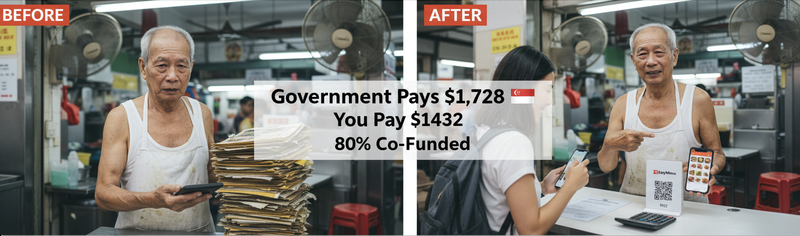
TLDR: When You're Paying Full Price While Government Offers 80% Off
Your hawker stall at Maxwell Food Centre. You've been considering digital menus for six months. Cost: S$2,160 for comprehensive setup.
What you didn't know: Singapore government's Productivity Solutions Grant (PSG) covers 80% of qualifying solutions. Your S$2,160 investment becomes S$432 after government co-funding. That's S$1,728 the government pays directly to your vendor.
The catch: You need to apply BEFORE purchasing. 53% of Singapore restaurants never apply—leaving S$15,000+ in available funding untouched because the process seems complicated.
Reality: 6-week approval. Vendor handles paperwork. Government pays vendor directly (no reimbursement wait). Best POS in Singapore provides detailed PSG application guidance including vendor comparison for pre-approved solutions.
Digital menu example: S$2,160 total → S$1,728 government pays → S$432 you pay (80% co-funded).
[Check PSG eligibility now - see if your restaurant qualifies for 80% co-funding]
The S$15,000 You're Not Claiming
It's Monday morning at Tiong Bahru Market. You're talking with the chicken rice uncle two stalls down.
"I want digital menus," he says. "But spending S$2,000+ right now? Cannot lah."
You mention PSG grants. "Government pays 80% what."
He looks confused. "I heard about that. But the application... so complicated. Need accountant or what?"
This conversation happens at every hawker center in Singapore. And it's costing restaurant operators S$15,000 annually in government funding they're eligible for but never claim.
Why 53% of Restaurants Don't Apply
Misconception 1: "It's Too Complicated for Small Operators"
What owners think: Need consultant. Complex forms. Weeks of paperwork.
Reality: Pre-approved solutions require 2-3 hours total involvement from you:
- Select solution online (30 minutes)
- Sign approval form (15 minutes)
- Accept implementation (30 minutes)
- Vendor handles 90% of documentation
Old Airport Road hawker operator (73 years old): "My nephew helped me select on website. Vendor came, set up everything, I signed paper. That's it. Government paid S$1,728, I paid S$432. Easier than getting business license renewed."
Misconception 2: "Only Big Restaurants Qualify"
What owners think: PSG is for chains and hotels, not hawker stalls or single-location restaurants.
Reality: If you're registered with ACRA and have minimum 30% local shareholding, you qualify. Hawker stalls, kopitiams, single cafés—all eligible for the same S$30,000 maximum as multi-location chains.
Maxwell Food Centre has 47 stalls with active PSG-funded digital solutions. Tiong Bahru Market: 23 stalls. These aren't tech companies—these are traditional hawker operations run by uncles and aunties who thought government grants were "for other people."
Misconception 3: "Application Takes Months"
What owners think: Submit application, wait 6-12 months like HDB application.
Reality: 6 weeks average for pre-approved solutions. Applications submitted today (29 October 2025) typically approved by mid-December.
Timeline breakdown:
- Week 1: Select solution, submit application (vendor assists)
- Weeks 2-5: Government processing
- Week 6: Approval notification
- Weeks 7-8: Implementation
- Week 9: Claim submission, government pays vendor
Faster than your last menu reprint. Most restaurants spend 3-4 weeks getting quotes, negotiating with printers, waiting for print run. PSG approval runs parallel to your normal decision timeline.
Misconception 4: "I Have to Pay First, Then Wait for Reimbursement"
What owners think: Pay S$2,160 upfront, submit receipts, wait months for government cheque.
Reality: Government pays vendor directly. You only pay your portion (20% for 80% co-funding, 50% for 50% co-funding) based on payment terms you arrange with vendor.
No upfront burden. No reimbursement wait. No cash flow disruption.
The Real Barrier: Knowing vs. Doing
Lau Pa Sat, CBD lunch rush. Three satay stalls side by side. Stall A has digital menus (PSG-funded). Stalls B and C still use printed boards.
Stall B operator: "I know about PSG. Been meaning to apply. Just haven't got around to it."
Stall C operator: "Someone told me about it last year. Seems like too much paperwork lah."
Stall A operator (who actually applied): "I also almost didn't do it. Took my daughter 2 hours to help me apply online. Government approved in 5 weeks. Vendor set up everything. I paid S$390, government paid S$1,560. Best decision. Now tourists can read my menu in Japanese, Korean, Chinese. Orders doubled."
The difference isn't knowledge. It's action.
What You're Actually Leaving on the Table
Scenario 1: Hawker Stall (Digital Menus Only)
Solution: Digital menu system (EasyMenus)
- Total cost: S$2,160 (setup + first year)
- PSG funding (80%): S$1,728
- Your actual cost: S$432
- Unclaimed funding if you don't apply: S$1,728
Annual benefit from digital menus:
- Printing cost eliminated: S$960
- Multilingual tourist revenue increase: S$9,000 (conservative)
- Space reclaimed for additional use: S$4,000 (condiment/drink sales)
- Total annual benefit: S$13,960
ROI: S$13,960 benefit from S$432 investment = 3,231% return in first year.
What you're leaving on table by not applying: S$1,728 government funding + S$13,960 operational benefits = S$15,688 total opportunity cost.
Scenario 2: Independent Restaurant (Comprehensive Digital Transformation)
Solution: POS + Digital Menus + Inventory Management
- Total cost: S$18,000 (integrated system)
- PSG funding (50% for this tier): S$9,000
- Your actual cost: S$9,000
- Unclaimed funding if you don't apply: S$9,000
Annual benefit:
- Faster service (higher table turns): S$42,000
- Inventory waste reduction: S$12,000
- Menu management efficiency: S$2,400
- Total annual benefit: S$56,400
ROI: S$56,400 benefit from S$9,000 investment = 627% return in first year.
What you're leaving on table by not applying: S$9,000 government funding + S$56,400 operational benefits = S$65,400 total opportunity cost.
Scenario 3: Kopitiam (Basic Digital Operations)
Solution: Digital ordering + Payment integration
- Total cost: S$4,800
- PSG funding (80%): S$3,840
- Your actual cost: S$960
- Unclaimed funding if you don't apply: S$3,840
Annual benefit:
- Labor cost reduction (self-ordering): S$18,000
- Order accuracy improvement: S$3,600
- Payment processing efficiency: S$2,400
- Total annual benefit: S$24,000
ROI: S$24,000 benefit from S$960 investment = 2,500% return in first year.
What you're leaving on table by not applying: S$3,840 government funding + S$24,000 operational benefits = S$27,840 total opportunity cost.
Step-by-Step: The Actual Process (2-3 Hours Total)
Step 1: Check Eligibility (5 Minutes Online)
Visit Business Grants Portal
You qualify if:
- Registered with ACRA ✓
- Minimum 30% local shareholding ✓
- Annual sales < S$100M OR employees < 200 ✓
Hawker stalls, kopitiams, single restaurants: Automatically qualify.
Step 2: Select Pre-Approved Solution (30 Minutes)
Browse pre-approved solutions: Best POS in Singapore vendor comparison
For digital menus, look under:
- "Customer Management & Analytics" category
- QR menu systems
- Digital ordering platforms
Compare 3-4 vendors:
- Features (multilingual support, allergen tracking, etc.)
- Total cost (setup + annual subscription)
- Support included (training, technical assistance)
- PSG co-funding percentage (80% vs 50% tiers)
Choose based on: Your actual needs, not what sounds impressive. If you just need menu updates and multilingual support, don't buy enterprise CRM system.
Step 3: Apply Through Vendor (1 Hour)
Documents needed:
- ACRA business profile (download online, 10 minutes)
- Latest financial statements (you already have these)
- CorpPass account (Singapore government digital ID - get this first if you don't have)
- Vendor quotation (vendor provides)
Process:
- Contact chosen vendor: "I want to apply for PSG for your solution"
- Vendor prepares quotation and technical specs
- You review via Business Grants Portal
- You click "approve" (digital signature)
- Vendor submits application on your behalf
Vendor is incentivized to help you succeed - they don't get paid unless you get approved and implement solution.
Step 4: Wait for Approval (6 Weeks)
Government processes application. Nothing required from you during this time.
Week 6: Approval email arrives. Now you can proceed with implementation.
If questions during processing: IMDA may request clarification. Vendor handles communication. You might need to provide additional document (rare).
Step 5: Implementation (1-2 Weeks)
Vendor installs/configures solution. Provides training. You test and approve.
Your involvement:
- Be available for setup appointment (1-2 hours)
- Attend training (30-60 minutes)
- Test system (30 minutes)
- Sign acceptance form
Step 6: Claim and Payment (Automatic)
Vendor submits claim with proof of implementation. Government pays vendor directly within 30 days. You pay your portion (20% or 50% depending on tier) based on payment terms arranged with vendor.
Total time investment from you: 2-3 hours across 8 weeks.
What PSG Actually Covers (And Doesn't Cover)
Covered Under PSG:
80% co-funding tier:
- Basic digital solutions (digital menus, simple POS)
- Single-purpose systems
- Pre-approved solutions for SMEs
- First-time digital adopters
- Maximum S$30,000 per entity per financial year
50% co-funding tier:
- Advanced integrated systems (POS + inventory + CRM)
- Multi-location management
- Custom implementations
- Enterprise-level features
- Also maximum S$30,000 per entity per financial year
Additional covered:
- Setup and installation
- First-year subscription for software
- Training (included in solution cost)
- Basic customization
NOT Covered Under PSG:
- Ongoing subscriptions after first year (you pay full cost from year 2+)
- Hardware not essential to solution (fancy tablets if basic ones work)
- Projects already started before PSG approval
- Solutions not on pre-approved list (unless you apply for non-pre-approved, which takes longer)
- Cosmetic upgrades that don't improve productivity
Important: You MUST apply BEFORE purchasing or signing contract. If you've already bought the system, that purchase is ineligible for PSG.
Real Singapore Restaurant Examples
Case Study: Tekka Centre (North Indian Restaurant)
Before PSG:
- Printing multilingual menus (English, Tamil, Hindi): S$1,360/year
- Tourist confusion causing low average check: S$42 per person
- Staff time explaining menu: 85 hours monthly
Applied for PSG:
- Digital menu solution: S$2,400 total
- PSG covered: S$1,920 (80%)
- Restaurant paid: S$480
Six months later:
- Zero printing costs
- Tourist average check: S$68 (61% increase from better menu comprehension)
- Staff time saved: 73 hours monthly
- Annual benefit: S$19,000+ from S$480 investment
Why they almost didn't apply: "I thought it was for big restaurants only. My nephew said 'why not just try?' Took us 2 hours total. Government paid 80%. Best S$480 I ever spent."
Case Study: Chinatown Complex (Chicken Rice Stall)
Before PSG:
- Handwritten chalkboard menu
- Weather damage (Singapore humidity): Replacing every 4 weeks, S$80 each
- Chinese tourists asking "what's Hainanese chicken rice?" in Mandarin
- Tourist orders: 1.8 dishes per person average
Applied for PSG:
- Digital menu with photos and Chinese descriptions: S$1,800 total
- PSG covered: S$1,440 (80%)
- Stall paid: S$360
Four months later:
- Menu updates in 30 seconds from phone
- No weather damage costs
- Chinese tourists see detailed Mandarin descriptions with photos
- Tourist orders: 3.2 dishes per person (78% increase)
- Annual benefit: S$11,000+ from S$360 investment
Why they almost didn't apply: "Auntie is 71 years old. Not computer-savvy. Her grandson did the online form in 45 minutes. Vendor came, set up everything. Auntie learned to update menu in 10 minutes. She says 'so easy, why I never do this earlier?'"
Related Singapore Restaurant Solutions:
- Singapore's S$3.3B SMEs Go Digital: How Restaurants Access Government Co-Funding
- How Singapore Hawker Centers Save S$2,800+ Yearly With Digital Menus
- How Hong Kong & Singapore Restaurants Lose 15-20% Revenue to Translation Failures
Common Questions
Can I apply for PSG if I'm a sole proprietor without formal company registration?
Yes, sole proprietors qualify if registered with ACRA. Registration takes 2-3 days online, costs S$15 for 1 year or S$65 for 3 years. Once registered, you meet the basic eligibility requirement. Most hawker stalls operate as sole proprietorships—you're not disadvantaged versus incorporated companies. Detailed PSG eligibility criteria explains the full requirements including sole proprietors.
What happens if I choose a non-pre-approved solution—can I still get PSG?
Yes, but approval takes longer (8-12 weeks vs. 6 weeks) and requires more documentation. You need detailed project proposal explaining why pre-approved solutions don't meet your needs. Approval rate is lower (~60% vs ~87% for pre-approved). Recommendation: Start with pre-approved solutions for faster, more reliable approval. Only go non-pre-approved if you genuinely need something unavailable in pre-approved list.
I already bought a POS system last month—can I claim PSG retroactively?
No. PSG requires application and approval BEFORE purchase order or contract signing. This is strictly enforced. If you've already purchased, that specific project is ineligible. However, you can apply for PSG for your NEXT technology investment (e.g., if you bought POS, you can apply for PSG for digital menus, inventory management, etc.). Don't let past missed opportunity prevent future claims—you still have S$30,000 maximum available for eligible projects.
How does the 80% vs. 50% co-funding tier decision happen—do I choose or does government decide?
It's based on the pre-approved solution's classification. When you browse solutions on Business Grants Portal, each lists its support level. Generally: Basic single-purpose solutions (digital menus, simple POS) qualify for 80%. Advanced integrated systems (POS + inventory + CRM) qualify for 50%. You can see the tier before applying. For restaurant budgeting: Assume 50% for comprehensive systems, 80% for focused solutions. Vendors can tell you which tier their solution qualifies for.
Can I apply for multiple PSG grants for different solutions at the same time?
Yes, but subject to S$30,000 annual maximum per entity. You can apply for digital menus (S$2,000) + POS upgrade (S$15,000) + inventory management (S$10,000) = S$27,000 total, all eligible under one S$30,000 limit. You submit separate applications for each solution. Processing runs in parallel. Smart approach: Bundle related solutions in one go rather than spreading across multiple years—you get your full transformation faster. Financial year in Singapore runs April-March, so maximum resets annually.
Does PSG cover ongoing annual subscriptions for software, or just first-year setup?
PSG covers first-year subscription included in approved solution cost. From year 2 onward, you pay full annual subscription. Example: Digital menu system S$180/year subscription—PSG covers first year as part of total project cost. Year 2+: You pay S$180 annually. Rationale: Government helps overcome initial adoption barrier. By year 2, ROI should be proven from year 1 benefits, making ongoing cost easily justified. Most restaurant solutions have 6-12 month payback period, so year 2+ costs are covered by operational savings.
The Honest Reality
PSG grants don't eliminate all costs. If government pays 80%, you still pay 20%. For S$10,000 project, you invest S$2,000.
They don't guarantee business success. Technology is enabler, not magic solution. Poor food or bad service still fail regardless of digital menus.
They don't cover ongoing costs indefinitely. Year 2+ subscriptions are your full responsibility.
What PSG grants do solve:
- Initial investment barrier (80% co-funding for basic solutions)
- Cash flow burden (government pays vendor directly)
- Technology selection paralysis (pre-approved solutions vetted)
- Risk reduction (if solution doesn't work well, you only paid 20%)
The program makes digital transformation accessible to traditional F&B businesses that couldn't otherwise justify S$10,000-$20,000 upfront technology investment.
Try It: 5-Minute Eligibility Check
Right now, before you forget:
- Visit: Business Grants Portal
- Enter your company UEN number
- View automatic eligibility assessment
- Browse pre-approved F&B solutions
- Calculate your co-funded cost
Your next menu reprint costs S$240. Digital menu system with PSG co-funding costs S$432 for entire year. That's 1.8× one printing cost for 12 months of unlimited updates.
The question isn't whether you can afford digital transformation.
It's whether you can afford to keep paying full price when government offers 80% off.
53% of Singapore restaurants never apply for PSG—leaving S$15,000+ in available funding untouched. Don't be part of that statistic.
The funding exists. The vendors are ready. The process is streamlined. The government WANTS you to succeed.
What's stopping you?
[Check PSG eligibility now - see your restaurant's co-funding amount]
Additional Resources
For comprehensive PSG application guidance including vendor comparisons and detailed eligibility requirements, visit Best POS in Singapore's PSG grant guide.
For industry-specific roadmaps and digital transformation frameworks, reference Singapore's official Industry Digital Plans (IDPs) for F&B sector.
For questions about specific pre-approved solutions or vendor selection, consult Best POS in Singapore's vendor comparison tool.