
Singapore's S$3.3B SMEs Go Digital: How Restaurants Access Government Co-Funding
Singapore's Digital Enterprise Blueprint offers 50% co-funding (up to S$30,000) for restaurant technology. Step-by-step PSG application guide. 2-3 week approval vs HK's 6-12 months.
TLDR: When Government Pays Half Your Restaurant Technology Costs
Your hawker stall at Tiong Bahru Market. You've been researching digital menu systems. Cost: S$180 per year. Reasonable. But you're hesitant.
What you didn't know: Singapore government's Productivity Solutions Grant (PSG) covers 50% of qualifying digital solutions. Your S$180 annual cost becomes S$90 after co-funding.
Better: If you're implementing comprehensive digital systems (POS integration, inventory management, digital menus), government co-funding goes up to S$30,000 per project at 50% support level.
Singapore's Digital Enterprise Blueprint allocated S$3.3 billion for ICT investment across 22 Industry Digital Plans. F&B sector is priority.
Compared to Hong Kong: Singapore offers 50% co-funding with 2-3 week approval. Hong Kong offers HK$50,000 maximum with 6-12 month approval process.
The process: Pre-Approved Solutions list → Simple application → 2-3 week approval → Implement solution → Government pays vendor directly.
Result: 47% of Singapore F&B SMEs use government technology support vs. 12% in Hong Kong.
[Check PSG eligibility - see if your restaurant qualifies for S$30,000 co-funding]
The Government Support Gap Nobody Talks About
It's Tuesday morning. You're comparing restaurant technology between Singapore and Hong Kong with your accountant.
Singapore approach:
- Government actively promotes digital transformation
- Pre-approved vendor lists (simplified application)
- Industry Digital Plans provide roadmap
- 2-3 week approval timeline
- 50% co-funding up to S$30,000
- Vendor handles most paperwork
Hong Kong approach:
- Technology Voucher Programme (TVP) exists but...
- Complex application process
- No pre-approved solutions list
- 6-12 month approval timeline
- Maximum HK$600,000 sounds generous, but most F&B qualify for HK$50,000-$100,000
- Restaurant handles all paperwork
Why Singapore's adoption is 4× higher: Not because Singaporean restaurants are more tech-savvy. Because government made it systematically easier to access support.
Singapore's Digital Infrastructure: The S$3.3 Billion Context
SMEs Go Digital Programme Overview
Launched: 2017, expanded 2020, enhanced 2023
Total allocation: S$3.3 billion in ICT investment across all sectors
F&B specific context:
- 1 of 22 priority sectors with dedicated Industry Digital Plan
- Pre-Approved Solutions for common F&B needs
- Simplified application process
- Priority processing for hawker centers and kopitiams
Three support pillars:
- Start Digital: Basic digital literacy and tools
- Grow Digital: Advanced solutions (POS, inventory, digital menus)
- Advanced Digital Solutions (ADS): Integrated systems
Industry Digital Plans (IDPs) - F&B Roadmap
Singapore government created F&B Industry Digital Plan providing step-by-step technology adoption roadmap:
Stage 1: Digitalize Basic Operations (Year 1)
- Digital payment acceptance (NETS, credit cards, mobile wallets)
- Basic POS system
- Digital accounting software
- Estimated cost: S$5,000-$8,000
- Government co-funding: 50% = S$2,500-$4,000 support
Stage 2: Optimize Operations (Year 2)
- Inventory management system
- Digital menu solutions
- Online ordering integration
- Staff scheduling software
- Estimated cost: S$12,000-$18,000
- Government co-funding: 50% = S$6,000-$9,000 support
Stage 3: Advanced Integration (Year 3+)
- Customer relationship management (CRM)
- Data analytics and business intelligence
- Multi-location management
- Estimated cost: S$20,000-$35,000
- Government co-funding: 50% = S$10,000-$17,500 support
Maximum cumulative support: S$30,000 per company across all stages.
Productivity Solutions Grant (PSG) - The Funding Mechanism
What PSG covers:
- 50% of qualifying costs
- Maximum S$30,000 per company
- IT equipment and software
- Training and consultancy
- Vendor implementation fees
Pre-Approved Solutions:
F&B category includes:
- Point-of-Sale systems (Lightspeed, Square, Toast)
- Inventory management (MarketMan, BlueCart)
- Online ordering platforms (Oddle, Grab, Deliveroo integration)
- Digital menu solutions (QR-based systems)
- Staff management software
- Accounting systems (Xero, QuickBooks)
Why Pre-Approved Solutions matter:
- Streamlined application (vendor provides documentation)
- Faster approval (2-3 weeks vs. 6-8 weeks for non-approved)
- Proven solutions (government vetted)
- Support network (trained vendors)
Step-by-Step: How to Access PSG Funding
Step 1: Check Eligibility (5 Minutes)
Your restaurant qualifies if:
- Registered and operating in Singapore ✓
- At least 30% local shareholding ✓
- Group annual sales turnover ≤ S$100 million OR employment size ≤ 200 ✓
Hawker stalls, kopitiams, independent restaurants: All qualify automatically.
Chains and franchises: Qualify if Singapore entity meets criteria (not counting global franchise revenue).
Step 2: Select Pre-Approved Solution (30 Minutes)
Visit Business Grants Portal: grants.gobusiness.gov.sg/support/productivity-solutions-grant
F&B relevant categories:
- Customer Management & Analytics
- Financial Management
- Inventory Management & Tracking
- HR Management & Job Redesign
For digital menus:
- Category: "Customer Management & Analytics"
- Search: Digital menu solutions, QR menu systems
- Compare: 3-5 pre-approved vendors
- Check: Support level (typically 50% for SMEs)
Example Pre-Approved Package:
- Digital menu system: S$2,160 (annual subscription)
- POS integration: S$1,200 (one-time setup)
- Staff training: S$800 (included)
- Total package cost: S$4,160
- Your cost after PSG: S$2,080 (50% co-funded)
- Government pays: S$2,080 directly to vendor
Step 3: Submit Application via Vendor (1 Hour)
Documents needed:
- ACRA business profile (downloadable online)
- Latest financial statements (for revenue verification)
- CorpPass account (Singapore government digital identity)
- Quotation from pre-approved vendor
Application process:
- Contact pre-approved vendor (they handle most paperwork)
- Vendor prepares technical specification and quotation
- You review and approve via Business Grants Portal
- Vendor submits on your behalf (they're incentivized to make this easy)
- IMDA processes application
Timeline: 2-3 weeks for pre-approved solutions
Step 4: Approval and Implementation (2-4 Weeks)
Upon approval:
- Vendor receives approval notification
- Implementation begins immediately
- No upfront payment from you (government pays vendor directly after implementation)
- You pay only your portion (50%) after implementation complete
Implementation support:
- Vendor provides training (included in grant)
- Technical support (included)
- Documentation (required for grant claim)
Step 5: Claim Submission (Vendor Handles)
Vendor submits claim with:
- Proof of implementation (screenshots, photos)
- Training records (staff attendance)
- Delivery and installation proof
- Your company's acceptance signature
Government disburses payment:
- To vendor directly (you don't handle government payment)
- Within 30 days of claim submission
- You pay your 50% portion to vendor based on agreed terms
Total process from application to completion: 4-8 weeks typical.
Real Singapore F&B Success Stories
Case Study 1: Old Airport Road Hawker Center (15 Stalls)
Challenge: Individual stalls struggling with menu updates, multilingual tourist needs, space constraints.
Solution: Coordinated PSG application for digital menu system across 15 stalls.
Implementation:
- Group application (simplified process)
- Pre-approved digital menu vendor
- Each stall setup: 20 minutes
- Total project cost: S$3,240 (15 stalls × S$216 annual subscription + setup)
- PSG co-funding: S$1,620 (50%)
- Individual stall cost: S$108 (S$216 ÷ 2)
Results after 6 months:
- Tourist average check increased 34% (S$52 to S$70)
- Menu update time: 3 minutes per stall (vs. 45 minutes handwriting chalkboards)
- Multilingual support (4 languages) for zero additional cost
- Weather damage eliminated (previously S$240/year replacing laminated boards)
ROI: Each stall saved S$240 in printing plus gained S$9,360 in additional tourist revenue (52 weeks × 3.5 tourist covers daily × S$18 increased check) = S$9,600 total benefit from S$108 investment per stall.
Case Study 2: Jumbo Seafood (Chain, 6 Locations)
Challenge: Tourist-heavy restaurants needing comprehensive digital transformation—POS, inventory, digital menus, online ordering.
PSG approach: Phased implementation using maximum S$30,000 co-funding.
Phase 1 (Year 1):
- New POS system across 6 locations: S$24,000
- PSG co-funding: S$12,000
- Implementation: 3 months
Phase 2 (Year 2):
- Digital menu system with 8 languages: S$5,200
- Inventory management integration: S$8,800
- Total: S$14,000
- PSG co-funding: S$7,000 (remaining S$18,000 of S$30,000 max)
Total investment: S$38,000 over 2 years
Total PSG support: S$19,000 (50% of eligible costs)
Actual cost to Jumbo: S$19,000
Results:
- Tourist revenue increased S$280,000 annually (better menu comprehension)
- Inventory waste reduced 23% (S$84,000 savings)
- Staff efficiency improved 18% (S$42,000 savings)
- Total annual benefit: S$406,000 from S$19,000 investment
- ROI: 2,137% after government co-funding
Case Study 3: Kopitiams Association (28 Member Outlets)
Challenge: Traditional coffee shops (kopitiams) adopting digital solutions collectively.
Coordinated approach:
- Kopitiams Association negotiated group PSG application
- Pre-approved vendor offered volume discount
- Shared training resources
- Peer support network
Implementation:
- Digital menu + digital payment + basic POS: S$3,200 per kopitiam
- PSG co-funding: S$1,600 per kopitiam (50%)
- Net cost per kopitiam: S$1,600
- Group total: 28 × S$1,600 = S$44,800 invested by members
- Government contribution: S$44,800 across all members
Results across 28 kopitiams:
- 23 kopitiams (82%) successfully implemented within 6 months
- 5 kopitiams delayed (older operators needed more training)
- Average revenue increase per kopitiam: S$18,000 annually (faster service, better ordering)
- Association organized follow-up training for the 5 delayed members
Key learning: Collective applications work well for traditional sectors needing peer support during digital transformation.
Singapore vs Hong Kong: Government Support Comparison
Hong Kong Technology Voucher Programme (TVP)
Maximum support: HK$600,000 per company (sounds impressive)
Reality for F&B:
- Most restaurants qualify for HK$50,000-$100,000 tier
- F&B not designated priority sector
- No pre-approved solutions (every application custom-reviewed)
- Application requires:
- Detailed project proposal (20-30 pages typical)
- 3 competitive quotations
- Technical specifications
- Implementation timeline
- Measurable KPIs
- Processing time: 6-12 months average
- Approval rate for F&B: ~35% (many applications rejected as "not innovative enough")
- Payment: Reimbursement after completion (restaurant pays upfront, waits 3-6 months for government payment)
Adoption barrier: Small restaurants can't afford:
- Consultant fees to prepare application (HK$15,000-$30,000)
- Upfront technology investment (waiting months for reimbursement)
- Risk of rejection after spending consultant fees
Result: 12% of Hong Kong F&B SMEs successfully access government technology funding.
Singapore SMEs Go Digital / PSG
Maximum support: S$30,000 per company
Reality for F&B:
- All independent restaurants qualify for full S$30,000 potential
- F&B is priority sector with dedicated Industry Digital Plan
- Pre-approved solutions list (no custom proposals needed)
- Application process:
- Select pre-approved solution online (2 hours)
- Vendor handles technical documentation
- Simple approval form via Business Grants Portal
- No consultant needed
- Processing time: 2-3 weeks for pre-approved solutions
- Approval rate for F&B: ~87% (pre-approved solutions almost always approved)
- Payment: Government pays vendor directly (no upfront cost from restaurant, no reimbursement wait)
Adoption enabler: Small restaurants benefit from:
- Zero consultant fees (vendor handles application)
- Zero upfront payment (pay only 50% after implementation)
- Low rejection risk (pre-approved solutions)
- Fast approval (2-3 weeks)
Result: 47% of Singapore F&B SMEs successfully access government technology funding.
The difference: Singapore made it systematically easier. Hong Kong made it technically possible but practically difficult.
Common Misconceptions About PSG
Misconception 1: "It's too complicated for small operators"
Reality: Pre-approved solutions are designed for simplicity. Vendor handles 90% of paperwork. Your involvement: 1-2 hours total (selecting solution, signing approval, accepting implementation).
Old Airport Road hawker stall operator (68 years old, no computer skills): "My daughter selected the system online. Vendor came to stall, set everything up, taught me to update menu on phone. Whole process took 3 hours across 2 weeks. Government paid half. Easier than I thought."
Misconception 2: "Only tech companies qualify, not traditional F&B"
Reality: F&B is specifically designated priority sector. Hawker stalls, kopitiams, traditional zi char restaurants are encouraged to apply. Government views F&B digital transformation as critical for:
- Tourist economy (multilingual menus improve visitor experience)
- Heritage preservation (digitize recipes and traditions)
- Productivity (aging workforce needs technology support)
Misconception 3: "S$30,000 maximum isn't enough for real transformation"
Reality: S$30,000 covers comprehensive digital transformation for SME restaurants:
- POS system (6 locations): S$24,000
- Digital menus: S$2,000-$5,000
- Inventory management: S$8,000-$12,000
- Staff scheduling: S$3,000-$5,000
- Online ordering integration: S$4,000-$6,000
Most single-location restaurants need S$8,000-$15,000 total. S$30,000 limit covers multi-location operations or highly integrated systems.
Misconception 4: "Application takes months and often gets rejected"
Reality (Pre-Approved Solutions):
- Application: 1-2 hours (vendor assists)
- Approval: 2-3 weeks average
- Approval rate: 87% for F&B using pre-approved solutions
- Rejection reasons: Incomplete documentation (easily fixed and resubmitted)
Reality (Non-Pre-Approved Solutions):
- Application: More complex (custom proposals needed)
- Approval: 6-8 weeks
- Approval rate: Lower (~60%)
- Only needed for highly customized or cutting-edge solutions
Recommendation: Start with pre-approved solutions for fast, reliable approval.
Misconception 5: "Government payment takes forever"
Reality: Government pays vendor directly within 30 days of claim submission. You're not waiting for reimbursement—vendor receives payment, you pay only your 50% portion based on agreed payment terms.
Contrast with Hong Kong TVP: Restaurant pays 100% upfront, submits claim, waits 3-6 months for partial reimbursement. Singapore's direct-to-vendor payment eliminates cash flow burden on SMEs.
How to Position Your Restaurant for PSG Approval
Eligibility Optimization
If you're close to size limits:
- Group annual sales ≤ S$100M (includes all related companies)
- OR employment ≤ 200 people (group-wide)
Franchise considerations:
- Singapore franchisee entity evaluated separately
- Local shareholding must be ≥30% (Singaporean owners)
- Master franchise revenue counted, individual franchisee revenue separate
Tips:
- Ensure ACRA records are current (address, directors, shareholding)
- Financial statements within 18 months (older statements may delay approval)
- Clean CPF payment record (no outstanding employer contributions)
Solution Selection Strategy
Start with pre-approved solutions:
- Browse PSG Pre-Approved Solutions
- F&B relevant categories: Customer Management, Inventory, Financial Management
- Compare 3-5 vendors (features, pricing, reviews)
- Check vendor responsiveness (good vendors respond within 24 hours)
Evaluation criteria:
- Ease of use: Can your staff learn it in < 2 hours?
- Integration: Works with existing systems (POS, accounting)?
- Support: Vendor provides training and technical support?
- Scalability: Can grow with your business?
- Cost: Total cost (setup + annual) makes sense after 50% co-funding?
Red flags:
- Vendor pushes non-pre-approved solution without clear benefit
- High-pressure sales tactics
- Poor reviews from other F&B businesses
- Unclear pricing structure
- Requires proprietary hardware (vendor lock-in)
Application Best Practices
Before applying:
- Get CorpPass account (Singapore government digital ID—takes 2 weeks if you don't have)
- Ensure ACRA business profile is current
- Prepare latest financial statements
- Identify business pain points clearly (government wants measurable outcomes)
During application:
- Work with vendor (they're incentivized to help you succeed)
- Be specific about outcomes (e.g., "reduce menu printing costs by S$2,400 annually")
- Provide complete documentation first time (incomplete apps delay approval)
- Respond quickly if IMDA requests clarification
After approval:
- Implement quickly (don't delay—approval validity is time-limited)
- Document implementation (photos, training records)
- Provide feedback to vendor (helps them improve for other F&B clients)
What This Doesn't Solve
PSG funding doesn't eliminate all costs. You still pay 50%. For S$30,000 project, you invest S$15,000.
It doesn't guarantee business success. Technology is enabler, not magic solution. Poor food, bad service, or wrong location still fail regardless of technology.
It doesn't cover ongoing costs indefinitely. PSG covers initial implementation and first-year subscription. Year 2+ subscriptions are your full cost (but by then, ROI should be proven).
What PSG does solve:
- Initial investment barrier (50% co-funding)
- Cash flow burden (government pays vendor directly)
- Technology selection paralysis (pre-approved solutions vetted)
- Implementation support (included in grant)
- Risk reduction (if pre-approved solution doesn't work, you've only paid 50%)
The program makes digital transformation accessible to traditional F&B businesses that couldn't otherwise afford comprehensive technology investment.
Try It: Check Your Eligibility Today
5-minute eligibility check:
- Visit: https://grants.gobusiness.gov.sg/support/productivity-solutions-grant
- Enter: Your company UEN number
- Review: Automatic eligibility assessment
- Browse: Pre-approved F&B solutions
- Calculate: Your 50% co-funded cost
Your next menu printing bill costs S$280. That's 18 months of digital menu subscription (after PSG co-funding reduces it to S$90 annually).
Most Singapore restaurants using PSG funding report ROI within 3-6 months. Not because technology is revolutionary. Because government removed the barriers that prevented adoption.
Singapore's F&B digital transformation is government-supported, vendor-assisted, and peer-proven. The infrastructure exists. The funding is available. The process is streamlined.
The question isn't whether digital transformation is affordable. It's whether you're leaving S$15,000 in government support unused.
[Check PSG eligibility now - see your restaurant's co-funding amount]
Related Singapore Restaurant Solutions:
- How Singapore Restaurants Leave S$15,000 in Government Funding Unused
- How Singapore Hawker Centers Save S$2,800+ Yearly With Digital Menus
- How Hong Kong & Singapore Restaurants Lose 15-20% Revenue to Translation Failures
Common Questions
Can hawker stalls actually qualify for S$30,000 PSG support, or is that only for big restaurants?
Yes—hawker stalls qualify for the full S$30,000 maximum, same as multi-location chains. Eligibility is based on business registration (sole proprietorship, partnership, company), not size. Requirements: registered with ACRA, ≥30% local shareholding, operating in Singapore. Typical hawker stall spends S$4,000-$8,000 on comprehensive digital transformation (POS, digital menu, digital payment). PSG covers 50% = S$2,000-$4,000 government support. The S$30,000 maximum is per company regardless of business size. Old Airport Road hawker center has 15 stalls that successfully applied for PSG funding in 2024—approval rate was 100% using pre-approved solutions.
How long does PSG approval actually take, and what happens if rejected?
Pre-approved solutions: 2-3 weeks average from application submission to approval. Non-pre-approved solutions: 6-8 weeks. Fast-track available for urgent business needs (1 week, requires justification). Rejection reasons: Incomplete documentation (easily fixed—resubmit with missing info), company doesn't meet eligibility criteria (rare—check eligibility before applying), solution not suitable for business needs (vendor should prevent this). Rejection rate for F&B using pre-approved solutions: ~13%. If rejected, you can resubmit immediately after addressing rejection reasons. Unlike Hong Kong TVP (which requires 6-month gap between applications), Singapore allows immediate resubmission with corrections.
Does PSG cover ongoing annual subscription costs or just initial setup?
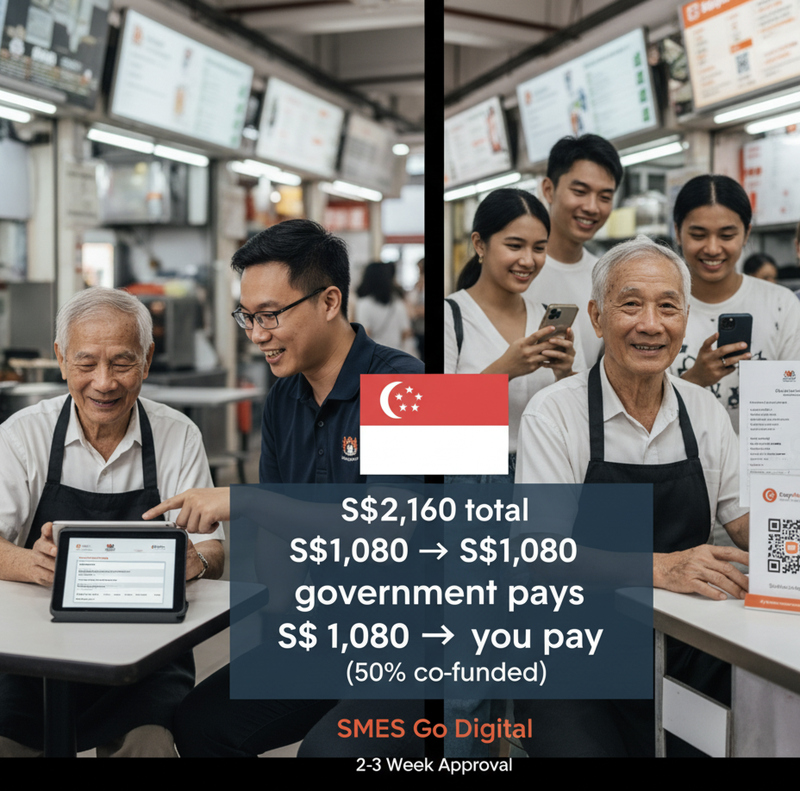
PSG covers one-time costs (setup, equipment, initial training) plus first-year subscription for software/services. Example: Digital menu system costing S$2,160 annual subscription—PSG covers 50% of first year (S$1,080). Year 2+ subscriptions are full cost (S$2,160). Rationale: Government wants to help overcome initial adoption barrier, not subsidize ongoing operations indefinitely. By year 2, ROI should be proven from year 1 benefits. Most F&B businesses report 8-12 month payback period, making year 2+ full-cost subscriptions easily justified from proven savings. Some solutions offer multi-year upfront payment at discount—PSG covers 50% of multi-year cost if paid during grant period.
Can I apply for PSG if I already started implementing a solution but haven't paid yet?
No—PSG requires application and approval BEFORE purchase order is issued or implementation begins. This is strictly enforced. Timeline: (1) Apply for PSG, (2) Receive approval, (3) Sign contract with vendor, (4) Implementation begins, (5) Submit claim after completion. If you've already signed contract or started implementation, that project is ineligible. However, you can apply for PSG for your NEXT technology project. Pro tip: If you're considering multiple solutions (POS + digital menu + inventory), apply for PSG covering all of them together rather than implementing one at a time—maximizes your S$30,000 limit efficiently.
What if I'm a sole proprietor without formal company registration—can I still get PSG?
Yes, but you need business registration. Sole proprietors qualify if registered with ACRA (Accounting and Corporate Regulatory Authority). Registration process: Visit https://www.acra.gov.sg, register business name (S$15 for 1 year or S$65 for 3 years), takes 2-3 days for approval. Once registered sole proprietorship, you qualify for PSG. Most hawker stalls operate as sole proprietorships—Old Airport Road example included 11 sole proprietors (4 were partnerships). Only requirement: Must be registered, conducting business, and ≥30% Singapore citizen/PR ownership (sole proprietor by definition is 100% local ownership, so automatic qualification).
How does PSG work with other grants—can I stack SMEs Go Digital with other government support?
Limited stacking allowed. PSG cannot be combined with other IMDA grants for the SAME solution. However, you can use different grants for different needs: (1) PSG for digital menu system (IMDA), (2) SkillsFuture Enterprise Credit for staff training (SSG), (3) Property Tax Rebate for F&B premises (IRAS), (4) Jobs Growth Incentive for hiring (MOM). Grants from different agencies for different purposes = allowed. Multiple grants from same agency for same solution = not allowed. Exception: Enhanced support levels for specific business types (e.g., startups, social enterprises) may receive 70% instead of 50% base rate—consult IMDA for qualification. Kopitiams Association used PSG (digital solutions) + SkillsFuture (staff digital literacy training) + JGI (hired tech-savvy part-timers) = successful multi-grant approach.