
Tourist-Heavy Texas Restaurants: Multilingual Menus Without Printing Costs
Bishop Arts serves 40,000+ weekend tourists. Stockyards handles 65,000+ weekly. How Texas restaurants eliminate multilingual printing costs with digital menus.
Tourist-Heavy Texas Restaurants: Multilingual Menus Without Printing Costs
Saturday night, 8:47pm. Your Fort Worth Stockyards restaurant is slammed. Table 14 is a German family. They're pointing at your menu, confused. "Brisket?" they ask. "What is pulled pork?" Your server tries explaining in broken German. Takes twelve minutes. Three other tables are waiting.
Table 18 is a Japanese couple. They want to know if the BBQ sauce has gluten. Your allergen information is printed on a separate sheet—somewhere in the back office. Your server disappears to find it. Five-minute delay. The couple looks frustrated.
This happens forty-seven times tonight. Every weekend. Bishop Arts District serves 40,000+ weekend tourists. Stockyards handles 65,000+ weekly visitors. Fort Worth tourism brought 9.5 million visitors in 2023. They don't all speak English.
You're printing menus in English. Maybe Spanish if you're organized. Possibly German for Stockyards' massive German tour group traffic. That's $220-380 per language, per reprint. Three languages? $660-1,140 every time prices change. Which is monthly, because beef costs fluctuate weekly and you can't serve at a loss.
Annual printing cost for trilingual menus: $7,920-13,680. Just to tell tourists what brisket is.
The Texas Tourism Reality
Texas received 83.4 million overnight visitors in 2023. Fort Worth alone: 9.5 million. San Antonio: 39 million (Alamo, River Walk, tourism machine). Austin: 32+ million (SXSW, F1, music tourism). Dallas: 28 million.
Not all tourism is international. Domestic US tourists dominate Texas travel. But tourist-heavy areas see concentrated international visitors:
Fort Worth Stockyards:
- German tour groups (massive BBQ tourism)
- Japanese visitors (Western culture interest)
- Mexican families (proximity)
- UK tourists (Western heritage)
- Brazilian visitors (growing segment)
San Antonio River Walk:
- Mexican nationals (70% of international visitors)
- German tourists (colonial history interest)
- UK visitors (historical sites)
- French tourists (cultural tourism)
- Asian tour groups (growing)
Bishop Arts District Dallas:
- Domestic tourists (75%+)
- Mexican visitors (cultural crossover)
- International urban tourists (foodie destination)
- Business travelers (convention overflow)
Austin Sixth Street:
- Music festival internationals (SXSW brings 417,000 attendees from 68 countries)
- F1 tourists (massive European presence)
- Tech conference internationals (year-round)
The common thread? Tourists who don't understand "Akaushi beef" or "jalapeño cheddar grits" without context. Your printed menu lists dishes. It doesn't educate.
What Multilingual Printing Actually Costs
Let's use real Texas numbers.
Fort Worth Stockyards BBQ restaurant (3-language menus):
- English menu: $180/reprint
- Spanish menu: $220/reprint (includes translation)
- German menu: $280/reprint (specialized BBQ terminology translation)
- Total per reprint: $680
- Frequency: Monthly minimum (beef prices, seasonal sides, special events)
- Annual printing: $8,160
Add rush fees when beef prices jump suddenly: +$200-400 per rush. Add specialty event menus (Stockyards Championship Rodeo weekends): +$300-500 per event. Real annual cost: $10,000-12,000.
San Antonio River Walk Mexican-American fusion restaurant (4-language menus):
- English menu: $200/reprint
- Spanish menu: $220/reprint
- German menu: $280/reprint
- Mandarin menu: $320/reprint (complex character translation)
- Total per reprint: $1,020
- Frequency: Every 6 weeks (supplier price changes, seasonal Texas ingredients)
- Annual printing: $8,840
Special fiesta menus (April): +$1,200. Christmas season menus: +$900. Real annual cost: $11,000-13,000.
Bishop Arts District contemporary American restaurant (2-language menus):
- English menu: $200/reprint
- Spanish menu: $240/reprint
- Total per reprint: $440
- Frequency: Monthly (farm-to-table sourcing variations, craft cocktail program updates)
- Annual printing: $5,280
Add wine list updates: +$180/month = $2,160 annually. Add seasonal tasting menu versions: +$800. Real annual cost: $8,200-9,000.
Digital menu cost: $150 annually. Savings: $8,000-13,000 per year.
Break-even: 3-7 days.
The BBQ Terminology Problem
Texas BBQ has language problems tourists can't solve with Google Translate.
Terms that confuse international visitors:
- Brisket: Germans ask "Is this beef chest?" (technically correct, unhelpful)
- Pulled pork: Japanese translations literally say "torn pig" (appetite killer)
- Burnt ends: UK visitors think it's overcooked mistakes
- Dry rub: Spanish translation suggests paper friction
- Texas crutch: French tourists utterly confused
- Bark: Germans think tree bark, seriously
- Mop sauce: Cleaning equipment?
Your server explains this verbally. Forty-seven times tonight. While six other tables wait for service.
Printed menus can't include detailed explanations—space limitations. Even if you print explanations, they're static. You can't adjust descriptions based on who's reading.
Digital menus with language detection: German tourist scans QR code. Menu appears in German. "Brisket (Rinderbrust)" includes: "Texas specialty: beef brisket slow-smoked 12-14 hours until tender. Crispy 'bark' crust outside, juicy inside. Served sliced with BBQ sauce on side. The most famous Texas BBQ cut."
Japanese tourist scans. Sees: "ブリスケット (Brisket) - テキサスバーベキューの代表的な料理。牛胸肉を12-14時間かけて燻製にし、外はカリカリ、中はジューシーに仕上げます。スライスして提供。" Plus photo showing exactly what arrives.
Your server takes orders. Doesn't teach BBQ 101 to international tourists. Service speeds up.
Texas Ingredient Education (That Printed Menus Can't Provide)
Texas cuisine uses regional ingredients tourists don't recognize:
Akaushi beef: Japanese-heritage Texas-raised cattle. More expensive than standard beef. Tourists see higher prices, don't understand why. Printed menu: "Akaushi ribeye $48." Digital menu: "Akaushi Ribeye $48 - Premium Japanese-heritage cattle raised in Texas. Superior marbling, richer flavor than standard beef. This specific cut selected for texture and taste." Photo shows marbling. Tourist understands. Orders confidently.
Hatch chiles: Available August-September. New Mexico origin, Texas obsession. Printed menu: "Hatch chile cheeseburger $16 (seasonal)." Tourist: "What's Hatch?" Server explains. Digital menu: "Hatch Chile Cheeseburger $16 (August-September only) - Flame-roasted New Mexico Hatch green chiles, Texas favorite with mild heat and smoky flavor. Cheddar, lettuce, tomato, house sauce." Tourist gets it immediately.
Texas pecans: Not just nuts. Cultural ingredient. Printed menu: "Pecan-crusted trout $28." Digital menu: "Pecan-Crusted Trout $28 - Fresh Texas pecans (state tree nut) create crunchy coating on pan-seared trout. Sweet-savory combination, Southern tradition. Served with seasonal vegetables." Cultural context included. Tourist appreciates the story.
Jalapeño cheddar grits: Southern breakfast staple, confusing to internationals. Printed menu: "Jalapeño cheddar grits $6." German tourist: "What is grits?" Server tries explaining corn porridge. Translation fails. Digital menu: "Jalapeño Cheddar Grits $6 - Creamy corn porridge (traditional Southern breakfast) with melted cheddar and mild jalapeño peppers. Savory comfort food, similar to polenta." Cultural bridge created.
Space limitations on printed menus prevent this education. Digital menus? Unlimited detail.
Allergen Information for Tourist Service
Fort Worth German tourists frequently ask about gluten. Celiac disease prevalence: Germany 1%, US 0.7%. German tourists expect detailed allergen information. Texas restaurants often provide basic lists—if you can find them.
Current allergen management: Printed allergen information sheets. Keep them at host stand. Servers retrieve on request. Takes 2-3 minutes. Information often outdated (supplier ingredient changes weekly).
Recent Texas restaurant example: Austin taco restaurant used corn tortillas. Supplier substituted wheat-flour tortillas one delivery (corn shortage). Printed allergen sheet said "gluten-free corn tortillas." Japanese tourist with severe gluten allergy ordered confidently. Anaphylactic reaction. $380,000 settlement. Restaurant closed.
Digital allergen management: Update ingredients in 90 seconds when supplier changes anything. Allergen warnings update automatically across all languages. German tourist with gluten sensitivity selects "gluten-free filter." Menu shows only safe options. Server confirms. No communication gap. No liability risk.
Setup time: 20 minutes to enter all allergen data initially. Updates: 30-90 seconds per ingredient change.
The Stockyards German Tour Group Scenario
Fort Worth Stockyards hosts massive German tour groups. Why? German fascination with American Western culture runs deep. Karl May novels, Western films, cowboy heritage tourism.
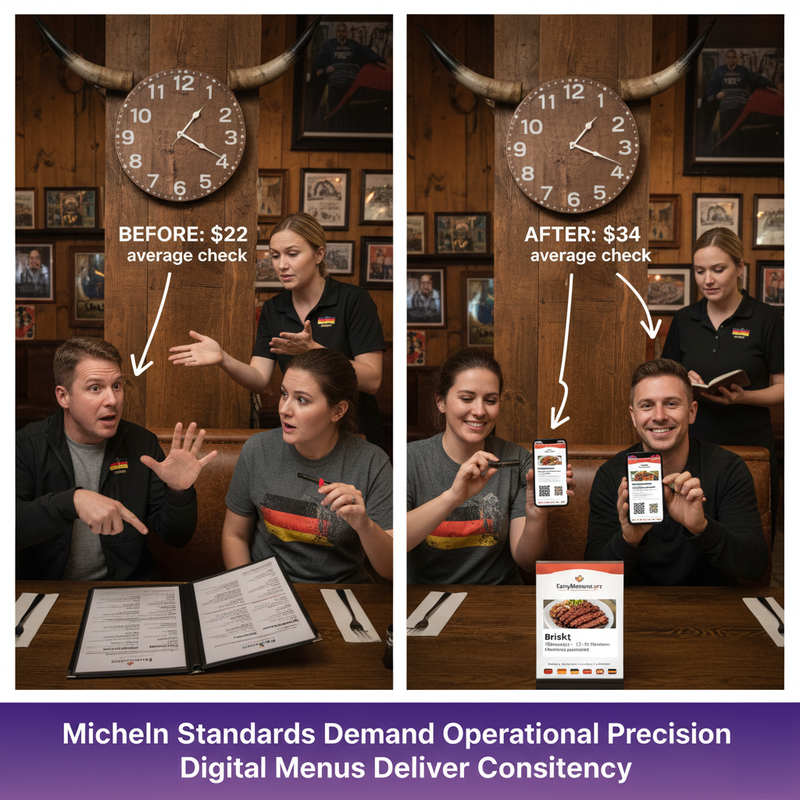
German tour bus arrives. 48 tourists. They have 90 minutes for lunch (scheduled tour). Your restaurant seats 60. You're now 80% German tourists who speak limited English.
Old reality:
- Printed German menus (if you have them, cost $280/reprint)
- Servers explain specials in English
- German tourists order safest options (chicken, salad)
- Average check: $22 per person
- Total group revenue: $1,056
- Service time: 75 minutes (cutting it close)
Digital menu reality:
- QR codes on tables
- German tourists scan automatically (QR literacy in Germany: 89%)
- Menu appears in perfect German with cultural explanations
- Brisket description makes sense
- Texas BBQ history included
- Tourists order confidently: brisket, pulled pork, ribs
- Average check: $34 per person (premium items, confidence ordering)
- Total group revenue: $1,632 (+$576 per bus, 54% increase)
- Service time: 62 minutes (faster ordering, no explanation delays)
Three German tour buses weekly: +$1,728 weekly revenue = $89,856 annually. Just from confident ordering.
Digital menu cost: $150 annually. ROI: 59,900%.
San Antonio River Walk Multilingual Reality
River Walk restaurants serve Mexican nationals (70% of San Antonio international tourism). Proximity to border = high Mexican visitor volume.
Mexican tourists speak Spanish fluently. Your Spanish menu helps. But Mexican Spanish ≠ Spain Spanish ≠ Texas Tex-Mex Spanish. Regional food terminology differs significantly.
Printed Spanish menu: "Enchiladas $14." Mexican tourist expects one thing. Gets Texas-style cheese enchiladas (very different from Mexican enchiladas). Disappointed. Reviews mention it.
Digital menu with regional explanation: "Texas-Style Cheese Enchiladas $14 - Corn tortillas filled with cheddar cheese (not traditional Mexican queso fresco), covered in Texas chile gravy (tomato-based, not mole), served with rice and refried beans. Texas interpretation of Mexican classic, different from Mexican enchiladas." Tourist knows what they're getting. Orders appropriately. Satisfaction increases.
German tourists on River Walk expect historical context. Alamo tourism, colonial Spanish missions, cultural heritage sites. They want food with stories.
Printed menu: "Cabrito $26." German tourist: confused. Digital menu: "Cabrito (Roasted Young Goat) $26 - Traditional South Texas dish with Spanish colonial origins. Young goat slow-roasted with Mexican spices. Regional specialty rarely found outside South Texas and Northern Mexico. Served with flour tortillas, guacamole, pico de gallo." Cultural bridge. Educational value. Tourist orders it.
Bishop Arts Weekend Tourist Traffic
Bishop Arts District: 40,000+ weekend tourists. Oak Cliff neighborhood transformation. Art galleries, boutique restaurants, design shops. Attracts Dallas urban tourists, domestic travelers, international design/food tourists.
Your Bishop Arts restaurant serves contemporary American, farm-to-table sourcing, Texas ingredients with modern technique. Your menu changes weekly based on farmers market availability.
Printed menus become outdated mid-week. New seasonal item arrives Thursday. Printing: $440 (English/Spanish). Rush fee for weekend delivery: +$120. Total: $560 for one mid-week change.
That happens 8-12 times annually (seasonal transitions, unexpected sourcing opportunities, special ingredient availability). Cost: $4,480-6,720 just for mid-cycle updates.
Digital updates: 3 minutes. $0 additional cost. Update from your phone Friday morning. Weekend tourists see current menu immediately.
Seasonal ingredient example: Texas peaches arrive June. Peak season: 3 weeks. Print special peach dessert menu? $560 (includes rush). After 3 weeks, those menus are trash.
Digital seasonal menu: Add peach items Friday. Remove them three weeks later. Zero printing. Zero waste. Zero outdated menus confusing customers.
What Actually Changes With Digital Menus
Week 1: Upload current English menu (PDF or photos). Add Spanish translation. System provides German translation (you review/adjust BBQ terminology). Generate QR codes. Print QR table tents: $80 one-time.
Total setup: 45 minutes.
Week 2-4: Place QR codes on tables. Keep printed menus available initially (backup). Train staff: "Our menu is available in English, Spanish, and German. Scan the QR code on your table with your phone camera." Most tourists scan automatically. QR literacy: US 52%, Germany 89%, Japan 78%, Mexico 43%.
Month 2+: Beef prices change. Old process: Call print shop, wait 5-7 days, pay $680. New process: Update prices on phone. Takes 90 seconds. Tourists see changes immediately. Cost: $0.
Seasonal special: Hatch chile season arrives. Old process: Print special inserts, $180. New process: Add items to digital menu. Takes 4 minutes. Cost: $0.
German tour group asks detailed questions: Brisket smoking time, rub ingredients, wood type. Old process: Server tries remembering, might get details wrong. New process: All information in digital menu, perfect German translation, includes smoking process photos. Tourist reads it themselves.
Your staff focuses on hospitality, not BBQ education in broken German. Service improves. Tips increase. Reviews get better.
The Honest Reality
First week feels weird. You're used to handing printed menus. QR codes feel impersonal. But tourists actually prefer them—they get information in their language without awkward translation conversations.
Some older domestic tourists prefer printed menus. Keep 3-5 printed English menus for them (10% of customers max). You're not eliminating printed menus completely. You're eliminating the cost of reprinting them constantly.
Not everything works perfectly immediately. German BBQ terminology needs tweaking. Mexican Spanish regional explanations need refining. You'll adjust based on tourist questions and server feedback. Takes 2-3 weeks to optimize.
But beef prices changing mid-week? You update prices Monday morning in 90 seconds. Used to cost $680 and 5-day wait. That alone pays for digital menus for 4.5 years.
Cost: $12.50/month = $150 annually Printing savings: $8,000-13,000 annually Break-even: 3-7 days Net savings: $7,850-12,850 annually
That's kitchen equipment. Staff training. Marketing budget. Anything except paper menus that are outdated the day beef prices change.
Start Here
Set up multilingual menus in 45 minutes and stop explaining brisket to German tourists forty-seven times per night. $12.50/month. English, Spanish, German, Japanese - all included. Update prices from your phone in 90 seconds.
Your Stockyards German tour groups are hungry. Your River Walk Mexican visitors want to understand Texas-style. Your Bishop Arts weekend tourists expect current menus. Paper isn't working anymore.
Frequently Asked Questions
How many languages should Texas tourist restaurants offer?
Minimum: English + Spanish (covers 95% of Texas tourism). High-value additions: German (Stockyards/cultural tourism), Japanese (growing Asian tourism), Mandarin (tour groups). Fort Worth Stockyards benefits most from German. San Antonio River Walk needs Spanish/English primarily. Austin adds German/Mandarin for F1/SXSW international crowds. Digital menus include all languages for $12.50/month—no per-language printing costs.
Do German tourists actually use QR code menus in Texas?
QR literacy in Germany: 89% (highest in Europe). German tourists expect and prefer digital menus—they use QR codes for public transit, museum information, restaurant payments in Germany. The challenge isn't getting Germans to scan—it's having menus actually translated into proper German, not Google Translate errors. BBQ terminology requires specialized translation: "Brisket" must explain it's "Rinderbrust (beef chest) slowly smoked 12-14 hours" not just the word translation.
Can digital menus handle Texas BBQ terminology correctly?
Yes, with proper setup. Generic auto-translation fails spectacularly ("pulled pork" becomes "torn pig" in Japanese). You control descriptions: enter detailed English explanations, review German/Spanish/Japanese translations, adjust BBQ-specific terms. Example: "Burnt ends" explained as "Flavorful crispy pieces from brisket point, not burnt mistakes" prevents confusion. Initial setup: 45 minutes for BBQ terminology review. Updates: 3-4 minutes per menu change.
What about older Texas tourists who don't use smartphones?
Keep 3-5 printed English menus available (costs $180 every 4-6 months vs. $680-1,140 for multilingual reprints monthly). Staff offers: "Would you prefer a printed menu?" to older diners. Actual request rate: 8-12% of customers. Digital menus solve the expensive problem—multilingual printing for international tourists—while keeping traditional menus for those who prefer them. Not either/or, it's both/and with 85-90% cost reduction.
How fast can menu changes update when beef prices change mid-week?
Immediate. Beef price increase Monday morning: log into digital menu system on phone, change prices, hit save. Takes 90 seconds. Every tourist scanning QR code after 9:03am sees new prices. Old method: call print shop Monday, pay rush fee $120, receive reprinted menus Thursday or Friday, 3-4 days with outdated prices causing server corrections and customer confusion. Digital eliminates the gap between price change and menu accuracy.
Related Articles: