
How Gastown Restaurants Handle Asian QR Expectations Without $15K Printing
Vancouver's Gastown restaurants serve 43% Asian customers expecting QR menus. Trilingual printing costs $15,000 yearly. Digital menus: $12.50/month, auto-translation included.
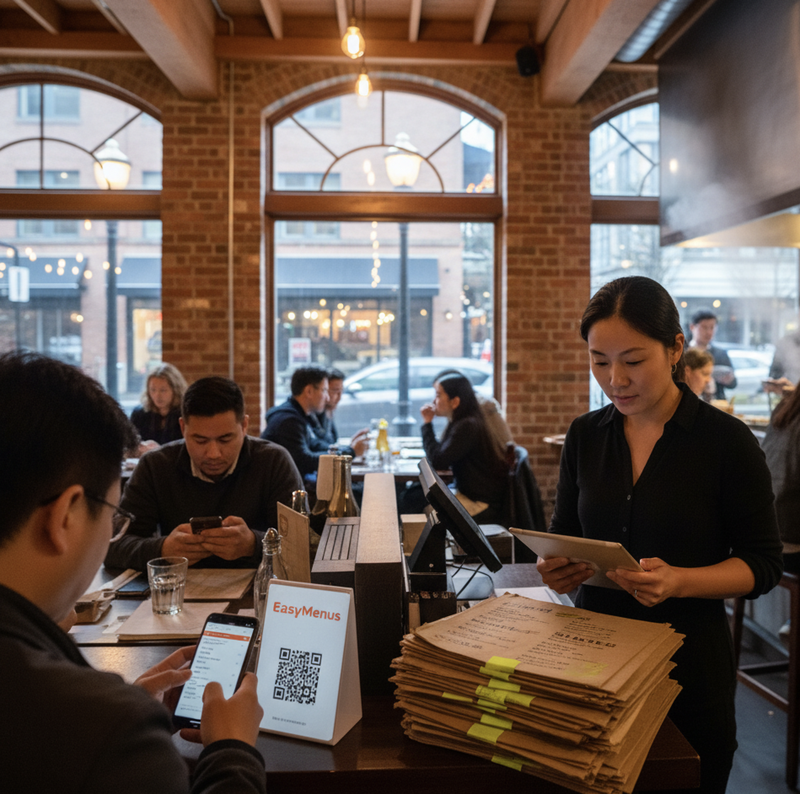
TLDR: The Multilingual Menu Math
Your Gastown restaurant serves Chinese businesspeople at lunch, Japanese tourists at dinner, and Korean students late night. You're printing English, traditional Chinese, and Japanese menus.
Current cost: $450 per language, per update. Three languages. Four seasonal updates yearly. That's $5,400 annually. Plus rush updates when suppliers change pricing: another $3,600-$9,600.
Your Asian customers already expect QR menus—it's standard in Shanghai, Tokyo, Seoul. But your printed multilingual approach costs $15,000 yearly and takes 2-3 weeks per update.
Digital solution: One QR code. Auto-detects customer's phone language (English, 繁體中文, 简体中文, 日本語, 한국어). Updates all languages simultaneously in 90 seconds. $150 yearly.
Setup: 20 minutes. Savings: $14,850 annually.
[Start 14-day trial - multilingual setup included]
Why Vancouver Is Different
Walk down Water Street in Gastown at 7pm. Half your diners are scanning phones before ordering.
But they're not looking at your menu. They're translating it with Google Lens. Squinting at grainy camera translations of your printed English menu. Trying to understand what "Fraser Valley duck confit" means in Mandarin.
You printed Chinese menus. They're on the host stand. But your server is busy, and the couple at table six already started photographing the English version rather than ask for translations.
Vancouver's 43% Asian visible minority creates baseline QR expectations that don't exist in Toronto or Montreal. In Richmond, Burnaby, and downtown Vancouver, QR code ordering isn't innovative—it's normal. Expected. Overdue.
Your Asian customers grew up scanning QR codes for everything. Paying for groceries. Ordering food. Checking vaccine status. Reading restaurant menus.
When you hand them printed menus, you're asking them to adapt to your older system. When you provide QR menus, you're meeting them where they already are.
The $15,000 Printing Problem
James runs a 65-seat contemporary Asian fusion restaurant in Gastown. His customer base: 35% Chinese-Canadian, 20% Japanese tourists, 15% Korean, 30% other (mostly local English speakers and European visitors).
Before digital menus, his printing looked like this:
English menus: 75 copies × $6 each = $450 Traditional Chinese menus: 50 copies × $6 each = $300
Japanese menus: 30 copies × $6 each = $180 Total per print run: $930
Seasonal updates: 4 times yearly = $3,720
But that's just planned updates. James's actual costs were much higher.
His seafood supplier adjusts pricing monthly. His produce supplier changes weekly based on Fraser Valley harvest. His sake importer discontinues products with two days' notice.
Each unplanned update: $930. He averaged 1.5 unplanned updates monthly. That's another $16,740 yearly—but he couldn't afford that, so he just... didn't update. Absorbed the margin losses. Told staff to verbally mention price changes.
His Chinese menus were always one update behind. His Japanese menus referenced three discontinued sake options. His English menus showed current pricing, but Asian customers reading translations never knew prices had changed.
"I was spending $5,000 on printing and losing probably another $3,000 in margin compression because I couldn't update fast enough," James said. "And my Asian customers were still using Google Lens on the English menu because our Chinese menus were outdated."
What Changed: The Coal Harbour Example
Marina operates a Japanese izakaya in Coal Harbour. 45-seat space. Customer mix: Japanese expats, Chinese businesspeople, Korean students, tech workers from nearby offices.
She switched to digital menus in April 2024. Setup took 23 minutes.
Now her workflow looks like this:
Monday morning: Seafood supplier emails new pricing for hamachi, toro, uni. Marina opens the menu system on her phone while walking to the restaurant. Updates three prices. Clicks publish. Done before she unlocks the door.
Every customer: Scans one QR code. Their phone language determines what they see:
- iPhone set to English → English menu
- 微信用户 → 简体中文菜单
- 日本語設定 → 日本語メニュー
- Korean Android → 한국어 메뉴
One update. Five languages. Thirty seconds.
Her previous workflow: Email designer ($80). Approve proofs for three language versions (2 hours across Tuesday). Print shop delivers Friday ($930). Staff manually replaces menus at every table (30 minutes).
Time saved per update: 7 days. Cost saved: $1,010.
She averages 18 updates yearly. That's $18,180 saved. And that's conservative—doesn't count the margin improvements from updating prices immediately instead of eating losses for a week.
The Yaletown Tech District Reality
Your Yaletown customers work at Amazon, Microsoft, SAP. They're scanning QR codes for everything already. Parking payment. Building access. Expense reports.
When they sit down at your restaurant and you hand them a printed menu, it feels anachronistic. Like being asked to fax something.
The QR expectation isn't just Asian anymore—it's tech culture. And Vancouver has both.
David runs a New Canadian cuisine spot near the Roundhouse. His lunch crowd is 70% tech workers from nearby offices. Dinner skews more Asian visitors and date nights.
Before digital menus, he maintained two menu versions:
- Lunch menu: Lighter, faster, business-appropriate
- Dinner menu: More elaborate, premium options
Two versions × three languages (English, Chinese, Japanese) × four seasonal updates = $11,160 yearly in planned printing alone.
Plus the logistics headache. Staff had to swap lunch menus for dinner menus every day at 3pm. Thirty minutes of labor. 365 days yearly. That's 182.5 hours of staff time just swapping menus—$5,475 in labor at $30/hour (including payroll taxes).
Now? One QR code. System automatically displays lunch menu 11:30am-3pm, dinner menu 5pm-close. Zero staff intervention. No printing. No swapping.
First-year savings: $16,635.
"The labor savings weren't even on my radar until I stopped doing it," David said. "You don't realize how much time you waste on menu logistics until you eliminate the task entirely."
The Multilingual Update Problem Nobody Mentions
Here's what the printing companies don't tell you: when you update one language, you should update all languages. But coordinating that is expensive.
Your designer charges $80-$120 per language for menu updates. They're not just translating—they're ensuring character spacing works, checking that Chinese doesn't overflow margins, verifying Japanese reads properly vertically if needed.
Most Gastown restaurants we talked to admitted they update English first, then update Asian languages "when budget allows" or "at next seasonal refresh."
Which means your Asian customers are reading menus that are one, two, sometimes three updates behind. They're seeing discontinued items. Old prices. Incorrect allergen information.
This isn't malicious—it's economic reality. When each language update costs $200-$300 total (designer + printing), you prioritize English because it serves more customers.
Digital menus eliminate this forced prioritization. Update English version. Click "apply to all languages." System propagates changes automatically using your existing translations. All languages update simultaneously.
No designer fees for adaptation. No coordination lag. No guilty feeling about your Chinese customers reading an outdated menu.
Gastown Tourist Context: The Japanese Customer
Vancouver gets 600,000+ Japanese visitors annually. They expect QR menus. Not as a nice-to-have. As default.
In Tokyo, 85% of restaurants use QR ordering. It's how Japanese diners operate. When they arrive in Vancouver and encounter printed-only menus, it's confusing.
"Do I need to ask for the QR code?"
"Is there an app I should download?"
"Why is this restaurant so analog?"
Keiko runs a modern Japanese restaurant on Water Street in Gastown. Prime tourist location. She was printing Japanese menus for visitors, but they still struggled with:
- Ordering logistics: Couldn't understand which items were lunch-only or dinner-only
- Dietary restrictions: Japanese text didn't indicate allergens clearly
- Sake selection: Wine list was English-only, sake list was Japanese-only—created confusion for mixed-language groups
Her digital menu solved all three:
Time-based availability: Lunch items automatically disappear after 3pm. Visitors don't need to ask "Is this still available?" or accidentally order off-menu items.
Allergen filtering: Japanese interface includes full allergen filtering (卵、乳製品、小麦、魚介類、大豆、ナッツ). Visitors can filter the entire menu to their dietary needs before ordering.
Mixed-language groups: Table of four with two Japanese speakers, two English speakers? Everyone scans the same QR code. Everyone sees their preferred language. No coordination needed.
"Japanese visitors are shocked we have a proper digital menu," Keiko said. "They expect Vancouver restaurants to be behind Tokyo technology. When we meet their expectations, it signals quality."
Richmond Connection: The Mandarin Standard
If you operate in Richmond, you already know: Chinese customers expect QR code menus. Period.
Richmond is 54% Chinese. It's not a minority—it's the majority. And they're coming from a dining culture where QR ordering is standard since 2016.
For Richmond restaurants, printed menus feel outdated to their primary customer base. For Gastown restaurants serving Richmond residents who drive downtown for dinner? Same expectation.
Lisa operates a Cantonese seafood restaurant in Yaletown that attracts Richmond families for special occasions. Before digital menus, she was printing:
- English menus: For business district lunch crowd
- Traditional Chinese menus: For Richmond family dinner customers
- Simplified Chinese menus: For mainland Chinese tourists
Three versions. $1,080 per update. She updated quarterly at minimum.
Her Richmond customers would look at the printed Chinese menu, then pull out their phones anyway. Because in Richmond, they're used to scanning QR codes that show:
- Current pricing (live updates for seafood market prices)
- Availability status (sold out items disappear automatically)
- Detailed dish descriptions with photos
- Spice level indicators
- Recommended tea pairings
Her printed menus couldn't compete with their expectations.
Now her QR menu matches Richmond standards. Shows live seafood market pricing. Displays 售完 (sold out) automatically when kitchen runs out. Includes detailed descriptions and photos that help non-Chinese speakers order confidently.
Richmond customers stopped pulling out their phones to research dishes elsewhere. They're scanning her QR code instead.
What This Doesn't Fix
Digital menus don't eliminate translation costs entirely. You still need quality translations initially. Poorly translated menus—whether printed or digital—damage credibility with Asian customers.
If you're currently using Google Translate for your printed Chinese menus, digital menus won't magically improve translation quality. You still need a proper translator. Budget $0.12-$0.18 per word for professional Chinese translation.
Digital menus also don't change customer preferences. Some older Asian customers prefer printed menus. Some European tourists find QR codes impersonal. Keep 2-3 printed reference menus for customers who request them.
What digital menus fix: the cost, time, and coordination burden of maintaining current multilingual menus. The printing expense. The update lag. The labor of swapping versions. The guilt of outdated translations.
They make keeping multilingual menus current economically feasible. That's it.
The Honest Cost Comparison
Traditional multilingual printing (Gastown average):
- English menus: $450 per update
- Chinese menus: $300 per update
- Japanese menus: $180 per update
- Total per update: $930
- Seasonal updates: 4× yearly = $3,720
- Unplanned updates: ~18 yearly average = $16,740
- Designer fees: $240 per update × 22 updates = $5,280
- Total yearly: $25,740
Most restaurants can't afford this, so they:
- Skip unplanned updates (lose margin on price changes)
- Update English only (Asian customers get outdated info)
- Extend update cycles (menus fall further behind reality)
Digital multilingual menus:
- Setup: $0 (included in subscription)
- Monthly: $12.50
- Yearly: $150
- Updates: Unlimited, instant, all languages simultaneously
- Designer fees: $0 (use existing translations)
Annual savings: $25,590 (if you were actually updating properly)
Realistic savings: $10,000-$15,000 (accounting for updates most restaurants were skipping)
Try It With Your Next Update
Setup takes 20 minutes. Upload your existing menu photos. The system extracts dishes automatically. Add your existing Chinese/Japanese translations. Review. Publish.
You can test it before your next printing bill arrives. If it doesn't work for your operation, you're out $12.50. If it does, you'll save $1,000+ on your next multilingual update alone.
Most Vancouver restaurants we work with save the annual subscription cost in their first update. Not because digital menus are revolutionary. Because eliminating the $930 trilingual reprint cycle pays for itself immediately.
Asian customers expect QR menus anyway. Tech district workers prefer them. Tourists need multilingual options. You're already operating in a market primed for digital menus.
The question isn't whether to switch. It's whether to switch before or after your next $930 printing bill.
[Start your 14-day trial - multilingual setup included]
Common Questions
How accurate are the auto-translations between Chinese variants? The system doesn't auto-translate between traditional and simplified Chinese—that would be unreliable for restaurant menus where subtle differences matter. You provide both translations once during setup (or just traditional, which most Chinese readers can understand). Updates to dish names or descriptions require manual translation, but price changes propagate automatically across all languages. Most Vancouver restaurants use a translator once during setup ($150-$300), then handle minor updates internally.
What about mixed-language groups where some people want English and others want Chinese? Everyone at the table scans the same QR code. Each person's phone displays the menu in their device language automatically. No coordination needed. A table with English speakers, Mandarin speakers, and Japanese speakers all see the same dishes in their preferred language. Most Vancouver restaurants report this as one of the biggest practical benefits—eliminates the "can you pass me the Chinese menu" coordination.
Do older Asian customers actually use QR codes? Adoption varies, but Vancouver's Asian seniors are generally more QR-comfortable than European seniors due to widespread QR payment systems in China/Hong Kong/Taiwan. Current Gastown data shows ~60% of 65+ Asian customers scan immediately, another 25% scan after brief staff encouragement. Keep 2-3 printed Chinese menus for the 15% who prefer them. Most restaurants report 80%+ adoption within first month as customers see others using it naturally.
How do you handle dishes that don't translate well culturally? Digital menus let you include both translation and description. For example, "Spot Prawns" might translate as "斑點蝦" (literal) but your description can explain these are BC's famous sweet prawns, harvested May-June, similar to 牡丹蝦 (botan ebi) in Japan. You control how much cultural context to provide. Many Gastown restaurants include both literal translations and familiar comparisons to help Asian customers understand local BC ingredients.
What happens during Chinese New Year or other holidays when you run special menus? Create temporary holiday menus in minutes. Set them to auto-activate for specific date ranges. System automatically shows CNY menu February 10-15, then reverts to regular menu February 16. Works for any cultural holiday, festival, or promotional period. No special printing, no staff coordination, no manually swapping menus. Previous year's holiday menus save in your account—edit and republish next year in under 5 minutes.
Can the system handle dish photos for visual identification? Yes, and this dramatically improves ordering for Asian customers unfamiliar with Canadian ingredients or Western cooking techniques. Most Vancouver Asian fusion restaurants include photos of 60-80% of dishes. Reduces server explanation time, increases order confidence, particularly for visitors. Upload photos during setup or add them gradually as you photograph dishes. Chinese and Japanese customers especially value visual menus—it's standard in their home markets.