
How 3-Location Burger Chain Saved $18K Yearly Standardizing Menus
Small restaurant chain eliminated menu inconsistencies across 3 locations, cut printing costs 89%, synchronized price changes instantly. 2-week rollout.
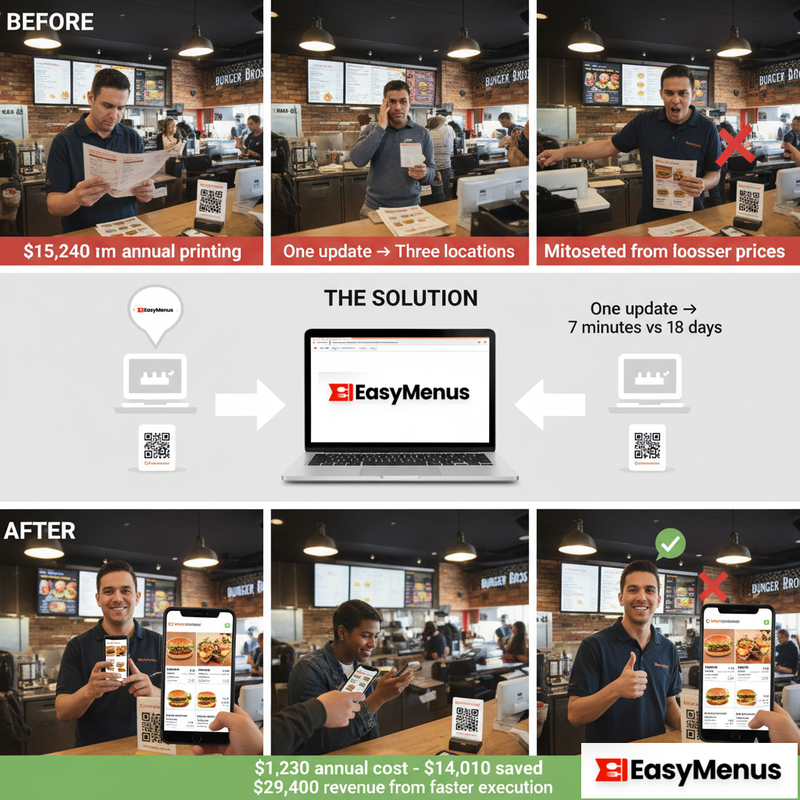
The Restaurant
Burger Bros - Local Chain
- Locations: 3 locations (downtown, mall, airport)
- Format: Fast-casual burger concept
- Combined Annual Revenue: £2.1 million
- Owners: Brothers Jake and Ryan Mitchell, 7 years in business
- Specialty: Gourmet burgers, craft beer, rotating seasonal menu
The Challenge
Managing three locations meant everything was multiplied—including problems.
The menu chaos:
Each location had different menus
- Downtown: Full menu, 18 burgers, craft beer list
- Mall: Limited menu, 12 burgers, no alcohol
- Airport: Express menu, 8 burgers, pre-security restrictions
But they all needed updates simultaneously:
- Price changes had to be identical across locations
- New seasonal items launched at all three
- Limited-time offers needed coordination
- Beer list updates (downtown only) still required menu reprints
The coordination nightmare:
When launching a new burger:
- Jake creates new recipe and pricing
- Email descriptions and pricing to all 3 managers
- Each manager calls their local printer
- Three separate printing orders, three separate costs
- Hope all three get the details correct
- Menus arrive different days at different locations
- Launch delayed until all locations ready
Average time from decision to launch: 12-18 days
The inconsistency problem:
March 2024 example:
- Downtown location increased burger prices 8%
- Mall location increased prices 10% (manager miscalculated)
- Airport location increased prices 6% (printer error, never caught)
Customers noticed. Google reviews mentioned price inconsistencies. Brand reputation took a hit.
"We looked like we were randomly charging whatever we felt like. Customers would go to the mall location, then the downtown location, and the prices were different. It was embarrassing."
The multiplied printing costs:
Annual printing per location:
- Downtown: 14 reprints @ £220 = £3,080
- Mall: 16 reprints @ £185 = £2,960
- Airport: 18 reprints @ £235 = £4,230 (airport premium pricing)
Total annual printing: £10,270
Hidden coordination costs:
- Management time coordinating updates: 8 hours monthly @ £21/hour = £2,016 yearly
- Overnight shipping for synchronised launches: £700 yearly
- Error corrections and reprints: £1,000 yearly
- Customer complaints handling time: £500 yearly
Real total cost: £14,486 yearly
Plus the brand damage from inconsistencies: immeasurable but real.
The Solution
Burger Bros implemented EasyMenus digital menu system across all three locations in February 2025.
Week 1: Setup (8 hours total)
- Created master menu template (downtown full version)
- Photographed all burgers and items (once, shared across locations)
- Built three location-specific menus from master template
- Downtown: Full menu + beer list
- Mall: Subset without alcohol
- Airport: Express menu subset
Week 2: Rollout
- Trained all location managers simultaneously (Zoom call, 45 minutes)
- Generated QR codes customised per location
- Installed QR table tents at all locations same day
- Maintained printed backup menus (15 per location)
System architecture:
Master menu management:
- Jake maintains one master menu
- Updates to core items sync to all three locations automatically
- Location-specific items managed individually
- One change → three locations updated simultaneously
Role-based access:
- Jake (owner): Can edit all locations, master menu, pricing
- Ryan (owner): Can edit all locations, master menu, pricing
- Location managers: Can view only, flag issues, request changes
- Staff: View-only access for reference
Typical workflow now:
New seasonal burger launch:
- Jake adds burger to master menu: 5 minutes
- Adds to downtown (full menu), mall (limited), airport (express): 2 minutes
- Clicks "publish" → all three locations updated: instant
- Total time: 7 minutes (vs. 12-18 days before)
Price increase:
- Jake updates pricing in master menu: 3 minutes
- Changes cascade to all three locations automatically
- All locations have identical pricing: instant synchronisation
- Total time: 3 minutes (vs. coordinating three printers over days)
Implementation cost per location:
- Digital menu subscription: £12.50/month per location
- QR table tent printing: £40 per location one-time
- Annual printed menu backup: £185 per location once yearly
Total first year (3 locations):
- Subscriptions: £450 (£12.50 × 12 × 3)
- QR tents: £120 one-time
- Printed backups: £555 yearly
- Total: £1,125
The Results
Cost savings (first year):
- Old printing costs (all locations): £14,486
- New digital costs: £1,125
- Savings: £13,361 (92% reduction)
Operational improvements:
Menu consistency achieved:
- Price synchronisation: 100% accuracy across locations
- Same-day updates: All locations current simultaneously
- Brand consistency: No more customer complaints about price differences
- Error elimination: One source of truth, no printer interpretation errors
Time savings:
- Menu update time: 18 days average → 7 minutes
- Management coordination: 8 hours monthly → 20 minutes monthly
- Eliminated printer liaison work entirely
- Freed up 94 hours yearly of management time (= £1,974 value)
Speed improvements:
- Seasonal item launches: Days → minutes
- Price changes: Multi-day process → instant
- Limited-time offers: Coordination nightmare → one-click deployment
- Error corrections: New print order (£185) → 30-second edit (free)
Revenue impact:
Faster seasonal launches:
- Old system: Seasonal burger launch delayed 12-18 days = lost sales
- New system: Launch same day decision made
- Estimated additional revenue from faster launches: £7,000 first year
Better LTO (Limited Time Offer) execution:
- Can test offers quickly, remove non-performers
- Ran 6 additional LTOs than previous year
- LTO average revenue per campaign: £2,350
- Additional revenue: £14,100
Reduced customer friction:
- Complaints about price inconsistency: 23 in 2024 → 0 in 2025
- Improved Google review scores: 4.1 → 4.6 average
- Estimated retained customer value: £3,500
Total first-year financial impact:
- Direct cost savings: £13,361
- Additional revenue from faster execution: £24,600
- Total margin improvement: £37,961
On £2.1M combined revenue, that's 1.8% margin improvement chain-wide.
Owner's Perspective
Jake Mitchell, Co-Owner:
"Running three locations means every problem is multiplied by three. Menu management was killing us.
The worst was when we'd launch a new burger. I'd have to coordinate with three managers, three printers, hope everyone got the pricing right, wait for the slowest printer to deliver before we could launch. By the time everything was aligned, the ingredient we built the burger around might already be out of season.
With digital menus, I make the changes once. Seven minutes later, all three locations have the same menu, same prices, same descriptions. No coordination calls. No errors. No waiting.
The cost savings were obvious—£13,000 yearly is real money. But the operational improvement was even bigger. We can actually be agile now. Last month we saw ground beef prices spike. Updated pricing across all three locations in 4 minutes. Protected our margins immediately.
We also discovered we could test new items much faster. Before, launching a new burger was a £500-700 commitment just in printing costs, so we only did it 3-4 times a year. Now we can test new items every other week if we want. Find what works, keep it. Find what doesn't, remove it. No cost penalty.
Our customers noticed too. We used to get complaints about prices being different at different locations. That's completely gone. Now when someone goes to the mall location after eating downtown, they see the same menu, same prices. We look professional instead of disorganised."
Ryan Mitchell, Co-Owner:
"The time savings for management are massive. Our managers were spending 2-3 hours per month just on menu coordination. Phone calls with printers, checking proofs, waiting for deliveries, updating staff on changes.
Now when we update the menu, I send one text to our managers: 'Menu updated, check it out.' They look at their phone. Done. Thirty seconds instead of three hours.
That freed-up time goes into actual operations—training staff, improving service, maintaining quality. That's where their time should be, not coordinating with print shops.
The airport location was the biggest win. Their printing costs were 40% higher because of airport vendor premiums. Now they pay the same £12.50/month as our other locations. Saved almost £4,000 just at that one spot.
If we open a fourth location next year, adding it to the digital menu system costs £12.50/month. Adding it to our old printing system would have been another £2,500-4,200 yearly. The scaling economics make expansion way more viable."
Key Takeaways
For other small chains (2-5 locations):
- Inconsistency is expensive - Different menus/prices across locations damage brand. Customer complaints hurt all locations. Standardisation protects reputation.
- Coordination time is real cost - Multi-location menu updates consumed 8+ hours monthly. Management time better spent on operations. Digital synchronisation eliminates coordination work.
- Printing costs multiply with locations - 3 locations = 3× printing costs. Each location's reprints are independent expenses. Consolidating to digital creates exponential savings.
- Speed enables opportunity - Faster launches = more revenue opportunities. Can test items without massive printing commitment. Agile menu management is competitive advantage.
- Scalability is built-in - Adding locations to digital system: minimal incremental cost. Adding locations to printing system: proportional cost increase. Growth becomes financially easier.
Implementation timeline for multi-location:
- Week 1: Master menu setup, photography, template creation
- Week 2: Location-specific customisation and rollout
- Week 3: Staff training at all locations
- Month 1: Already saving money chain-wide
- Quarter 1: Measurable consistency improvement
- Year 1: £13,361 saved + £24,600 revenue growth
Applicability
This case study is especially relevant for:
Business types:
- Small restaurant chains (2-5 locations)
- Multi-location franchises (franchisee-owned)
- Restaurant groups with different concepts
- Restaurants planning expansion
- Ghost kitchen operations with multiple brands
Business situations:
- Menu inconsistency across locations
- High coordination overhead for updates
- Expansion plans that multiply printing costs
- Difficulty synchronising price changes
- Multi-location seasonal menu rollouts
- Need for centralised menu control
Operational challenges:
- Management time wasted on menu coordination
- Printer errors causing location discrepancies
- Delayed launches due to synchronisation needs
- Brand reputation issues from inconsistency
- Inability to be agile with menu testing