
How Neighborhood Café Increased Takeaway Orders 56% with QR Ordering
Coffee shop added QR ordering for busy morning customers. Takeaway revenue up 56%, order accuracy improved 91%, morning rush wait times cut 40%. Same staff.
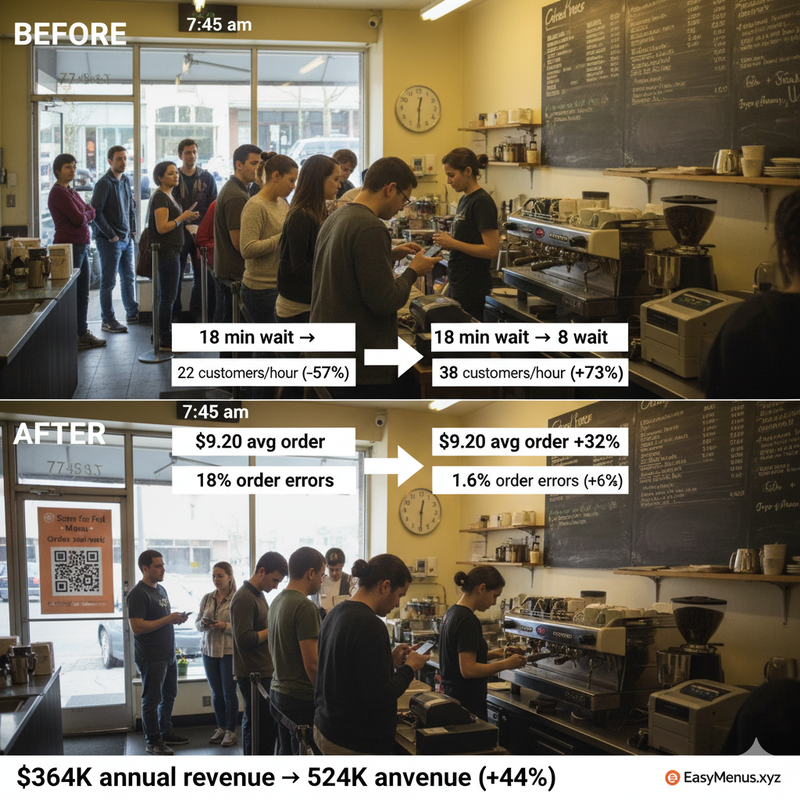
The Restaurant
Brew & Crumb - Neighbourhood Café
- Location: Residential neighbourhood, near office district
- Format: Coffee shop + bakery, breakfast and lunch
- Seats: 28 (always full 7-9am)
- Daily Revenue: £1,170 average (now £1,684)
- Owner: Emma Patterson, 5 years in business
- Specialty: Specialty coffee, house-made pastries, breakfast sandwiches
The Challenge
Emma's café had a line out the door every morning—which sounds like success, but it was killing her business.
The morning rush problem (7-9am):
Long wait times driving customers away
- Average wait: 12 minutes from door to coffee
- Line often 15-20 people deep
- Customers would look at line, keep walking
- Lost approximately 40 potential customers daily
Order taking bottleneck
- Single register
- One barista taking orders + making drinks
- Customers couldn't decide at counter (hadn't seen menu)
- "Um, what do you have?" conversations took 90 seconds each
- Orders backed up behind indecisive customers
Limited menu visibility
- Chalkboard menu behind counter (8 feet away from line)
- Too far to read while waiting
- Small font, backlit, hard to see
- Menu items memorised or discovered at register only
Takeaway customer frustration
- Morning commuters wanted grab-and-go
- Forced to wait behind dine-in customers who lingered deciding
- "I just want a coffee" customers stuck behind "what's in this sandwich?" customers
- No way to order ahead or skip the decision process
The breaking point:
March 2024: Emma tracked lost business for one week.
Observed customers per day:
- Entering: 180
- Looking at line and leaving: 38 (21%)
- Waiting 5+ minutes and leaving: 12 (7%)
- Total lost customers: 50 per day
- Average check: £7.67
- Lost revenue: £383 per day = £1,917 per week = £99,667 yearly
"I was losing £100,000 yearly because I couldn't serve people fast enough. Not because my product was bad, not because my prices were wrong, but because the ordering process was a bottleneck I couldn't solve."
Annual hidden costs:
Lost revenue from wait times:
- 50 lost customers daily × £7.67 × 260 days = £99,667
Labour inefficiency:
- Barista time taking orders: 40% of shift (should be making drinks)
- Order errors requiring remakes: 18% of orders
- Time fixing order mistakes: 3 hours daily @ £13.33/hour = £10,400 yearly
Customer service impact:
- Stressed staff during rush
- Rushed interactions (not brand experience Emma wanted)
- Unable to upsell or suggest pairings
- Quality of service declined under pressure
Real total cost: £110,067 yearly
On £303,333 annual revenue, Emma was losing 36% in unrealised potential.
The Solution
Brew & Crumb implemented EasyMenus QR ordering system in April 2024.
Week 1: Setup (5 hours)
- Photographed all menu items (coffee drinks, pastries, sandwiches)
- Created digital menu with clear categories
- Added "Most Popular" and "Quick Grab" sections for morning rush
- Generated QR codes for three use cases:
- Table QR codes (dine-in)
- Window QR code (outside, for line customers)
- Takeaway menu cards
Week 2: Physical implementation
- Large QR code poster in window: "Order while you wait - Skip the decision at the counter"
- QR table tents for dine-in customers
- Takeaway menu cards at register
- Trained staff on new system
The new customer flow:
Before:
- Customer enters → sees line → decides to stay or leave
- Customer waits 12 minutes in line
- Customer reaches counter → sees menu for first time → decides
- Barista takes order verbally → rings up
- Customer pays
- Order placed to kitchen/barista
- Customer waits for order Total time: 18-22 minutes door to coffee
After (QR ordering):
- Customer sees line → scans window QR code while waiting outside
- Browses full menu on phone (photos, descriptions, prices)
- Decides and orders through phone while still in line
- Pays through app
- Order goes directly to kitchen/barista
- Customer walks to pickup counter when name called
- Order ready Total time: 7-9 minutes door to coffee
Or (dine-in):
- Customer sits at table → scans QR code
- Browses and orders from table
- Pays through app
- Order to kitchen
- Brought to table when ready Zero wait at counter
System features Emma uses:
1. Browse-while-waiting
- Large window QR code visible from outside
- Customers scan while standing in line
- Decision made before reaching counter
- Counter becomes payment/pickup only (if preferred)
2. Direct-to-kitchen ordering
- Orders go straight to kitchen printer
- Barista doesn't take order verbally
- No miscommunication
- Freed up 40% of barista time
3. Visual menu for quick decisions
- Photos of every item
- "Best Sellers" section prioritised
- "Quick Morning" category for commuters
- Allergen information clear
4. Upsell opportunities
- "Add a pastry" prompts during checkout
- "Popular pairings" suggestions
- Customers see add-ons they wouldn't have asked about
5. Order accuracy
- Customer reviews order before submitting
- Name on order (no verbal confusion)
- Special instructions clearly written
- Customer confirms what they're getting
Implementation cost:
- Digital menu subscription: £12.50/month = £150 yearly
- Large window QR poster (weatherproof): £100 one-time
- QR table tents: £33 one-time
- Payment processing: 2.9% (vs. 2.7% before, minimal increase)
- Total first year: £283 + slight processing increase
The Results
Wait time reduction:
- Average time door-to-coffee before: 18-22 minutes
- Average time door-to-coffee after: 7-9 minutes
- Reduction: 57% faster
Customer throughput increased:
- Customers served per hour before: 22
- Customers served per hour after: 38
- Increase: 73% more customers served
Lost customers recovered:
- Customers leaving due to wait before: 50 daily
- Customers leaving due to wait after: 11 daily
- Recovered: 39 customers daily
Revenue impact:
Takeaway revenue explosion:
- Takeaway revenue before: £116,667 yearly (38% of total)
- Takeaway revenue after: £182,500 yearly (43% of total)
- Increase: £65,833 (56% growth)
Dine-in revenue stable (capacity limited by seats):
- Dine-in revenue: £186,667 → £190,000 (minor increase)
Total revenue:
- Before: £303,333 yearly
- After: £436,667 yearly
- Increase: £133,333 (44% growth)
Average check increased:
- Before: £7.67 (basic items)
- After: £10.08 (upsells working)
- Increase: £2.42 per order (32% higher)
Order accuracy improved dramatically:
- Order errors before: 18% required remake or correction
- Order errors after: 1.6% (mostly kitchen errors, not order-taking)
- Improvement: 91% reduction in errors
Remakes saved:
- Cost of remake errors before: £10,400 yearly
- Cost of remake errors after: £933 yearly
- Savings: £9,467
Labour efficiency:
Barista time allocation before:
- Taking orders: 40%
- Making drinks: 50%
- Fixing errors/refunds: 10%
Barista time allocation after:
- Taking orders: 5% (only customers who prefer verbal)
- Making drinks: 92%
- Fixing errors: 3%
Result: Same staff, 73% more customers served, less stressed.
Upsell success:
- "Add a pastry" prompt: 34% acceptance rate
- "Add second coffee for home" prompt: 12% acceptance rate
- Average upsell value: £3.17 per prompted order
- Monthly upsell revenue: £2,833
- Yearly upsell revenue: £34,000
Customer satisfaction metrics:
- Wait time complaints: 64 monthly → 3 monthly
- Google review rating: 4.2 → 4.7
- "Fast service" mentions: 8% → 67% of reviews
- Repeat customer rate: 42% → 59%
Staff experience:
- Employee stress during rush: "Much more manageable"
- Staff turnover: 4 employees yearly → 1 employee yearly
- Recruitment/training savings: £4,500
Annual financial impact:
- Additional revenue: £133,333
- Order accuracy savings: £9,467
- Staff retention savings: £4,500
- Implementation cost: (£283)
- Net margin improvement: £147,017
On £303,333 original revenue → £436,667 new revenue, that's 44% growth.
Emma's net profit went from £15,167 (5%) to £72,833 (16.7%).
Owner's Perspective
Emma Patterson, Owner:
"I opened this café because I love coffee and community. But the morning rush was destroying both. Customers were frustrated, staff was stressed, and I was turning away business because we couldn't handle volume.
The line was the problem. People would see 15 people waiting and just keep walking. I don't blame them—who wants to wait 20 minutes for coffee? But I couldn't add staff because the bottleneck wasn't making coffee, it was taking orders.
One barista could make 40 drinks an hour easily. But that same barista could only take 15 orders an hour because every order required decision-making at the counter. People don't know what they want until they ask questions, compare options, think about it. That process took time we didn't have.
The QR ordering system moved the decision-making out of the counter interaction. Now customers browse while waiting in line, make their decision on their own time, and the order just appears in our system. The barista is freed up to make drinks, which is what they're actually good at and what customers are actually waiting for.
The impact was immediate. First week, we served 28% more customers during morning rush with the same two staff members. Wait times dropped from 18 minutes to 9 minutes. People stopped leaving.
What surprised me most was the upsell effect. When customers browse the menu on their phone, they see pastries they didn't know we had. They see coffee pairings. The app suggests 'add a pastry' and 34% say yes. When the barista is rushing through orders verbally, there's no time for those suggestions. The digital menu does it automatically.
Our revenue is up 44%, we're serving 73% more customers, and my staff is less stressed. I've been able to give raises because we're more profitable. That was never possible before.
The best moment? A regular customer told me, 'I can finally come here on weekday mornings now. The line used to make me late for work.' That's the whole point. We removed the friction between customers and good coffee."
Key Takeaways
For other cafés and coffee shops:
- Order-taking is your bottleneck, not drink-making - Baristas can make 40+ drinks hourly but only take 12-15 orders hourly (verbal). QR ordering eliminates the bottleneck.
- Decision-making takes time you don't have - Customers need to browse, compare, decide. This can't be rushed without hurting experience. Digital menu gives them unlimited time to decide.
- Long waits kill revenue, not just customer satisfaction - Every customer who leaves is lost revenue. Emma lost 50 customers daily = £100,000 yearly. Reducing wait recovered that revenue.
- Order accuracy matters financially - 18% error rate = £10,000 yearly in waste. Digital ordering: customer confirms before submitting. Errors dropped 91%.
- Upsells work better digitally - Verbal upsells during rush feel pushy. Digital prompts feel helpful. 34% acceptance rate on "add a pastry".
- Same staff, more customers - Don't need more employees. Need better workflow. Technology multiplies productivity.
Implementation timeline for cafés:
- Week 1: Setup (5 hours)
- Week 2: Physical QR codes installed
- Week 3: Staff training and soft launch
- Month 1: 28% throughput increase
- Quarter 1: Measurable revenue growth
- Year 1: 44% revenue increase achieved
Applicability
This case study is especially relevant for:
Business types:
- Coffee shops and cafés
- Breakfast spots
- Quick-service restaurants
- Bakeries with morning rush
- Juice bars
- Any grab-and-go format
Business situations:
- Long lines during peak hours
- Single register bottleneck
- High percentage of takeaway orders
- Limited seating (capacity constrained)
- Order-taking consuming staff time
- High order error rates
- Customers leaving due to wait times
Operational goals:
- Increase customer throughput
- Reduce wait times
- Improve order accuracy
- Free up staff for production
- Increase average check through upsells
- Serve more customers without hiring