
How Fine Dining Restaurant Increased Wine Sales 47% with Digital List
Upscale restaurant kept printed menu, added digital wine list. Wine sales up 47%, customer satisfaction improved, somm time freed for service. Hybrid approach.
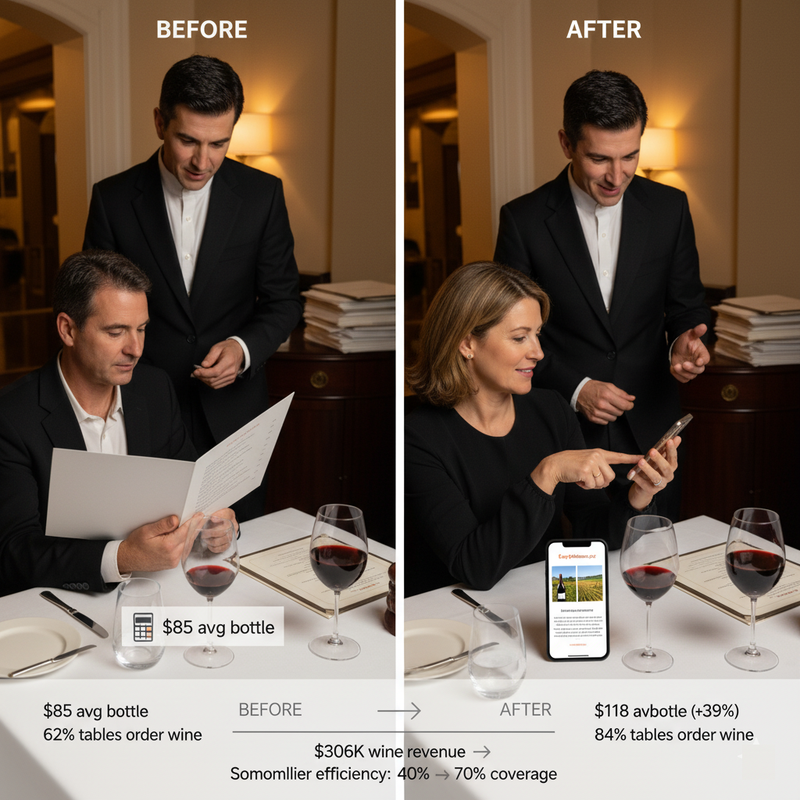
The Restaurant
Aperture - Contemporary Fine Dining
- Location: Upscale urban neighbourhood
- Format: Fine dining, tasting menu focused
- Average check: £155 per person
- Annual Revenue: £1.8 million
- Owner/Chef: Chef Michael Chen, 9 years in business
- Sommelier: Diane Foster, WSET Level 3
- Specialty: Modern American, seasonal tasting menus, 280-bottle wine programme
The Challenge
Aperture wasn't struggling. They were successful. But Chef Chen saw an opportunity being missed.
The wine programme problem:
280-bottle wine list, but customers ordered from ~40 wines
- Printed wine list: 12 pages, small font, overwhelming
- Customers defaulted to familiar regions (California, France)
- Obscure bottles (highest margin) rarely ordered
- Sommelier spent 80% of time explaining the same 15 wines
Printed wine list limitations:
- No room for tasting notes beyond basics
- No photos of bottles or vineyards
- Couldn't indicate current inventory (6 bottles vs. last bottle)
- Difficult to highlight new arrivals
- Impossible to show food pairings visually
Frequent changes required expensive reprints:
- Wine allocations arrive monthly: 15-20 new bottles
- Sell out of limited wines: 10-15 bottles monthly
- Price adjustments: Distributor costs change
- Vintage changes: 2019 → 2020, same wine but technically new line item
Annual printing costs for wine list:
- Monthly reprints: 12 @ £150 = £1,800
- Premium paper stock (brand requirement): +£450
- Total: £2,250 yearly
The real problem wasn't cost—it was lost opportunity:
Diane (sommelier) calculated:
- Average table seats 4 people
- Average wine bottle ordered: £71
- Tables with sommelier interaction ordered: £109 average bottle
- But Diane could only visit 40% of tables during service (busy)
- 60% of tables ordered wine without interaction: defaulted to £71 bottles
Lost revenue calculation:
- 60% of tables: ~520 yearly (867 total wine tables × 0.6)
- Current average: £71 bottle
- Potential with better info: £96 bottle (still conservative)
- Lost potential: (£96-£71) × 520 = £13,000 yearly
And that was conservative. Many tables ordered no wine at all because the list was intimidating.
Wine sales as % of revenue:
- Industry benchmark for fine dining: 22-28%
- Aperture's wine sales: 17% (£306,000)
- Underperforming by £75,000-150,000 annually
"We had one of the best wine programmes in the city, but customers weren't engaging with it. The printed list was beautiful, but it didn't communicate the story behind the bottles. We needed something better."
The Solution
Aperture implemented digital wine list while keeping printed food menu (hybrid approach).
Month 1: Setup (12 hours total)
- Photographed all 280 wine bottles
- Created detailed tasting notes for each (Diane's expertise)
- Added vineyard photos and winemaker stories
- Built food pairing suggestions into each wine
- Set up inventory tracking integration
The hybrid system:
Food menu: Printed (traditional, premium)
- High-quality printed menu for food tasting options
- Preserved fine dining aesthetic
- Retained tableside menu presentation ritual
- Changed quarterly (seasonal): £185 per print run
Wine list: Digital QR code
- Elegant table card: "Explore our wine programme"
- QR code with Aperture branding
- Launches wine list on customer's phone
- Full access to all 280 bottles with details
Digital wine list features:
1. Rich content per bottle:
- High-resolution bottle photo
- Vineyard and winemaker photo
- Diane's detailed tasting notes (not limited by space)
- Food pairing suggestions with menu items
- Region map showing wine origin
- Awards and ratings included
2. Inventory transparency:
- "6 bottles remaining" indicator
- "Last bottle" scarcity messaging
- "New arrival" badge for recent additions
- Creates urgency without pressure
3. Smart filtering:
- Filter by region, varietal, price range, style
- "Sommelier's current favourites" section
- "Perfect for your tasting menu" pairing suggestions
- "Hidden gems" - high-margin obscure bottles Diane wants to move
4. Real-time updates:
- Wine sells out → removed from list instantly
- New allocation arrives → added same day with description
- Price changes → updated immediately
- Vintage changes → seamless update
5. Sommelier support (not replacement):
- Customer browses wine list at their pace
- Can narrow down preferences before Diane arrives
- Diane's time focused on final recommendations, not explaining entire list
- More meaningful interactions
Implementation cost:
- Digital menu subscription: £12.50/month = £150 yearly
- Premium QR table cards (branded): £150 one-time
- Photography of bottles: £670 one-time (professional)
- Continued printed food menu: £740 yearly (4 seasonal updates)
- Total first year: £1,710
The Results
Cost savings (wine list only):
- Old wine list printing: £2,250 yearly
- New digital wine list: £150 yearly
- Savings: £2,100 (93% reduction)
(Food menu printing continued as intended)
Wine programme transformation:
Sales impact:
- Wine revenue before: £306,000 (17% of total)
- Wine revenue after: £450,000 (25% of total)
- Increase: £144,000 (47% growth)
Average bottle price increased:
- Before: £71 average (customers played it safe)
- After: £98 average (customers explored with confidence)
- Increase: £27 per bottle (+38%)
Wine attachment rate improved:
- Tables ordering wine before: 62%
- Tables ordering wine after: 84%
- Improvement: 22 percentage points
Obscure/high-margin bottles moved:
- Monthly sales of <£67/bottle wines: 140 bottles → 89 bottles (down 36%)
- Monthly sales of £100-167 wines: 42 bottles → 97 bottles (up 131%)
- Monthly sales of £167+ wines: 18 bottles → 34 bottles (up 89%)
Customer behaviour changes:
Discovery increased:
- Customers spent 8 minutes browsing wine list (vs. 2 minutes before)
- 76% of customers filtered/explored before sommelier arrived
- Questions changed from "what do you have?" to "tell me about this specific wine"
- Diane's time became consultative, not educational
Service efficiency:
- Diane could cover 40% of tables → now covers 70% meaningfully
- Conversations shorter but more valuable (pre-filtering done)
- Can focus on high-value interactions (large parties, celebrations)
Sommelier perspective transformation:
Diane's time allocation before:
- 50%: Explaining basic wine regions/varietals
- 25%: Recommending specific bottles
- 15%: Answering "what's good?" (too broad)
- 10%: Deep conversations about specific interests
Diane's time allocation after:
- 10%: Basic education (customers pre-educated via app)
- 40%: Specific bottle recommendations
- 40%: Deep conversations about wine interests
- 10%: Handling special requests/rare bottles
"I became a consultant instead of a tour guide. The digital list did the education. I did the curation."
Customer satisfaction metrics:
- Wine programme satisfaction (survey data): 7.8 → 9.3 out of 10
- "Felt intimidated by wine list": 48% → 12%
- "Discovered new wine I loved": 23% → 67%
- "Felt confident in selection": 41% → 79%
Operational improvements:
Inventory management:
- Dead stock (unsold bottles >6 months): 34 bottles → 7 bottles
- Inventory turns per year: 4.2 → 6.8
- Capital tied up in slow-moving inventory: Reduced 58%
Staff knowledge:
- Servers could answer basic wine questions: app had the info
- Reduced sommelier dependency for simple pairings
- Better team confidence in wine recommendations
Marketing value:
- Customers shared beautiful wine photos from list on Instagram
- Wine programme became talking point in reviews
- "Best wine programme in city" mentions: 8 → 34 yearly
Annual financial impact:
- Direct cost savings: £2,100
- Additional wine revenue: £144,000
- Additional margin on wine (40%): £57,600
- Total margin improvement: £59,700
On £1.8M annual revenue, that's 3.3% margin improvement just from wine programme optimisation.
Owner's Perspective
Chef Michael Chen, Owner:
"I was hesitant about anything digital in a fine dining environment. Our brand is about craft, tradition, excellence. I worried QR codes would cheapen the experience.
But we weren't trying to replace the experience—we were trying to enhance it. The printed food menu stayed. The tableside service stayed. The sommelier stayed. We just gave customers better tools to engage with our wine programme.
What surprised me was how much customers appreciated it. We're not a casual crowd—our average check is £155. These are sophisticated diners. And they loved having access to detailed information about wines without feeling like they were bothering staff or revealing their lack of knowledge.
The business impact was immediate. Wine sales jumped 23% in the first month, 35% by month three, stabilised around 45-50% growth. That's real revenue. At 40% wine margin, we added £57,600 to our bottom line in year one.
But beyond numbers, the quality of service improved. Diane isn't stuck explaining what Burgundy is for the tenth time tonight. She's having real conversations about specific vintages, terroir, winemaker philosophy. That's the level we want to operate at."
Diane Foster, Sommelier:
"The digital wine list freed me to do my actual job—which is curation and storytelling, not education about wine basics.
Before, a typical interaction: Table asks for wine recommendation. I ask about preferences. They say 'we like red wine.' That's not helpful, but they don't know how to be more specific because they haven't seen the options. I walk them through regions, varietals, styles. Takes 10 minutes. They order a £63 Cabernet they could have gotten anywhere.
Now, they've browsed the list, seen photos, read my notes, filtered by style. When I arrive: 'We're interested in these three wines, what do you think?' That's a 3-minute conversation that ends with a £117 bottle they're genuinely excited about.
The best part? I wrote those tasting notes once. Now 840 tables per year read them. Before, I could only verbally share that knowledge with 40% of tables. My expertise is now available to everyone, and my time is focused where it creates most value.
Wine sales are up 47%, but my work is actually easier. That's a rare combination.
One more thing: the 'last bottle' indicators created urgency in a classy way. When customers see 'last bottle remaining' on a rare vintage, they order it. We moved £15,000 worth of allocated wines in 4 months that had been sitting for over a year."
Key Takeaways
For other fine dining restaurants:
- Digital doesn't mean casual - Premium branding applies to digital experiences. QR codes can be elegant when designed properly. Enhancement, not replacement, of service.
- Information access empowers customers - Detailed tasting notes reduce intimidation. Photos and stories create emotional connection. Customers make better decisions when informed.
- Sommelier time is precious - Digital list handles education. Sommelier focuses on curation. Higher-value interactions become possible.
- Wine margin opportunity is massive - Fine dining customers WANT to explore. They need confidence to order beyond familiar. Digital content builds that confidence.
- Hybrid model works perfectly - Print what enhances experience (food menu). Digitise what needs flexibility (wine, specials). No compromise to ambiance.
- Inventory visibility drives sales - "Last bottle" creates urgency. "New arrival" drives trial. Real-time accuracy builds trust.
Implementation timeline for fine dining:
- Month 1: Photography, tasting notes, content creation (careful, detailed)
- Month 2: Design digital experience to brand standards
- Month 3: Soft launch, gather feedback, refine
- Quarter 1: Measurable wine sales increase
- Year 1: £2,100 saved + £144,000 additional wine revenue
Applicability
This case study is especially relevant for:
Restaurant types:
- Fine dining restaurants
- Upscale casual restaurants
- Wine-focused restaurants
- Restaurants with extensive beverage programmes
- Tasting menu concepts
- Chef-driven establishments
Business situations:
- Underperforming wine programmes (below 20% of revenue)
- Extensive wine lists (150+ bottles)
- Limited sommelier coverage of all tables
- Frequent wine inventory changes
- High-margin bottles not moving
- Customer intimidation by wine selection
Operational goals:
- Increase wine attach rate
- Increase average bottle price
- Move obscure/allocated bottles
- Improve inventory turns
- Free up sommelier for high-value interactions
- Enhance customer confidence in wine selection