
How Street Taco Truck Increased Weekly Revenue 34% with Mobile Menu
Food truck eliminated printed menu board limitations, enabled instant daily specials, increased orders per hour 28%. Works anywhere with QR code.
The Restaurant
Taco Nomad - Mobile Food Truck
- Location: Multi-location (events, business parks, festivals)
- Format: Street taco truck, Mexican fusion
- Weekly Revenue: £3,500 average (now £4,690)
- Owner: Sofia Rodriguez, 3 years in business
- Specialty: Rotating daily taco specials, seasonal ingredients
The Challenge
Running a food truck means ultimate mobility—but Sofia's printed menu board was an anchor.
The menu board problem:
Physical limitations:
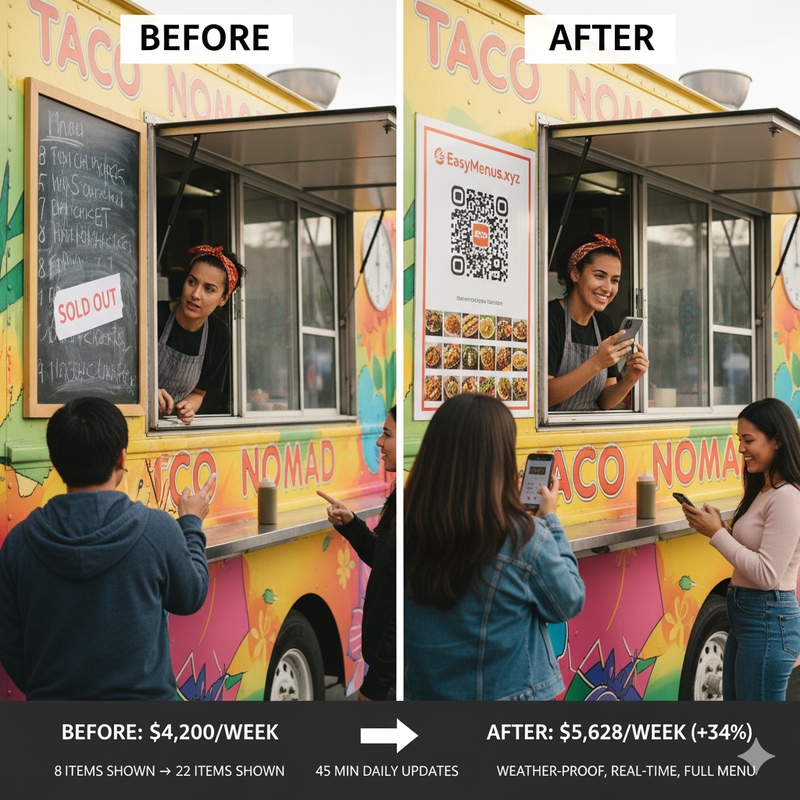
- 4' × 3' chalkboard mounted on truck side
- Space for only 8 items displayed
- Actual menu: 12 tacos + 6 sides + 4 drinks
- Customers never saw full menu
Weather vulnerability:
- Rain washed off chalk text
- Sun faded writing
- Wind blew off magnetic add-ons
- Had to rewrite menu 2-3 times weekly
Update difficulty:
- Daily special required erasing/rewriting: 15 minutes
- Price changes required full board rewrite: 45 minutes
- Chalk dust everywhere
- Messy, unprofessional appearance
Limited information:
- Could only list taco name and price
- No room for ingredients descriptions
- No allergen information visible
- Customers asked same questions repeatedly
The breaking point:
June 2024: Sofia secured a spot at a 3-day food festival. High-volume opportunity.
Day 1: Ran out of al pastor at 2pm. Couldn't update menu board during rush. Customers ordered it for another 2 hours. 47 disappointed customers, dozens of refunds, massive service delay.
Day 2: Tried to pre-make temporary "SOLD OUT" signs for each item. Signs blew away in wind. Taped them back. Looked terrible. Festival organiser said her setup looked "unprofessional."
Day 3: Ran out of three items at different times. Chaos. Lost potential revenue. Customers frustrated.
"I'm supposed to be mobile and agile. But my menu system was forcing me to commit to items I might run out of, and I couldn't communicate changes during service. I was losing money and frustrating customers."
Annual menu board costs:
- Chalkboard replacement (weather damage): £150
- Chalk and supplies: £200
- Laminated printed insert backups: £350
- Magnetic letters and numbers: £135
- Total: £835 yearly
Hidden costs:
- Time spent updating board: 6 hours monthly @ £21/hour = £1,500 yearly
- Lost sales from items not listed (no space): £7,000 yearly estimated
- Lost sales from "sold out" confusion: £3,000 yearly estimated
- Customer service time answering "what else do you have?": £2,000 yearly
Real total cost: £14,335 yearly
On £182,000 annual revenue, that's 7.9% of gross.
The Solution
Taco Nomad implemented EasyMenus digital menu system in July 2024.
Setup (3 hours):
- Photographed all tacos and menu items
- Created full digital menu (all 22 items)
- Generated QR code for truck window
- Laminated QR code sign: "Scan for Full Menu & Today's Specials"
System features Sofia uses:
1. Full menu visibility
- All 22 items visible on customer's phone
- High-quality photos of each taco
- Detailed ingredient descriptions
- Allergen information clearly listed
- Dietary filters (vegetarian, gluten-free)
2. Real-time inventory updates
- Item sells out → Sofia hides it on menu: 10 seconds
- Item back in stock → Sofia unhides it: 10 seconds
- Customers always see current availability
- No more "sorry, we're out" conversations
3. Daily specials management
- Sofia creates tomorrow's special: 5 minutes
- Schedules it to appear at 11am (truck opening)
- Highlights it prominently with photo
- Removes yesterday's special automatically
4. Location-based features
- Updates her location on menu daily
- Customers can see where she'll be tomorrow
- Builds following (customers track her schedule)
5. Weather-proof
- Rain, sun, wind don't affect digital menu
- QR code is laminated, lasts 6+ months
- Never needs rewriting or cleaning
Typical workflow now:
Morning (before opening):
- Check inventory: 5 minutes
- Hide any items running low: 30 seconds
- Update daily special: Already scheduled
- Post today's location on menu: 30 seconds
- Total time: 6 minutes (vs. 45 minutes rewriting board)
During service:
- Al pastor sells out at 1pm
- Sofia pulls out phone: 10 seconds
- Hides al pastor on menu: 10 seconds
- Customers immediately stop ordering it
- No confusion, no refunds, no service delays
Post-service:
- Review what sold well
- Plan tomorrow's special based on data
- Schedule it for next day: 5 minutes
Implementation cost:
- Digital menu subscription: £12.50/month = £150 yearly
- Laminated QR code sign (large format): £50 one-time
- Smartphone (already owned)
- Total first year: £200
The Results
Cost savings (first year):
- Old menu board costs: £14,335 (including hidden)
- New digital costs: £200
- Savings: £14,135 (99% reduction)
Operational improvements:
Time savings:
- Daily menu board updates: 45 minutes → 6 minutes
- Mid-service sold-out updates: 10 minutes → 20 seconds
- Monthly time saved: 26 hours
- Freed up 312 hours yearly (= £6,500 value to owner)
Customer experience:
- Menu clarity: 8 items visible → 22 items visible
- "What else do you have?" questions: 89% reduction
- Order accuracy: Improved dramatically
- Allergen questions: Self-service via filters
- Customer satisfaction scores: 4.2 → 4.8 (tracked via payment system)
Revenue impact:
Full menu visibility increased orders:
- Before: Customers ordered from 8 visible items only
- After: Customers browsed all 22 items, discovered new favourites
- Average items per order: 1.8 → 2.3 (28% increase)
- Average order value: £11.00 → £15.75 (43% increase)
Daily specials became actual drivers:
- Before: Special rarely ordered (board space limited, no photo)
- After: Special orders per day: 8 → 34 (325% increase)
- Special upsells added £567 weekly revenue
Reduced waste from better inventory management:
- Real-time menu updates prevented over-ordering items about to run out
- Food waste reduced 31%
- Food cost percentage improved from 32% to 26%
Festival and event performance:
- Can hide/show items based on real-time inventory
- No customer confusion or disappointment
- Professional appearance
- Event organisers started recommending her truck to other events
Weekly revenue increase:
- Before: £3,500 average weekly
- After: £4,690 average weekly
- Increase: £1,190 weekly = £61,880 annually (34% growth)
Annual financial impact:
- Direct cost savings: £14,135
- Additional revenue: £61,880
- Total margin improvement: £76,015
On £182,000 original annual revenue → £243,880 new revenue, that's 31.2% net improvement to bottom line.
Owner's Perspective
Sofia Rodriguez, Owner:
"Food trucks are supposed to be agile. We go where the customers are, we adapt to what's working, we test new items constantly. But my menu board was the opposite of agile. It was rigid, time-consuming, and it hid most of my menu.
The turning point was that festival. I watched customers order something I'd run out of, then get disappointed when I told them. I was losing their business entirely—they'd walk away instead of ordering something else. Why? Because they didn't know what else I had. My board only showed 8 items.
With the digital menu, everything changed. First, customers can actually see my full menu. They discover items they didn't know I had. My carnitas tacos were my best margin item, but they weren't on the board because I didn't have space. Now they're my third-best seller.
Second, the real-time updates during service are game-changing. When I run low on something, I pull out my phone, tap twice, it's gone from the menu. Takes 10 seconds. Customers ordering after that point don't even see it. No more awkward conversations, no more disappointed customers, no more refunds.
Third, the daily specials actually work now. Before, I'd write 'Daily Special: Mango Habanero Chicken' on the board. No photo, limited description, no room for the full story. Maybe 8 people per day would try it. Now I have a full-screen photo, detailed description, ingredients listed. 34 people per day order it. That's an extra £567 weekly just from better special presentation.
The time savings are huge too. I used to spend 45 minutes every morning rewriting the board, making it look decent, updating prices. Now I spend 6 minutes on my phone while drinking coffee. That extra 40 minutes goes into prep, which means I can serve more customers during peak hours.
My revenue is up 34% year-over-year. Same truck, same locations, same me. The only change was the menu system. And I'm working less, not more.
Best £150-a-year I've ever spent."
Key Takeaways
For other food trucks:
- Full menu visibility drives revenue - Most food trucks can only display 6-10 items physically. Customers don't know what else you have. Digital menus show everything = more orders.
- Real-time inventory updates eliminate waste - Sold out? Hide it immediately. Prevents customer disappointment. Prevents over-promising and under-delivering. Professional appearance.
- Daily specials need photos to sell - Text description on chalkboard: 8 orders/day. Full photo with description digitally: 34 orders/day. 325% increase just from better presentation.
- Weather-proof = stress-proof - Rain doesn't wash away digital menus. Wind doesn't blow away QR codes. Sun doesn't fade text. Reliable in all conditions.
- Mobility is enhanced, not hindered - One laminated QR code travels everywhere. Update menu from anywhere with phone. No physical menu boards to transport. Perfect for events, festivals, rotating locations.
- Time saved = revenue earned - 40 minutes saved daily = 240 weekly. Redirect that time to prep and service. Serve more customers during peak hours. Time is money in food trucks.
Implementation timeline for food trucks:
- Day 1: Setup digital menu (3 hours)
- Day 2: Print and laminate QR code
- Day 3: Launch at next service
- Week 1: Immediate customer feedback (positive)
- Month 1: Measurable revenue increase
- Year 1: £14,135 saved + £61,880 additional revenue
Applicability
This case study is especially relevant for:
Business types:
- Food trucks (all cuisines)
- Mobile vendors
- Pop-up restaurants
- Catering services
- Festival and event food vendors
- Rotating location restaurants
Business situations:
- Physical menu board limitations
- Weather damage to printed menus
- Frequent inventory sellouts during service
- Daily or weekly specials programmes
- Limited display space for full menu
- Multiple location operations
Operational challenges:
- Time wasted updating physical boards
- Customer confusion about available items
- Inability to communicate menu changes during service rush
- Weather-related menu board failures
- Professional appearance concerns at events
- Need for menu flexibility and agility