
The R15,000 Monthly Printing Bill Cape Town & Joburg Restaurants Are Eliminating
Cape Town wine country restaurants spend R96,000-R144,000 annually on wine list printing. Johannesburg corporate venues R72,000-R120,000 on menus. Digital: R2,700/year.
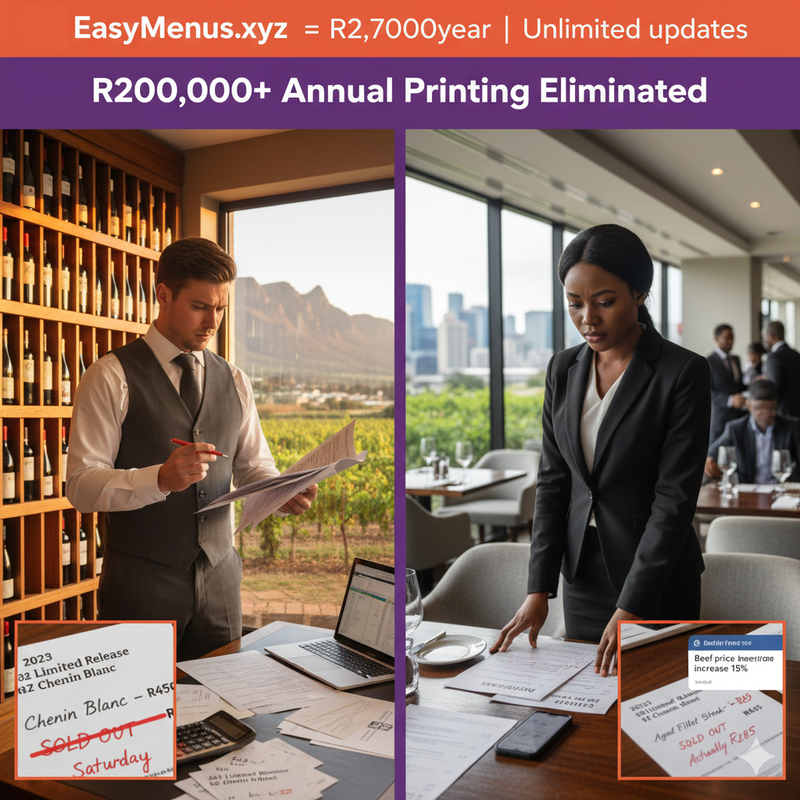
It's Thursday night in Cape Town. You're finally off your feet after dinner service at your Stellenbosch wine estate restaurant. Your phone buzzes - WhatsApp from your wine supplier. "Just got 12 new bottles in. Stunning Chenin Blanc, limited release Pinotage. Want them on your list?"
Of course you want them. Your guests tomorrow are international wine tourists who flew here specifically to taste Cape wines. But your printed wine lists? You just had 50 copies done on Monday. That's R8,000 you spent three days ago on lists that are already outdated.
You do the math. Rush printing to get new lists by tomorrow lunch? R12,000. Normal printing and tell guests for two days "Actually, we have some amazing wines not on this list..."? Still frustrating.
Meanwhile in Johannesburg, different problem, same printing bill. Your Sandton restaurant serves corporate lunch crowds. Monday you printed menus with your winter specials. Wednesday your meat supplier texts: "Beef up 15% starting today, sorry." Now you're telling your lunchtime business clients "Sorry, that fillet is actually R285, not R245" while they're looking at yesterday's printed menu showing the old price.
That's R6,000 you spent Monday on menus that are wrong by Wednesday.
There's got to be a better way. And yeah, 50+ restaurants from Cape Town to Johannesburg already figured it out. Not because they love technology. Because they got tired of paying the printer every single week.
Two South Africas, Two Restaurant Realities
Thursday Afternoon in the Cape Winelands
You're running a restaurant anywhere in the Cape - maybe it's on your wine estate in Stellenbosch like Jordan or Tokara. Maybe it's Franschhoek fine dining like La Petite Colombe or Protégé. Maybe you're in the city at FYN or The Shortmarket Club.
Your guests are wine tourists. International visitors who saved up for this trip. They're here to experience South African wine country. They want the full experience - food pairings, rare bottles, the whole story.
Your wine list has 200+ bottles. It changes weekly because:
- Limited releases sell out
- New vintages arrive
- Seasonal wines rotate
- Your winemaker neighbor just dropped off something special
- That 2019 you've been aging is finally ready
Every change means reprinting. R8,000-R12,000 per print run for quality wine lists that match your restaurant's standard. You're printing monthly at minimum. Sometimes weekly during harvest season when everything's changing.
That's R96,000-R144,000 annually just on wine lists. Not including your food menu. Not including the special tasting menu cards. Not including the cocktail list that rotates seasonally.
FYN Restaurant down on Parliament Street? They're doing Modern African cuisine with Japanese influences. Their menu is complex, seasonal, constantly evolving. They were reprinting every two weeks. Grub & Vine on Bree Street? Wine pairing is their thing - rotating small plates, extensive wine program. The Table Restaurant out in Stellenbosch? Farm-to-table means the menu literally depends on what arrived from the farm that morning.
All of them printing constantly. All of them spending R10,000-R20,000 monthly on keeping menus current.
Tuesday Lunch Rush in Sandton
Cut to Johannesburg. You're in Sandton, Rosebank, or Maboneng. Your clientele is different - business lunches, corporate dinners, mall shoppers, local professionals.
Your printed menus? They need to be professional. Your Sandton clients expect polished presentation. Your Rosebank corporates are used to global dining standards. Your menu can't look cheap or amateur.
But your costs are volatile. Beef prices swing monthly. Imported ingredients (because half your clientele wants international cuisine) fluctuate with the rand. Your specials change based on what you can source. Load shedding impacts your cold storage, so you adjust menu items accordingly.
Marble Restaurant with their wood-fire focus? Premium aged meats, extensive wine program, rooftop views. They need professional menus that match the R500+ per head experience. Saint Restaurant with David Higgs' handmade pasta? They're updating menus for seasonal ingredients while maintaining fine dining standards.
Level Four at the Southern Sun? They're doing afternoon tea service plus regular dining - that's multiple menu prints. Aurum Restaurant up in The Leonardo? Skyscraper location, luxury hotel integration, French-Mediterranean complexity. These aren't places that can hand guests photocopied menus.
You're reprinting R6,000-R15,000 monthly depending on your update frequency. That's R72,000-R180,000 annually on menus that are often outdated within days when prices change or specials sell out.
The Wine List Problem Nobody Talks About
Here's what happened last Saturday at a Constantia wine estate restaurant. True story.
International couple sits down. They're here from Germany specifically for Cape wine tourism. They've read about South African wines. They're excited. They open your wine list.
They want to try the Chenin Blanc everyone's talking about. The one you featured last week. It's on the list. They order it.
Your sommelier has to tell them: "Unfortunately, we sold out of that yesterday. But we have this amazing alternative..."
The guests are understanding. But in their heads, they're thinking: This is supposed to be wine country. They can't keep their list current?
That's not the experience you want to give. That's not why they flew 11 hours to Cape Town.
Now multiply that scenario by every wine estate restaurant, every Franschhoek venue, every Stellenbosch farm-to-table spot. Everyone's dealing with:
- Limited production wines (you have 6 bottles, then it's gone)
- Seasonal availability (this Chenin is only available during harvest)
- Vintage changes (2023 is out, 2024 just arrived)
- Special allocations (your winemaker neighbor brought 12 bottles, just for you)
- Sold out inventory (guests ordered 8 bottles at lunch, now you're out)
Traditional solution? Reprint the wine list. R8,000-R12,000 every time. Or hand-write changes on a chalkboard that guests have to cross-reference with the printed list. Or verbally tell every table "Actually, we're out of these three, but we have these two new ones..."
Your sommelier shouldn't be updating people on inventory all night. They should be telling wine stories and creating experiences.
Why Cape Town Restaurants Email More (And Why It Matters)
Here's the hypothesis we're testing: Cape Town restaurants probably respond better to email marketing than Johannesburg restaurants.
Why? Tourism culture.
Cape Town restaurants live on TripAdvisor reviews, Instagram posts, and international bookings. Their guests are planning trips months in advance. They're emailing for reservations. They're digitally savvy because they have to be - 40%+ of their customers are international visitors who found them online.
You check your email daily because tourists are booking. You respond to Instagram DMs because that's where your marketing happens. You update Google Business because overseas visitors are searching. You're on OpenTable or DinePlan because tourists book that way.
Johannesburg restaurants? More walk-in business. More corporate bookings through assistants. More local regulars who just show up. Less email dependency.
This matters for digital menus because Cape Town restaurants are already digitally engaged. The transition is easier. You're already updating websites, responding to online inquiries, managing digital bookings. Adding digital menu management? It's the same skillset you're already using.
Joburg restaurants are catching up. Sandton's corporate culture demands professional digital presentation. Rosebank's international hotels expect global standards. But the adoption pattern is different.
What 50+ South African Restaurants Figured Out
Let's talk about what actually works.
Scenario 1: The Saturday Morning Wine Delivery
Your winemaker friend arrives Saturday morning. "Brought you something special. Just bottled it. Only made 100 bottles, you get 12."
You taste it. It's exceptional. Your guests tonight will love it. They'll post about it on Instagram. This is what Cape wine tourism is about.
Old way: Great wine. Guests won't know about it unless servers mention it. You might hand-write it on a chalkboard. Some tables see it, some don't. You sell 4 bottles instead of all 12 because only half your guests even knew you had it.
New way: Take a photo of the bottle. Open your phone. Add to menu: "Just Bottled - Winemaker's Reserve Chenin Blanc 2024, 12 bottles only, R450, notes of stone fruit and honeysuckle, pairs beautifully with our linefish." Hit save. Every guest who scans your QR code in the next hour sees it. Sommelier mentions it at tables. You sell all 12 bottles by 9pm. Guests are posting about discovering this rare wine.
That's not a "feature." That's revenue you would've missed.
Scenario 2: The Tuesday Price Increase
Your meat supplier WhatsApps Tuesday morning. "All beef up 15% starting today. Market prices, sorry mate."
You need to adjust menu prices. Today.
Old way: Update menu file. Email to printer. "Boss, can you rush this? How much? R12,000 for rush delivery? When? Thursday? That's two days of telling customers wrong prices. Okay, fine, do it."
Meanwhile Tuesday lunch, Wednesday lunch: "Sorry, that fillet is actually R285, not R245." Guests are annoyed. Some think you're trying to pull something. Your servers are embarrassed.
New way: Open your phone. Update the six meat dishes with new prices. Hit save. Done. Tuesday lunch, every guest scanning the QR code sees current prices. No awkward conversations. No rush printing fees. Zero rand. Three minutes of your time.
That's not revolutionary. It's just not paying R12,000 to tell people beef got more expensive.
Scenario 3: The International Wine Tourist Who Doesn't Speak Afrikaans
European tourists sit down at your Stellenbosch venue. Your menu descriptions are in English (mostly) with some Afrikaans terms and local references they don't understand.
"What is waterblommetjie bredie?" "What's the difference between Pinotage and Cinsault?" "Which Chenin Blanc is more dry?" "Can you explain the wine regions to us?"
Old way: Your server explains. Takes 10 minutes per table. You have eight international tables tonight. That's 80+ minutes of menu education while your six other tables are waiting for service.
New way: Menu has detailed explanations built in. Click on waterblommetjie bredie, see full description with photos. Wine list includes tasting notes, region information, food pairing suggestions. Guests explore on their phones at their own pace. Your server focuses on hospitality and recommendations, not basic explanations.
You hired servers for service. Let them serve.
Scenario 4: The Sandton Business Lunch
Corporate client books lunch for 8 people. Thursday at 12:30pm. They need to be in and out in 60 minutes for their 2pm meeting.
Old way: They sit down. Open printed menus. Someone has dietary restrictions. "What's gluten-free?" Server explains. "What about this dish?" Server checks with kitchen. Comes back. Meanwhile, 12:40pm. They haven't ordered yet. Now they're rushed. They order whatever's fast. They're stressed. Not a great experience.
New way: Menu has allergen filters. Click "gluten-free," see six options immediately. Decide quickly. Order by 12:35pm. Food out by 12:50pm. Done by 1:30pm. They're happy. You turned the table. Everyone wins.
That's Sandton's pace. Digital menus match it.
The Real Cost in Rand (And Why It Adds Up Fast)
Let's do the accounting nobody wants to do.
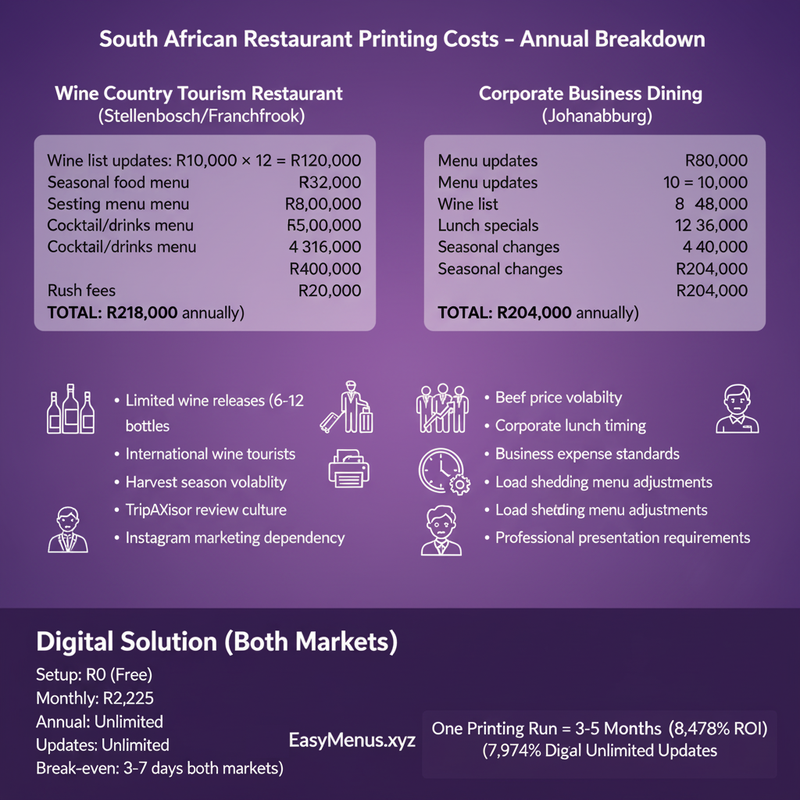
Cape Winelands Restaurant (Wine Estate or Franschhoek Fine Dining):
- Wine list updates: R10,000 × 12 times/year = R120,000
- Seasonal food menu: R8,000 × 4 times/year = R32,000
- Tasting menu cards: R5,000 × 6 times/year = R30,000
- Cocktail/drinks menu: R4,000 × 4 times/year = R16,000
- Rush fees (because you always need it yesterday): R20,000/year
- Total annual printing: R218,000
Sandton/Rosebank Corporate Restaurant:
- Menu updates: R8,000 × 10 times/year = R80,000
- Wine list: R6,000 × 8 times/year = R48,000
- Lunch specials: R3,000 × 12 times/year = R36,000
- Seasonal changes: R10,000 × 4 times/year = R40,000
- Total annual printing: R204,000
Digital menu solution:
- Setup: Free
- Monthly cost: R225 (about $12.50 USD)
- Annual cost: R2,700
- Number of menu changes: Unlimited
- Number of wine list updates: Unlimited
- Rush fees: R0
Cape Winelands savings: R215,300 annually Sandton savings: R201,300 annually ROI: 7,974% to 8,478%
But let's be honest about the real value - it's not just the rand. It's being able to add that special wine Saturday morning and have it on the menu Saturday lunch. It's updating prices Tuesday and not spending two days apologizing. It's tourists being able to explore your wine regions and grape varieties on their phones instead of asking your overworked server to explain terroir for the fifth time tonight.
That's worth more than R200,000. That's your reputation.
Real South African Restaurants, Real Results
FYN Restaurant (Parliament Street, Cape Town)
Modern African/Japanese fusion. Seasonal menu complexity. Multi-course tasting menus. Extensive wine pairings.
Before: R15,000 monthly reprinting menus and wine lists. Seasonal changes meant constant updates. Guest confusion about complex flavor profiles.
After: Menu includes detailed explanations of African ingredients (amadumbe, morogo, waterblommetjie) with photos. Wine pairings embedded with each course. Japanese techniques explained. Guests explore the story before ordering. Staff focuses on experience, not education.
The Table Restaurant (Stellenbosch)
Farm-to-table. Menu depends on what farmers deliver.
Before: R12,000 monthly menu updates. "Sorry, we're actually out of that" conversations. Missing revenue on daily specials guests didn't know about.
After: Morning farm delivery, lunch menu updated by 11am. Guests see what's actually available, fresh today. No surprises. No waste.
Marble Restaurant (Rosebank, Johannesburg)
Wood-fire fine dining. Premium aged meats. Extensive wine program.
Before: R18,000 monthly printing (menus + wine lists + aging program details). Corporate clients expecting professional presentation.
After: Digital menus maintain luxury feel. Meat aging program explained with photos. Wine list current. Professional standards met without weekly printing costs.
Tokara Restaurant (Stellenbosch Wine Estate)
Multi-course set menus. Vegan options. Cliff-top views. Refined plaaskos.
Before: Wine estate = wine list changes weekly. R10,000+ monthly on wine lists alone. Tourist expectations for current availability.
After: Wine list reflects actual cellar inventory. Limited releases shown with bottle counts. Guests know what's truly available. Sommelier focuses on storytelling, not inventory updates.
"But My Guests Prefer Printed Menus"
Do they though? Or do they prefer menus that are actually correct?
Because right now, if your international wine tourist orders that Chenin Blanc they read about, and you tell them "Sorry, we sold out yesterday but it's still on our printed list," they're not thinking about authentic printed menus. They're thinking about poor inventory management.
FYN has excellent reviews. The Shortmarket Club is packed. Marble is Johannesburg fine dining at its best. All using digital menus in some capacity. Guests aren't complaining.
Actually, tourists in reviews specifically mention "detailed menu descriptions helped us understand local ingredients" and "wine list had excellent tasting notes."
The question isn't "digital or printed." The question is "current and accurate or outdated and frustrating."
"I'm not technical enough."
You're on WhatsApp all day with suppliers. You're posting food photos on Instagram. You're managing bookings through Dineplan or OpenTable. You're responding to TripAdvisor reviews.
If you can do that, you can update a menu.
The setup takes 3 minutes:
- Upload your current menu (or photograph it)
- Customize colors to match your restaurant
- Generate QR code
- Print code, put on tables
Updating takes 30 seconds:
- Open app on your phone
- Change the price or add the new wine
- Hit save
- Every guest scanning the code sees the update instantly
You're not learning to code. You're editing text like you edit WhatsApp messages. On your phone. In English or Afrikaans. However you want.
"What about load shedding?"
Same thing that happens when load shedding hits now - you light candles and keep serving. Menus work offline on guests' phones once loaded. Your backup printed menus are still there if you want them.
But honestly, how often does load shedding actually stop service versus just being annoying? Your digital menus are less affected than your kitchen equipment.
The Cape Town vs Joburg Digital Divide (And Why Both Benefit)
Cape Town restaurants are switching faster. That's reality. Why?
Cape Town has:
- International tourism driving digital expectations
- Wine industry requiring frequent updates
- Instagram culture (Camps Bay, V&A Waterfront, Stellenbosch)
- Tech-savvy operators marketing globally
- Average check R400-R800 (tourism spending)
Cape Town guests expect:
- Detailed wine information
- Ingredient explanations
- Current availability
- Professional digital presence
- TripAdvisor-level service
Johannesburg is different.
Joburg has:
- Corporate dining culture (Sandton, Rosebank)
- More walk-in local traffic
- Business expense accounts
- Traditional marketing still works
- Average check R350-R700 (business lunches, mall dining)
Joburg guests need:
- Efficient service (business lunches are time-sensitive)
- Professional presentation (corporate standards)
- Accurate pricing (no surprises for expense reports)
- Consistency (regular clients notice changes)
But here's the thing - both markets benefit. Cape Town for tourism flexibility. Johannesburg for corporate efficiency.
And both are paying R10,000-R20,000 monthly to print menus that are outdated within days. That's the common pain point.
How This Actually Happens (No IT Department Required)
You're thinking "This sounds good but I barely have time to breathe, let alone implement new systems."
That's the point. It's designed for busy restaurant operators.
The actual process:
- Sign up: Use your phone number or email, takes 2 minutes
- Upload menu: Photograph your current menu with your phone, or upload your PDF if you have one
- Add details: Wine descriptions, allergen information, pairing suggestions (optional, do it gradually)
- Customize: Match your restaurant's colors and style if you want (optional)
- Generate QR code: Automatic
- Print the code: Use your regular printer or get nice table stands made
- Place on tables: Done
Time: 3 minutes for basic setup. 30 minutes if you want to add all the wine tasting notes and detailed descriptions right away.
Updating later:
- Open app on your phone
- Change whatever needs changing (price, new wine, sold out item, daily special)
- Hit save
- Every guest scanning the code sees the update immediately
You can do this from your phone while driving home after service. While sitting at the wine estate. While shopping at Woolworths. Anywhere you have cell signal.
The QR codes on your tables never change. Guests scan, they always see your current menu. In real-time. Automatically.
The Honest Truth
Look, 50+ restaurants across Cape Town, Stellenbosch, Franschhoek, Johannesburg, Sandton, and Rosebank switched already. Not because they're tech innovators. Because they're tired.
Tired of calling the printer every week. Tired of R15,000 rush fees. Tired of telling wine tourists "Sorry, that's actually sold out." Tired of explaining to Sandton clients why the menu price is wrong. Tired of paying R200,000+ annually for paper that's outdated before it reaches tables.
Takes 3 minutes to set up. Costs R225 per month - less than 2% of one menu print run. If you hate it, cancel. You're out R225. Back to the printer next month.
But you probably won't hate it.
Most restaurants' only regret is not switching earlier. Not because it transformed their business dramatically. Just because it's one less headache in an industry that's already full of them.
Your wine list costs don't disappear magically. You actively stop calling the printer. Your menu accuracy doesn't fix itself. You update it once and it stays current. Your tourists don't suddenly speak Afrikaans. You give them detailed explanations in English.
It's not magic. It's just better.
And honestly? Your Stellenbosch Chenin Blanc deserves a menu that explains why it's special. Your Franschhoek cuisine deserves descriptions that do it justice. Your Sandton business clients deserve menus with accurate prices the first time.
Start managing your South African restaurant menu properly in 3 minutes and stop paying the printer. R225/month (about $12.50 USD). No contract. Cancel whenever. But you probably won't want to.
Frequently Asked Questions
Why do Cape Town restaurants adopt digital menus faster than Johannesburg restaurants?
Cape Town's tourism economy (international visitors, wine tourism, Instagram culture) creates immediate demand for professional digital presence. Restaurant operators check email daily for overseas bookings, respond to TripAdvisor reviews, and update online listings - digital menu management fits this existing workflow. Johannesburg's corporate dining scene and local walk-in traffic meant less digital urgency historically, though Sandton's business culture now demands professional digital standards. Both markets are adopting, just at different speeds based on customer expectations.
How much do South African restaurants actually spend on wine list printing?
Cape Winelands restaurants printing wine lists monthly (200+ bottles, quality paper matching fine dining standards) spend R8,000-R12,000 per print run = R96,000-R144,000 annually just on wine lists. Add food menus (R8,000 × 4 seasonal updates = R32,000), tasting menu cards (R5,000 × 6 updates = R30,000), and rush fees (R20,000) - total annual printing easily exceeds R200,000. Johannesburg corporate restaurants spend R6,000-R10,000 monthly on menu updates = R72,000-R120,000 yearly. Digital solutions eliminate all of this for R2,700 annually (R225/month).
Do international wine tourists accept digital menus or prefer printed?
International tourists visiting Cape wine country specifically praise digital menus in reviews: "Detailed wine region information helped us understand what to order," "Tasting notes and food pairings made choosing easier," "Could read ingredient explanations at our own pace." Tourists book restaurants via TripAdvisor, OpenTable, Instagram - they expect digital convenience. The resistance isn't "digital vs printed," it's "professional vs amateur." Quality digital menus matching restaurant standards get better reviews than outdated printed menus with wrong availability.
What South African restaurants are successfully using digital menus?
FYN Restaurant (Cape Town Modern African), The Table Restaurant (Stellenbosch farm-to-table), Marble Restaurant (Johannesburg wood-fire fine dining), Tokara Restaurant (wine estate), Grub & Vine (Bree Street wine focus), Saint Restaurant (Sandton Italian), and growing adoption among Franschhoek fine dining establishments (La Petite Colombe, Protégé, Dusk) and Stellenbosch wine estates (Jordan, Rust en Vrede) managing complex wine programs and seasonal menus requiring frequent updates.
Does load shedding affect digital menu systems?
Digital menus work offline on guests' phones once initially loaded (content cached). Your QR codes function without power. Guests scan with their phones (which have batteries and data), not your electricity. During load shedding, your digital menus work better than your kitchen equipment. Backup printed menus remain available if desired, but load shedding typically doesn't prevent digital menu access since guest smartphones and cellular data continue functioning regardless of restaurant power status.
Related Articles
- Stellenbosch & Franschhoek Wine Lists: When 200+ Bottles Change Weekly
- Franschhoek Fine Dining: Digital Menu Solutions for Multi-Course Tasting Menus
- Cape Town Tourism Restaurants: Serving International Visitors Without Translation Chaos
- Sandton Corporate Dining: Why Business Lunch Restaurants Need Instant Menu Updates
- Complete Guide: South African Restaurant Digital Menu Upgrade