
Stellenbosch & Franschhoek Wine Lists: When 200+ Bottles Change Weekly
Cape Winelands restaurants spend R8,000-12,000 monthly on wine list printing. Limited releases, vintage changes, harvest season chaos. Digital: R225/month.

Saturday morning, your winemaker friend pulls up to your Stellenbosch restaurant. "Just bottled it yesterday. Made 100 bottles. You get 12."
You taste it. Exceptional Chenin Blanc. Stone fruit, honeysuckle, perfect acidity. Your international wine tourists tonight will love it. They'll post about it. This is what Cape wine country is about.
But your wine list? You printed 50 copies on Monday. Cost you R8,000. That was four days ago.
Now you've got this special wine that won't appear on any printed list. You could hand-write it on a chalkboard that half your tables won't see. Or mention it verbally to the tables your sommelier reaches before getting slammed with weekend service.
Or you could add it to your digital menu in 2 minutes. Photo of the bottle. Tasting notes. Food pairing. "Just Bottled - Winemaker's Reserve Chenin Blanc 2024, 12 bottles only, R450." Every guest who scans your QR code sees it instantly.
That's not about technology. That's about revenue. You sell all 12 bottles by 9pm instead of 4 bottles because only some tables heard about it.
This is the reality for tourism-driven restaurants like those in Cape Town's wine country where wine programs change weekly and tourists expect current information.
The Cape Winelands Wine List Reality
What you're managing:
- 200+ bottle wine program (Stellenbosch estates, Franschhoek fine dining standard)
- Limited production wines (6 bottles from boutique producer, then gone)
- Vintage transitions (2023 sells out, 2024 arrives mid-week)
- Harvest season chaos (February-April, everything changes)
- Special allocations (winemaker brings 12 bottles just for you)
- Seasonal availability (this Chenin only during harvest)
- Sold-out tracking (8 bottles ordered at lunch, now unavailable for dinner)
Your current printing costs:
- Wine list quality printing: R8,000-12,000 per run
- Frequency: Monthly minimum (more during harvest season)
- Annual wine list printing alone: R96,000-144,000
- Rush fees when harvest delivery forces urgent update: R15,000+
- Food menus: Additional R32,000-48,000 annually
- Tasting menu cards: Additional R30,000 annually
Total Cape Winelands restaurant printing: R160,000-240,000 yearly
That's R13,000-20,000 monthly telling wine tourists what you had last week, not what you have right now.
Why Wine Lists Are Different From Food Menus
Your food menu has bulk inventory. You've got 40kg of lamb. Even when running low, there's warning time. Multiple portions before you're out.
Wine? You have exactly one bottle of that 2019 reserve Pinotage. When it sells, it's gone. The replacement might be:
- Different vintage (2020, not 2019)
- Different price (R850, not R750)
- Different tasting profile (2020 is fruitier, less tannic)
- From different block (east-facing slope, different terroir)
- Not available at all (that was the last bottle, producer sold out)
Your printed wine list shows what you had when you printed it three weeks ago. Not what you have Saturday night when German tourists who researched your Pinotage program specifically want that wine they read about.
The International Wine Tourist Expectation
They flew 11 hours to Cape Town. Rented a car. Drove to Stellenbosch specifically for wine country dining. They researched your restaurant on TripAdvisor. They read about your Chenin Blanc program. They're excited.
They open your printed wine list. They want the 2023 Chenin you featured last month. It's on the list. They order it.
Your sommelier: "Unfortunately, we sold out of that yesterday. But we have this amazing 2024 alternative..."
They're understanding. But in their heads: This is wine country. They can't keep their list current?
That's not the experience they flew here for. That's not the experience you want to give.
With digital wine lists:
- 2023 Chenin sells out Thursday afternoon → Remove from menu in 30 seconds
- 2024 Chenin arrives Thursday evening → Add to menu with new tasting notes (2 minutes)
- Saturday tourists → See accurate current availability
- No "sorry, we're out" situations → Professional wine country standards maintained
This is why Cape Winelands restaurants are evaluating digital solutions faster than Johannesburg. The wine program complexity demands it.
The Harvest Season Chaos (February-April)
Harvest season in Cape wine country means everything changes constantly:
Monday: New vintage Sauvignon Blanc arrives from Stellenbosch producer Tuesday: Chenin Blanc from Swartland ready for release
Thursday: Pinotage from your estate finally bottled Saturday: Cabernet from last year's harvest now at peak drinking
All of this while managing international wine tourists, local wine club members, and your regular fine dining service.
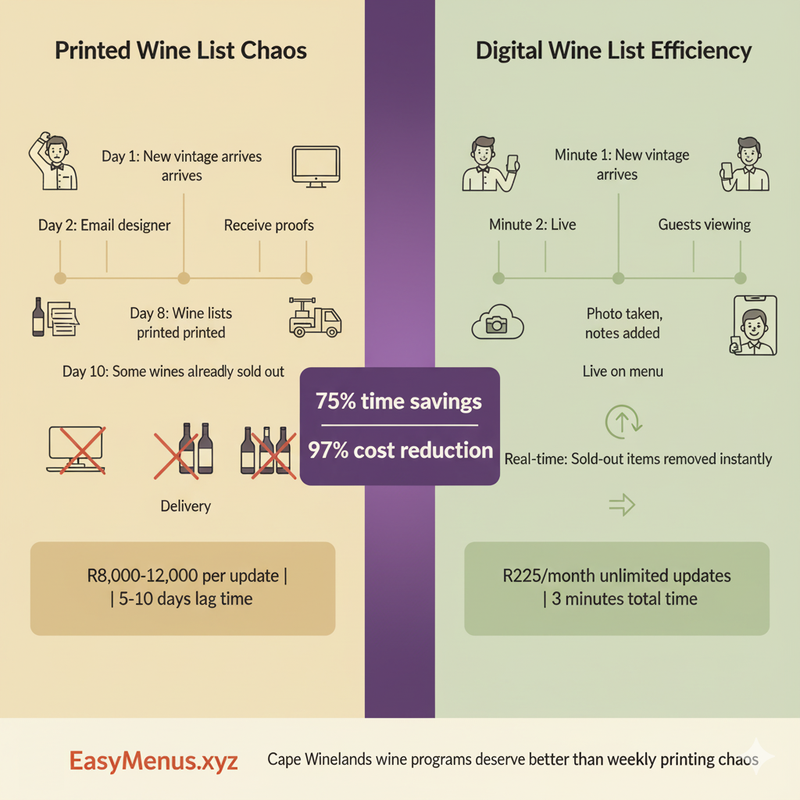
Traditional harvest season wine list management:
- Receive new wines
- Update wine list document
- Email designer (if you use one)
- Wait 2-3 days for revisions
- Send to printer
- Wait 3-5 days for printing
- Receive wine lists a week after wines arrived
- Some wines already sold out before appearing on printed list
Cost during harvest season: R12,000-15,000 per update × 3-4 updates = R36,000-60,000 just for February-April
Digital wine list during harvest:
- New wine arrives
- Open phone
- Add wine with photo and tasting notes (2 minutes)
- Guests see it immediately
- Update sold-out status in real-time throughout service
Cost during harvest season: Included in R225/month subscription
What Your Sommelier Is Actually Doing
Time breakdown with printed wine lists (weekly):
- Updating master wine list document: 3-4 hours
- Coordinating with designer: 2 hours
- Proofing and corrections: 2-3 hours
- Waiting for printing: 5-7 days (lost opportunity time)
- Distributing new lists, removing old ones: 1 hour
- Training staff on new wines and changes: 3-4 hours
- Verbally updating guests on sold-out items: 10-15 minutes per table × 40 tables/week = 6-10 hours
Total weekly time: 17-24 hours managing wine list logistics
Time breakdown with digital wine lists (weekly):
- Adding new wines as they arrive: 2-3 minutes each × 5 wines = 15 minutes
- Updating sold-out items throughout service: 30 seconds each × 10 items = 5 minutes
- Adjusting prices when vintages change: 30 seconds each × 5 changes = 2.5 minutes
- Staff automatically see current list: 0 additional time
Total weekly time: 22-25 minutes
Time savings: 16-23 hours weekly
That's not just efficiency. That's your sommelier doing their actual job - telling wine stories, building relationships with guests, educating about terroir - instead of coordinating with printers.
The Small Producer Relationship Problem
You have relationships with 15-20 small Cape wine producers. They bring you limited releases. Special vintages. Experimental wines. Bottles they only made 50-200 of.
This is what differentiates your restaurant. This is what wine tourists want. These relationships are gold.
But those small producers call on Friday: "Brought 6 bottles of something special. Can I drop them off Saturday morning before lunch service?"
With printed wine lists: "Sure, but guests won't know about it until we reprint next week." You sell maybe 2-3 bottles because servers mention it when they remember.
With digital wine lists: "Perfect, I'll have it on the menu by lunch service." You photograph the bottle when it arrives, add tasting notes, set quantity to 6 bottles. Every lunch guest sees it. You sell all 6 bottles, winemaker is happy, guests discovered something rare, everyone wins.
That's not hypothetical. That's every Saturday in Stellenbosch and Franschhoek.
The Vintage Transition Window
Here's what happened last Tuesday at a Constantia wine estate restaurant:
2023 Chenin Blanc: 8 bottles remaining, R450 2024 Chenin Blanc: 24 bottles arriving Thursday, R485 (price increased)
Tuesday-Wednesday guests ordered 6 bottles of 2023. Thursday morning, 2 bottles of 2023 remain, 2024 arrives.
With printed wine lists showing 2023 at R450:
- Thursday lunch guests order 2023
- Server: "Actually we only have 2 bottles left, but we have new 2024 at R485"
- Guests feel bait-and-switched (menu showed one thing, reality is different)
- Some decline the 2024 (price increase annoys them)
- Restaurant loses revenue on premium new vintage
With digital wine lists:
- Thursday morning: Update 2023 to "2 bottles remaining"
- Thursday afternoon when 2023 sells out: Remove 2023, add 2024 with new price and tasting notes
- Thursday dinner guests: See current reality, make informed decisions
- No surprises, no complaints, smooth vintage transition
What Franschhoek Fine Dining Actually Needs
La Petite Colombe. Protégé. Dusk Restaurant. These aren't casual bistros. These are Eat Out Top 10 establishments. Michelin Guide Africa mentions. International wine tourists specifically booking for these experiences.
Your wine program expectations:
- 200-300 bottle selection minimum
- Extensive Chenin Blanc library (South Africa's signature grape)
- Pinotage program (showcase South African variety)
- International wines for comparison (French, Italian for context)
- Vintage library (older vintages for serious collectors)
- Wine pairings for tasting menus (5-7 courses, specific selections)
Your operational reality:
- Limited production wines (boutique producer made 200 bottles, you have 12)
- Vintage variations (2022 vs 2023 Chenin tastes completely different)
- Seasonal availability (Sauvignon Blanc releases spring, drink young)
- Temperature-sensitive storage (cellar conditions affect readiness)
- Guest education needs (explaining Cape terroir to international visitors)
Printed wine lists can't handle this complexity at the pace required. You're reprinting R10,000-15,000 monthly minimum just keeping pace.
The Real Cost Mathematics
Tokara Restaurant (Stellenbosch Wine Estate) Reality:
- Wine list printing: R10,000 × 12 months = R120,000
- Harvest season extra updates: R12,000 × 3 = R36,000
- Rush fees (vintage arrives unexpectedly): R15,000
- Food menu seasonal updates: R8,000 × 4 = R32,000
- Tasting menu cards: R5,000 × 6 = R30,000
- Annual total: R233,000
Digital menu solution:
- Monthly: R225
- Annual: R2,700
- Net savings: R230,300
- ROI: 8,433%
Break-even: 7 days
But the real value isn't just rand. It's Saturday morning's special wine being on the menu by Saturday lunch. It's international tourists seeing accurate availability. It's your sommelier telling stories instead of apologizing.
The Bottom Line For Cape Winelands Restaurants
You're managing 200+ bottle wine programs that change weekly. Limited releases. Vintage transitions. Harvest season chaos. International wine tourists expecting wine country professional standards.
Your current solution: R8,000-12,000 monthly printing wine lists that are outdated within days.
Your better solution: R225 monthly, update wine list in 2 minutes from your phone, guests always see current availability, zero "sorry we're out" situations, sommelier focuses on hospitality not logistics.
Cost: R2,700 annually vs R96,000-144,000 printing Time: 22 minutes weekly vs 17-24 hours weekly Guest experience: Current accurate availability vs frequent disappointments Wine program reputation: Professional wine country standards vs inventory management complaints
Start managing your Cape Winelands wine program properly in 3 minutes - every wine list update, harvest season chaos included, R225/month. One wine list printing costs more than 3-5 months of digital unlimited updates.
Frequently Asked Questions
Why do Stellenbosch and Franschhoek restaurants spend so much on wine list printing?
Cape Winelands fine dining restaurants require quality wine lists matching R400-800 per person dining standards (professional printing, quality paper, proper presentation). Wine programs of 200-300 bottles change weekly due to limited production wines (boutique producers making 50-200 bottles), vintage transitions (2023 sells out, 2024 arrives mid-service), harvest season additions (February-April with constant new releases), and special allocations (winemaker brings 12 bottles exclusively). Quality printing costs R8,000-12,000 per run. Monthly updates = R96,000-144,000 annually just for wine lists, before food menus (R32,000), tasting cards (R30,000), or rush fees (R15,000+). International wine tourists expect wine country professional standards, making outdated lists damage reputation more than printing costs.
How do digital wine lists handle harvest season chaos in South African wine country?
Harvest season (February-April) creates maximum wine list volatility: Monday new vintage Sauvignon Blanc arrives, Tuesday Chenin Blanc released, Thursday Pinotage bottled, Saturday Cabernet ready. Traditional management requires updating documents, designer coordination, 3-5 day printing wait, resulting in R12,000-15,000 per update × 3-4 harvest updates = R36,000-60,000 for three months. Digital wine lists enable instant additions: sommelier photographs new bottle, adds tasting notes and food pairings (2 minutes), guests see immediately on scanning QR code, sold-out items removed real-time throughout service. Harvest season updates included in R225 monthly subscription with unlimited changes, eliminating R36,000-60,000 seasonal printing burden while maintaining accurate availability for wine tourists.
Can small boutique wine producers benefit from digital wine lists at estate restaurants?
Small Cape producers (Stellenbosch boutiques, Swartland natural winemakers) making 50-200 bottles rely on restaurant placements for exposure. Saturday morning delivery: "Brought 6 bottles of experimental Chenin, only for you." With printed wine lists reprinting weekly, guests don't know about special wine for 7-10 days (missed revenue, producer disappointed). Digital wine lists enable immediate addition: photograph bottle on arrival, add tasting notes highlighting limited availability (2 minutes), every lunch/dinner guest sees "6 bottles only - winemaker exclusive," sells all 6 bottles same day. This strengthens producer relationships critical for wine country differentiation, increases revenue from premium limited releases, and delivers authentic wine discovery experiences tourists specifically seek in Stellenbosch/Franschhoek dining.
What wine program time savings do Stellenbosch sommeliers achieve with digital menus?
Cape Winelands sommeliers managing 200+ bottle programs spend 17-24 hours weekly with printed lists: updating master documents (3-4 hours), designer coordination (2 hours), proofing (2-3 hours), distribution (1 hour), staff training (3-4 hours), plus 6-10 hours verbally correcting sold-out items at tables (10-15 minutes per table × 40 tables/week). Digital wine lists reduce this to 22-25 minutes weekly: adding new wines (2-3 minutes each × 5 = 15 minutes), updating sold-out status (30 seconds each × 10 = 5 minutes), price adjustments (2.5 minutes). Time savings: 16-23 hours weekly. Sommelier redirects time to actual hospitality: explaining Cape terroir to international guests, building winemaker relationships, creating wine pairing experiences, telling stories about South African wine heritage rather than coordinating printing logistics.
How do vintage transitions work with digital wine lists in wine country restaurants?
Vintage transitions create guest experience challenges: Tuesday restaurant has 8 bottles 2023 Chenin (R450), Thursday receives 24 bottles 2024 Chenin (R485). With printed lists showing 2023, Thursday guests ordering see: "Actually only 2 bottles left, but new 2024 at R485" (feels bait-and-switch, price increase annoys guests, lost revenue on premium vintage). Digital management: Thursday morning update 2023 to "2 bottles remaining," Thursday afternoon when sold remove 2023 and add 2024 with new tasting notes and price. Guests see current reality, make informed decisions, no surprises. Critical for Cape wine programs where vintage variations significantly affect tasting profiles (2022 vs 2023 Chenin completely different due to weather), and accurate vintage information maintains professional wine country reputation with sophisticated international wine tourists.
Related Articles
- Cape Town vs Johannesburg Restaurants: How Tourism Culture Affects Digital Menu Adoption
- Dallas Restaurant Wine Lists: The $12,600 Annual Printing Problem
- Wine List Management for Swiss Restaurants: How Digital Menus Save 40+ Hours Monthly
- Wine List Management for Canadian Restaurants: How Digital Menus Save 35+ Hours Monthly