
Vancouver & Toronto Wine Lists: How $2,400 Annual Printing Wastes 35+ Hours Monthly
Vancouver and Toronto restaurants spending $1,440-2,400 annually just on wine list printing. BC Okanagan wines, Ontario programs, import premiums. Digital saves 35+ hours monthly.
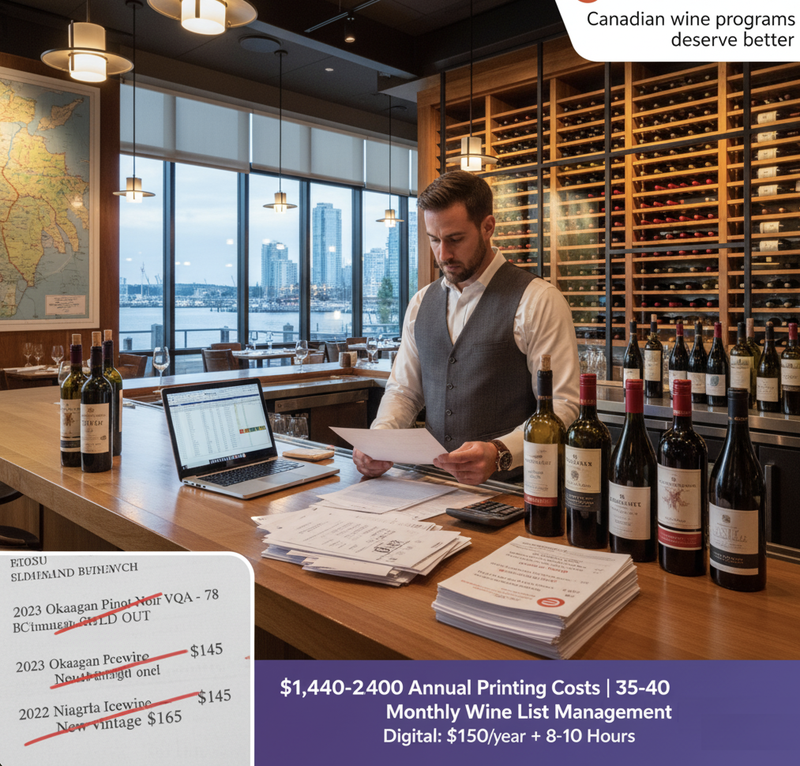
Wednesday afternoon in Vancouver. Your Okanagan wine supplier texts: "That Naramata Bench Pinot Noir you've been pouring? Producer only made 800 bottles this vintage. We're sold through. But I've got 12 bottles of exceptional Summerland Riesling instead. $68 wholesale. Want them?"
Of course you want them. Your Coal Harbour restaurant guests specifically come for BC wine programs. They want Okanagan Valley stories. Local terroir. Canadian wine discovery.
But your printed wine lists? You just had 50 copies done Monday. Cost you $200. That was two days ago.
Now you've got limited Okanagan Riesling arriving tomorrow that won't appear on any printed list. Meanwhile, the Naramata Pinot your menu shows? Gone. Guests tonight will order it. You'll disappoint them.
Rush printing to add the Riesling and remove the Pinot? $180 for 48-hour turnaround. That's $380 spent this week alone on wine list updates.
This is Vancouver and Toronto restaurants spending $1,440-2,400 annually just on wine list printing because Canadian wine programs - BC Okanagan limited releases, Ontario Niagara seasonal vintages, import premium volatility - create inventory complexity printed lists can't handle.
Meanwhile in Toronto, different wine culture, same printing problem. Your Harbourfront restaurant serves Ontario wine enthusiasts and international business travelers. Monday you printed wine lists featuring your Niagara Peninsula program. Wednesday your distributor emails: "That Prince Edward County Chardonnay sold out. But new vintage Niagara Riesling just arrived, $12 more per bottle due to vintage quality."
That's $180 you spent Monday on wine lists that are wrong by Wednesday. Two different Canadian wine markets, identical waste.
The Two Canadas Wine Reality
Vancouver - BC Wine Focus:
You're managing:
- Okanagan Valley limited production (small vineyards, 2,000-5,000 bottle runs)
- Naramata Bench wines (boutique producers, restaurant allocations of 12-24 bottles)
- Summerland varieties (Gewürztraminer, Riesling, Pinot Gris)
- Fraser Valley emerging wines (local angle, tiny production)
- Import wines (California, Oregon, Washington competing with BC pricing)
- VQA certification complexity (BC standards, estate bottled requirements)
Your Coal Harbour wine-focused restaurant reality:
- 200+ bottle program (BC wines 40%, US imports 35%, international 25%)
- Weekly deliveries (Okanagan producers dropping limited releases)
- Vintage volatility (BC weather variations create significant taste differences year-to-year)
- Tourist expectations (visitors want BC wine education, local stories)
- Currency impact (CAD/USD affects import pricing, BC wines priced in stable CAD)
Toronto - Ontario Wine Programs:
You're managing:
- Niagara Peninsula classics (Chardonnay, Riesling, Pinot Noir)
- Icewine specialties (premium dessert wine program, vintage critical)
- Prince Edward County cool climate (emerging region, limited availability)
- VQA Ontario standards (different from BC regulations)
- French/Italian imports (Ontario fine dining expectations, high-end programs)
- Business dining culture (expense accounts, corporate entertainment standards)
Your Harbourfront fine dining reality:
- 180-220 bottle program (Ontario wines 30%, European imports 45%, New World 25%)
- Seasonal Ontario releases (Niagara harvest timing affects availability)
- Icewine program complexity (vintage quality dramatically affects pricing $95-165/375ml)
- International clientele (business travelers, tourists, locals all with different expectations)
- Price sensitivity (CAD/USD fluctuations impact imported wine margins)
Common Canadian challenge: Provincial liquor regulations create interprovincial sourcing complications. BC wine available in BC restaurants, Ontario wine in Ontario venues, but cross-provincial availability limited. Your wine list reflects provincial reality, not national selection.
The Okanagan Valley Limited Production Problem
BC wine industry produces for domestic consumption primarily. Okanagan Valley vineyards are small compared to California operations. What this means operationally:
Typical BC wine production:
- Small vineyard: 2,000-5,000 bottles per wine
- Restaurant allocation: 12-24 bottles (week's worth at busy venue)
- No backstock (producer sells out, that's it until next vintage)
- Vintage variations significant (BC weather creates noticeable year-to-year differences)
Your Vancouver wine-focused restaurant scenario:
Monday: Naramata Bench Pinot Noir arrives. 18 bottles. Exceptional vintage. $78 bottle, $20 glass. Your printed wine list from last Friday doesn't mention it.
Tuesday dinner service: How do guests know you have this special Okanagan wine? Server mentions it? Chalkboard notation? Some tables hear about it, others don't. You sell 6 bottles Tuesday.
Wednesday: Wine blogger posts Instagram review. Suddenly everyone wants that Pinot. You've got 12 bottles left. Sell 8 bottles Wednesday.
Thursday: 4 bottles remaining. Your printed wine list still doesn't show it (next reprint scheduled for Monday). The guests who would've ordered it Tuesday don't know it existed. Lost revenue: potentially 6-8 bottles × $78 = $468-624.
Friday: Sold out. Remove it? Not on the list anyway. Add the next limited release that just arrived? Not printing until Monday.
With digital wine lists:
Monday morning: Naramata Pinot arrives. Photograph bottle. Add to menu: "Just Arrived - Naramata Bench Pinot Noir VQA 2023, limited 18 bottles, estate grown, $78 bottle / $20 glass, notes of cherry, earth, violet." Save (2 minutes). Every lunch and dinner guest sees it immediately.
Sell bottles in real-time, update inventory: "14 bottles remaining... 8 bottles remaining... 3 bottles only."
Thursday: Last 3 bottles. Update menu: "Final 3 bottles - Naramata Bench Pinot Noir." Creates urgency, maximizes revenue.
Friday morning: Sold out. Remove from menu (30 seconds). Friday lunch guests see accurate current selection. Zero "sorry, we're out" disappointments.
Revenue maximization: 18 bottles × $78 = $1,404 captured instead of missing 30-40% because guests didn't know it existed.
Blue Water Cafe's By-The-Glass BC Wine Volatility
Blue Water Cafe. Vancouver seafood institution. Serious BC wine program featuring Okanagan Valley selections by-the-glass. Their operational reality:
By-the-glass program complexity:
- 6 BC whites (Okanagan Chardonnay, Riesling, Pinot Gris, Gewürztraminer)
- 4 BC reds (Pinot Noir, Merlot, Syrah, Meritage blends)
- 2 sparkling (BC and Champagne comparison)
The bottle-level depletion challenge:
Monday: Open 2023 Summerland Riesling for by-the-glass. It's on printed wine list from last week.
Tuesday: Riesling is exceptional. Sell 12 glasses (1.5 bottles). One bottle left.
Wednesday morning: Distributor calls. "That Riesling? Producer sold through. But we have outstanding Oliver Riesling, different producer, $8 more per bottle wholesale."
Wednesday lunch: Last bottle of Summerland Riesling gone. Oliver Riesling arrives afternoon. Different wine, different price ($16 glass vs $14), different tasting profile.
With printed wine lists: Wednesday dinner, guests ordering from printed list seeing "$14 Summerland Riesling." Server explains: "Actually, we're now pouring Oliver Riesling at $16, different producer." Guests annoyed by price increase on menu item they can't get.
With digital wine lists: Wednesday afternoon when substitution arrives, update by-the-glass selection: Replace Summerland with Oliver, update price and tasting notes (1 minute). Wednesday dinner guests see current accurate offering. Zero confusion, professional execution.
This happens weekly with BC by-the-glass programs. Small production volumes mean frequent substitutions. Printed lists create constant verbal corrections.
Canoe Restaurant's Ontario Wine Seasonal Challenge
Canoe Restaurant. Toronto icon. 54th floor Toronto Dominion Centre. Canadian cuisine with Ontario wine focus. Their Niagara Peninsula program complexity:
Ontario wine program specifics:
- Niagara VQA Chardonnay (multiple producers, vintage critical)
- Riesling diversity (dry to off-dry, vintage variations significant)
- Icewine specialty (375ml bottles, $95-165 depending on vintage and producer)
- Prince Edward County cool climate (Chardonnay, Pinot Noir from emerging region)
- Seasonal releases (Niagara harvest September-October, fresh vintages November-December)
The icewine pricing volatility problem:
Your printed wine list shows: "2022 Niagara Icewine VQA - $135/375ml"
January: 2022 vintage sells out. 2023 vintage arrives. Producer pricing: $145/375ml (vintage quality excellent, 10-point Parker score increase justifies premium).
Your printed wine lists? Reprinted in December. Show 2022 at $135. Next scheduled reprint: March.
Current situation: January-February guests ordering icewine from printed list showing wrong vintage, wrong price. Servers explaining: "Actually, that's 2023 now at $145, not 2022 at $135." Icewine is premium dessert wine - $10 surprise price increase creates negative impression.
With digital wine lists: January when 2023 vintage arrives, update icewine entry: new vintage, new price, updated tasting notes highlighting vintage quality (90 seconds). Every guest sees accurate current offering. Premium positioning maintained without surprise pricing.
Ontario icewine is signature Canadian wine product. Vintage accuracy matters for international business travelers and tourists specifically seeking authentic Canadian wine experience.

The CAD/USD Import Premium Volatility
Canadian restaurants face currency exposure with imported wines:
Your wine sourcing reality:
- 30-40% Canadian wines (BC or Ontario, CAD pricing stable)
- 35-45% US imports (California, Oregon, Washington - USD pricing)
- 20-25% European imports (France, Italy, Spain - EUR pricing)
What happens with currency fluctuations:
January: Your printed wine list shows California Napa Cabernet at $95 (based on CAD/USD 1.35 exchange rate, $70 USD wholesale).
April: CAD/USD rate shifts to 1.38 (Canadian dollar weakens). Your wholesale cost increases 2.2%. To maintain margins, retail should be $98.
Your printed wine lists: Still showing $95. Options:
- Absorb $3 loss per bottle (margin erosion over time)
- Reprint wine lists mid-cycle ($180-200 additional cost)
- Server verbal corrections (unprofessional, confuses guests)
With digital wine lists: Currency volatility detected, update US import section pricing across all affected wines (15-20 minutes total). Guests see current accurate pricing. Margins maintained without mid-cycle reprinting costs.
This happens quarterly with CAD/USD and CAD/EUR fluctuations. Printed lists force choice between margin loss or expensive reprints. Digital enables instant currency-adjusted pricing.
Alo Restaurant's Wine Director Time Allocation
Alo Restaurant. Toronto's premier fine dining. Michelin Guide recommended. Extensive wine program featuring Ontario focus with international depth.
Their wine director managing printed wine lists (monthly):
- Updating master wine list document: 10-12 hours (180-220 bottles, detailed tasting notes)
- Coordinating with designer: 4-5 hours (professional quality matching Michelin standards)
- Proofing accuracy (vintages, pricing, VQA certifications): 6-8 hours
- Interprovincial compliance verification: 2-3 hours (Ontario liquor regulations)
- Staff training on changes: 5-6 hours (sommeliers need comprehensive wine knowledge)
- Waiting for printing: 5-7 days lag time (missed revenue on new arrivals)
- Verbally correcting sold-out items: 10-12 minutes per table × 50 tables monthly = 8-10 hours
Total monthly time: 35-42 hours managing printed wine list logistics
With digital wine list management (monthly):
- Adding new Ontario seasonal releases: 3-4 minutes each × 8 wines = 32 minutes
- Updating sold-out bottles real-time: 30 seconds each × 15 = 7.5 minutes
- Vintage transitions: 2 minutes each × 6 = 12 minutes
- Icewine pricing adjustments: 1 minute each × 4 = 4 minutes
- Currency-adjusted import pricing: 15-20 minutes quarterly (5-7 minutes monthly average)
- Staff automatically see current list: 0 training time on changes
Total monthly time: 8-10 hours
Time savings: 25-34 hours monthly
Alo's wine director should be sourcing rare Ontario vintages, building winemaker relationships, creating pairing experiences - not coordinating printing schedules.
The Interprovincial Wine Sourcing Reality
Canadian wine regulations create unique operational complexity:
BC restaurants:
- Easy BC wine access (local producers deliver directly)
- Ontario wine availability limited (interprovincial shipping restrictions)
- Focus naturally skews BC wine programs (regulatory and logistical reality)
Ontario restaurants:
- Easy Ontario wine access (Niagara producers 90-minute drive)
- BC wine availability limited (different provincial liquor systems)
- Focus naturally skews Ontario wine programs (proximity advantage)
Digital wine lists handle this by:
- Region-specific menu highlighting (BC restaurants showcase Okanagan Valley)
- Clear sourcing information (guests understand local vs import)
- Educational content (explain why BC restaurants feature BC wines prominently)
- No reprinting needed when provincial allocations shift
Vancouver example: Your BC wine section changes weekly (Okanagan deliveries constant). Your international section changes monthly (slower inventory turn). Digital lists enable different update frequencies without printing costs.
Toronto example: Your Ontario section changes seasonally (Niagara harvest timing). Your European section changes bi-monthly (vintage transitions). Digital lists accommodate different update patterns seamlessly.
Burdock & Co's Natural Wine Program Efficiency
Burdock & Co. Vancouver. Farm-to-table. Natural wine focus. Small producers, organic, biodynamic. Their wine program reflects restaurant philosophy.
Natural wine operational challenges:
- Tiny allocations (6-case = 72 bottles, gone in days)
- Frequent producer changes (one producer sells out, replace with different natural wine)
- Education critical (guests need natural wine context, what to expect)
- Price premiums (small production, artisanal methods justify higher cost)
With printed wine lists:
Monday: Natural wine allocation arrives from Okanagan producer. 72 bottles. Organic Gamay Noir, low intervention, $68 bottle.
Wait until Friday's scheduled reprint to add it? Miss 4 days of sales.
Reprint immediately? $180 for 2-day turnaround.
Handwrite on chalkboard? Undermines natural wine program premium positioning.
Wednesday: Different natural wine sells out (48 bottles sold in 2 days). Still on printed list. Servers telling every table "Sorry, that one's gone."
With digital wine lists:
Monday morning: Allocation arrives. Add to menu with detailed natural wine story: "Just Arrived - Okanagan Natural Gamay Noir, organic certified, 72 bottles only, minimal intervention, unfined/unfiltered, $68 bottle / $17 glass." (3 minutes)
Monday lunch-dinner: Guests see it immediately. Natural wine enthusiasts order it. You sell 24 bottles Monday-Tuesday instead of zero while waiting for Friday printing.
Wednesday: Sold out different natural wine. Remove from menu (30 seconds). Wednesday guests see accurate selection, no disappointments.
Natural wine programs depend on immediate communication of limited availability. Printed lists create revenue loss and guest frustration.
The Real Cost Mathematics
Vancouver Wine-Focused Restaurant (Coal Harbour, 200+ bottles):
- Monthly wine list printing: $200 × 12 = $2,400
- Seasonal updates: $180 × 4 = $720
- By-the-glass emergency updates: $120 × 6 = $720
- Special event pairing menus: $150 × 4 = $600
- Annual total: $4,440
Wine director time cost:
- 37 hours monthly × $45/hour = $1,665 monthly
- Annual: $19,980
Total annual cost (printing + time): $24,420
Toronto Fine Dining Restaurant (Harbourfront, 180-220 bottles):
- Monthly wine list printing: $180 × 12 = $2,160
- Niagara seasonal releases: $200 × 3 = $600
- Icewine program updates: $150 × 6 = $900
- Annual total: $3,660
Wine director time cost:
- 32 hours monthly × $45/hour = $1,440 monthly
- Annual: $17,280
Total annual cost (printing + time): $20,940
Digital menu solution (both cities):
- Monthly: CAD $12.50
- Annual: CAD $150
- Wine director time: 9 hours monthly × $45 = $405 monthly = $4,860 annually
Total annual cost (digital + time): CAD $5,010
Net savings:
- Vancouver: $19,410 annually (79% reduction)
- Toronto: $15,930 annually (76% reduction)
Break-even:
- Vancouver: 5-7 days
- Toronto: 6-9 days
The Bottom Line For Canadian Wine Programs
You're managing BC Okanagan limited production wines (2,000-5,000 bottle runs, 12-24 bottle restaurant allocations), Ontario Niagara seasonal releases (vintage quality variations, icewine pricing volatility), CAD/USD import premium fluctuations (quarterly currency impacts), and interprovincial sourcing complexity (BC wines in BC, Ontario wines in Ontario).
Current solution: $1,440-2,400 annually printing wine lists, plus 30-40 hours monthly coordinating logistics.
Better solution: $150 annually, update from smartphone in 2 minutes, all Canadian wine program complexity included.
Cost: $150/year vs $2,160-4,440/year Time: 8-10 hours monthly vs 30-40 hours monthly
Accuracy: 100% real-time vs 60-75% with lag Canadian wine focus: Easy Okanagan/Niagara updates vs expensive reprints
Start managing your Canadian wine program properly in 3 minutes - Okanagan limited releases, Niagara seasonal vintages, icewine programs, currency adjustments all included. CAD $12.50/month. One Vancouver wine list printing costs 12 months of digital unlimited updates.
Frequently Asked Questions
Why do Vancouver and Toronto wine programs have different printing costs?
Vancouver wine-focused restaurants (Coal Harbour, Yaletown) managing 200+ bottle programs with 40% BC Okanagan wines require monthly updates ($200 × 12 = $2,400) due to limited production allocations (small Naramata Bench vineyards making 2,000-5,000 bottles, restaurants receiving 12-24 bottles then sold out), weekly Okanagan producer deliveries (direct winery relationships mean constant new releases), VQA BC certification tracking complexity, and tourist education needs (international visitors want BC wine stories). Toronto fine dining (Harbourfront, Yorkville) managing 180-220 bottles spends $2,160 annually (lower volume, less frequent updates) with focus on Ontario Niagara seasonal releases (3-4 major updates annually), business dining culture (corporate clients less focused on latest vintages), and European import programs (slower inventory turn). Both markets waste 30-40 hours monthly on printed list logistics despite different update drivers.
How do BC Okanagan limited production wines create wine list management challenges?
Okanagan Valley small vineyards produce 2,000-5,000 bottles per wine (versus 50,000+ California commercial productions), with Vancouver restaurant allocations of 12-24 bottles. Naramata Bench Pinot Noir limited release means: Monday 18 bottles arrive, Tuesday-Wednesday sell 14 bottles (busy restaurant, by-the-glass program), Thursday 4 bottles remain, Friday sold out. Printed wine lists reprinted monthly cannot track this depletion speed. With digital menus, Monday morning arrival goes on menu immediately ("Just Arrived - 18 bottles only"), inventory updates real-time throughout week ("8 bottles remaining... 3 bottles final"), Thursday creates urgency ("Last 3 bottles"), Friday removal prevents "sorry, we're out" situations. BC wine tourism culture demands accurate availability - guests travel to Vancouver specifically for Okanagan wine programs, outdated printed lists damage reputation with sophisticated wine enthusiasts.
What Ontario wine program complexities affect Toronto restaurant wine list costs?
Toronto restaurants managing Ontario wine programs face: Niagara Peninsula vintage volatility (2022 vs 2023 Chardonnay taste significantly different due to weather, pricing varies $15-25 bottle based on vintage quality and critic scores), icewine specialty pricing ($95-165/375ml depending on vintage and producer with dramatic year-to-year fluctuations), Prince Edward County emerging region limited availability (cool climate Chardonnay and Pinot Noir, tiny production volumes), VQA Ontario certification standards (different from BC regulations, affects menu descriptions), and seasonal release timing (Niagara harvest September-October, fresh vintages November-December require menu updates). Printed wine lists showing "2022 Niagara Icewine $135" but 2023 vintage arriving at $145 (vintage quality premium) create constant server corrections. Digital menus enable instant vintage transitions, accurate icewine pricing updates, and real-time seasonal release additions without Toronto's typical $180 mid-cycle reprint costs.
How much time do Canadian wine directors save with digital wine list management?
Vancouver wine directors managing 200+ bottle programs spend 35-40 hours monthly with printed lists: updating master documents highlighting BC Okanagan wines (10-12 hours), designer coordination (4-5 hours), proofing VQA certification accuracy (6-8 hours), interprovincial compliance verification (2-3 hours), staff training on BC wine regions and varietals (5-6 hours), plus 8-10 hours verbally correcting sold-out limited releases at tourist tables. Toronto wine directors spend 30-35 hours monthly: master document updates featuring Ontario Niagara programs (8-10 hours), designer coordination (3-4 hours), vintage and icewine pricing verification (5-6 hours), compliance checks (2-3 hours), staff training (4-5 hours), sold-out corrections (6-8 hours). Digital management reduces this to 8-10 hours monthly for both cities: adding new wines (32 minutes), removing sold-out bottles (7.5 minutes), vintage transitions (12 minutes), currency adjustments (5-7 minutes). Time savings: 25-32 hours monthly, redirected to actual wine program development: sourcing rare Ontario/BC vintages, building winemaker relationships, creating Canadian wine education experiences.
Can digital wine lists handle CAD/USD currency volatility affecting imported wine pricing?
Canadian restaurants sourcing 35-45% US wines (California, Oregon, Washington) face CAD/USD exchange rate volatility. January printed wine lists show California Napa Cabernet $95 (based on 1.35 rate, $70 USD wholesale). April CAD/USD shifts to 1.38 (Canadian dollar weakens 2.2%), wholesale cost increases, retail should be $98 to maintain margins. Printed lists still showing $95 force choice: absorb $3 loss per bottle (margin erosion quarterly), reprint mid-cycle ($180-200 additional cost), or verbal price corrections (unprofessional). Digital wine lists enable immediate currency-adjusted pricing updates across all US import sections (15-20 minutes total updating 30-40 wines). This happens quarterly with CAD/USD and CAD/EUR fluctuations. Vancouver restaurants with 35% US imports and Toronto venues with 40% European wines both benefit from instant currency adjustment capability, eliminating $720-960 annual mid-cycle reprinting costs while maintaining import program profit margins despite Canadian dollar volatility.
Related Articles
- Stellenbosch & Franschhoek Wine Lists: When 200+ Bottles Change Weekly
- Dallas Restaurant Wine Lists: How $12,600 Annual Printing Kills Wine Program Profits
- Swiss Wine Lists: How Geneva & Zurich Restaurants Waste 40+ Hours Monthly
- Cape Town vs Johannesburg: How Tourism Culture Affects Digital Menu Adoption