
Dallas Restaurant Wine Lists: The $12,600 Annual Printing Problem
Wine program management and beverage menu complexity
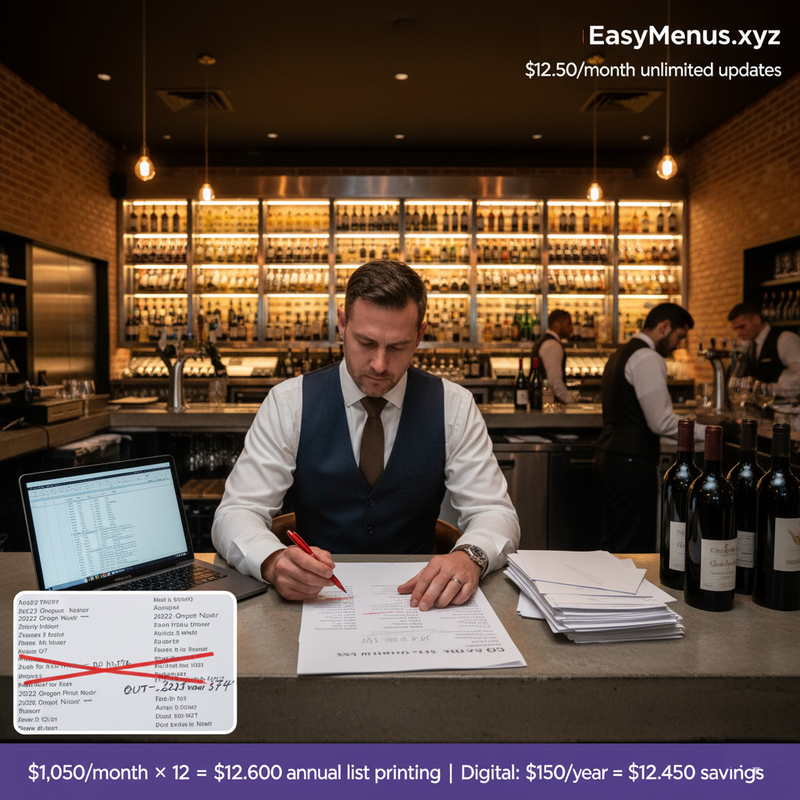
Tuesday afternoon. Your wine distributor calls. "That Oregon Pinot you've been pouring? Producer just released the 2023 vintage. 2022 is done. New pricing: $74 wholesale, up from $68. Ships Thursday."
You've got 40 copies of your wine list printed last Friday. $1,050 spent five days ago. Every single list shows "2022 Oregon Pinot Noir - $68 glass / $272 bottle."
Thursday the new vintage arrives. Different year. Different price. Your printed lists are wrong.
Options: Reprint everything for another $1,050 rush order. Hand-write corrections on 40 menus (looks amateur). Tell servers to verbally correct every table. Or just eat the $6 price difference until next month's reprint and watch your wine program margins evaporate.
This is Dallas restaurants with serious wine programs spend up to $12,600 annually just on wine list printing. Not because they want to. Because vintages change, natural wines rotate weekly, craft cocktails need seasonal updates, and wine-focused dining demands current accuracy.
You're not printing menus. You're subsidizing your distributor's inventory changes.
The Dallas Wine Scene Reality
What makes Dallas different:
Dallas isn't Napa. You're not a winery restaurant with your own production. You're sourcing from:
- Oregon Pinot Noir (Willamette Valley imports)
- California cult wines (allocation-based, vintage dependent)
- Texas Hill Country (local angle, limited production)
- Natural wine rotation (small producers, 6-case allocations)
- Old World imports (Burgundy, Barolo, Rioja with vintage volatility)
- Craft cocktail programs (seasonal ingredients, menu rotations)
Your operational challenges:
- Vintage transitions without warning (distributor sells out, new year arrives)
- Small allocation wines (you get 6 bottles, then it's gone)
- Texas heat affecting inventory (storage conditions limit aging potential)
- Natural wine volatility (small producer makes 200 cases, you get 12 bottles)
- Craft cocktail seasonality (fall menu completely different from summer)
- Competition (Uptown, Deep Ellum, Design District all fighting for wine tourists)
Current printing schedule:
- Monthly wine list updates: $800-1,200 per print
- Craft cocktail seasonal menu: $400 quarterly
- By-the-glass program updates: $250 bi-weekly when vintages change
- Special dinner wine pairing menus: $300 per event (4-6 annually)
Annual total: $10,800-15,600 just keeping beverage menus current
Little Blue Bistro's Natural Wine Problem
Little Blue Bistro. Natural wine focus. Small producers. Organic, biodynamic, minimal intervention. This is their thing. Their customers come specifically for these wines.
Problem: Natural wine producers make tiny quantities. You get a 6-case allocation. 72 bottles. That's 18 four-top tables pouring by-the-glass. At busy dinner service, that's 2-3 nights maximum.
Their current situation with printed wine lists:
Monday: New natural wine allocation arrives from small Loire Valley producer. 72 bottles of Chenin Blanc. Your printed wine list from last Friday doesn't mention it.
Option 1: Wait until next month's scheduled reprint. Miss out on selling this wine for 3-4 weeks while customers don't know you have it.
Option 2: Reprint immediately. $1,050 rush order, delivered Saturday. Five days of verbal server mentions before printed lists arrive.
Option 3: Handwrite it on a chalkboard. Half your tables don't see it. Looks unprofessional for wine-focused fine dining.
Wednesday: Different natural wine sells out entirely. 48 bottles gone in two days. Your printed list still shows it. Servers telling every table "Sorry, we just sold out of that."
With digital wine lists:
Monday morning: Allocation arrives. Photograph bottle. Add to menu: "Just Arrived - Loire Valley Natural Chenin Blanc, Organic, 72 bottles only, $14 glass / $56 bottle, notes of green apple and wet stone." Save. Every customer scanning QR code at lunch sees it. You sell 30 bottles Monday-Tuesday instead of waiting a month.
Wednesday afternoon: Wine sells out. Remove from menu in 30 seconds. Wednesday dinner, nobody tries to order it because it's not there. Zero awkward conversations.
This isn't theoretical. This is every week at natural wine focused restaurants.
Sketches of Spain's Vintage Accuracy Challenge
Sketches of Spain. Spanish wine program. Tempranillo, Garnacha, Albariño. Regional focus from Rioja, Ribera del Duero, Priorat. Serious wine list for serious Spanish cuisine.
Their vintage volatility:
Spanish wine vintages matter. 2018 Rioja tastes completely different from 2019. Pricing varies $20-40 per bottle depending on vintage quality and critic scores.
Your printed wine list shows:
- "2018 Rioja Reserva - $78"
- "2019 Priorat - $95"
- "2020 Ribera del Duero - $68"
Reality this week:
- 2018 Rioja sold out Monday (last 4 bottles ordered at one table)
- 2019 Priorat replaced by 2020 vintage at $102 (7-point price increase due to Parker score)
- 2020 Ribera del Duero now 2021 at $72 (vintage transition, new pricing)
Your printed lists are wrong on 3 out of 15 Spanish wines. That's 20% inaccuracy rate.
Customers ordering from printed lists see: "Sorry, that's actually 2020 now at $102, not 2019 at $95" or "We're out of the 2018, but we have 2019 at $84."
That's not providing Spanish wine expertise. That's creating confusion and mistrust.

The Craft Cocktail Seasonal Rotation Problem
Dallas craft cocktail scene is serious. Your bar program rotates seasonally:
- Summer: Mezcal watermelon cocktails, gin cucumber refreshers, tequila jalapeño margaritas
- Fall: Bourbon apple cider cocktails, whiskey pumpkin old fashioneds, rum spiced pear drinks
- Winter: Dark spirit focus, warming spices, citrus-based cold weather drinks Spring: Bright florals, lighter spirits, herb-forward cocktails
Each season = completely different cocktail menu. That's $400 printing × 4 seasons = $1,600 annually just for cocktails.
But here's what actually happens:
Mid-season ingredient availability changes: Your summer menu features strawberry basil gin fizz. Mid-July, strawberry season ends. Local supplier can't source quality strawberries. You need to replace it.
With printed menus: Either keep listing it and disappoint customers ("Sorry, we're out of strawberries"), or handwrite menu changes that look unprofessional for $18 cocktails.
With digital menus: Replace strawberry cocktail with blueberry lavender alternative (2 minutes). Every customer scanning menu sees current summer offerings. No disappointment, no amateur aesthetics.
Bartender experimentation: Your craft cocktail program thrives on creativity. Bartender creates something special off-menu. Customers love it. Instagram blows up. You want to add it officially.
With printed menus: Wait until next reprint (miss momentum) or handwrite it (undermines craft cocktail premium positioning).
With digital menus: Add new cocktail with ingredients, photo, pricing. Available immediately. Strike while Instagram interest is hot.
The By-The-Glass Wine Program Economics
Your by-the-glass program is profit-critical. But it's also inventory-volatile.
Standard by-the-glass rotation:
- 5 whites, 5 reds, 2 sparkling, 1 rosé (13 wines total)
- Each wine = 1 bottle open at a time
- Bottle lasts 2-5 days depending on traffic
- Once opened, clock is ticking on oxidation
What creates by-the-glass printing chaos:
Monday: Open new California Chardonnay for by-the-glass program. It's on your printed list from last Friday.
Tuesday: Chardonnay is exceptional. You sell 8 glasses. You've got maybe 12 glasses left in the bottle. You order more from distributor.
Wednesday: Distributor response: "That Chardonnay is sold out. Producer allocation complete. But we have this excellent alternative at $2 more wholesale."
Thursday: Alternative Chardonnay arrives. It's $2 more cost = $4 more retail pricing to maintain margins. Your printed menu shows old Chardonnay at old price. Customers order it. Servers explain: "Actually, we have a different Chardonnay now at $16 instead of $12."
This happens weekly with by-the-glass programs. Wines sell out. Vintages change. Distributors substitute. Pricing shifts.
With printed lists: Constant verbal corrections. Customer confusion. Margin erosion if you absorb price differences.
With digital lists: Update by-the-glass selection as wines change. Accurate pricing always. Zero confusion.
The Special Dinner Wine Pairing Problem
You're doing a Spanish wine dinner with Sketches of Spain's chef. Five courses, five wine pairings. This is marketing, community building, revenue opportunity.
Traditional wine pairing menu process:
- Plan dinner with chef: 2 weeks before
- Select wines with wine director: 10 days before
- Design pairing menu: 7 days before
- Send to printer: 5 days before
- Receive menus: 2 days before
- Day of event: Wine distributor calls. "That 2018 Rioja you were pairing with course 3? Sold out. We have 2019 at $8 more per bottle."
Now you're handwriting corrections on $300 worth of custom-printed pairing menus. Or absorbing the cost difference. Or disappointing guests expecting specific wines.
With digital pairing menus:
- Plan dinner, select wines
- Create digital pairing menu (15 minutes)
- Day of event, distributor issue occurs: Update menu in 30 seconds
- Guests scan QR code at their seat, see accurate pairings
- Zero printing cost, total flexibility
You're hosting 6-8 special dinners annually. That's $1,800-2,400 in pairing menu printing that's vulnerable to last-minute changes. Digital eliminates all of it.
What Your Wine Director Is Actually Doing
Time breakdown managing printed wine lists (monthly):
- Updating master wine list document: 8-10 hours
- Coordinating with graphic designer: 3-4 hours
- Proofing accuracy (vintages, pricing, descriptions): 4-5 hours
- Waiting for printing (opportunity cost of accuracy lag): 3-5 days
- Distributing new lists, collecting old ones: 2 hours
- Staff training on wine changes: 3-4 hours
- Verbally correcting sold-out wines at tables: 15 minutes/table × 60 tables/month = 15 hours
Total monthly time: 35-40 hours managing wine list logistics
That's a full work week every month spent on administrative coordination instead of:
- Building relationships with small producers
- Educating staff on wine regions and varietals
- Creating wine pairing experiences
- Engaging with guests about selections
- Sourcing unique allocation wines
- Attending industry tastings
With digital wine lists (monthly):
- Adding new wines as they arrive: 3-4 minutes each × 10 wines = 40 minutes
- Removing sold-out wines: 30 seconds each × 15 = 7.5 minutes
- Updating vintages and pricing: 1 minute each × 8 changes = 8 minutes
- Craft cocktail seasonal updates: 30 minutes quarterly
Total monthly time: 2-3 hours
Time savings: 32-37 hours monthly
Your wine director should be building your wine program, not coordinating with printers.
The Real Cost Mathematics
Dallas Wine-Focused Restaurant (150-200 bottle program):
- Monthly wine list printing: $1,050 × 12 = $12,600
- Craft cocktail seasonal menus: $400 × 4 = $1,600
- By-the-glass updates: $250 × 6 = $1,500
- Special dinner pairings: $300 × 5 = $1,500
- Rush fees (vintage emergencies): $1,800
- Annual beverage menu printing: $19,000
Digital menu solution:
- Monthly: $12.50
- Annual: $150
- Net savings: $18,850
- ROI: 12,467%
Break-even: 3.6 days
But it's not just money. It's natural wine allocations selling out before appearing on printed lists. It's vintage accuracy for Spanish wine programs. It's craft cocktails staying current without $400 quarterly reprints. It's special dinners without last-minute handwritten corrections.
The Bottom Line For Dallas Wine Programs
You're managing 150-200 bottle wine programs with natural wine rotations, vintage volatility, craft cocktail seasonality, and by-the-glass fluidity.
Current solution: $12,600 annually on wine list printing, plus $6,400 on cocktail and pairing menus. Total: $19,000 yearly telling customers what you had last month.
Better solution: $150 annually, update in real-time from your phone, customers always see current selections, zero awkward vintage explanations.
Cost: $150/year vs $19,000/year Time: 2-3 hours monthly vs 35-40 hours monthly Accuracy: 100% vs 70-80% Customer experience: Current information vs constant corrections
Start managing your Dallas wine program properly in 3 minutes - natural wine rotations, vintage accuracy, craft cocktail updates, special pairing menus all included. $12.50/month. One wine list printing costs 7 months of digital unlimited updates.
Frequently Asked Questions
Why do Dallas restaurants spend $12,600 annually just on wine list printing?
Dallas wine-focused restaurants managing 150-200 bottle programs face monthly updates ($1,050 × 12 = $12,600) due to vintage transitions without warning (distributor sells out 2022 Oregon Pinot, 2023 arrives at new price), small allocation wines (natural wine producers making 200 cases, restaurant gets 12 bottles then gone), Texas heat affecting inventory planning (storage limitations prevent long-term aging like California/Oregon cellars), craft cocktail seasonal rotations (complete menu changes quarterly = additional $1,600 annually), and by-the-glass program volatility (wines sell out mid-week, distributors substitute alternatives at different pricing). Special dinner wine pairings add $1,500+ annually. Total beverage menu printing: $19,000 yearly for wine programs requiring accuracy Dallas wine enthusiasts expect.
How do natural wine programs at restaurants like Little Blue Bistro benefit from digital menus?
Natural wine restaurants receive tiny allocations (6-case = 72 bottles) from small organic/biodynamic producers. With printed wine lists reprinted monthly, Monday arrival of Loire Valley natural Chenin means waiting 3-4 weeks before appearing on printed menu (missing sales momentum) or paying $1,050 rush reprint (uneconomical for 72-bottle allocation). Digital menus enable immediate addition: photograph bottle on arrival, add tasting notes and limited quantity notice (2 minutes), every lunch/dinner customer sees "Just Arrived - 72 bottles only" description. Allocation sells out Wednesday? Remove from menu in 30 seconds, preventing "sorry, we're out" conversations. Natural wine customers specifically seek rare finds - digital menus maximize revenue from small allocations while maintaining boutique wine program authenticity.
What vintage accuracy challenges do Spanish wine restaurants like Sketches of Spain face?
Spanish wine programs featuring Rioja, Priorat, Ribera del Duero face constant vintage transitions where vintage year significantly affects taste and pricing ($20-40 bottle differences based on critic scores). Printed wine list shows "2018 Rioja Reserva - $78" but this week: 2018 sold out Monday (last bottles ordered), 2019 Priorat replaced by 2020 at $102 (+$7 due to Parker rating), 2020 Ribera now 2021 at $72 (vintage transition). Result: 20% wine list inaccuracy requiring servers to correct every table ordering Spanish wines ("Sorry, that's actually 2020 at $102, not 2019 at $95"). Digital menus update vintages and pricing in real-time (30 seconds each), maintaining Spanish wine program credibility where vintage knowledge demonstrates expertise Dallas Spanish food enthusiasts expect.
How much time do Dallas wine directors save with digital wine list management?
Dallas wine directors managing printed lists spend 35-40 hours monthly: updating master documents (8-10 hours), designer coordination (3-4 hours), proofing accuracy (4-5 hours), distribution logistics (2 hours), staff training (3-4 hours), plus 15 hours verbally correcting sold-out wines at tables (15 minutes × 60 tables/month). Digital management reduces this to 2-3 hours monthly: adding new wines (40 minutes), removing sold-out selections (7.5 minutes), vintage/price updates (8 minutes), quarterly cocktail changes (30 minutes). Time savings: 32-37 hours monthly. Wine director redirects time to actual wine program development: building small producer relationships, staff education on regions/varietals, creating pairing experiences, engaging guests, sourcing allocation wines, attending industry tastings rather than coordinating printing logistics.
Can digital menus handle craft cocktail seasonal rotations and special wine dinner pairings?
Dallas craft cocktail programs require complete menu changes quarterly (summer mezcal watermelon vs fall bourbon apple cider) plus mid-season ingredient substitutions (strawberry season ends, need blueberry alternative). Traditional printing: $400 quarterly seasonal menus ($1,600 annually) plus inability to capitalize on bartender experimental cocktails that gain Instagram momentum. Digital menus enable instant seasonal rotations (upload new cocktail menu photos/descriptions quarterly) and mid-season ingredient pivots (2-minute updates maintaining craft cocktail premium positioning). Special wine dinners (6-8 annually) traditionally require $300 custom pairing menu printing vulnerable to last-minute distributor changes. Digital pairing menus: create in 15 minutes, update day-of if wine substitutions needed, guests scan at seats. Eliminates $1,800-2,400 annual pairing printing while providing total flexibility for wine dinner logistics.
Related Articles
- Stellenbosch & Franschhoek Wine Lists: When 200+ Bottles Change Weekly
- Wine List Management for Swiss Restaurants: How Digital Menus Save 40+ Hours Monthly
- Wine List Management for Canadian Restaurants: How Digital Menus Save 35+ Hours Monthly
- Dallas-Fort Worth Restaurant Printing Costs for Independent Restaurants