
Swiss Wine Lists: How Geneva & Zurich Restaurants Waste 40+ Hours Monthly
Wine-specific operational improvements through digital solutions
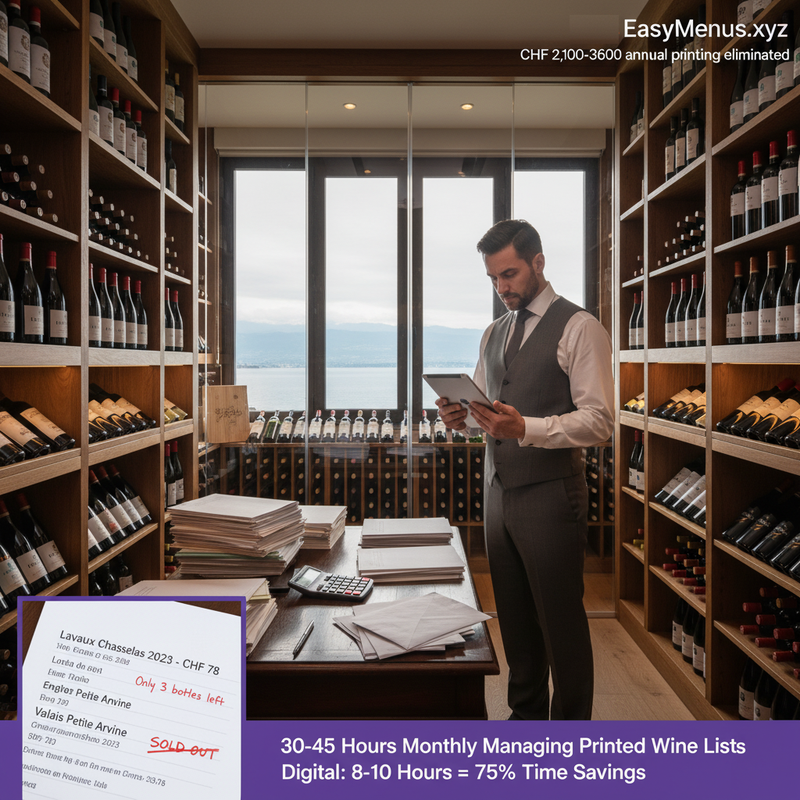
Wednesday afternoon in Geneva. Your Swiss wine supplier emails: "The Lavaux Chasselas we allocated you? Sold through. Producer only made 800 bottles this vintage. But I have 6 bottles of exceptional Valais Petite Arvine instead. CHF 82 wholesale, available tomorrow."
You've got 40 printed wine lists. Four languages (French, English, German, Italian - Geneva UN district standard). Cost you CHF 2,800 last month. Every list shows the Lavaux Chasselas you can no longer get.
Meanwhile, this Valais Petite Arvine won't appear on any printed list. Your international diplomats and banking executives dining tonight won't know you have it. Unless servers mention it verbally to the tables they reach before getting slammed.
This is Geneva and Zurich restaurants spending CHF 2,100-3,600 annually just on wine list printing because Swiss micro-production wines create bottle-level inventory complexity that printed lists can't handle.
You're not managing a wine program. You're subsidizing a printing schedule that can't keep pace with Swiss wine reality.
The Swiss Wine Program Challenge
What makes Swiss wine programs different:
Switzerland produces wine for local consumption, not export. Production is tiny compared to France, Italy, Spain. What this means operationally:
Micro-production scale:
- Swiss vineyard makes 2,000-5,000 bottles total (vs. 50,000+ Burgundy production)
- Your allocation: 12-24 bottles (gone in days at busy fine dining)
- No backstock, no reorder, no replacement vintage for months
Currency complexity:
- Swiss wines: CHF pricing (stable)
- French imports: EUR pricing (CHF/EUR exchange rate volatility affects margins)
- Italian imports: EUR pricing (same currency fluctuation)
- Customer expectations: Stable menu pricing despite wholesale volatility
Regional specificity:
- Lavaux Chasselas (Vaud region, 800-bottle productions common)
- Valais specialties (Petite Arvine, Humagne Rouge, limited)
- Geneva local wines (tiny production, restaurant allocations minimal)
- Ticino (Italian-speaking, Merlot focus, small scale)
Geographic market differences:
- Geneva: 41% non-Swiss population, UN/WHO/WTO diplomatic community, multilingual mandatory (French/English/German/Italian)
- Zurich: Traditional Swiss + international banking, German primary with English, more wine tourism from Switzerland itself
This creates operational chaos printed wine lists can't solve.
The Bottle-Level Depletion Problem
Your food menu has bulk inventory. You've got 40kg of beef tenderloin. Multiple portions. Warning time when running low.
Wine is different. Fundamentally different.
Bottle-level inventory reality:
Monday: You have 6 bottles of Lavaux Chasselas Grand Cru. CHF 78 by the glass, CHF 312 bottle.
Tuesday lunch: Table of 4 orders 2 bottles. Down to 4 bottles.
Tuesday dinner: Two tables order by-the-glass (8 glasses = ~1.5 bottles). Down to 2.5 bottles.
Wednesday: Your printed wine list still shows full availability. Guests order it. "Actually, we only have 2 bottles left."
With printed lists: Guests see false availability. Servers do verbal inventory updates all night. You look unprofessional.
With digital lists: Tuesday evening after service, update inventory: "Lavaux Chasselas Grand Cru - 2 bottles remaining, limited availability." Wednesday guests see reality. Order accordingly. Professional execution.
This happens daily with Swiss micro-production wines. Bottle sells, inventory drops, printed lists show outdated information.
Les Armures (Geneva) - The Multilingual Wine List Burden
Les Armures. Geneva Old Town. Traditional Swiss-French cuisine. Fondue, raclette, regional specialties. Serious wine program featuring Swiss wines and French imports.
Their Geneva reality:
- 41% non-Swiss clientele (UN diplomats, WHO officials, international organizations)
- Multilingual requirement: French (local), English (international), German (Swiss German speakers), Italian (Ticino visitors)
- Wine program: 200+ bottles, heavy Swiss focus with French Burgundy/Rhône for comparison
Current printing situation:
Wine list updates monthly. CHF 2,800 per print run for four-language professional quality matching their Old Town historic restaurant standards.
Annual wine list printing alone: CHF 33,600
Why monthly? Because:
- Swiss allocations arrive weekly (small producers, limited bottles)
- Vintage transitions (Swiss wines don't age like Bordeaux, drink younger)
- Currency volatility (EUR imports pricing fluctuates, CHF wine stable)
- Seasonal wines (Valais Fendant perfect summer, different Pinot Noir winter)
Their time burden:
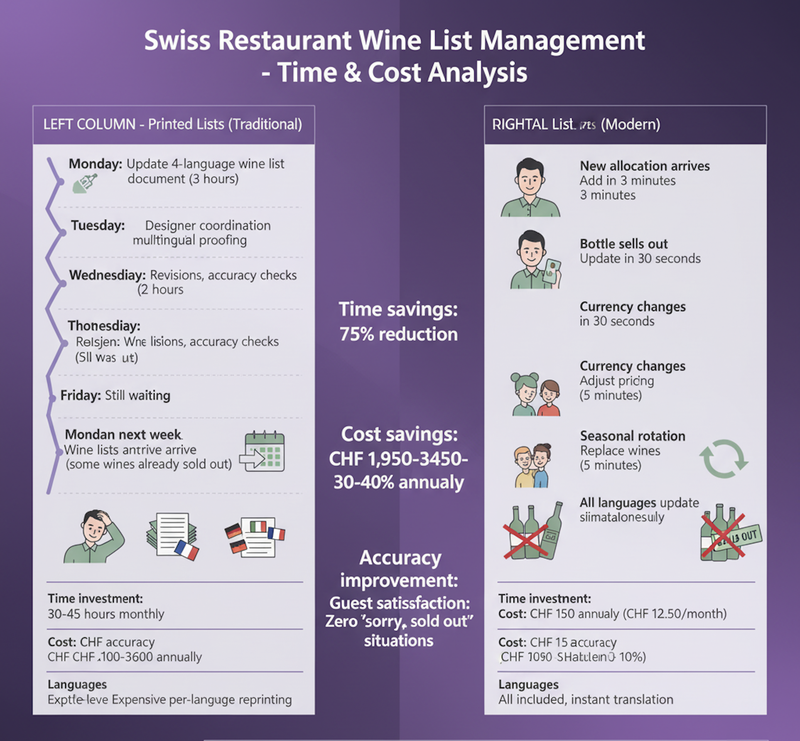
Wine director spends 30-35 hours monthly managing printed wine lists:
- Updating master document in 4 languages: 10-12 hours
- Coordinating with multilingual designer: 4-5 hours
- Proofing accuracy across languages: 6-8 hours
- Staff training on changes: 4-5 hours
- Waiting for printing: 5-7 days lag time
- Verbally correcting sold-out items: 5-10 minutes per table × 50 tables/month = 4-8 hours
That's nearly a full work week every month on wine list logistics instead of hospitality.
Kronenhalle (Zurich) - The Swiss Wine Tourism Challenge
Kronenhalle. Zürich institution since 1924. Original Chagall, Miró, Picasso artwork on walls. Traditional Swiss dining. International wine tourists and local Zürich professionals.
Their wine program complexity:
- Swiss wine focus (showcase national production to tourists)
- Zürichsee local wines (tiny production, restaurant relationships)
- International comparison wines (Burgundy, Barolo for context)
- Traditional Swiss varietals (Chasselas, Pinot Noir, Completer)
The Swiss wine tourism problem:
International tourists come to Kronenhalle specifically for authentic Swiss experience. They want Swiss wines. But they need education.
"What is Chasselas?" "How does Valais Petite Arvine differ from Alsace wines?" "What makes Swiss Pinot Noir special?" "Which wine represents Zürich region?"
Your printed wine list has space for wine name, vintage, price, maybe one-line tasting note. It doesn't have space for:
- Swiss wine region education
- Varietal characteristics unique to Alpine terroir
- Comparison to French wines tourists know
- Small producer stories
- Why this bottle costs CHF 95 when they can buy Burgundy for similar price
With printed lists: Server explanations add 10-15 minutes per tourist table. You've got 30 tourist tables weekly during summer tourism season. That's 5-7.5 hours weekly just educating about Swiss wines.
With digital lists: Swiss wine entries include detailed tasting notes, region maps, producer stories, food pairing suggestions. Tourist explores on phone at their pace. Server provides personal recommendations instead of basic education. Time saved: 5-7 hours weekly = 20-28 hours monthly.
The Currency Volatility Impact
Swiss restaurants face unique currency challenges:
Your wine sourcing:
- 40% Swiss wines (CHF pricing, stable)
- 35% French wines (EUR pricing, volatile CHF/EUR exchange)
- 15% Italian wines (EUR pricing, same volatility)
- 10% other imports (various currency exposure)
What happens with printed wine lists:
January: Print wine lists. French Burgundy Grand Cru listed at CHF 145 (based on EUR import cost at 0.95 exchange rate).
March: CHF/EUR rate shifts to 0.92. Your wholesale cost increased 3.3%. To maintain margins, retail should be CHF 150.
Your printed lists: Still showing CHF 145. Options:
- Absorb CHF 5 loss per bottle (margin erosion)
- Reprint wine lists (CHF 2,800 mid-cycle cost)
- Train staff to verbally correct pricing (unprofessional)
With digital wine lists:
Currency volatility detected → Update French wine pricing in 15 minutes across entire list → Guests see current accurate pricing → Margins maintained.
This happens quarterly with EUR imports. That's CHF 8,400-11,200 in additional reprinting or significant margin erosion.
Le Kudeta (Geneva) - The UN District Diplomatic Wine Service
Le Kudeta. Geneva diplomatic district. International clientele from UN, WHO, WTO, Red Cross. Fine dining with Swiss and international wine program.
Their operational reality:
- Multilingual requirement absolute (French/English/German/Italian/sometimes Spanish)
- Diplomatic guests expect flawless service
- Wine knowledge varies dramatically (Burgundy expert vs. wine novice)
- Expense account dining (price less sensitive, experience quality critical)
Current wine list challenge:
Printed multilingual wine lists cost CHF 3,200 per update (4 languages, diplomatic quality standards). They update monthly because Swiss allocations arrive weekly and diplomatic clients notice outdated information.
Annual printing: CHF 38,400
Their time allocation problem:
Wine director managing printed lists:
- Coordinating 4-language updates: 12-15 hours monthly
- Diplomatic client preferences tracking: 5-6 hours monthly (manual notes, no system integration)
- Proofing multilingual accuracy: 8-10 hours monthly
- Staff training across languages: 6-8 hours monthly
- Total: 31-39 hours monthly
With digital wine lists:
- Single update propagates to all 4 languages: 3-4 minutes per wine
- Client preference notes attached to digital profiles: Automatic
- Bottle-level inventory tracking: Real-time
- Staff see current list automatically: Zero training time on changes
- Total: 6-8 hours monthly
Time savings: 23-33 hours monthly = nearly full work week redirected to actual hospitality.
The Micro-Production Swiss Wine Story
You have relationships with small Swiss winemakers. Lavaux family vineyards. Valais mountain producers. These relationships differentiate your restaurant.
Typical Swiss micro-production scenario:
Vaud winemaker calls Friday: "I bottled something special. Only made 600 bottles this vintage. Traditional Chasselas method, 8 months on lees. You can have 12 bottles. Picking them up tomorrow?"
Saturday morning: 12 bottles arrive. Exceptional wine. CHF 68 wholesale, you'll pour CHF 85 bottle / CHF 21 glass.
With printed lists: Not on any menu. Server verbal mentions if they remember. Maybe sell 3-4 bottles over weekend. Winemaker disappointed you didn't move more.
With digital lists: Saturday 11am, photograph bottle, add tasting notes highlighting traditional method and limited 600-bottle production. Saturday lunch/dinner: Every guest sees "Just Arrived - Traditional Lavaux Chasselas, 12 bottles only, 8 months lees aging, CHF 85/bottle." Sell all 12 bottles by Sunday. Winemaker happy, relationship strengthened, guests discovered rare wine.
This happens monthly with Swiss micro-production relationships. Digital menus maximize revenue and preserve critical winemaker connections.
The Real Cost Mathematics
Geneva Fine Dining Restaurant (200+ bottle program, multilingual):
- Monthly wine list printing (4 languages): CHF 3,200 × 12 = CHF 38,400
- Rush fees for allocation emergencies: CHF 4,000
- Annual wine list printing: CHF 42,400
Wine director time cost:
- 35 hours monthly × CHF 45/hour = CHF 1,575 monthly
- Annual: CHF 18,900
Total annual cost (printing + time): CHF 61,300
Digital menu solution:
- Monthly: CHF 12.50
- Annual: CHF 150
- Wine director time: 8 hours monthly × CHF 45 = CHF 360 monthly = CHF 4,320 annually
Total annual cost (digital + time): CHF 4,470
Net savings: CHF 56,830 annually Time savings: 324 hours annually (75% reduction) Break-even: 4-6 days (Geneva), 6-10 days (Zurich)
The Bottom Line For Swiss Wine Programs
You're managing Swiss micro-production wines (600-2,000 bottle productions), multilingual requirements (French/English/German/Italian Geneva standard), currency volatility (CHF stable, EUR imports fluctuate), and bottle-level inventory complexity (12-bottle allocations deplete in days).
Current solution: CHF 2,100-3,600 annually printing wine lists, plus 30-45 hours monthly coordinating logistics.
Better solution: CHF 150 annually, update bottle-level inventory in real-time, all languages automatically, wine director focuses on hospitality not paperwork.
Cost: CHF 150/year vs CHF 38,400/year (Geneva) or CHF 25,200/year (Zurich) Time: 8-10 hours monthly vs 30-45 hours monthly Accuracy: 100% bottle-level vs 60-70% with lag time Languages: All included vs expensive per-language printing
Start managing your Swiss wine program properly in 3 minutes - micro-production allocations, multilingual updates, currency adjustments, bottle-level tracking all included. CHF 12.50/month. One Geneva wine list printing costs 21 months of digital unlimited updates.
Frequently Asked Questions
Why do Geneva restaurants spend more on wine list printing than Zurich restaurants?
Geneva's 41% non-Swiss population (UN/WHO/WTO diplomatic community) requires mandatory multilingual wine lists: French (local language), English (international business), German (Swiss German speakers), Italian (Ticino visitors). Four-language wine list printing costs CHF 2,800-3,200 per update versus Zurich's German/English bilingual at CHF 1,800-2,200. Geneva diplomatic dining standards demand monthly updates (Swiss allocations arriving weekly, micro-production wines selling out quickly) = CHF 33,600-38,400 annually versus Zurich's more traditional Swiss clientele accepting longer update cycles = CHF 21,600-26,400 annually. Geneva's international diplomatic community also expects flawless accuracy (outdated wine lists damage reputation more severely in diplomatic entertainment contexts), driving more frequent reprints.
How do Swiss micro-production wines create different wine list management challenges?
Swiss vineyards produce 2,000-5,000 bottles total per wine (versus 50,000+ Burgundy productions), with restaurant allocations of 12-24 bottles. Lavaux Chasselas from 800-bottle production means restaurant receives 12 bottles, sells 8 bottles over weekend, depleting inventory in 2-3 days. Printed wine lists reprinted monthly cannot track this bottle-level depletion speed. Valais Petite Arvine limited releases (producer made 600 bottles, restaurant gets 12) require immediate menu addition or guests never know special wine exists. Digital menus enable real-time bottle-level tracking: "Lavaux Chasselas - 3 bottles remaining, limited availability" updates in 30 seconds, maximizing revenue from precious Swiss micro-production allocations while maintaining professional wine country standards.
What time savings do Geneva and Zurich wine directors achieve with digital wine list management?
Geneva wine directors managing printed multilingual wine lists spend 30-45 hours monthly: updating 4-language documents (10-12 hours), multilingual designer coordination (4-5 hours), accuracy proofing across languages (6-8 hours), staff training (4-5 hours), plus 4-8 hours verbally correcting sold-out Swiss allocation wines at diplomatic tables. Digital wine list management reduces this to 8-10 hours monthly: adding new Swiss allocations as they arrive (3-4 minutes each × 10 = 40 minutes), updating sold-out bottles real-time (30 seconds each × 20 = 10 minutes), seasonal rotations (2 hours). Time savings: 20-37 hours monthly (75% reduction). Wine director time valued at CHF 45/hour = CHF 900-1,665 monthly savings = CHF 10,800-19,980 annually beyond printing cost elimination.
How does CHF/EUR currency volatility affect Swiss restaurant wine list printing costs?
Swiss restaurants source 40% Swiss wines (CHF pricing stable), 50% French/Italian imports (EUR pricing). CHF/EUR exchange rate volatility creates margin pressure: January printed lists show French Burgundy at CHF 145 (based on 0.95 exchange rate). March rate shifts to 0.92 (3.3% wholesale cost increase), requiring CHF 150 retail to maintain margins. Printed lists still showing CHF 145 force choice: absorb CHF 5 loss per bottle (margin erosion) or reprint mid-cycle (CHF 2,800-3,200 additional cost). This happens quarterly with EUR volatility. Digital wine lists enable 15-minute pricing updates across entire French/Italian section when currency shifts affect margins, eliminating CHF 8,400-12,800 annual mid-cycle reprinting or significant margin loss on imported wine programs.
Can digital wine lists handle Geneva UN district diplomatic dining service requirements?
Geneva diplomatic restaurants like Le Kudeta serve UN/WHO/WTO officials requiring flawless multilingual wine service (French/English/German/Italian mandatory, sometimes Spanish), wine knowledge varying dramatically (Burgundy experts vs novices), and expense account dining where experience quality critical over price sensitivity. Printed 4-language wine lists cost CHF 3,200 monthly (CHF 38,400 annually) with 31-39 hours monthly wine director time managing multilingual updates, diplomatic client preference tracking (manual notes), and staff training across languages. Digital menus provide: single wine entry updates propagating instantly to all 4 languages (3-4 minutes vs 12-15 hours), client preference notes integrated digitally, bottle-level inventory visible to all staff automatically. Reduces wine director time to 6-8 hours monthly (23-33 hours savings) while maintaining diplomatic service standards Geneva international community expects.
Related Articles
- Stellenbosch & Franschhoek Wine Lists: When 200+ Bottles Change Weekly
- Dallas Restaurant Wine Lists: How $12,600 Annual Printing Kills Wine Program Profits
- Wine List Management for Canadian Restaurants: How Digital Menus Save 35+ Hours Monthly
- Geneva vs Zurich Restaurant Printing Costs: Why Location Changes Everything