
Cebu City Restaurants: Handle 1.4M Tourists Without Printing Menus in 5 Languages
1.4M annual tourists. Korean, Japanese, American, Chinese visitors. Cebu lechon restaurants spend ₱120,000-240,000/year on multilingual printing. Digital solution: ₱8,400/year.
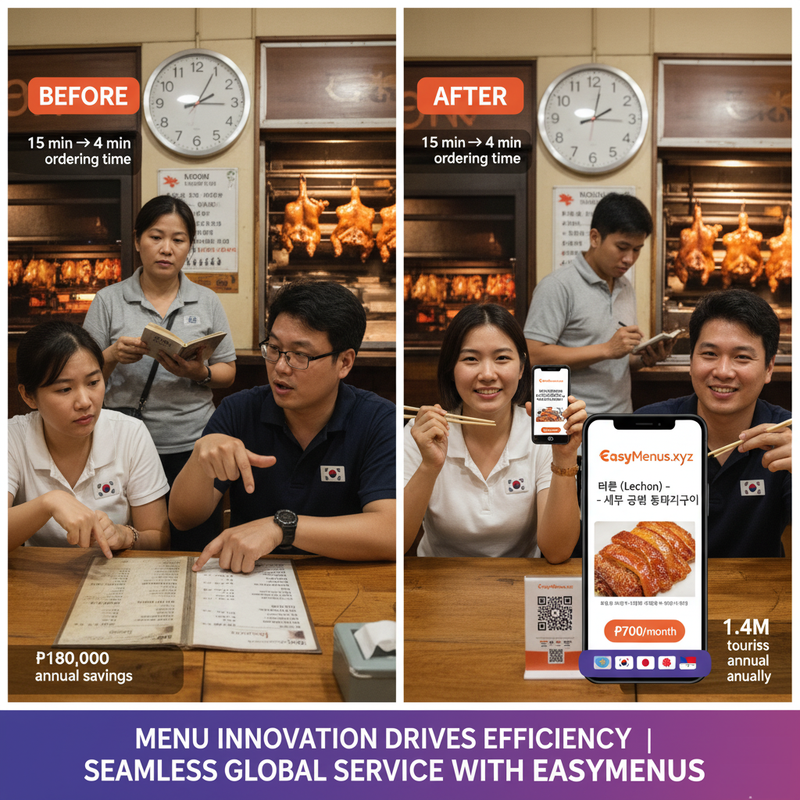
Korean tourist walks into your lechon restaurant in Cebu. You're famous. TripAdvisor says so. They flew here specifically for your lechon. Anthony Bourdain mentioned Cebu lechon. They've been planning this meal for weeks.
They can't read your menu.
"Lechon - ₱450/kg" printed there. That's it. No explanation of what lechon is. No photos showing how crispy the skin gets. No description of your special preparation making Cebu lechon different from Manila lechon. No guidance on what to order with it.
Your server explains. In English if they can manage. Using hand gestures and pointing at display case if they can't. Tourist nods politely, orders something, hopes it's what they wanted. Takes photo of menu with phone to translate later on Google Translate.
That's not the experience you want for someone who flew 1,500 kilometers to try your food.
Next table. Japanese family. Same explanation needed. Next table. American couple. Same thing. You're doing this 50 times daily during tourist season. Staff exhausted. Your famous lechon deserves better presentation.
The Cebu Tourist Reality
1.4 million foreign tourists come through Cebu every year. That's not counting Filipino tourists from Manila and other regions. Just international visitors.
Korean tourists are your biggest group. Then Japanese. Then Americans. Chinese tour groups. European backpackers. Australian families. All heard about Cebu lechon. All want to try it. None can read your Tagalog menu.
If you're printing menus in multiple languages? Spending ₱10,000-20,000 every update. Which is monthly minimum. Sometimes more when pork prices change or you add seasonal items.
₱120,000-240,000 annually. Just so tourists can understand what they're ordering.
And even with printed translations, half still ask questions. Because printed menus can't explain:
- What makes Cebu lechon different from Manila lechon
- How you prepare it (special herbs, slow roasting process)
- Which part of pig is best for first-timers
- What sides go with it traditionally
- Why it's the most famous food in Cebu
Your server explains all this. Verbally. In broken English. Forty-seven times today. While six other tables wait.
What Famous Cebu Restaurants Are Dealing With
Zubuchon—probably the most famous lechon in Cebu. Name everywhere. TripAdvisor. Food blogs. Travel vlogs. Korean variety shows mentioned them.
Every Korean tourist wants to go there. Every Japanese food blogger needs photos. Every American traveler following guidebook shows up.
They all need same information:
- What is lechon?
- How do you eat it?
- Which part should I try first?
- What's that sauce?
- Can I get it less fatty?
- Do you have other dishes?
Before digital menus? Staff explaining non-stop. In English. To people whose English isn't great. Communication gaps everywhere. Orders getting confused. Tourists leaving slightly disappointed because they didn't understand what they ordered.
House of Lechon—multiple locations around Cebu. Same challenge, multiplied by location count. Every branch needs current menus. In multiple languages. Updated simultaneously when prices change.
Print cost for one location updating monthly: ₱15,000. Three locations: ₱45,000. Annually: ₱540,000 on printing. Just for menus.
Rico's Lechon—Cebu institution. Been around forever. Locals love them. Tourists discover them. Both groups need different things from menu.
Locals know lechon. They just want prices and what's available today. Tourists need education. History. Context. Recommendations. You can't fit all that on printed menu without making it overwhelming.
The Translation Exhaustion Problem
Your server speaks Cebuano and Tagalog fluently. English is okay. Enough to take orders and explain basics.
But explaining Filipino food culture to Japanese tourists who speak minimal English? That's hard work. Doing it 50 times daily? Exhausting.
They're not translators. They're hospitality professionals. Should be reading table, recommending pairings, ensuring good service, building rapport. Not playing charades trying to explain what lechon belly is versus lechon shoulder.
When they spend 10 minutes per table doing food education? Table turnover slows. Wait times increase. Other customers frustrated. Staff burns out.
One Japanese food blogger told us: "I wanted to ask about preparation method but server was so busy I felt bad taking their time. I just ordered what next table had."
That's not language barrier. That's missed opportunity to share your craft.
The Review Problem Nobody Mentions
Check TripAdvisor reviews. We looked at 15 famous Cebu restaurants. What keeps appearing?
"Wish the menu had more description"
"Staff was nice but couldn't really explain dishes"
"Had to use Google Translate on phone"
"Would be better with English explanations"
"Not sure if I ordered what I wanted"
These aren't complaints exactly. These are tourists being polite. What they're actually saying: "I flew here specifically for this food experience and couldn't fully understand what I was eating."
Your 4-star review could've been 5 stars if they understood what made your lechon special. Your "good" review could've been "amazing" if they knew to try crispy skin first, then belly, then shoulder—each with different textures and flavors.
You're not getting bad reviews. You're getting okay reviews when you deserve great reviews. Because communication failed.
What Actually Works
Scenario 1: Korean Tour Group Arrives
Twenty Korean tourists. Bus just parked outside. They're here because tour guide said you have best lechon in Cebu. They've got 45 minutes before bus leaves for next stop.
Old way: Chaos. Server brings English menus. Koreans struggle reading. Tour guide tries translating for everyone. Server explains same thing twenty times. Orders get confused. Some people order wrong items. Takes 15 minutes just to order. Food comes rushed. Bus leaves. Reviews are "okay" because experience was stressful.
New way: Each person scans QR code. Menu appears in perfect Korean. Full explanation: "Lechon - Cebu's Famous Roast Pig. Slowly roasted over charcoal 4-5 hours. Skin crispy and golden, meat tender and flavorful. Cebu-style uses less liver sauce than Manila style, focusing on natural pork flavor enhanced with lemongrass stuffing. Traditionally served at fiestas and celebrations." Photos show whole roasted pig, then individual cuts with labels. They understand immediately. Order quickly and correctly. Server focuses on service, not translation. Better experience. Better reviews.
That's twenty potential 5-star reviews instead of twenty "it was fine" reviews.
Scenario 2: Price Increase (Market Reality)
Monday morning. Pork supplier messages on Viber. "Boss, pork prices up 20% starting tomorrow. Market situation. Sorry."
You need to update menu prices. Today. For four languages: Tagalog, English, Korean, Japanese.
Old way: Call print shop. "Boss, need emergency reprint. Four languages. How much? ₱18,000 for rush? When? Thursday? Too late, tourists arriving tomorrow. ₱22,000 for tomorrow delivery? Sige, go ahead." Meanwhile for three days your menu shows wrong prices and you're verbally correcting every order.
New way: Open phone. Change peso amount in one place. Hit save. Automatically updates in all four languages instantly. Every tourist who scans tomorrow sees current prices. Zero printing cost. Three minutes of your time.
That ₱22,000 stays in your pocket. Every single time prices change.
Scenario 3: Tourist Has Questions
Japanese couple sits down. They scan QR code. Menu appears in Japanese. They read:
"Lechon Belly (Liempo) - ₱520/kg - The most tender, juicy cut with perfect fat-to-meat ratio. Best for first-time lechon eaters. Crispy skin on top, melt-in-mouth fat underneath. Traditionally eaten with garlic rice and atchara (pickled papaya)."
They understand. They see photos. They order confidently. No translation needed. No staff time explaining. No communication gaps. No wrong orders.
Your server brings food, ensures everything's perfect, offers drink pairings. That's hospitality, not translation services.
The IT Park Factor
Something's changing in Cebu. IT Park restaurants catching up to Manila speed.
Why? BPO workers. Call center professionals. Tech startups. International clients visiting. They're used to Manila-level digital convenience. They expect efficient ordering. They expect accurate menus. They expect professional presentation.
Your printed menu is faded. Prices changed last month but menu says old prices. Some items sold out but still listed. They're annoyed. They leave. They don't come back.
IT Park has 40+ restaurants. Ones with digital menus are packed. Ones still using printed menus losing customers to competitors who got their act together.
This isn't just about tourists anymore. It's about Cebu's growing professional class demanding better.
Hotel Restaurant Reality
You're running hotel restaurant. Shangri-La Mactan. JPark Island. Waterfront. Radisson. You've got international guests expecting international hotel standards.
Your guest speaks German. Your menu is English. Your server speaks Cebuano, Tagalog, and English. Guest wants to know if kinilaw has raw fish (like ceviche). Server doesn't know German word for raw. They go ask. They come back. Guest frustrated. Two other tables waiting.
You're printing menus in six languages. English. Tagalog. Japanese. Korean. Chinese. Spanish. That's ₱30,000 per update. You update monthly because hotel standards demand current menus. ₱360,000 annually on printing.
Or you could spend ₱8,400 annually (₱700/month) and have unlimited updates in unlimited languages.
The math is brutal. ₱351,600 savings per year. Every year. That's full-time server's salary. Or kitchen equipment upgrades. Or staff training. Anything except paper menus outdated before they hit tables.
What This Actually Costs
Digital menu cost: ₱700/month (about $12.50 USD)
Your current printing costs (Cebu lechon restaurant printing 4 languages):
- Menu updates: ₱12,000 per update × 12 times/year = ₱144,000
- Seasonal specials: ₱5,000 × 6 times = ₱30,000
- Rush fees (because you always forget): ₱15,000/year
- Total annual printing: ₱189,000
Hotel restaurant printing 6 languages:
- Regular updates: ₱25,000 × 12 = ₱300,000
- Seasonal menus: ₱30,000 × 4 = ₱120,000
- Special dietary menus: ₱10,000 × 6 = ₱60,000
- Total annual printing: ₱480,000
Digital menu solution:
- Setup: Free
- Monthly cost: ₱700 (about $12.50 USD)
- Annual cost: ₱8,400
- Languages: Unlimited (Tagalog, English, Korean, Japanese, Chinese, Spanish, whatever you need)
- Updates: Unlimited (price changes, new dishes, sold-out items, instant)
Lechon restaurant savings: ₱180,600 annually
Hotel restaurant savings: ₱471,600 annually
But real savings? Staff not explaining lechon 50 times daily. Tourists understanding what makes your food special. Reviews saying "amazing" instead of "okay." Your reputation growing because communication actually works.
The Honest Truth
Cebu is growing. 1.4 million foreign tourists this year. Probably more next year. Korean tourists keep coming. Japanese food tourism increasing. China's opening back up.
Your famous lechon deserves professional presentation matching its reputation. Korean tourists deserve to read about your 4-hour roasting process in Korean. Japanese food bloggers deserve to understand what makes Cebu lechon different from Manila lechon in Japanese. American travelers deserve photos and context in English.
You're not translator. You're restaurant. Staff should be serving food and building hospitality, not playing charades explaining what crispy pata is.
Takes 3 minutes to set up. Costs ₱700/month—less than half of one menu reprint. If you hate it, cancel next month. You're out ₱700. Back to print shop.
But you probably won't hate it.
Most Cebu restaurants' only regret is not switching when they first heard about it. Not because it revolutionized anything. Just because it's one less headache. Korean tourist reads menu in Korean. Japanese blogger understands what they're eating. American family orders correctly. Staff focuses on hospitality.
Your famous lechon gets presentation it deserves. In every language your tourists speak.
Set up multilingual menus in 3 minutes and stop explaining lechon 50 times daily. ₱700/month (about $12.50 USD). Tagalog, English, Korean, Japanese, Chinese, Spanish—all included. No printing costs. Ever.
Frequently Asked Questions
How many languages do Cebu tourist restaurants actually need?
Minimum four: Tagalog (locals), English (general tourism), Korean (largest foreign tourist group), and Japanese (second-largest food tourism). Hotel restaurants typically need six: add Chinese (growing tour groups) and Spanish (European/Latin American guests). Famous lechon restaurants benefit from all six since they're food destinations attracting international visitors. IT Park restaurants might prioritize English and Tagalog for BPO professionals.
What do Korean tourists say about Cebu restaurant menus?
Korean travel blogs and reviews consistently mention menu difficulties: "Hard to understand menu" appears frequently. Tour guides spend time translating instead of enjoying meals. Some Korean tourists post that they "ordered randomly and hoped for the best." Food bloggers want to explain dishes to Korean audiences but struggle to get accurate information. Digital menus in Korean eliminate this completely—Korean tourists see perfect translations with cultural context and photos instantly.
How much are Cebu's famous lechon restaurants spending on multilingual printing?
Zubuchon, House of Lechon, and Rico's combined serve thousands of tourists weekly. Printing menus in 4 languages (Tagalog, English, Korean, Japanese) costs ₱12,000-18,000 per update. Most update monthly minimum = ₱144,000-216,000 annually. House of Lechon with 3 locations multiplies this across branches. Add seasonal specials, price changes, and rush fees = ₱180,000-250,000 yearly per restaurant. Digital solutions eliminate all of this for ₱8,400 annually (₱700/month).
Do Japanese food tourists accept QR code menus?
Japanese tourists expect and prefer digital convenience—Japan leads global QR code adoption. Japanese food bloggers specifically praise restaurants with Japanese-language menus because it allows them to create accurate content for Japanese audiences. Reviews from Japanese visitors mention "easy to understand," "photos were helpful," and "could learn about Filipino food culture." They're more comfortable with digital menus than printed English menus they struggle to read.
What Cebu restaurants are successfully using multilingual digital menus?
Hotel restaurants (Shangri-La Mactan, JPark Island Resort, Waterfront Hotel, Radisson Blu) switched early for international guest standards. IT Park restaurants serving BPO professionals are adopting for efficiency. Famous lechon specialists are beginning adoption to improve tourist experience and reduce staff translation burden. Current adoption approximately 10-15% of tourist-facing restaurants, with rapid growth expected.
Related Articles: