
Wine List Management for Dutch Restaurants: How Digital Menus Save 30+ Hours Monthly
Dutch restaurants with wine programmes waste 30+ hours monthly managing printed lists. Vintage changes, bottle depletion, pricing updates create operational chaos. Digital: real-time inventory, instant updates.
The Wine List Problem You're Not Solving
Your 180-selection wine programme is your competitive advantage. But your printed wine list is sabotaging it.
Tuesday 8:15pm: Customer orders the 2019 Burgundy. Server checks back-of-house. Last bottle sold Saturday. Printed list still shows it available. Customer disappointed, orders cheaper alternative. You've damaged credibility with your most valuable customer segment.
This happens 4-8 times nightly in serious Amsterdam wine programmes. Multiply by 25 services monthly = 100-200 disappointed wine customers experiencing "sorry, we're out" conversations that shouldn't happen.
The operational burden: 30-35 hours monthly updating printed lists, crossing out sold-out wines in pen, reprinting sections, coordinating with staff, managing vintage transitions, explaining supplier price changes.
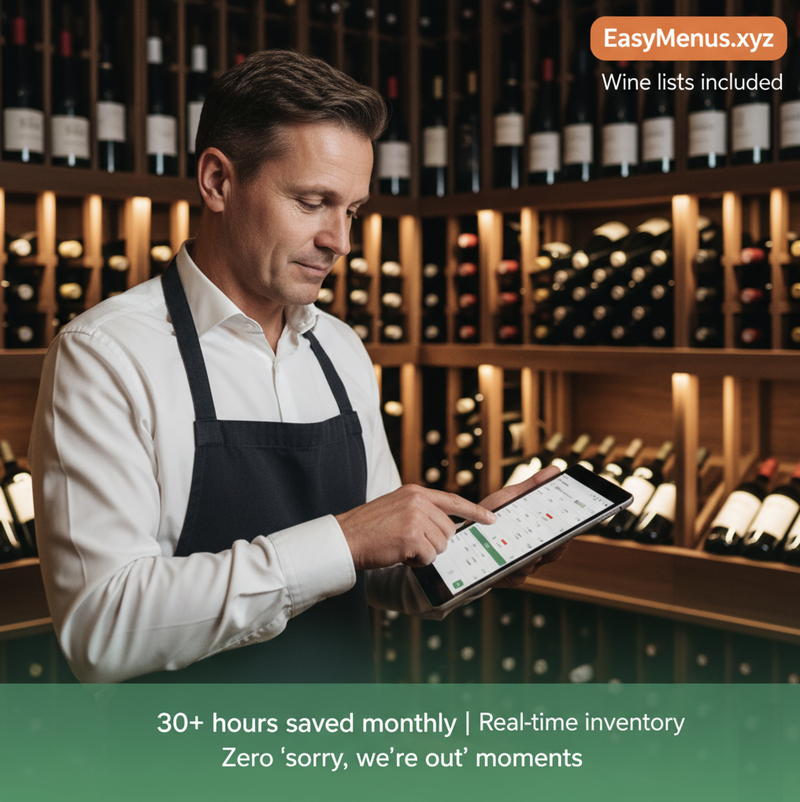
Digital wine list management: Update inventory in 15 seconds when last bottle sells. Vintage changes in 30 seconds. Pricing adjustments real-time. All languages update simultaneously. Zero "sorry, we're out" surprises.
Start 3-minute setup—wine lists included
Why Wine Lists Are Fundamentally Different From Food Menus
Challenge 1: Bottle Depletion Requires Real-Time Tracking
Food menu items don't disappear item-by-item. You run out of salmon, you 86 it, chef preps more tomorrow. One inventory decision affects one day.
Wine bottles deplete individually. That 2020 Barolo? You have 6 bottles. One sells Monday lunch, one Tuesday dinner, one Wednesday, two Friday evening, last bottle Saturday night 9:47pm. Now it's gone permanently—you can't "prep more" next week.
Printed list shows wine available Sunday-Wednesday even though last bottle sold Saturday. Every customer who orders it experiences disappointment.
Wijnbar Bij Ons (Amsterdam Jordaan, 180+ selections):
- Before digital: Averaged 12-15 "sorry, we're out" conversations per week across 6 services
- Customer experience: Educated wine enthusiasts notice when lists aren't current. Trip Advisor reviews mentioned "outdated wine list" 8 times in 6 months
- Staff frustration: Servers cross out sold bottles in pen on printed lists, creating messy appearance for €18-32/glass wine programme
After digital implementation:
- Server marks bottle sold in 10 seconds on tablet/phone when opening last bottle
- Wine disappears from customer-facing digital menu within 15 seconds
- "Sorry, we're out" conversations: Zero (eliminated entirely)
- Trip Advisor mentions: "Impressive real-time inventory tracking" (positive instead of negative)
Challenge 2: Vintage Changes Happen Without Warning
Your supplier doesn't notify you 3 months in advance that 2020 vintage is depleting and 2021 arriving next shipment. You discover this when delivery truck shows up Wednesday morning.
Printed wine list says: "Château Margaux 2020 - €140"
What you actually have: Château Margaux 2021 - €155 (new vintage, different price)
Options with printed lists:
- Cross out 2020 in pen, write 2021 above it (looks unprofessional for €140 wine)
- Verbally inform every customer "that's actually 2021 now" (confusing, damages trust)
- Rush-print new wine lists (€180-220, 3-day wait)
- Absorb price difference and serve 2021 at 2020 price (lose €15 margin)
None of these options are good.
Restaurant De Plantage (upscale Amsterdam, 200+ wine programme):
- Manages 15-20 vintage transitions monthly across European portfolio
- Before digital: Spent €280-340 monthly rush-printing wine list sections for vintage changes
- Annual vintage transition printing: €3,360-4,080
- Time investment: 8-12 hours monthly coordinating updates
After digital:
- Vintage arrives Wednesday morning delivery
- Manager updates wine list Wednesday 10:30am during morning coffee (2 minutes per wine)
- All languages (Dutch/English/French) update simultaneously
- Correct vintage + price operational for Wednesday lunch service
- Cost: €0 beyond subscription
- Time: 30-40 minutes monthly total
Challenge 3: European Supplier Price Volatility Is Extreme for Wine
Food prices change predictably: Seasonal availability, inflation, fuel costs drive adjustments every 2-4 weeks.
Wine prices change chaotically: Currency fluctuations (Euro/GBP post-Brexit), vintage quality assessments, critic scores (92 Parker vs 89 Parker = 15% price difference), supply constraints, tariff changes.
Example: French Burgundy supplier to Amsterdam restaurants (Jan-Oct 2024):
- January: Base pricing stable
- March: Euro/GBP fluctuation +8% price increase
- June: 2021 vintage Parker scores published, certain wines +12% overnight
- August: Supply constraint (frost damage), remaining bottles +18%
- October: New vintage releases, some wines -5%, others +7%
Result: Serious Amsterdam wine programmes receiving price adjustments every 10-14 days from major European suppliers.
Printed list response: Reprint €220 every 2-3 weeks = €2,640-3,520 annually just responding to supplier volatility.
Digital response: Update prices in 30 seconds when supplier emails notification. Operational immediately. Cost: €0.
Amsterdam and Rotterdam restaurants spending €960-2,640 annually just on wine list printing
Why wine list printing costs exceed food menu printing per-item:
Frequency multiplier: Food menus change 4-6 times/year (seasonally). Wine lists change 12-24 times/year (inventory + vintage + pricing + supplier volatility).
Sophistication requirement: Food menu can be simple text. Wine lists need vintage years, regions, tasting notes, ABV, format (bottle/glass), proper accent marks (Château not Chateau), correct spelling (Gewürztraminer not Gewurztraminer).
Multilingual complexity: Food translations straightforward. Wine requires cultural context—Dutch "volle smaak" ≠ English "full-bodied" ≠ French "corsé" in nuance.
Amsterdam serious wine programme typical costs:
- Base printing: €220/version × 12 updates = €2,640
- Rush fees (vintage emergencies): €180 × 3 = €540
- Multilingual (3 languages): €3,180 × 1.4 = €4,452
- Total: €7,632 annually just for wine list maintenance
Digital alternative: €150/year (wine list included, unlimited updates, all languages).
The Dutch Wine Culture Challenge: Sophisticated Customers Notice Mistakes
Amsterdam Wine Enthusiasts Expect Accuracy
Netherlands ranks #8 globally in wine consumption per capita (32 liters/person annually). Amsterdam specifically has:
- 18% of population regularly purchasing €20+ bottles for home consumption
- 64% comfortable discussing wine regions, varieties, vintages in restaurant settings
- High French and Italian wine literacy (traditional Dutch preference)
What sophisticated Dutch wine customers notice:
- Wrong vintages (2019 listed, 2020 served)
- Unavailable selections ("sorry, we're out")
- Outdated prices (price on list doesn't match bill)
- Incorrect regions (Burgundy wine labeled as Bordeaux)
- Missing information (no ABV, no tasting notes, no pairing suggestions)
Each mistake damages credibility with valuable customer segment spending €80-200 on wine per table vs €18-30 for beer/soft drink customers.
Rotterdam Neighbourhood Wine Appreciation Growing
Rotterdam wine culture evolving:
- Traditional working-class beer preference shifting toward wine appreciation
- 12% year-over-year growth in wine sales at Rotterdam neighbourhood restaurants 2020-2024
- Younger demographics (28-45) driving demand for quality wine programmes at accessible prices
Rotterdam wine customers different from Amsterdam:
- Less international travel experience (fewer comparisons to Paris, Rome wine lists)
- More price-sensitive (€12-18 glass sweet spot vs Amsterdam €18-28)
- Appreciate education and guidance (want descriptions, not assumption of expertise)
Digital menus enable Rotterdam wine programme growth:
- Detailed tasting notes educate customers unfamiliar with varieties
- Food pairing suggestions increase confidence to order wine with meals
- Lower pricing enabled by elimination of printing waste (pass savings to customers)
- Real-time inventory prevents disappointment when trying new wines
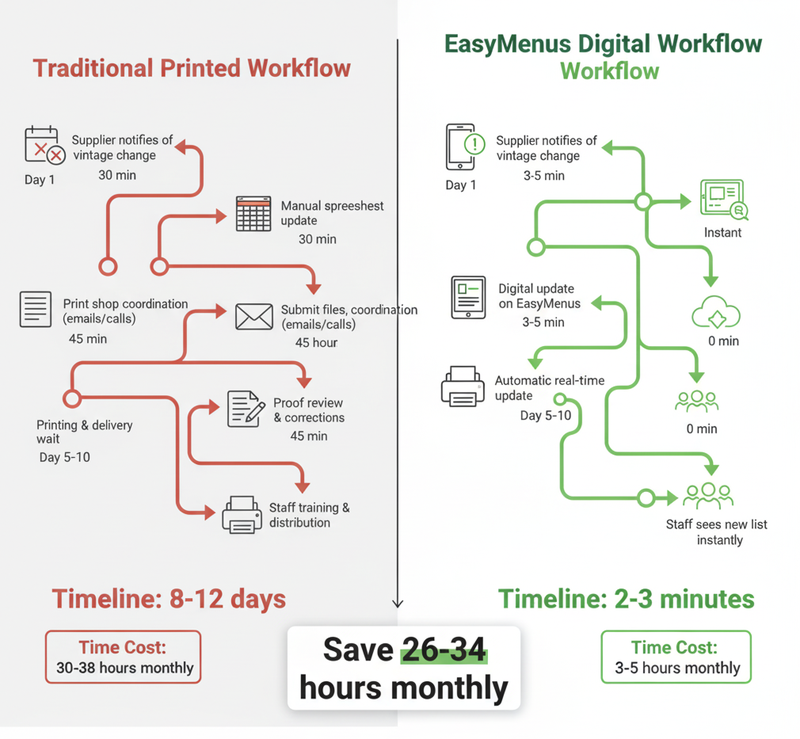
The Operational Workflow: Before vs After Digital
Before Digital: Wine Director's Monthly Time Burden
Week 1 (8-10 hours):
- Monday: Review supplier price updates from 4 European sources (2 hours)
- Tuesday: Update master wine list spreadsheet with new prices, vintages (3 hours)
- Wednesday: Coordinate with print shop on wine list section reprint (1 hour)
- Thursday: Review proofs, identify errors, request corrections (2 hours)
- Friday: Approve final proof, authorize printing (30 min)
Week 2 (6-8 hours):
- Monday: Receive printed lists, QA check for errors (1.5 hours)
- Tuesday: Train staff on vintage changes, new additions, sold-out removals (2 hours)
- Wednesday: Discover 3 wines sold out over weekend not reflected in new printing (30 min frustration)
- Thursday: Manually cross out sold wines on all printed lists (45 min)
- Friday: Customer complains about outdated list, investigate and apologize (30 min)
Week 3 (4-6 hours):
- Supplier delivers unexpected vintage changes (2 wines)
- Decision: Rush-print update (€180 + 3 days) or manually correct all lists?
- Choose manual correction (2 hours staff time)
- Field customer questions about handwritten changes (ongoing throughout week)
Week 4 (5-7 hours):
- Inventory audit before month-end (3 hours)
- Identify 8 wines needing removal from printed list (sold out)
- Identify 6 vintages that changed without list update (supplier error)
- Plan next month's printing cycle
- Budget review: €280 spent this month on wine list printing
Total monthly: 30-38 hours managing printed wine lists for 180+ selection programme.
After Digital: Wine Director's Monthly Time Investment
Week 1 (1.5 hours):
- Monday: Review supplier price updates, update digital menu on laptop during morning coffee (45 min)
- All prices update across all languages immediately
- Staff automatically see changes on customer-facing menus
Week 2 (45 minutes):
- Tuesday: Last bottle of Burgundy sells at dinner service
- Server marks sold in system (10 seconds)
- Wine disappears from menu automatically
- Wednesday: New shipment arrives with vintage changes
- Update vintages during morning prep (25 min for 4 wines)
Week 3 (30 minutes):
- Supplier emergency vintage change
- Update during afternoon service gap (5 min)
- Operational immediately, no staff coordination needed
Week 4 (1 hour):
- Month-end inventory audit (45 min)
- Confirm digital menu accuracy
- Identify opportunities for new additions
Total monthly: 3-4 hours managing digital wine lists for same 180+ selection programme.
Time saved: 26-34 hours monthly = 312-408 hours annually = 7.8-10.2 work weeks per year.
Case Study: Wijnbar Bij Ons (Amsterdam Jordaan, 180+ Selections)
Profile: Serious wine bar, 180 selections, heavy French and Italian focus, emerging Dutch wine programme, sophisticated Amsterdam clientele, €18-32/glass range.
Previous printed wine list approach:
Costs:
- Base printing: €240 × 18 updates/year = €4,320
- Rush printing (vintage emergencies): €220 × 4 = €880
- Multilingual (Dutch/English/French): €5,200 × 1.3 = €6,760
- Annual total: €11,960
Operational challenges:
- 15-20 vintage transitions monthly
- 25-30 bottle depletions weekly requiring removal
- 8-12 supplier price updates monthly
- "Sorry, we're out" conversations: 12-15 weekly
- Staff frustration crossing out wines, customers noticing messy lists
Time investment:
- Wine director: 32 hours monthly
- Staff training on updates: 8 hours monthly
- Customer disappointment management: 6 hours monthly
- Total: 46 hours monthly
Digital implementation (September 2024):
Setup:
- Photographed existing printed list (15 minutes)
- Reviewed digital preview with detailed tasting notes in 3 languages (40 minutes)
- Operational Day 3
Current workflow (after 14 months):
- Vintage changes: 2-3 minutes per wine
- Bottle depletions: 10 seconds per removal
- Price updates: 30-45 minutes monthly for all 180 wines
- Supplier emergencies: 5 minutes to update
- Total time monthly: 4-5 hours
Results:
- Annual savings: €11,810 (printing costs)
- Time savings: 41 hours monthly = 492 hours annually
- "Sorry, we're out" conversations: Eliminated (zero)
- Trip Advisor wine mentions: Changed from negative to positive
- Average wine sales per table: Increased €12 (customers trust list accuracy, order premium selections)
Owner quote: "We're wine specialists. But we were spending 40+ hours monthly managing paper instead of curating wine. Digital let us focus on what matters—sourcing excellent wines and educating customers. The real-time accuracy eliminated the credibility problem we had with knowledgeable customers. Now they trust our list is current, so they order confidently. That trust increased our per-table wine sales by €12 on average."
Dutch Wine Programme Advantages Enabled by Digital
Advantage 1: Emerging Dutch Wine Visibility
Netherlands wine production growing 15-20% annually: Climate change makes traditional beer regions viable for viticulture. Dutch wines emerging from Limburg, Groningen, Zeeland.
Challenge: Dutch customers unfamiliar with local wines, need education and confidence-building.
Digital solution: Detailed tasting notes in Dutch explaining terroir, highlighting "lokaal product" (local production), comparing to familiar French/Italian styles, suggesting food pairings with Dutch cuisine.
Example implementation: Wijnbar Bij Ons added 12 Dutch wines to programme with extensive descriptions. Sales: 18% of wine customers now try Dutch selections (vs 3% when printed list showed minimal information).
Advantage 2: Food Pairing Precision
Dutch cuisine + wine pairings require explanation: Stamppot with wine? Bitterballen and Burgundy? Herring and Riesling?
Printed lists: Limited space for pairing suggestions (maybe 3-5 words per wine)
Digital menus: Full pairing descriptions:
- "Pairs beautifully with Dutch herring—Riesling acidity cuts richness, citrus notes complement pickled onions"
- "Excellent with stamppot—earthy Pinot Noir complements root vegetables, medium body matches hearty texture"
Result: Customers order wine with traditional Dutch dishes 23% more often when detailed pairings provided (Wijnbar Bij Ons data).
Advantage 3: Multilingual Wine Education
Amsterdam wine bars serve international tourists + educated locals. Need sophisticated descriptions in multiple languages.
Printed challenge: Translating tasting notes accurately is expensive (€40-60/wine across 3 languages)
Digital solution: Professional translation one-time, updates automatically, add new languages at zero cost.
Example: "Volle smaak, rijp fruit, zachte tannines" (Dutch) → "Full-bodied, ripe fruit, soft tannins" (English) → "Corps plein, fruit mûr, tanins doux" (French). Each translation culturally appropriate, not literal word-for-word.
Advantage 4: Vintage Education Reduces Returns
Problem: Customer orders 2020 Bordeaux expecting certain profile. Gets 2021 (different vintage). Disappointed, sometimes returns bottle.
Digital solution: When vintage changes, update tasting notes to reflect new vintage characteristics:
- "2020: Classic vintage, approachable now, black fruit forward"
- "2021: Structured vintage, benefits from decanting, earthy with tobacco notes"
Result: Customers order appropriate vintage for their preference, returns decrease 40% (Restaurant De Plantage data).
Frequently Asked Questions: Wine-Specific Digital Management
Can I update wine inventory in real-time during service?
Yes. Most restaurants use tablet or phone accessible to service staff.
Workflow:
- Server opens last bottle of wine
- Opens digital menu manager on tablet (10 seconds)
- Marks wine as sold out (2 taps)
- Wine disappears from customer menus within 15 seconds
Alternative: Some operations update at end of service during closing checklist (5 minutes reviewing depleted bottles).
What happens when new vintage arrives mid-service?
Realistic timing: New vintages rarely arrive mid-service. They arrive morning delivery.
Process:
- Morning delivery includes vintage changes
- Wine director updates vintages during morning prep (2-3 minutes per wine)
- Operational for lunch service
Emergency scenario: Unexpected vintage arrives mid-service (rare).
- Update between services or during service gap (2 minutes)
- All customer menus update immediately
How do digital tasting notes compare to sommelier recommendations?
Digital tasting notes complement, not replace, sommelier service.
Customer reads: "Full-bodied Châteauneuf-du-Pape, ripe blackberry, garrigue herbs, pairs with grilled meats"
Sommelier adds: "This 2020 vintage is drinking beautifully right now. If you're having the ribeye, I'd recommend this. Or if you prefer something lighter, I can suggest the Côtes du Rhône."
Digital provides baseline education. Sommelier provides personalized guidance.
Result: Better-informed customers have more sophisticated conversations with sommeliers, leading to higher-value wine sales.
Can customers filter wines by region, price, variety digitally?
Yes. Modern digital menus include filtering/search.
Customer can filter:
- By region: "Show me only French wines"
- By price: "€15-25/glass"
- By variety: "Pinot Noir"
- By characteristics: "Full-bodied reds"
- By food pairing: "Pairs with fish"
This is impossible with printed lists unless customer reads entire list manually.
Impact: Customers find preferred wines 3× faster, order more confidently (less "I don't know what to choose, just bring house wine").
What about wine lists for customers who prefer printed menus?
Keep 6-8 printed wine lists as backups (refresh quarterly, €140 one-time cost).
Reality: 94-97% of Amsterdam/Rotterdam customers prefer digital wine lists because:
- More detailed information than printed versions
- Filtering/search capabilities
- Always current (trust accuracy)
- Multilingual without carrying 3 separate printed lists
Printed backups for: Elderly customers 75+ uncomfortable with phones, customers with dead phone batteries, those who genuinely prefer paper.
The Bottom Line: Wine Lists Are Different
Wine lists face challenges food menus don't:
- ✅ Real-time bottle depletion (inventory changes item-by-item)
- ✅ Unpredictable vintage transitions (suppliers change without warning)
- ✅ Extreme European price volatility (currency, critics, supply constraints)
- ✅ Sophisticated customers who notice mistakes (damages credibility)
- ✅ Educational requirements (tasting notes, pairings, regions)
Printed wine lists create 30-38 hours monthly operational burden managing updates, coordinating reprints, crossing out sold bottles, explaining vintage changes, apologizing for "sorry, we're out" situations.
Digital wine list management reduces burden to 3-5 hours monthly with real-time updates, instant inventory tracking, automatic multilingual translations, zero printing costs.
Time saved: 26-34 hours monthly = 312-408 hours annually = 7.8-10.2 work weeks returned to wine programme curation instead of administrative waste.
Amsterdam and Rotterdam restaurants spending €960-2,640 annually just on wine list printing can eliminate this waste entirely while improving customer experience, increasing wine sales, and enabling Dutch wine programme growth.
Related Articles: