
You're Reprinting Again. That's €220 This Month.
Brussels restaurants reprint menus 2-3 times monthly due to price changes. That's €660+ on printing. Digital menus update in 30 seconds for €12.50/month.
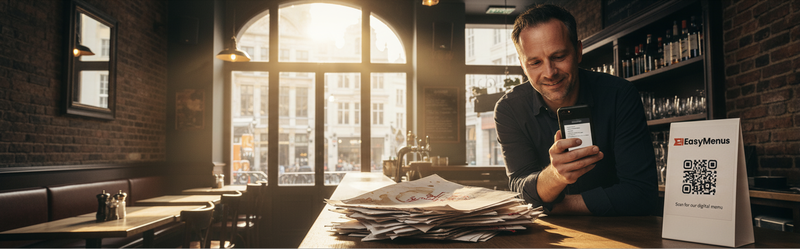
You're Reprinting Again. That's €220 This Month.
You open the email at 7:42am, first coffee still brewing.
Subject line: "Price Update - Effective Immediately"
Your beef supplier. Everything's up 9%. Six dishes on your menu just became unprofitable at current prices.
You grab last month's printing invoice. €220 for 100 menus. Delivered two weeks ago.
Now you need to reprint. Again.
This is the third time this month.
The Reprint Cycle Nobody Talks About
First time was planned. Spring menu change. New seasonal dishes, updated wine list. €220. You budgeted for it.
Second time was your wine distributor. Called Wednesday afternoon - they discontinued your house red. The one on every table. Had to replace it fast. Another €220.
Now this. Beef prices up 9%. You can't absorb that on 8% margins.
You call the designer. She can start Thursday. €80 for rush updates.
You call the printer. €220 for 100 menus, same as always. Ready next Tuesday if you approve proofs Friday.
Nine days minimum. Meanwhile, you're serving €24 steaks that cost you €19 to make. You're losing €3 per plate after labor and overhead.
You run the math. Forty covers this weekend, maybe twenty order steak. That's €60 gone. Just in lost margin on one dish. For nine days.
And that's if nothing else changes. If another supplier doesn't send another email. If nobody else raises prices. If the fish guy doesn't call with tomorrow's catch that isn't on your menu.
€660 this month on printing. €660 last month. You're on track for €7,920 this year telling customers what things cost.
Jan's Brussels Gastropub
Jan runs a place four streets from Grand Place. Sixty seats. Good local crowd, steady tourist traffic. €35-55 per person. Nothing fancy, but solid.
He spent €880 on menu reprints in October. Four separate print runs.
"I calculated it one Sunday after service," Jan told me. "I was spending more on printing than my POS system, my reservation software, and my website hosting combined. And those actually help me run the restaurant."
The breaking point was fresh turbot.
His fish supplier called Thursday afternoon. Beautiful turbot, caught that morning, only eight portions available for weekend pickup. Premium opportunity - €42 per dish, €20 profit margin.
With printed menus, Jan couldn't add it. Not properly. By the time new menus came back, the fish would be gone.
He made a chalkboard. Sold three portions Friday, two Saturday. The other three went to staff meal Sunday because tourists couldn't read his handwriting and locals assumed "specials board" meant cheaper daily options, not premium fresh catch.
Lost revenue: €126. More than half a menu reprint. Gone because printed menus can't move fast.
What Actually Works
Jan switched to digital menus in September.
Setup took twenty minutes. He photographed his existing menu with his phone. The system pulled out the dishes automatically. He reviewed them, fixed two typos, adjusted one description. Done.
Now when suppliers email price changes, Jan opens his phone. Finds the affected dishes. Updates the prices. Clicks publish.
Every table's QR code shows new prices within seconds.
Total time: ninety seconds. Maybe two minutes if he's checking margins while he updates.
The turbot scenario? Jan's supplier texted at 3:15pm Thursday. Jan added "Fresh Turbot - caught this morning - €42" to his digital menu while walking to the van to pick it up.
Customers scanning at 7pm saw it automatically. Sold all eight portions by 9:30pm Saturday. €336 revenue. €160 profit. That's seven months of digital menu subscription from one product Jan couldn't have featured with printed menus.
He hasn't called the print shop in four months. He's saved €880 in reprinting costs. He's captured probably €400+ in special opportunities he would have missed. And he's stopped wasting hours coordinating updates with designers and printers.
"Best part isn't even the money," Jan said. "It's that I stopped thinking about menus. I just update them. Takes less time than texting my supplier back."
Brussels Reality: It Keeps Changing
You know your neighbourhood. Grand Place tourists want English menus. European Quarter business lunches need French and English minimum. Ixelles locals prefer French but half speak English primarily.
Printed menus force you to guess. You pick two languages, print them, hope you guessed right.
Jan's digital menu detects the customer's phone language automatically. French speakers see French. English speakers see English. German tourists see German. Dutch speakers see Dutch.
One QR code. Four languages. Every language costs him zero extra.
When he updates prices, all four languages update simultaneously. No coordination. No multiply-your-costs-by-four math. Just update once, it propagates everywhere.
His Grand Place location gets 40% tourists in summer. Before digital menus, he kept separate English menus printed. Cost him €180 extra every time he updated - €90 per language version.
Now? Zero. Update once. Everyone sees their language.
The Honest Math
Digital menu: €12.50 per month. That's €150 per year.
Jan's old printing: €220 per reprint. He was averaging 2.5 reprints monthly before switching. That's €550 per month. €6,600 per year.
Savings: €6,450 annually. Forty-three times the cost of the digital subscription.
And that's just printing. Doesn't count the designer fees (€80 per update, so another €2,400 yearly). Doesn't count the opportunities he missed because printed menus couldn't move fast enough (conservatively €1,000+ annually in his case).
Total yearly impact for Jan: approximately €9,850 better than his printed menu operation.
What It Doesn't Fix
Let's be honest about what this doesn't solve.
It doesn't make your supplier emails stop coming. Prices will keep changing. That's not a menu problem, that's an inflation problem.
It doesn't make your food cost less. You still need to update prices when suppliers raise theirs.
It doesn't automatically update your menu. You still have to log in and change the prices. It just makes that take ninety seconds instead of nine days and €220.
What it does: eliminates the time, cost, and coordination lag of printed menus. You can respond to price changes immediately instead of eating losses while waiting for reprints.
That's it. It's not revolutionary. It's just cheaper and faster than calling the print shop every time something changes.
Try It Before the Next Reprint
Setup takes twenty minutes. If you can send a photo to your mum, you can set up your digital menu.
Costs €12.50 per month. You'll spend more than that on your next reprint.
Try it for 14 days. If it doesn't work for you, you're out €12.50. If it does, you'll probably wish you switched sooner.
Most Brussels restaurants we work with save the subscription cost in their first week. Not because digital menus are magic. Because stopping the €220 reprint cycle pays for itself immediately.
[Start your 14-day trial - setup takes 3 minutes]
Common Questions
How long does setup actually take? Twenty minutes if you photograph your existing menu. The system extracts the dishes automatically. You review them, adjust anything wrong, set your prices. Most people finish in under 30 minutes.
What if I need to change something mid-service? Open the app on your phone. Find the dish. Change it. Click publish. Takes about 30 seconds. Every table sees the update immediately.
Can my staff update the menu or just me? You control permissions. Most owners let managers update but keep pricing locked to themselves. You decide who can change what.
What happens if I'm closed and need to update? Update from anywhere. Your phone, your computer, your tablet. You're not tied to being in the restaurant. Update prices from your couch if you want.
Do I need to cancel my printer? Keep them for backup if it makes you comfortable. Most places keep 2-3 printed menus for the rare customer who doesn't want to scan. But you won't need to reprint constantly - that's the whole point.
What about older customers who don't use phones? About 70% scan immediately in Brussels. Staff can show the menu on their tablet to anyone who prefers it. After two months, most places report 85% of customers using QR codes naturally.
Related Compliance & Cost Stories:
- The Amsterdam Café That Accidentally Served Peanuts: €47,000 From One Menu Lag
- The Butter Crisis: How One Irish Restaurant Paid €87,500 in Allergen Failures
Related Operational Flexibility:
- The Rotterdam Fish That Arrived Monday But Your Menu Says Thursday
- The Utrecht Lunch Rush When Everything Was Wrong: 8 Apologies Before 1pm
Related Market-Specific Insights: