
Multilingual Menu Solutions for South African Tourism Restaurants: German, Mandarin, and Dutch Translations
Cape Town serves German wine tourists, Mandarin-speaking Chinese visitors, Dutch travelers. V&A Waterfront restaurants spend R8,000-12,000/year on multilingual printing. Digital: R1,860/year.
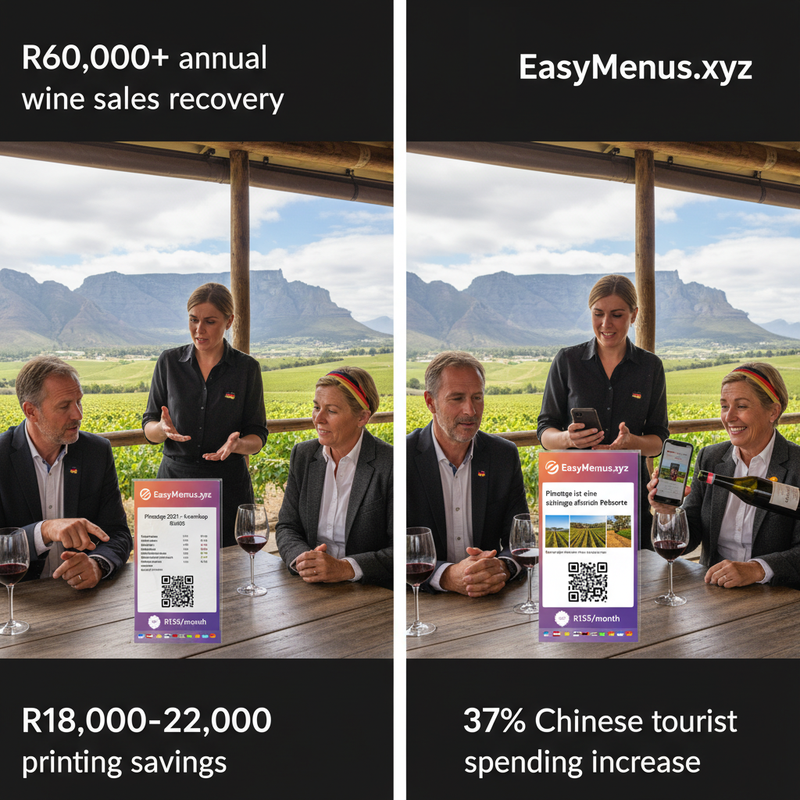
Your Cape Town restaurant attracts international wine tourists. German couple sits at table eight studying your English menu, confused about "snoek pâté" and "waterblommetjie bredie." They order fish and chips—safe option they recognize. Spend R340.
Table twelve is a Chinese family. They're photographing Table Mountain through your V&A Waterfront windows. Your server brings English menu. They struggle. Pull out translation app. Point at items. Hope for the best. Order pizza and burger—familiar foods. Spend R480.
Dutch backpackers at table four understand English reasonably well. But "bobotie" and "sosaties" mean nothing to them. They ask what everything is. Your server explains for ten minutes while other tables wait. They eventually order, spending R420.
Three tables. Three different nationalities. All ordering conservatively because they don't fully understand what they're getting. Total: R1,240.
If they'd had menus in German, Mandarin, and Dutch? They'd have ordered local specialties confidently. Total spend: R1,680-1,920. That's R440-680 additional revenue. From three tables. Multiply that across a week, a month, a year.
South Africa's Specific International Tourism
Cape Town's international visitor profile:
- German tourists (largest European segment, wine tourism focus)
- UK visitors (significant numbers, English-speaking)
- US travelers (Table Mountain, wildlife, wine routes)
- Chinese tourists (growing dramatically, group tours and independent)
- Dutch visitors (historical connection, Afrikaans similarity, backpackers)
- French tourists (wine country, cultural tourism)
What makes SA tourism unique for multilingual needs:
South African cuisine has words that don't translate easily: bobotie, biltong, boerewors, sosaties, waterblommetjie, snoek, bunny chow, pap en vleis. These aren't English words with clear meanings. They're Afrikaans, indigenous, or uniquely South African terms.
German tourist reading "waterblommetjie bredie" on English menu: completely lost. Even spelling it out doesn't help. Google Translate gives: "water flower stew." Accurate but unhelpful. They don't order it.
Chinese tourist sees "bobotie": translation app struggles. Gives something about curry and mince? They're confused about sweet/savory. Don't order it.
Dutch tourist reads "boerewors" and recognizes similarity to Dutch words (boer = farmer, worst = sausage). But doesn't know it's specifically South African spiced sausage. Orders something else to be safe.
Your restaurant's unique South African menu becomes barrier instead of selling point.
The German Wine Tourist Opportunity
Stellenbosch. Franschhoek. Constantia. South African wine routes attract massive German tourism. Germans love wine. They take it seriously. They want details.
Your wine list: "Pinotage 2021 - Kanonkop R450." German wine tourist sees this. Doesn't understand why South African wine costs R450. Doesn't know what Pinotage is (South African grape varietal). Doesn't know Kanonkop's reputation. Orders beer instead. You lost R450 sale and R180 margin.
Digital menu in German with wine education:
"Pinotage 2021 - Kanonkop R450
Pinotage ist eine einzigartige südafrikanische Rebsorte (Kreuzung aus Pinot Noir und Cinsaut). Kanonkop ist eines der renommiertesten Weingüter Südafrikas. Dieser Wein bietet Noten von dunklen Früchten, Rauch und Gewürzen. International mit 94/100 Punkten bewertet. Hervorragendes Preis-Leistungs-Verhältnis im Vergleich zu ähnlichen europäischen Weinen (€60-80)."
Photo shows vineyard. Photo shows wine bottle and pour. Photo shows Stellenbosch landscape.
German tourist understands: unique South African grape, prestigious winery, excellent value compared to European wines they know. Orders confidently. Your R450 sale and R180 margin preserved.
Multiply this across every German wine tourist table. That's significant revenue recovery.
Chinese Tourist Group Dynamics
V&A Waterfront. Chinese tour groups everywhere. They're organized. They follow guides. They have scheduled meal times. They want to order quickly and correctly.
Chinese tour group enters your restaurant. Twenty people. They have 60 minutes total including ordering, eating, payment.
English menus. Tour guide tries translating key items. Takes time. Tourists order conservatively—foods they recognize or that look safe in photos if you have them. Average: R380 per person. Group total: R7,600.
With Mandarin digital menus:
QR codes on tables. Chinese tourists scan (QR literacy in China: 95%+). Menu appears in perfect Mandarin. Descriptions explain South African dishes with Chinese cultural context:
"Bobotie - R165
南非传统菜肴。香料肉末配黄色米饭和干果。味道类似咖喱但更甜。顶部有蛋奶烤层。开普马来文化经典菜肴,融合了荷兰、马来和非洲影响。"
Photos show exactly what arrives. Tourists understand it's curry-like but sweeter, Dutch-Malay heritage, unique to South Africa. They order it. And other local specialties. Confidently.
Average per person: R520. Group total: R10,400. Increase: R2,800 per group (37% higher). Two Chinese groups weekly: R5,600 weekly = R280,000 annually just from confident ordering.
Digital menu cost: R1,860/year. ROI: 15,000%.
Dutch Travelers and Afrikaans Confusion
Dutch speakers can partially understand Afrikaans. But "partially" creates confusion. They think they understand, but misinterpret.
"Boerewors" looks like Dutch. Dutch tourist thinks: farmer's sausage, probably basic. Doesn't realize it's specifically South African spiced sausage with coriander, very different from Dutch worst. Orders something else.
"Sosaties" looks vaguely Dutch (sate = satay?). But South African sosaties are Cape Malay-spiced meat skewers, not Indonesian satay. Tourist expects one thing, would get another. Orders conservatively instead.
Digital menu in Dutch eliminates confusion:
"Boerewors R85
Traditionele Zuid-Afrikaanse worst met unieke kruiden (koriander, nootmuskaat, piment). Verschilt van Nederlandse worst - meer geur, grover gemalen. Standaard bij braai (barbecue). Geserveerd met pap (maismeel porridge) en sous."
"Sosaties R145
Zuid-Afrikaanse gekruide vleespennen (Kaapse Maleise invloed). Geen Indonesische satay - zoeter door abrikozenjam, kruiden omvatten kerrie en kurkuma. Traditioneel lamsvlees of kip."
Dutch tourist understands: similar-sounding words, different foods, specific South African preparations. Orders correctly. Enjoys authentic experience.
The Printing Cost Reality
Multilingual printing for SA tourism restaurant:
Languages needed: English, Afrikaans (locals), German (wine tourists), Mandarin (Chinese tourists), Dutch (travelers)
Per reprint cost:
- English: R180
- Afrikaans: R200
- German: R280 (specialized wine terminology)
- Mandarin: R320 (character complexity)
- Dutch: R220
- Total: R1,200 per reprint
Frequency: Monthly minimum (wine list changes, seasonal ingredients, price adjustments)
Annual printing: R14,400
Add seasonal menu changes: +R2,400
Add wine list separate updates: +R3,600
Real annual cost: R20,000-24,000
Digital menu cost: R1,860 annually (R155/month)
Savings: R18,000-22,000 per year
Break-even: 1-2 weeks
What This Actually Costs
Digital menu cost: R155/month = R1,860/year
What you eliminate:
- Five-language printing: R1,200/month = R14,400/year
- Seasonal updates: R2,400/year
- Wine list updates: R3,600/year
- Staff translation time: 5-8 minutes per international table
- Lost revenue from conservative ordering: R280,000+/year (Chinese groups example)
Cape Town tourism restaurant total annual value:
- Printing elimination: R20,000/year
- Chinese group confident ordering: R280,000/year
- German wine sales recovery: R60,000+/year
- Staff efficiency: R24,000/year
- Total: R384,000+/year
Cost: R1,860/year
Net value: R382,000+/year
ROI: 20,500%
The Honest Reality
V&A Waterfront tourists expect professional service. International wine tourists in Stellenbosch and Franschhoek expect detailed information. Chinese tour groups need efficiency.
Digital multilingual menus provide all of this. Setup: 30 minutes. Upload current English menu. Select additional languages (Afrikaans, German, Mandarin, Dutch). System provides translations. Review and adjust South African food terms for cultural accuracy.
Ongoing updates: 2 minutes when prices change. All languages update automatically. Wine descriptions update instantly when bottles change.
Some older tourists prefer printed menus. Keep 5 printed English/Afrikaans menus. Cost: R380 every 3 months versus R1,200 monthly for full multilingual printing.
Set up multilingual menus for SA tourism in 3 minutes and stop explaining bobotie in broken Mandarin forty times daily. R155/month. English, Afrikaans, German, Mandarin, Dutch, French—all included.
Your German wine tourists flew 11 hours to experience Stellenbosch. Your Chinese groups are on tight schedules. Your Dutch travelers want to understand what makes South African food unique.
English-only menus aren't meeting their expectations anymore.
Frequently Asked Questions
Which languages do Cape Town tourism restaurants actually need?
Minimum: English + German + Mandarin (covers 65% of international tourism). Add: Afrikaans (local respect), Dutch (travelers), French (Franschhoek connection). V&A Waterfront and Camps Bay restaurants benefit most from all six languages. Stellenbosch and Franschhoek wine route restaurants should prioritize German (wine tourism focus) and Mandarin (growing Chinese wine tourism). Digital menus include all languages for R155/month—traditional six-language printing costs R1,200 per update.
Do German wine tourists really need specialized wine descriptions?
Absolutely. German wine culture is sophisticated—they understand grape varietals, terroir, aging, vinification. They want details. Pinotage (uniquely South African grape) is unfamiliar to most Germans. Without explanation, they default to familiar choices (Sauvignon Blanc, Chenin Blanc) or skip wine entirely. Detailed German descriptions enabling confidence ordering recover R60,000+ annually from premium wine sales at typical wine route restaurant.
How do Chinese tour groups respond to Mandarin digital menus in South Africa?
Chinese tourists expect digital convenience—QR code adoption in China: 95%+. English menu with tour guide translation: slow, conservative ordering, R380 average. Mandarin digital menu with photos and cultural context: fast, confident ordering of local specialties, R520 average. That's 37% revenue increase per person. Two Chinese groups weekly = R280,000 additional annual revenue. Critical for V&A Waterfront, Table Mountain, and Cape Winelands restaurants hosting Chinese tourism.
Can digital menus explain uniquely South African food terms that don't translate?
This is actually digital menus' primary value for SA tourism. Bobotie, waterblommetjie, sosaties, biltong, bunny chow—all require explanation that printed menus can't provide (space limitations). Digital menus give: detailed ingredient descriptions, cultural heritage stories (Cape Malay, Dutch, indigenous influences), photos showing actual dishes, taste comparisons to familiar foods from tourist's culture. German tourist gets "ähnlich wie Currygericht aber süßer" comparison. Chinese tourist gets "类似咖喱" reference. Essential for selling authentic SA cuisine.
What's the ROI for Stellenbosch wine route restaurants using multilingual menus?
Stellenbosch wine route restaurants save R14,400-20,000 annually on multilingual printing elimination. But bigger value: German wine tourist confident ordering recovery (R60,000+/year from premium wine sales), efficient service enabling more tastings and sales, wine education building return visits. Total annual value: R80,000-100,000. Digital menu cost: R1,860/year. ROI: 4,300-5,300%. Break-even: 1-2 weeks during peak wine tourism season (November-April).
Related Articles: