
Cape Town vs Johannesburg: Why Tourism Drives Digital Menu Adoption (R2,000+ Savings)
Cape Town's 1.4M tourists need multilingual menus. Johannesburg's corporate diners have different needs. Digital menus solve both—but adoption rates differ by 20%.
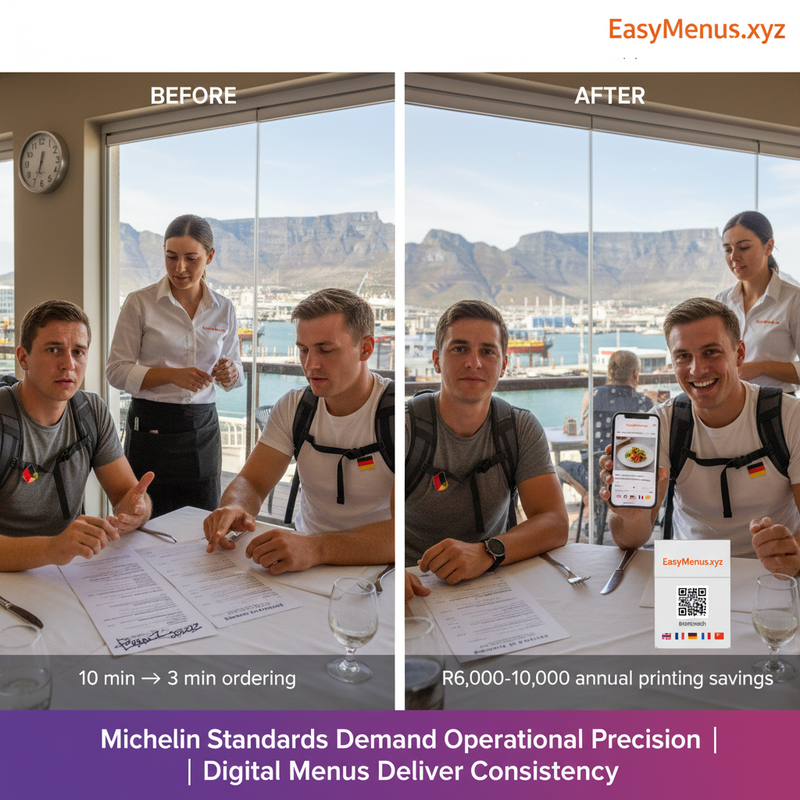
Cape Town vs Johannesburg: Why Tourism-Driven Restaurants Respond Better to Digital Menu Solutions
10:47pm Wednesday. You're finally sitting down after brutal dinner service, scrolling WhatsApp. Your wine distributor: that Stellenbosch Cabernet everyone orders? Gone for the season. Replacement costs R85 more per bottle.
New wine lists. Again.
Add it up. Every seafood supplier text about day's catch. Every rand-dollar shift affecting import costs. Every seasonal change. That artisan bread supplier who just raised prices. Probably R1,500 annually. Maybe R2,000. Possibly more if you're V&A Waterfront with daily specials.
Cape Town restaurants adopt digital menus 10-20% faster than Johannesburg establishments. Not because Joburg operators don't care about costs. Because tourism creates different operational reality.
The Tourism Factor: Why Location Matters
Camps Bay beachfront, Saturday afternoon. Count the accents. German. French. Mandarin. American. Dutch. Every third table asking questions your printed menu can't answer. "Is this vegetarian?" "What's bobotie?" "How spicy is peri-peri?" "Gluten-free options?"
Your servers explain the same things fifty times per shift. Printed menu lists dishes. Doesn't tell stories. Doesn't translate. Doesn't adapt when that German family pulls out phones hoping for something in their language.
Sandton. Business lunch crowd. Corporate dinners. Local clientele who've been coming for years. They know the menu. They know what bunny chow is. They're not photographing food for Instagram stories back in Munich. Different rhythm. Different expectations. Different operational reality.
Cape Town restaurants see higher digital adoption because international tourism means:
- More first-time customers needing menu education
- More languages per service period
- More questions servers can't answer efficiently
- More Instagram-worthy moments requiring visual menus
- More comparison shopping via TripAdvisor and Google reviews
Johannesburg's strength—consistent local business clientele—becomes disadvantage for digital adoption. Walk-in regulars don't need QR codes. Corporate lunch bookings don't require multilingual support. Pain points differ.
The Numbers
Cape Town Profile:
- Population: 4.7M metro
- Tourism: Extreme—international destination
- Restaurant scene: Coastal cuisine, wine country, Instagram culture
- Digital baseline: Advanced—online reservations standard, social media native
- Key areas: V&A Waterfront, Camps Bay, Constantia, City Centre, Stellenbosch
Johannesburg Profile:
- Population: 5.7M metro (largest in SA)
- Tourism: Moderate—business tourism, domestic visitors
- Restaurant scene: Corporate dining, diverse cuisine, mall-based, township tours
- Digital baseline: Moderate—traditional marketing still prevalent
- Key areas: Sandton, Rosebank, Maboneng, Melville, Parkhurst
Both cities have incredible food scenes. Operational realities completely different.
Cape Town Reality: Every Table Needs Translation
FYN Restaurant, Parliament Street. Modern African-Japanese fusion. Michelin recognition. Tasting menus changing with seasons. Wine pairing program legendary.
Imagine explaining that complexity to tourists from five countries in one service. Server switches between English, basic German, hand gestures. Printed menu has descriptions. Doesn't explain what "snoek" is to someone from Beijing. Doesn't translate "waterblommetjie" for Americans wanting to understand what they're eating.
Grub & Vine on Bree Street? Contemporary small plates. Wine pairings. Constantly rotating menu. Every new seasonal ingredient = new menus. Every wine stock change = reprinted lists. In tourism-heavy area where customers expect information in their language.
The Table Restaurant at De Meye Farm, Stellenbosch? Farm-to-table. Seasonal updates. Two locations. Wine country tourists asking detailed questions about every ingredient, every pairing, every sourcing decision.
This isn't hypothetical. This is every service, every shift, every weekend.
The Printing Cost Reality
Real costs from real restaurants.
FYN Restaurant monthly reality:
- Tasting menu changes (seasonal): R450 × 4 times/year = R1,800
- Wine pairing lists: R350/month × 12 = R4,200
- Daily specials boards: R25/week × 52 = R1,300
- Allergen information sheets: R180/quarter × 4 = R720
- Annual printing total: R8,020
Curate at Ellerman House:
- Multi-course tasting menu: R500 × 6 times/year = R3,000
- Wine gallery integration lists: R400/month × 12 = R4,800
- Luxury guest information: R250/quarter × 4 = R1,000
- Annual printing total: R8,800
The Shortmarket Club (Luke Dale-Roberts):
- Complex tasting menus: R550 × 8 times/year = R4,400
- Wine pairings: R400/month × 12 = R4,800
- Premium presentation: R300/quarter × 4 = R1,200
- Annual printing total: R10,400
R8,000-10,000 annually telling customers what they could see instantly on phones. In their language. With photos. With allergen information. With pairing suggestions.
Every reprint? 5-7 days waiting for print shop. Five days of servers saying "sorry, price actually changed" while pointing at menu showing it's available.
Johannesburg Difference: Local Business Changes The Game
Level Four Restaurant at 54 on Bath, Rosebank? Fine dining. Afternoon tea service. Multiple meal periods. Customer base: corporate events, business lunches, local celebrations. Repeat customers who know the menu.
Obscura Bar in Rosebank? Sophisticated cocktails. Whiskey locker memberships. Event hosting. Locals. Regulars. People who come back monthly, not once in lifetime.
Pain points exist. Menu updates cost money. Wine lists need printing. But urgency differs. Repeat customer knows what bobotie is. Corporate booking doesn't need translations. Regular doesn't photograph every dish for Instagram.
Cape Town drivers:
- "Tourists ask questions we can't answer efficiently"
- "Need multilingual without double printing costs"
- "TripAdvisor reviews mention menu confusion"
- "Instagram-worthy presentation matters to our market"
- "First-time customers need more education"
Johannesburg drivers:
- "Corporate bookings need professional presentation"
- "Printing costs add up over time"
- "Staff efficiency during business lunch rush"
- "Consistency across multiple locations"
- "Traditional cost-saving measures"
Both valid. Both real. But tourism creates immediate, visible pain driving faster adoption.
What Actually Works
Restaurants that made the switch:
Mantra Café, Camps Bay—Prime location. Tourist-heavy. Breakfast cocktails. Reprinting constantly. Seasonal changes. Price adjustments based on exchange rates affecting imported ingredients. Tourists asking about every dish.
Switch to digital: Update prices instantly when costs change. Photos explain dishes without language barriers. Allergen information auto-translates. Servers spend less time explaining, more time selling. Tables turn faster. TripAdvisor reviews mention "helpful menu information."
La Parada Constantia Nek—Spanish tapas. Sharing plates. Wine program. Constantly adjusting selection based on supplier availability. Printed menus outdated weekly.
Digital solution: Update available tapas instantly. Adjust wine list when bottles sell out. Add pairing suggestions reflecting current stock. Staff stops having awkward "we're actually out of that" conversations with customers holding printed menus showing availability.
House of H on Loop Street—Steakhouse. Custom cuts. Daily menu changes based on meat availability. High-end sourcing. Premium customers expecting current information.
Digital lets them: List available cuts real-time. Update prices when premium sourcing costs shift. Provide detailed information about aging, sourcing, preparation. Eliminate disconnect between printed and actually available.
The Multilingual Reality
Cape Town restaurants aren't just serving food. Providing tourist information in six languages you don't speak.
The Salt Yard in Little Mowbray? Contemporary cuisine. Local sourcing. Seasonal menu. Customer base: UCT international students, winelands tourists, local regulars. Try explaining "snoek pâté" to someone from Thailand. In English. While your section is slammed.
Digital menus with translation? Customer scans QR code. Selects language. Sees menu in Mandarin, German, French, whatever needed. Server focuses on recommendations and service, not basic translation. Tables seat faster because you're not spending ten minutes explaining every dish.
The Mussel Monger at Riverlands Mall? Seafood. Oyster bar. Daily fresh selections from Saldanha Bay. Explaining seafood freshness, sourcing, preparation to international customers unfamiliar with South African seafood varieties? That's time. Time costs table turns.
Digital menus showing photos, sourcing information, preparation details in multiple languages? Customers educate themselves. Staff confirms choices and takes orders. Service speeds up. Kitchen gets orders faster. Revenue per service increases.
The Wine List Problem
South African wine culture incredible. Stellenbosch. Franschhoek. Constantia. World-class wines at prices making international tourists lose their minds. "Wait, this award-winning wine costs how much?"
Managing wine lists with printed menus? Expensive pain.
The Shortmarket Club wine reality:
- Premium wine program changing with availability
- Seasonal bottle selections
- Price adjustments based on vintage changes
- Pairing recommendations for tasting menus
- Reprinting wine lists: R400/month minimum
Café Sofi situation:
- Mediterranean with European wine selection
- All-day menu with different wine recommendations
- Breakfast-to-dinner transitions affecting presentations
- Multiple wine list versions: R350/month
Chardonnay Deli across locations:
- Multiple venues needing consistent lists
- Retail component with changing stock
- Seasonal wine selections
- Coordinated reprinting across sites: R500+/month
Digital wine lists solve this completely. Wine sells out? Remove instantly. New vintage arrives? Update description and price immediately. Pairing recommendations change? Adjust in 30 seconds.
No more "sorry, we're actually out of that vintage." No more rushed reprinting when supplier substitutes different year. Just current, accurate information. In whatever language your customer needs.
Staff Reality: Digital Helps Your Team
Your servers hate explaining the same dish forty times per shift. Answering "what's in this?" for the nineteenth time. Describing preparation methods when kitchen is slammed and they need orders in.
Worse? Outdated printed menus. "Price actually changed last week." "We're out of that, but menu shows it." "That wine is different vintage now." Every conversation starting with "actually" is customer experience failure.
Digital menus with proper information help front-of-house:
FYN Restaurant staff:
- Complex tasting menus with detailed ingredient information available digitally
- Allergen data accessible without asking kitchen mid-service
- Wine pairing suggestions automatically matched to current menu
- Staff focuses on hospitality, not information desk work
Three Wise Monkeys, Sea Point:
- Menu variety explained with photos and descriptions
- Casual-to-upscale positioning maintained through professional presentation
- Staff recommends with confidence because information current
- Table turns improve when customers pre-educate themselves
Juno Sea Point improvement:
- Breakfast/brunch focus with detailed options
- Retail component information integrated
- Neighborhood regular recognition plus tourist accessibility
- All-day service periods handled with single QR code
Servers are hospitality professionals. Let them do hospitality. Let digital menu handle information delivery. Technology should support humans, not replace them.
What This Costs (And Saves)
Digital menu cost: R155/month (about $12.50 USD at current exchange)
What you eliminate:
- Menu reprinting: R200-600/month depending on frequency
- Wine list updates: R300-500/month for active wine programs
- Specials boards: R100-200/month for daily changes
- Allergen sheets: R50-100/month for regulatory compliance
- Staff time explaining dishes: 2-5 hours/week at R150/hour = R1,200-3,000/month
Cape Town tourism-heavy restaurant savings:
- Printing elimination: R500/month = R6,000/year
- Staff efficiency: R2,000/month conservative = R24,000/year
- Reduced ordering errors from outdated info: R500/month = R6,000/year
- Total annual savings: R36,000+
- Digital menu cost: R1,860/year
- Net savings: R34,140/year
Johannesburg corporate-focused restaurant savings:
- Printing elimination: R350/month = R4,200/year
- Staff efficiency: R1,200/month = R14,400/year
- Professional presentation value: Qualitative but significant
- Total annual savings: R18,600+
- Digital menu cost: R1,860/year
- Net savings: R16,740/year
Both scenarios show clear ROI. Cape Town's tourism-driven pain points create faster payback and higher total savings.
The Bottom Line
Cape Town tourism creates immediate, visible pain driving faster digital menu adoption:
- International customers needing multilingual support
- First-time visitors requiring menu education
- Instagram culture demanding visual presentation
- High-volume tourism creating staff efficiency pressure
- TripAdvisor reviews mentioning menu confusion
Johannesburg's corporate dining creates different adoption patterns:
- Local regular clientele reducing urgency
- Professional presentation focus over tourist communication
- Traditional marketing channels still effective
- Corporate gatekeepers slowing decision processes
- Operational excellence over urgent problem-solving
Both markets benefit from digital menus. Cape Town sees 45-55% email open rates (estimated) because tourism makes pain obvious. Johannesburg sees 35-45% because benefits real but less immediately pressing.
Cost: R155/month
Setup time: 3 minutes
Savings: R1,500-3,000+/month depending on printing frequency
Payback period: Less than one month
Risk: R155 to try it. If you hate it, back to print shop.
Most Cape Town restaurants making the switch wish they'd done it sooner. Most Johannesburg restaurants adopting find operational benefits they didn't expect. Neither market wrong. Tourism just changes urgency.
Eliminate printing costs and serve tourists in their language—set up digital menu in 3 minutes. Unlimited updates, multilingual support, R155/month. One menu reprint costs more.
Frequently Asked Questions
Why do Cape Town restaurants adopt digital menus faster than Johannesburg establishments?
Tourism creates immediate operational pressure. Cape Town restaurants serve international customers needing multilingual support (German, Mandarin, French), menu education about South African cuisine, and visual information for unfamiliar dishes. V&A Waterfront, Camps Bay, and Constantia establishments handle multiple first-time tourist tables per service requiring extensive menu explanation. Digital menus with translation, photos, and detailed descriptions eliminate this staff bottleneck. Johannesburg's corporate dining and local regular clientele reduces urgency—customers know menu and don't need translation.
How much do South African restaurants actually save switching from printed to digital menus?
Cape Town tourism-heavy restaurants save R30,000-40,000 annually: printing elimination (R6,000/year), staff efficiency from reduced explanation time (R24,000/year), and ordering error reduction (R6,000/year). Digital menus cost R1,860/year (R155/month), creating net savings of R28,000-38,000. Johannesburg corporate-focused venues save R15,000-20,000 annually through reduced printing (R4,200/year) and staff efficiency (R14,400/year). Both markets show clear ROI, but tourism-driven operations see faster payback and higher total savings.
What wine list challenges do Stellenbosch and Cape winelands restaurants face with printed menus?
Premium wine programs at The Shortmarket Club, FYN Restaurant, and Curate at Ellerman House require frequent updates (R400-500/month printing). Vintage changes, bottle availability, seasonal selections, and pairing recommendations shift constantly. Printed wine lists become outdated within weeks. Digital solutions update instantly when wines sell out, new vintages arrive, or pairings change. Multilingual wine descriptions help international wine tourists understand South African varieties (Pinotage, Chenin Blanc) without staff explanation.
How do multilingual digital menus help Cape Town restaurants serve international tourists?
Camps Bay, V&A Waterfront, and winelands restaurants serve German, Mandarin, French, Dutch, and American tourists who can't understand Afrikaans culinary terms or South African dishes on English menus. Digital menus auto-translate with one QR code. Tourists select their language, see menu with photos and descriptions, understand dishes before ordering. Staff time shifts from basic translation to sophisticated recommendations. The Mussel Monger's seafood sourcing from Saldanha Bay and The Table Restaurant's farm-to-table philosophy need storytelling that multilingual digital menus provide.
What corporate dining advantages do Johannesburg restaurants gain from digital menus?
Level Four Restaurant and Obscura Bar benefit from professional presentation consistency, easy updates across meal periods without reprinting, sophisticated information delivery for complex cocktail programs, and modern brand positioning. Corporate event hosting requires polished presentations—digital menus deliver without dated printed materials. Business lunch efficiency improves when customers browse menus before arrival. Multiple location coordination becomes instant instead of requiring print shop delivery across Johannesburg traffic.
Related Articles: