
UAE Type C License Wine Lists: AED 4,800/Year Printing vs Digital Updates
Type C licensed UAE restaurants spend AED 4,800-6,000 yearly on wine list printing. 30% alcohol tax + licensing complexity demand real-time accuracy. Digital solves it.
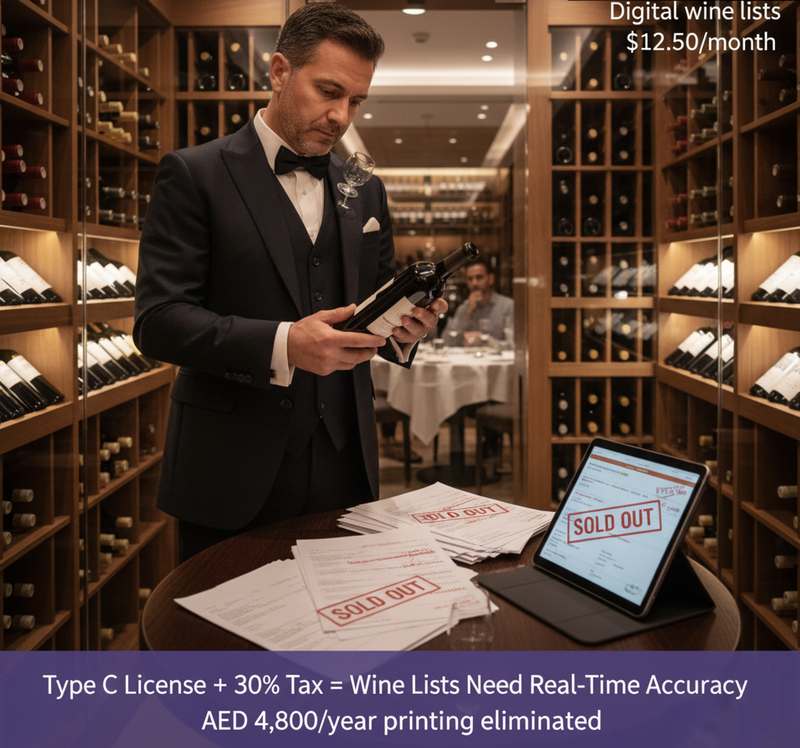
You've got the Type C license. You paid AED 6,500 upfront. You're paying 30% alcohol tax on every bottle you sell (as of January 2025). Your wine program is supposed to be a profit centre, not a printing expense.
But here's what's actually happening: A customer orders the Bordeaux from your printed list. Your server checks. It sold out yesterday. The replacement vintage arrived this morning but costs AED 150 more per bottle. Your printed wine list shows the old price, old vintage, old tasting notes.
That conversation doesn't end well. And you can't blame the customer.
UAE restaurants with Type C alcohol licenses face unique operational pressure. The licensing isn't cheap. The tax burden is substantial. Your wine inventory moves at bottle-level precision, not bulk like food. And printed wine lists? They're outdated the moment a bottle sells.
Here's what licensed restaurants are spending just to keep wine lists current.
The Real Cost of Printed Wine Lists (When Every Bottle Counts)
Zuma DIFC's reality:
- Contemporary Japanese with extensive sake program
- Three-floor operations, multiple service areas
- Michelin-listed standards requiring accuracy
- High-volume weekend brunch with wine pairings
- Wine list reprinting: AED 400/month minimum across all floors
- Annual wine list printing alone: AED 4,800
Cipriani Dubai's scale:
- 300-capacity operations across two levels
- Legendary Venetian brand standards (Harry's Bar heritage)
- Classic Italian wine program with vintage variations
- Business lunch selections different from dinner service
- Private event wine lists customized per booking
- Multi-level coordination: AED 500/month minimum
- Annual cost: AED 6,000 just for wine lists
Le Petit Beefbar's complexity:
- French steakhouse with Art Deco aesthetic
- All-day dining (breakfast through late night)
- Monaco brand standards (Riccardo Giraudi group)
- Wine pairings for various beef cuts and preparations
- By-the-glass program changing weekly based on availability
- Maintaining printed lists current: AED 350/month
- Annual total: AED 4,200
Add it up. That's AED 4,200-6,000 annually just keeping wine lists synchronized across your operation. And this assumes you're only reprinting monthly. Most fine dining establishments update more frequently.
Why Wine Lists Are Different From Food Menus
Your food menu has bulk inventory. You've got 40 kilos of lamb. 60 portions of sea bass. Even when you're down to final portions, there's warning time.
Wine? You've got exactly one bottle of that 2018 Château Margaux. When it sells, it's gone. The replacement might be:
- Different vintage (2019, not 2018)
- Different price (AED 2,600, not AED 2,400)
- Different tasting profile
- From a different supplier entirely
Your printed wine list can't reflect this. It shows what you had when you printed it two weeks ago, not what you've got right now.
Digital wine lists update the instant a bottle sells. Your server pours the last glass of Barolo? Remove it from the list in 15 seconds. Replacement vintage arrives? Update price and tasting notes while still standing in the wine cellar. New Lebanese wine from Bekaa Valley? Add it before lunch service starts.
The Type C License Compliance Reality
Type C licenses aren't casual permissions. You've invested AED 6,500-7,500 for the license. You're collecting 30% alcohol tax on every transaction (reinstated January 2025). The regulatory scrutiny is real.
Your wine list is a legal document. It needs to show:
- Accurate pricing (including the 30% tax component)
- Current availability
- Clear alcohol content information
- Proper categorization (wine, spirits, beer)
- Compliance with serving regulations
Printed wine lists create compliance gaps:
Pricing discrepancies: You printed the list when Champagne was AED 450. Import costs increased. It's now AED 520. Your printed list shows AED 450. The actual charge is AED 520. Customer sees the printed price. Complaint ensues.
Availability claims: Customer orders from your printed list. Bottle sold out three days ago. You're promising inventory you don't have. That's not good business practice under regulatory scrutiny.
Tax documentation: You need audit trails showing what you sold, when, at what price, with what tax collected. Printed menus don't help here. Digital systems log every change automatically.
The "Sorry, We're Out" Problem (That Kills Wine Program Credibility)
Walk into Hutong DIFC. Northern Chinese fine dining. Michelin Hong Kong pedigree. 30-page wine list featuring rare Burgundies and aged Bordeaux.
Customer orders the 2016 Gevrey-Chambertin listed at AED 890. Your sommelier checks the cellar. Gone. Sold at last night's private event. Replacement is 2017 vintage at AED 940.
That customer flew from London specifically for Hutong. They researched your wine program. They planned their order. And now you're saying "sorry, we're out, but we have something similar that costs more."
This happens daily with printed wine lists. You can't update them fast enough. Bottles sell. Vintages change. Import allocations shift. Your printed list becomes fiction.
Digital wine lists eliminate this completely:
- Bottle sells → removed from list instantly
- New vintage arrives → updated before cellar door closes
- Price changes → reflected in real-time
- Customer sees current availability, current pricing, current vintages
No more "sorry." No more credibility damage. No more disappointed customers who chose your restaurant specifically for a wine that's been gone for five days.
In-Article Image Prompt
How Much Time You're Actually Wasting
Your wine director or head sommelier has better things to do than coordinate printed wine lists across multiple service areas.
Time breakdown with printed wine lists:
- Weekly wine inventory reconciliation: 4-6 hours
- Coordinating reprints with graphic designer: 2-3 hours
- Proofing wine list updates for accuracy: 2-3 hours
- Waiting for print shop delivery: 5-7 days lead time
- Distributing new lists across all service stations: 1-2 hours
- Training staff on new additions and changes: 2-4 hours
Total monthly time commitment: 40-50 hours
That's a full work week every month just managing wine list logistics. Your wine director should be curating selections, building supplier relationships, educating staff, engaging customers. Not coordinating printing schedules.
Time breakdown with digital wine lists:
- Update inventory in real-time as bottles sell: 5-10 minutes daily
- Add new arrivals immediately: 2-3 minutes per wine
- Adjust pricing when needed: 30 seconds per change
- Staff always see current list automatically: 0 additional time
- Customer-facing list updates instantly: 0 additional time
Total monthly time commitment: 8-12 hours
That's 75-80% time reduction. Your sommelier focuses on hospitality and expertise, not logistics and printing.
The Weekend Reality (When Every Hour Counts)
UAE's three-day weekend (Friday-Sunday) concentrates wine sales into compressed periods. Friday lunch through Sunday dinner is when licensed restaurants generate significant wine revenue.
This is also when inventory moves fastest. Saturday night private event? Twenty bottles of Champagne gone. Sunday brunch? Fifteen bottles of Prosecco sold by 2pm. Weekend guests ordering that special Barolo you've been featuring? Three bottles remaining, down from six on Thursday.
With printed wine lists, your staff are managing inventory discrepancies all weekend:
- "That Champagne sold out at Friday's event"
- "We're down to two bottles of the Chianti, save them for the right tables"
- "Don't offer the Sancerre by-the-glass, we're out"
Digital lists eliminate this constant communication burden. Bottle sells at Friday lunch? Staff see updated availability immediately on their phones. No radio calls. No confusion. No promising wine you don't have.
DIFC Business Lunch Reality (When Time Is Money)
DIFC business lunch crowd moves fast. International executives. Investment bankers. Corporate lawyers. They've got 60-75 minutes between meetings.
They order wine. They expect efficiency. They don't want conversations about "actually, that bottle sold out, but we have something similar."
When you're managing wine lists with 30% alcohol tax and Type C licensing complexity in Dubai's business district, accuracy matters. Your wine list needs to show exactly what's available, at current prices, right now.
Digital wine lists let business lunch service flow:
- Customer scans QR code while reviewing food menu
- Sees current wine selection with accurate pricing
- Makes selection confidently
- Order flows to server without questions or corrections
- Wine service happens smoothly
This is how you maintain DIFC standards while managing Type C license complexity.
What About Wine By The Glass Programs?
By-the-glass programs create even more complexity. You're opening bottles daily. Tracking oxidation windows. Rotating selections based on what's open and how long it's been breathing.
Traditional printed wine list challenges:
- Can't update which wines are available by-the-glass daily
- Can't reflect when you switch from Merlot to Cabernet mid-service
- Can't show customers which open bottles are fresh vs. approaching oxidation
- Can't adjust by-the-glass pricing when you open premium bottles for special events
Digital wine list capabilities:
- Update by-the-glass selections in real-time throughout service
- Show customers exactly which wines are available right now
- Adjust pricing instantly when you open special bottles
- Remove wines as they approach oxidation limits
- Add newly opened selections immediately
Le Petit Beefbar runs all-day dining with by-the-glass programs changing from breakfast through late night. Their printed wine lists can't keep pace. Digital updates let them maximize revenue from open bottles while maintaining quality standards.
How This Actually Works For Licensed Restaurants
Week 1: Setup
- Import current wine list (PDF or Excel typically)
- Add bottle-level inventory tracking if desired
- Organize by category (sparkling, white, red, dessert, sake, etc.)
- Add tasting notes and pairing suggestions
- Set pricing including 30% alcohol tax transparency
- Generate QR codes for tables and wine list cards
Ongoing operation:
- Bottle sells → update inventory from phone (15 seconds)
- New vintage arrives → photograph label, update details (2 minutes)
- Pricing changes → adjust in real-time (30 seconds)
- Sommelier adds tasting notes → visible immediately to all customers
- Staff always see current inventory automatically
Compliance benefits:
- Automatic change logs for regulatory audit trails
- Pricing accuracy guaranteed (no outdated lists with old prices)
- Inventory documentation built-in
- Clear alcohol tax component can be shown or calculated
- Age verification reminders can be programmed
The Bottom Line For Type C License Restaurants
You invested AED 6,500-7,500 in your alcohol license. You're paying 30% tax on every bottle sold. Your wine program should be generating profit, not consuming resources on printing logistics.
Current wine list printing costs:
- Fine dining: AED 4,800-6,000 annually
- Casual dining with wine program: AED 2,400-3,600 annually
- Business lunch venue: AED 3,000-4,200 annually
Digital wine list costs:
- $12.50/month (approximately AED 46/month)
- Annual total: AED 552
Net savings: AED 1,850-5,450 annually depending on your update frequency
Additional benefits:
- 75-80% time reduction managing wine lists
- Zero "sorry, we're out" situations
- Real-time vintage and pricing accuracy
- Type C license compliance documentation
- Better customer experience
- Increased wine program credibility
Break-even: 11-14 days for most licensed restaurants
What Licensed Restaurants Are Doing Now
Zuma DIFC is evaluating digital wine lists because coordinating sake and wine selections across three floors with printed materials is becoming unsustainable at their service volume.
Hutong DIFC sees the value in real-time wine list updates for their Michelin-pedigree expectations where "sorry, we're out" damages brand standards.
The Guild DIFC (five-concept venue) needs unified wine list management across Nurseries, Potting Shed, Rockpool, Salon, and Aviaries without printing five separate wine lists daily.
These aren't future scenarios. These are UAE restaurants evaluating solutions right now because managing wine lists with 30% alcohol tax and Type C licensing complexity demands better tools than printed paper.
Start your digital wine list setup in 3 minutes - Type C license restaurants save AED 1,850-5,450 annually while eliminating "sorry, we're out" conversations. One month of printed wine lists costs more than six months of digital updates.
Frequently Asked Questions
How do digital wine lists help with Type C license compliance in the UAE?
Type C licensed restaurants in Dubai and Abu Dhabi must maintain accurate pricing documentation including the 30% alcohol tax (reinstated January 2025), track inventory for regulatory audits, and provide clear alcohol content information. Digital wine lists automatically log all changes with timestamps (regulatory audit trail), update pricing instantly when tax calculations change (compliance accuracy), show current inventory preventing "out of stock" situations that create documentation gaps, and can display alcohol content and legal serving requirements clearly. Printed wine lists create compliance risks with outdated pricing (AED 4,800-6,000 annual printing costs) and inventory discrepancies. The Type C license itself costs AED 6,500-7,500 annually, making wine program efficiency critical for licensed restaurants.
What's the actual time savings for wine directors managing digital vs printed lists?
Printed wine list management requires 40-50 hours monthly: weekly inventory reconciliation (4-6 hours), coordinating reprints with designers (2-3 hours), proofing accuracy (2-3 hours), waiting for print shop delivery (5-7 days), distributing lists across service areas (1-2 hours), and staff training on changes (2-4 hours). Digital wine lists reduce this to 8-12 hours monthly: real-time updates as bottles sell (5-10 minutes daily), adding new arrivals (2-3 minutes per wine), price adjustments (30 seconds per change), with instant staff access requiring zero additional time. This represents 75-80% time reduction, allowing sommeliers to focus on curation, supplier relationships, and customer education rather than printing logistics.
How do digital wine lists prevent "sorry, we're out" situations for UAE restaurants?
UAE Type C licensed restaurants face unique challenges: bottle-level inventory (unlike bulk food ingredients), vintage transitions without warning from suppliers, high-value wines with single-bottle availability, and multi-floor operations (Zuma DIFC's three floors, Cipriani Dubai's two levels) requiring coordination. Printed wine lists show historical inventory from reprint date (2-4 weeks old), not current availability. Digital wine lists update instantly when bottles sell (15-second process), reflect new vintages immediately upon arrival (2-minute update), synchronize across all service areas automatically, and eliminate situations where customers order from outdated printed lists showing sold-out inventory. This protects brand credibility for fine dining establishments where wine program expertise is part of the value proposition.
Can digital wine lists handle by-the-glass programs that change throughout service?
By-the-glass wine programs present additional complexity: bottles opened daily tracking oxidation windows, selections rotating based on availability and freshness, premium bottles opened for special occasions requiring price adjustments, and offerings changing from lunch to dinner to late-night service. Printed wine lists cannot reflect intra-service changes. Digital wine lists enable real-time by-the-glass updates (adding/removing wines throughout service), oxidation window tracking (removing wines approaching quality limits), dynamic pricing (adjusting when opening premium bottles), service-period variations (different by-the-glass selections for business lunch vs. weekend dinner), and immediate customer visibility (updated selections visible on phones instantly). Le Petit Beefbar's all-day dining operation exemplifies this need, requiring by-the-glass flexibility from breakfast through late night that printed lists cannot provide.
What are the actual cost savings for UAE licensed restaurants switching to digital wine lists?
Fine dining establishments (Zuma DIFC, Hutong DIFC, The Guild) spend AED 4,800-6,000 annually on wine list printing (AED 400-500 monthly reprints across multiple floors and service periods). Casual dining with wine programs spend AED 2,400-3,600 annually (AED 200-300 monthly updates). Business lunch venues (DIFC area) spend AED 3,000-4,200 annually (AED 250-350 monthly for rapid turnover). Digital wine lists cost $12.50/month (AED 46 monthly, AED 552 annually), creating net savings of AED 1,850-5,450 yearly depending on update frequency. Break-even occurs in 11-14 days for most licensed restaurants. Additional savings include wine director time (AED 1,200-2,400 monthly at standard hourly rates), eliminated rush printing fees, and revenue protection from eliminating "out of stock" customer disappointments.
Related Articles
- Dubai vs Abu Dhabi Restaurants: Why 16.79M Tourists Drive 40-60% Faster Digital Menu Adoption
- Heritage Emirati Restaurant Digitization: Al Dhafra and Traditional UAE Dining in the Digital Age
- Six-Language Menu Solutions for Dubai's 16.79 Million Annual Tourists
- DIFC Restaurant Technology: Digital Menu Solutions for Dubai's International Business District