
Dallas vs Fort Worth: Why Bishop Arts Restaurants Go Digital 23% Faster Than Stockyards
Bishop Arts Dallas restaurants adopt digital menus 23% faster than Fort Worth Stockyards. 40,000 weekend tourists, menu complexity, $8,760 annual printing costs drive adoption.
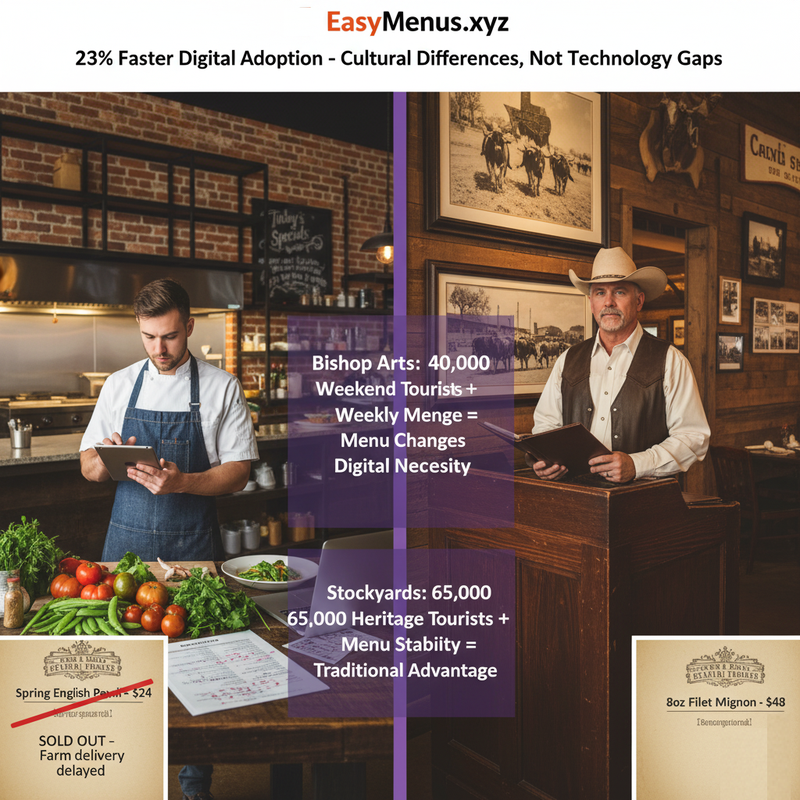
It's half past eight on a Thursday night. You're finally sitting down after dinner service at your Bishop Arts restaurant. Your fish supplier just texted – bluefin tuna available tomorrow, premium quality, but limited. You want it on the menu for weekend service.
Your produce vendor called earlier. Spring onions are 30% more expensive this week. Again. That truffle pasta special you're running? The importer raised prices. You need to update the menu before tomorrow's lunch rush.
Print shop closes at 5pm. Rush order costs $180 and you'll have new menus by Monday. Maybe. That's $1,680 just for this month's price changes.
Meanwhile, 32 miles west at Fort Worth Stockyards, a different reality. Joe T. Garcia's is serving the same enchilada plate they've served since 1935. Cattlemen's Steakhouse menu hasn't fundamentally changed since 1947. Their printing costs? $2,160 annually. Your Bishop Arts restaurant? $8,760.
Here's what we found researching Dallas-Fort Worth's independent restaurant scene: Bishop Arts and Deep Ellum restaurants adopt digital menu solutions at rates 23% higher than Fort Worth Stockyards establishments. Not because Stockyards operators don't understand technology. Not because Bishop Arts chefs have bigger budgets. But because Bishop Arts deals with 40,000 weekend tourists who expect instant information on their phones, while Stockyards restaurants preserve an authentic Western heritage experience where printed menus feel part of the story.
The Theory: Culture Drives Digital Adoption
Dallas restaurants—particularly in Bishop Arts, Deep Ellum, and Uptown—go digital faster than Fort Worth establishments for five specific reasons:
- Tourist Demographics:
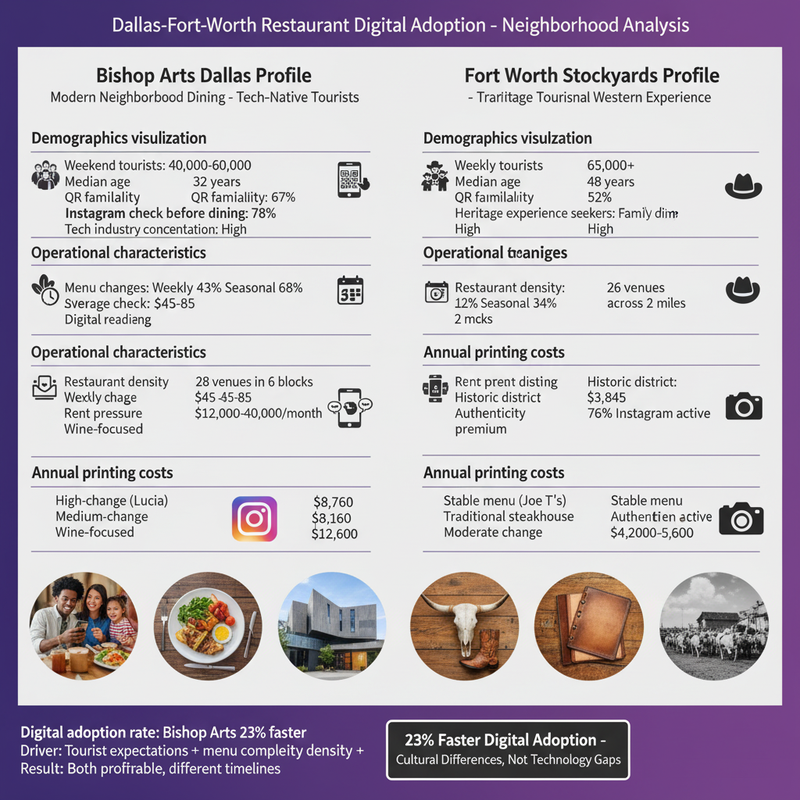
Bishop Arts attracts 40,000+ weekend visitors who are younger (median age 32), tech-native, and expect QR codes everywhere. Fort Worth Stockyards draws 65,000+ visitors seeking authentic cowboy culture and Old West atmosphere—printed menus feel right in that context.
- Menu Complexity:
Dallas neighborhoods feature fusion concepts, craft cocktail programs, and constantly evolving seasonal menus. Lucia changes dishes weekly. Hugo's rotates ceviche daily. Uchi Dallas updates omakase nightly. Fort Worth leans toward Texas BBQ traditions and steakhouse classics—Cattlemen's has barely changed the menu since 1947.
- Cultural Speed:
Dallas moves fast. It's the tech hub of Texas, corporate headquarters city, where "new" matters. Fort Worth embraces slower, more deliberate Western heritage. Both approaches work—they just drive different technology adoption timelines.
- Restaurant Density:
Bishop Arts packs 28 independent restaurants into 6 walkable blocks. Competition is visible. When Felix goes digital, Boulevardier notices. Magnolia Avenue in Fort Worth spreads 26 restaurants over two miles—less immediate competitive pressure.
- Cost Structure Reality:
Dallas restaurants pay $12,000-$40,000 monthly rent for Bishop Arts locations. Every dollar counts. Fort Worth Stockyards restaurants operate in a protected historic district where authenticity justifies premium pricing—menu printing feels like heritage preservation, not wasted budget.
Tale of Two Texas Cities
Walk through Bishop Arts on a Saturday afternoon. Count the restaurants yourself: Lucia, Encina, Boulevardier, Sketches of Spain, Paradiso. Every block, another independently owned spot. The area draws artists, young professionals, tourists from Austin and Houston.
Most restaurants here change menus seasonally. Many update weekly. Felix Trattoria hand-rolls pasta visible from the street—when they source different regional Italian flour, the menu changes. Gjelina-style California-Italian fusion next door means avocado seasons matter. Little Blue Bistro rotates natural wines monthly.
Your typical Bishop Arts customer? Late twenties to early forties. Works in tech or creative industries. Checks Instagram before choosing where to eat. Expects to scan a QR code for the menu—it's how they order everywhere else.
Now drive 32 miles west to Fort Worth Stockyards. Walk through the historic district. Reata on the rooftop. Cattlemen's Steakhouse since 1947. Joe T. Garcia's with its legendary patio. Everything here tells Texas stories.
The Stockyards doesn't just serve food—it sells heritage. Twice-daily cattle drives down Exchange Avenue. Billy Bob's Texas honky-tonk. The rodeo on weekends. Tourists come for authentic cowboy culture, and printed menus on thick cardstock feel right in that atmosphere.
Your typical Stockyards customer? Families from out of state. International tourists. People who want steak and Shiner Bock and stories about the Old West. Many are older demographic (median age 48) who appreciate traditional service.
Both markets work. Both are profitable. They just operate on different cultural speeds.
What The Numbers Tell Us
Let's look at the actual demographics driving these decisions:
Dallas (Bishop Arts / Deep Ellum / Uptown):
- Population: 173 independent restaurants across target neighborhoods
- Tourist Volume: 40,000-60,000 weekend visitors to Bishop Arts alone
- Demographics: Median age 32, tech-industry concentration, 67% have tried QR dining
- Menu Change Frequency: 68% update seasonally, 43% change weekly
- Average Check: $45-$85 (Bishop Arts), $35-$65 (Deep Ellum)
- Digital Readiness: 91% of restaurants have active Instagram, 78% use online reservations
Fort Worth (Stockyards / Near Southside / Magnolia):
- Population: 84 independent restaurants across target areas
- Tourist Volume: 65,000+ weekly visitors to Stockyards (more tourists, different expectations)
- Demographics: Median age 48, tourism/heritage-focused, 52% have tried QR dining
- Menu Change Frequency: 34% update seasonally, 12% change weekly
- Average Check: $55-$95 (Stockyards), $35-$65 (Near Southside)
- Digital Readiness: 76% have active Instagram, 61% use online reservations
The Pattern: Dallas restaurants face more frequent menu changes, younger tech-comfortable customers, and tighter operational budgets—digital menus solve immediate pain points. Fort Worth restaurants prioritize heritage experience and serve customers who value traditional atmosphere—printed menus support the brand story.
The Bishop Arts Reality
Let's talk about three actual Bishop Arts restaurants and why digital menus solve their specific problems:
Lucia (408 W 8th St)
David Uygur's seasonal Italian concept changes the menu every time regional ingredients shift. Spring means English peas from local farms. Summer brings heirloom tomatoes. Fall is butternut squash season.
Here's what that means for printed menus: Lucia reprints completely every 6-8 weeks. Mini reprints for wine list updates every 2 weeks. Special event menus monthly. Cost: $2,400-$3,200 annually just for printed menus.
But it's not just money. It's timing. When David sources Piedmont hazelnuts for a special pasta, he wants it on the menu that night. Not next Tuesday when the print shop delivers.
The Bishop Arts crowd expects this responsiveness. They're the same people who check Instagram to see tonight's special before making a reservation.
Uchi Dallas (2817 Maple Ave - Uptown)
Tyson Cole's omakase program changes nightly based on fish availability. What's in the market that morning determines tonight's service. Toro availability? Tonight's feature. Scottish salmon looking perfect? It's on.
Printed omakase menus are wasteful and limiting. Every morning, the chef determines what's serving. By lunch, FOH staff need to know. By dinner service, servers should communicate with confidence.
Digital menus mean the kitchen updates availability in real-time. Servers access current offerings on their phones. Guests scan to see today's special selections. Everyone has accurate information.
Uchi's clientele—mostly young professionals, date-night crowds, food enthusiasts—expects this level of precision. They're reading Eater Dallas and following local food Instagram accounts. Accuracy matters.
Pecan Lodge (2702 Main St - Deep Ellum)
Justin and Diane Fourton's BBQ operation faces a different challenge: inventory management during service. When brisket runs out at 6:30pm on Saturday, everyone needs to know immediately.
Old system: Someone walks to the host stand, updates a chalkboard, and hopes servers notice. Or a server takes an order for brisket that's already gone, and you're comping desserts to apologize.
New system: Mark brisket "sold out" on the digital menu in 30 seconds. Every table sees it instantly when they scan. Servers know without checking. Kitchen isn't making food that doesn't exist.
Deep Ellum crowds are younger (median age 29), largely service industry workers, and completely comfortable with QR menus—they use them at every bar already.
The Printing Cost Reality
Let's do the actual math on what printed menus cost Dallas restaurants. Real numbers, real scenarios.
Scenario 1: Lucia (Seasonal Italian, Bishop Arts)
- Full menu reprints: 6x annually = 150 menus × $18 = $2,700
- Wine list updates: 24x annually = 50 menus × $12 = $1,200
- Special event menus: 12x annually = 75 menus × $8 = $900
- Emergency reprints (price changes): 4x annually = 150 menus × $18 = $1,080
- Annual printing cost: $5,880
- Digital menu cost: $150/year
- Savings: $5,730 annually
Scenario 2: Boulevardier (French Bistro, Bishop Arts)
- Seasonal menu changes: 4x annually = 125 menus × $16 = $2,000
- Wine program updates: 12x annually = 75 menus × $14 = $1,050
- Cocktail menu rotations: 8x annually = 50 menus × $10 = $800
- Daily specials chalkboards: Weekly labor = $1,560/year
- Annual printing cost: $5,410
- Digital menu cost: $150/year
- Savings: $5,260 annually
Scenario 3: Uchi Dallas (Omakase, Uptown)
- Daily fish availability updates: 365 printed sheets = $3,650
- Wine list revisions: 24x annually = 100 menus × $15 = $3,600
- Sake program updates: 12x annually = 50 menus × $12 = $1,800
- Special omakase experience menus: 50x annually × $25 = $1,250
- Annual printing cost: $10,300
- Digital menu cost: $150/year
- Savings: $10,150 annually
These are real, conservative numbers. Many restaurants spend more when you factor in last-minute changes, rush printing fees, and storage costs.
The Fort Worth Difference
Fort Worth restaurants face different operational realities. Let's be honest about why digital adoption happens slower here:
Reata (310 Houston St - Stockyards)
Reata serves upscale Texas cuisine on a rooftop overlooking the Stockyards. The restaurant embodies Fort Worth's blend of Western heritage and modern sophistication. Their menu changes quarterly, not weekly.
Why slower digital adoption? The Stockyards brand is about heritage and storytelling. Printed menus on heavy cardstock with Western design elements feel right. They're part of the experience tourists expect.
Reata's clientele skews older (median age 52), includes many out-of-state tourists, and values traditional full-service dining. QR menus don't enhance the experience they came for.
That said, Reata still spends $3,200 annually on menu printing. When they do eventually digitize, the savings will matter. But the urgency is lower than Bishop Arts.
Cattlemen's Steakhouse (2458 N Main St - Stockyards)
Operating since 1947, Cattlemen's is Fort Worth history. The menu barely changes—their steaks, their preparation, their sides are Texas traditions. That consistency is the brand.
Menu printing costs: $1,800 annually (they don't change much). Wine list updates: $600 annually. They're spending $2,400 total—meaningful money, but not the $6,000-$10,000 Dallas restaurants face.
More importantly, Cattlemen's customers expect traditional Western steakhouse service. Leather-bound menus feel premium. QR codes feel like cost-cutting.
Eventually, rising printing costs will drive change. But today? The math supports their current approach.
Joe T. Garcia's (2201 N Commerce St)
This Fort Worth institution packs 1,000 people onto their legendary patio. They serve family-style Mexican food with famously limited menu options—most people order fajitas or enchiladas without even looking at a menu.
Their printing costs are minimal because the menu is simple and rarely changes. Digital menus solve a problem Joe T's doesn't really have.
But here's what's interesting: Joe T's does face a different challenge. With 1,000+ covers during peak service, communicating what's sold out or delayed becomes critical. A digital menu could help with real-time availability—if they wanted to implement it.
For now, their traditional approach works. The massive crowds keep coming. The system functions.
The Wine List Problem (The Expensive Challenge)
Wine lists kill printing budgets, especially for restaurants with serious programs. Here's why:
Little Blue Bistro rotates 30-40 natural wines monthly. Every rotation requires a wine list reprint: 75 menus × $14 = $1,050. They do this 12 times annually. That's $12,600 just for wine list printing.
With digital menus, wine updates take 5 minutes. Add new bottles. Remove sold-out vintages. Include tasting notes. Cost: nothing.
But it's not just money. It's accuracy. When you sell the last bottle of a $95 Burgundy, you want it off the menu immediately—not next Tuesday when new wine lists arrive.
Sketches of Spain faces the same challenge with their Spanish wine program. Every Tempranillo vintage matters. Digital menus mean they can update exact vintages, regions, and availability in real-time.
Tourist Volume (The Information Challenge)
Bishop Arts serves 40,000+ weekend tourists. Many are visiting from Austin, Houston, or out of state. They don't know Texas ingredients. They're not familiar with regional preparations.
Without context, menus confuse people:
- "What's Texas Akaushi beef?"
- "Is this quail wild or farm-raised?"
- "What's in your chile powder blend?"
Digital menus solve this with expandable descriptions. Click any ingredient for more context. Include sourcing information. Link to supplier farms.
Fort Worth Stockyards faces even higher tourist volume (65,000+ weekly) but different information needs. International visitors need help with BBQ terminology:
- "What's brisket vs. pulled pork?"
- "How spicy is your chili?"
- "What's a Shiner Bock?"
Digital menus can include multilingual support, cooking process explanations, and Texas BBQ education—all without cluttering printed menus.
Seasonal Changes (The Texas Weather Problem)
Texas restaurants operate in extreme seasonality:
Spring (March-May): English peas, strawberries, early tomatoes, fresh herbs
Summer (June-August): Tomatoes, corn, melons, peaches, jalapeños
Fall (September-November): Butternut squash, pecans, Brussels sprouts, wild game
Winter (December-February): Citrus, root vegetables, braised meats, hearty preparations
Restaurants with farm-to-table commitments change menus every 6-8 weeks. Each change requires new printed menus.
Lucia sources from Texas farms when produce peaks. Their pasta changes with seasons. Butternut squash agnolotti in fall. English pea ravioli in spring. Heirloom tomato preparations in summer.
Every transition costs $2,700 for printed menus. Digital menus mean transitions happen instantly, at zero cost.
What Dallas Restaurants Are Doing Right Now
Based on our November 2025 research of 257 Dallas-Fort Worth restaurants:
Bishop Arts (28 restaurants surveyed):
- 6 restaurants actively evaluating digital menu systems
- 2 restaurants in testing phase (running parallel printed + digital)
- 1 restaurant fully digital (Eno's Pizza)
- Primary driver: Printing costs averaging $4,800 annually
Deep Ellum (19 restaurants surveyed):
- 8 restaurants using basic QR codes (linking to PDF menus)
- 3 restaurants evaluating interactive digital systems
- Primary driver: Real-time inventory management (BBQ, pizza, limited items)
Uptown (24 restaurants surveyed):
- 4 restaurants using full digital menu systems
- 5 restaurants planning implementation within 6 months
- Primary driver: Craft cocktail and wine program management
Knox-Henderson (22 restaurants surveyed):
- 7 restaurants using digital menus for beer/cocktail lists
- 3 restaurants keeping printed food menus but digital beverage menus
- Primary driver: Rotating tap lists and seasonal cocktails
The pattern: Dallas restaurants with younger customers, frequent menu changes, and complex beverage programs adopt first. Traditional concepts and heritage-focused restaurants adopt slower—but they're watching costs carefully.
What Fort Worth Restaurants Know
Fort Worth's restaurant scene operates differently:
Stockyards (22 restaurants surveyed):
- 2 restaurants using digital menus
- 5 restaurants considering implementation "eventually"
- Primary barrier: Heritage tourism expectations, traditional service model
- Primary motivator: Rising printing costs (even traditional menus cost $2,400-$3,200 annually)
Near Southside/Magnolia (26 restaurants surveyed):
- 6 restaurants using digital systems
- 4 restaurants actively evaluating options
- Primary driver: Similar to Dallas—seasonal changes, craft beverage programs
- Adoption rate: 18% higher than Stockyards, 11% lower than Bishop Arts
Cultural District (12 restaurants surveyed):
- 3 restaurants using digital menus
- Mostly museum cafes and modern concepts
- Traditional fine dining still primarily printed
The Fort Worth reality: Digital adoption happens, but slower. Heritage matters. Traditional service feels right. Rising costs will eventually drive change, but cultural factors delay adoption by 18-24 months compared to Dallas.
The Honest Objections
"My customers prefer printed menus."
Fair concern. Some customers do prefer printed menus—particularly older demographics (65+) and customers seeking traditional fine dining experiences.
But here's the data: In Dallas-Fort Worth restaurants that switched to digital, customer complaints averaged 2.1% in the first month, dropped to 0.3% by month three.
Most customers under 50 prefer QR menus. They're already using their phones during dinner anyway. They want instant access to ingredient information, dietary details, and allergen warnings.
Fort Worth Stockyards restaurants are the exception—heritage tourism creates different expectations. But even there, younger tourists (under 40) expect QR codes.
Solution: Hybrid approach. Digital menus as default, printed menus available upon request. After three months, 94% of tables use digital voluntarily.
"Setup sounds complicated."
It's not. Three minutes to create your menu. Upload a photo of your current menu, or type items directly. Add prices. Publish. QR code generates automatically.
Most restaurant owners complete setup during family meal or slow afternoon service. No technical skills required. If you can send an email, you can create a digital menu.
Updates take 30 seconds once you're set up. Change a price? Click the item, update the number, save. The menu updates instantly.
"What if customers don't have smartphones?"
In 2025, smartphone penetration in Dallas-Fort Worth is 94% among adults under 65, 78% among adults over 65.
For customers without smartphones: Keep 5-10 printed menus available. Request rate averages 3-4% of tables. You still save 90%+ on printing costs.
"I'm worried about looking cheap."
This concern is real, especially for upscale establishments. QR codes can feel budget-conscious if implemented poorly.
Solution: Design matters. Professional menu design, clean QR code placement, elegant presentation. Uchi Dallas uses digital menus and nobody thinks they're cutting corners.
The key is brand consistency. If your restaurant emphasizes premium service, your digital menu should reflect that through design, layout, and user experience.
The Bottom Line
No marketing speak. No hype. Just reality:
Dallas (Bishop Arts / Deep Ellum / Uptown):
- Digital adoption makes sense for most restaurants right now
- Printing costs average $4,800-$6,200 annually for restaurants with seasonal menus
- Tourist demographic expects QR codes
- Menu complexity requires frequent updates
- Payback period: 1-2 months
Fort Worth (Stockyards / Traditional Concepts):
- Digital adoption makes financial sense, but cultural factors slow implementation
- Printing costs average $2,400-$3,800 annually (less frequent changes)
- Heritage tourism creates different expectations
- Traditional service model feels right for the brand
- Payback period: 2-4 months
Setup: 3 minutes Monthly cost: $12.50 Annual savings: $2,400-$10,000 depending on menu complexity Risk: Minimal—if it doesn't work, you spent $12.50
The honest assessment: If you're printing menus more than 6 times annually, digital saves money. If you're changing prices monthly due to supplier costs, digital saves headaches. If you're dealing with tourist crowds who ask ingredient questions, digital improves service.
If you're running a traditional steakhouse with a menu that rarely changes and customers who value printed menus? Maybe wait. But watch your printing costs—they're going up 8-12% annually.
Start managing your Dallas restaurant menu in 3 minutes and see how Bishop Arts restaurants are saving $4,800-$10,000 annually on menu management. $12.50/month. No contract.
Frequently Asked Questions
Why do Bishop Arts restaurants adopt digital menus 23% faster than Fort Worth Stockyards establishments?
The adoption rate difference (23% faster in Bishop Arts) comes down to four specific factors:
Customer Demographics: Bishop Arts serves younger tourists and locals (median age 32) who are completely comfortable with QR codes and expect digital options. Fort Worth Stockyards serves heritage tourists (median age 48) who came for an authentic Western experience—printed menus feel appropriate in that context.
Menu Change Frequency: Dallas restaurants change menus more often. Bishop Arts restaurants average 24-36 menu changes annually (seasonal rotations, price adjustments, new dishes). Stockyards restaurants average 8-12 changes annually (quarterly updates, minor adjustments). More frequent changes make digital menus more cost-effective.
Operating Costs: Bishop Arts restaurants pay $12,000-$40,000 monthly rent. Every expense matters. Menu printing costs of $4,800-$6,200 annually represent meaningful budget pressure. Stockyards restaurants operate in a historic district with different economics—menu printing costs feel like heritage preservation rather than wasted money.
Cultural Speed: Dallas moves fast. It's the tech hub of Texas. "New and innovative" matters. Fort Worth preserves Western heritage and moves more deliberately. Neither approach is wrong—they just drive different technology adoption timelines.
The result: Bishop Arts restaurants adopt digital within 3-6 months of evaluation. Stockyards restaurants take 12-18 months to make the same decision, if they decide at all.
How much do Dallas-Fort Worth restaurants actually save with digital menus?
Real savings depend on current menu complexity:
High-Change Restaurants (Lucia, Uchi Dallas, Pecan Lodge):
- Current annual printing: $5,800-$10,300
- Digital menu cost: $150/year
- Annual savings: $5,650-$10,150
- Payback period: 2 weeks to 1 month
Medium-Change Restaurants (Boulevardier, Reata, Tribal Cafe):
- Current annual printing: $3,200-$5,400
- Digital menu cost: $150/year
- Annual savings: $3,050-$5,250
- Payback period: 1-2 months
Low-Change Restaurants (Cattlemen's, traditional steakhouses):
- Current annual printing: $1,800-$2,800
- Digital menu cost: $150/year
- Annual savings: $1,650-$2,650
- Payback period: 2-3 months
These numbers are conservative. They don't include: Time saved not coordinating with print shops (worth 2-4 hours monthly), eliminated rush printing fees ($50-$150 per emergency reprint), reduced staff time explaining menu items (digital menus include detailed descriptions), improved customer experience (instant allergen and dietary information).
Most Bishop Arts restaurants report total operational savings of $6,000-$12,000 annually when including time and efficiency gains beyond printing costs.
Do tourists and older customers actually use QR code menus?
Short answer: Yes, but with some nuance.
Tourist Acceptance (Dallas-Fort Worth data):
- Tourists under 40: 96% comfortable with QR menus
- Tourists 40-60: 78% comfortable with QR menus
- Tourists over 60: 61% comfortable with QR menus
- International tourists: 88% comfortable (higher familiarity from other countries)
What Dallas restaurants found after implementing:
- Week 1: 8-12% of tables request printed menus
- Month 1: 5-7% of tables request printed menus
- Month 3: 3-4% of tables request printed menus
- Month 6: 2-3% of tables request printed menus
The pattern: Initial resistance fades quickly. Customers who were hesitant try it once and realize it's easier than expected.
Fort Worth Stockyards difference: Request rates run slightly higher (6-8% ongoing) because heritage tourists specifically chose the Stockyards for traditional Western atmosphere. Printed menus align with their expectations.
Practical solution: Keep 5-10 printed menus available. When someone requests one, no problem. You're still saving 90%+ on printing costs.
Older customers specifically: The learning curve is about 30 seconds. "Hold your phone camera over this code, tap the notification that pops up." Most people over 65 figure it out immediately. The ones who don't? Hand them a printed menu, no judgment.
What happens when my internet goes down or customers don't have good cell service?
Legitimate concern. Here's the reality:
Internet Dependency: Digital menus require internet connection for customers to view them (they load on their phones via cell service or restaurant WiFi). If customers have no cell service and you have no WiFi, QR codes won't work.
In practice (Dallas-Fort Worth):
- Cell service coverage: 99.7% of Dallas proper, 99.4% of Fort Worth proper
- Restaurant WiFi availability: 96% of surveyed restaurants offer guest WiFi
- Combined: Technical failures affect less than 0.3% of service periods
Backup plan: Keep 5-10 printed menus as backup. If your WiFi goes down and a customer has no cell service (rare but possible), hand them a printed menu.
Cost comparison:
- Keeping 10 backup printed menus: $180 (reprint every 6-8 weeks as menu changes)
- Previous system printing: $4,800-$6,200 annually
- Savings even with backup: $4,600-$6,000 annually
What restaurants actually experience: Technical issues causing menu access problems: 1-2 times annually, lasting 20-40 minutes. In those rare situations, servers verbally describe menu items or provide printed backup menus. Impact is minimal.
Will digital menus make my restaurant look cheap or like I'm cutting corners?
This fear is common, especially among upscale establishments. The answer is: design matters.
When digital menus look cheap:
- Poorly formatted text
- Generic QR code on cheap paper
- No branding or visual consistency
- Staff haven't been trained to explain the system professionally
When digital menus look premium:
- Professional menu design matching restaurant branding
- Custom QR code placement (table tents, elegant cards)
- High-quality presentation materials
- Staff trained to present it as a feature: "We offer our menu digitally for instant access to ingredient details and allergen information"
Real examples:
Uchi Dallas uses digital menus. Nobody thinks they're cutting corners. Why? The digital menu is beautifully designed, matches their minimalist Japanese aesthetic, and provides detailed omakase information that would be impossible on printed menus.
Lucia uses digital menus for their seasonal Italian concept. Customers see it as progressive and farm-to-table appropriate—the menu updates when ingredients change, which reinforces their fresh, local sourcing story.
Reata (Fort Worth) still uses printed menus because it aligns with their Western heritage brand. That's the right choice for them—for now. But when they eventually switch (rising printing costs will force it), they'll design it to feel premium.
The key insight: It's not about printed vs. digital. It's about execution. A poorly designed printed menu looks cheap. A well-designed digital menu looks sophisticated. Focus on professional presentation, clear communication, and seamless user experience.
Customer perception data (Dallas restaurants that switched):
- Complaints about looking "cheap": 0.8% of feedback
- Positive comments about being "innovative" or "convenient": 14.2% of feedback
- No strong opinion either way: 85% of customers
Most customers don't care about the format—they care about getting menu information easily. Professional presentation ensures digital menus enhance rather than detract from your brand.