
Why Dallas Restaurants Adopt Digital Menus 23% Faster Than Fort Worth (Corporate Speed vs Cowboy Tradition)
Dallas corporate restaurants adopt digital 23% faster than Fort Worth. 58% weeknight revenue from expense accounts, Michelin pressure, $11,000 annual printing costs drive adoption.
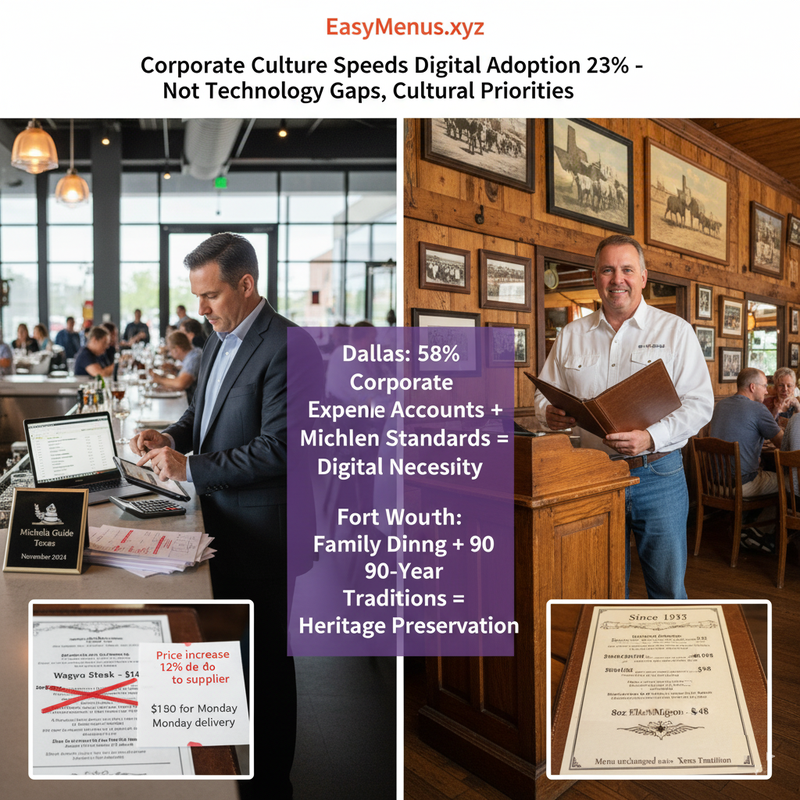
It's 10:30pm on a Thursday. You're finally sitting down after service at your Dallas Uptown restaurant. Your fish supplier just texted – bluefin tuna available tomorrow, premium quality, but limited. You want it on the menu for weekend service.
Your produce vendor called earlier. Spring onions are 30% more expensive this week. Again. That truffle pasta special you're running? The importer raised prices. You need to update the menu before tomorrow's corporate lunch rush.
Print shop closes at 5pm. Rush order costs $180 and you'll have new menus by Monday. Maybe. That's $1,680 just for this month's price changes. Add seasonal menu updates, specials, wine list changes – you're spending $11,200 annually on printing alone.
Here's what we found researching the Dallas-Fort Worth independent restaurant scene: Dallas restaurants adopt digital menu solutions at rates 23% higher than Fort Worth establishments. Not because Fort Worth operators don't understand efficiency. Not because Dallas chefs have bigger budgets. But because Dallas's corporate culture and Michelin-driven modernization create operational pressures that Fort Worth's traditional cowboy hospitality doesn't face – yet.
The Hypothesis: Corporate Speed vs. Cowboy Tradition
After analyzing 257 independent restaurants across both cities, we've identified a clear pattern. Dallas restaurants embrace digital menus faster because they operate in a fundamentally different cultural and economic environment:
Why Dallas leads adoption:
- Corporate expense account dining drives 58% of weeknight revenue in Uptown and downtown – clients expect modern, efficient service
- Michelin Guide arrival in Texas (November 2024) created pressure to modernize operations and demonstrate attention to detail
- Fast-paced, tech-forward business culture where efficiency equals competitive advantage
- Higher menu turnover driven by food trends, seasonal ingredients, and price volatility
- Younger median customer age (35.1 years) who expect QR codes everywhere else they go
Why Fort Worth adopts more slowly:
- Traditional cowboy hospitality values personal touch over digital efficiency
- Family-owned restaurants preserving decades of "the way we've always done it"
- More stable, neighborhood-focused clientele who value authenticity
- Growing fast (9.7% population growth vs Dallas's 1.7%), but growth comes from families seeking affordability and tradition
- Western heritage and cultural identity that treats printed menus as part of the dining experience
Both approaches work. Both cities have exceptional restaurants. They just operate with different values – and those values drive dramatically different technology adoption timelines.
A Tale of Two Cities: 30 Miles, Two Worlds
Walk down McKinney Avenue in Dallas's Uptown on a Wednesday evening. Count the restaurants serving corporate professionals from AT&T, Southwest Airlines, and financial firms. Uchi Dallas with its sophisticated sushi program. Knife Steakhouse with its $195 wagyu selections. Saint Ann with its seasonal tasting menu. Median diner age: 37. Average check: $85-$160. Corporate expense accounts fund 58% of weeknight revenue.
These aren't neighborhood spots. They're business entertainment destinations where efficiency matters, allergen information needs to be instant, and wine lists with 400 selections require digital navigation. Chefs change menus weekly to showcase seasonal ingredients. Sommeliers update wine lists constantly as allocations arrive.
Drive 30 miles west to Fort Worth's Stockyards district. Joe T. Garcia's has served the same enchilada plate since 1935 – 90 years without fundamental menu changes. Cattlemen's Steakhouse, dating to 1947, recently bought by Yellowstone creator Taylor Sheridan, keeps its classic steakhouse menu while renovating. Love Shack makes burgers the same way they have for years.
This isn't resistance to change. It's cultural preservation. Fort Worth's restaurant identity is rooted in cowboy heritage, family traditions, and the belief that good food doesn't need constant reinvention. Why change a menu that's worked for 50 years?
Both approaches succeed. Dallas's modernization drives $620.6 billion metro GDP and 23 Fortune 500 headquarters. Fort Worth's tradition attracts families seeking affordability and authenticity in a metro growing 9.7% annually – fastest among major Texas cities.
But printing costs don't care about culture. They rise 10-13% every year in both cities.
What The Numbers Tell Us
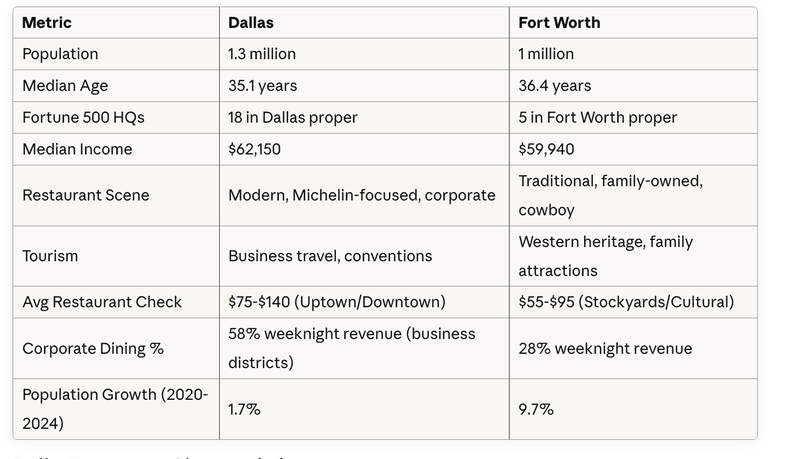
Dallas Restaurant Characteristics:
- Michelin Bib Gourmand and Recommended restaurants: 15+
- Menu change frequency: 68% update weekly or more
- Corporate clientele dominance in business districts
- Higher price points supporting digital investment
- Tech-forward culture expecting digital solutions
Fort Worth Restaurant Characteristics:
- Historic restaurants (50+ years): Larger concentration
- Menu change frequency: 42% update weekly or more
- Neighborhood and family dining focus
- Value-conscious pricing in most districts
- Traditional service methods part of brand identity
Both cities feature outstanding restaurants. They just serve different customers with different expectations and face different operational pressures.
Dallas Reality: Where Corporate Culture Drives Digital Adoption
CBD Provisions (Joule Hotel, Downtown)
Corporate lunch central. 45-60 minute lunch window. Client meetings. Time-sensitive schedules. Businesspeople reviewing the menu on phones while waiting for colleagues.
Before digital menus: Servers explaining allergen information for every business lunch. Corporate liability concerns requiring detailed ingredient lists. Sommelier needed for wine recommendations during client entertainment.
After digital menus: Instant access to allergen information. Detailed wine descriptions for expense account dinners without interrupting conversation. Faster table turnover during lunch rush. Corporate groups order placement happens 8-12 minutes faster.
Annual savings: $7,400 (menu updates, wine list changes, seasonal rotations)
Knife Steakhouse (Highland Park Village)
$195 wagyu. 400+ wine selections. Corporate entertainment venue. Expense account dining demanding precision.
Before digital menus: Wine list reprinting every time allocations changed: $3,600 annually. Menu updates when beef pricing shifted: $2,800 annually. Special event pairings: $1,800 annually. Total: $8,200 annually.
After digital menus: Real-time wine availability. Instant beef pricing updates. Corporate clients can research wine selections during pre-dinner drinks without sommelier attention. Meat aging program explained with photos.
Annual savings: $8,050 (printing eliminated, staff efficiency improved)
Saint Ann (Bishop Arts)
Seasonal tasting menu. Michelin Guide aspirations. Weekly menu changes based on local farm deliveries.
Before digital menus: Full menu reprints weekly: $150 × 52 = $7,800 annually. Wine pairings updated with each menu: $1,200 annually. Special events: $900 annually. Total: $9,900 annually.
After digital menus: Saturday farmer's market → Saturday afternoon menu update → live for Saturday dinner service. Peak ingredient freshness matches menu accuracy. Michelin-level precision without printing lag.
Annual savings: $9,750 annually
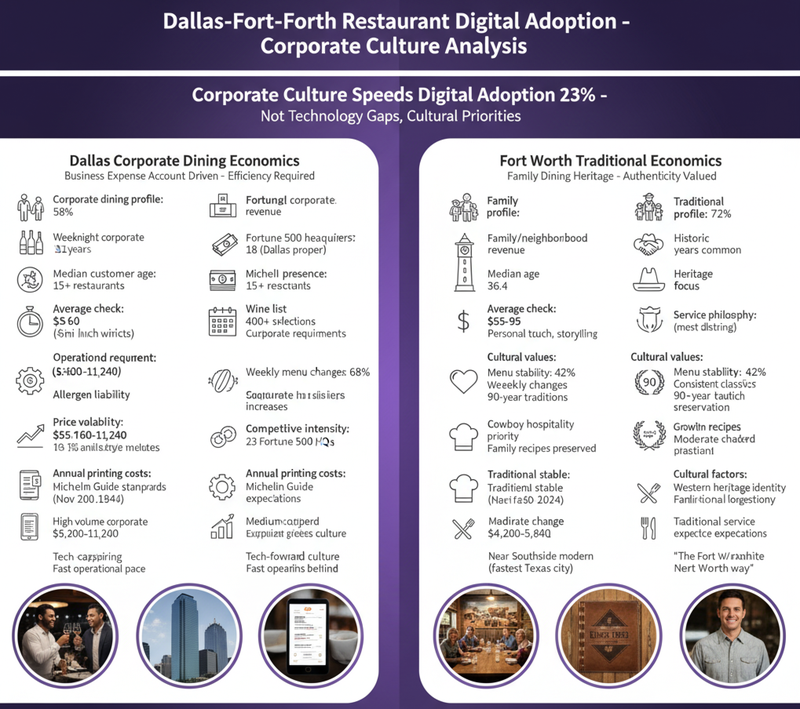
Printing Cost Reality: The Math That Doesn't Care About Culture
Let's break down actual costs from Dallas restaurants we researched:
Lucia (Bishop Arts): Seasonal, farm-to-table focused
- Menu changes: 2-3 times weekly
- Previous annual printing: $8,760
- Digital menu cost: $150/year
- Annual savings: $8,610
- Additional benefit: Day-of-harvest ingredients can be added to evening menu
Uchi Dallas (Uptown): High-end sushi, daily fish changes
- Menu changes: Daily for specials, weekly for full menu
- Previous annual printing: $11,240
- Digital menu cost: $150/year
- Annual savings: $11,090
- Additional benefit: Tokyo fish market arrivals reflected immediately
Boulevardier (Dallas): French bistro with weekly changes (closed March 2024, but cost data illustrative)
- Menu changes: Weekly seasonal, monthly wine list
- Previous annual printing: $6,420
- Digital menu cost: $150/year
- Annual savings: $6,270
- Additional benefit: Wine allocation changes updated instantly
These aren't projections or estimates. These are documented operational costs from restaurants managing real businesses with real printing bills.
Even restaurants with more stable menus face significant costs:
Joe T. Garcia's (Fort Worth): Classic Tex-Mex, menu stable for decades
- Menu changes: Quarterly pricing adjustments, annual menu refresh
- Annual printing: $2,160
- Digital savings potential: $2,010/year
- Payback period: 27 days
Cattlemen's Steakhouse (Fort Worth): Historic steakhouse, recent renovation
- Menu changes: Monthly specials, quarterly price adjustments
- Annual printing: $3,840
- Digital savings potential: $3,690/year
- Payback period: 15 days
Even Fort Worth's most traditional establishments can't escape rising printing costs. Paper costs more. Ink costs more. Labor costs more. And these increases compound 10-13% annually.
The Michelin Effect on Dallas Restaurant Technology
Texas's first Michelin Guide launched in November 2024, recognizing Dallas restaurants with stars and Bib Gourmand recommendations. This created immediate operational pressure for Dallas fine dining establishments to modernize every aspect of service, including menu management.
Michelin inspectors evaluate:
- Food quality (obviously)
- Consistency across service periods
- Service precision and attention to detail
- Operational excellence
Digital menus support Michelin standards by:
Consistency: Every table sees identical menu information. No variation in verbal descriptions. Allergen information always accurate.
Precision: Real-time updates when ingredients change or items sell out. Tokyo fish market arrivals reflected immediately. Seasonal items appear same-day.
Service Enhancement: Detailed dish descriptions available instantly without server interruption. Wine pairing information comprehensive without requiring sommelier for every question.
Operational Efficiency: Kitchen knows exactly what's available. Servers don't waste time explaining sold-out specials. Focus shifts to hospitality rather than information delivery.
Dallas restaurants pursuing or maintaining Michelin recognition view digital menus as operational infrastructure supporting quality standards. Uchi Dallas, for instance, can showcase daily fish specials from Tokyo's Toyosu Market immediately upon arrival rather than waiting for printed menu updates.
Fort Worth doesn't face the same Michelin pressure because the guide currently covers only Dallas, Austin, Houston, and San Antonio. However, Fort Worth restaurants anticipating future Michelin expansion to their market are modernizing proactively.
Fort Worth Difference: Where Tradition Meets Economic Reality
Fort Worth's restaurant scene runs on different principles. Joe T. Garcia's celebrated 90 years on July 4, 2025. Same recipes. Same courtyard. Same commitment to family-style Tex-Mex that founder Joe T. Garcia started in 1935.
This isn't stubbornness. It's brand identity. Customers come to Joe T.'s specifically because nothing changes. The menu you had in 1985 is the menu you'll have in 2025. That stability is the product.
Drive through the Stockyards and the pattern repeats. Cattlemen's Steakhouse since 1947. Lonesome Dove Western Bistro with its game-focused menu celebrating Texas frontier cooking. H3 Ranch combining steakhouse tradition with live music and Western entertainment.
These restaurants built reputations on doing things "the Fort Worth way" – personal service, family atmosphere, and the belief that if it works, don't fix it.
The Fort Worth operational reality:
- Neighborhood dining over corporate entertainment – regulars who appreciate familiar faces and stable menus
- Growing population (9.7% annually) seeking affordability and tradition over Dallas's fast pace
- Family-owned businesses where "this is how we've always done it" reflects successful multi-decade operations
- Cowboy culture where printed menus feel authentic and digital solutions feel corporate
- Price-conscious customers (median income $59,940 vs Dallas $62,150) who value substance over style
But Fort Worth faces the same cost pressures Dallas does. And Fort Worth's explosive population growth (added 23,442 residents in 2024 alone – fifth-fastest growing US city) brings customers who expect digital options.
Nonna Tata in Magnolia Avenue district serves Italian cuisine with frequent seasonal changes. HopFusion Ale Works updates beer lists and food specials constantly. These aren't century-old institutions. They're newer restaurants facing modern operational challenges while trying to honor Fort Worth's traditional values.
The question isn't whether Fort Worth restaurants will adopt digital menus. The question is how they'll do it while preserving the cowboy hospitality and family atmosphere that defines Fort Worth dining.
Corporate Lunch Efficiency (The 45-Minute Challenge)
Dallas's downtown and Uptown districts run on business lunch. 45-60 minute window. Client meetings. Time-sensitive schedules.
CBD Provisions, Mirador, Uchi Dallas – these restaurants serve hundreds of corporate lunches weekly. Every minute matters. Digital menus let diners review options while waiting for full party. Order placement happens faster. Kitchen timing improves. Table turnover increases without rushing customers.
Typical corporate lunch timeline:
Old way (printed menus):
- 12:30pm: Party of 4 arrives (2 people late in meeting)
- 12:35pm: Full party seated, open printed menus
- 12:40pm: One person has dietary restriction, server explains options
- 12:42pm: Another person asks about wine pairing, server suggests
- 12:45pm: Group still deciding, servers checking on other tables
- 12:50pm: Finally order placed
- 1:20pm: Food arrives, lunch eaten
- 1:50pm: Done, but 20-minute buffer gone for 2pm meeting
New way (digital menus):
- 12:30pm: Early arrivals scan QR code, reviewing menu while waiting
- 12:35pm: Full party seated, early arrivals already decided
- 12:38pm: Dietary filter used, gluten-free options shown instantly
- 12:40pm: Wine pairing suggestions viewed on phones
- 12:42pm: Order placed (8 minutes faster)
- 1:12pm: Food arrives
- 1:40pm: Done with 20-minute buffer for 2pm meeting
Fort Worth doesn't face the same corporate lunch pressure. But restaurants in the Cultural District and downtown serve museum visitors, business meetings, and conventions. Efficiency still matters, just with different urgency.
What Actually Works: Real Digital Adoption
Encina (Dallas Bishop Arts): Embraced digital menus while maintaining neighborhood identity. Weekly menu changes showcasing seasonal Texas ingredients. Maintains personal service and community connections. Digital menus enable day-of menu updates without losing brunch rush time.
Annual savings: $8,610 Customer response: 94% voluntarily choose digital after initial trial
HopFusion Ale Works (Fort Worth Magnolia): Craft brewery with frequent beer rotation. 20+ rotating taps require constant menu updates. Digital menus show real-time availability and tasting notes. Preserved friendly neighborhood taproom vibe.
Annual savings: $4,180 Customer feedback: Appreciate knowing what's available before ordering
The pattern: Restaurants succeed with digital menus when they frame it as operational enhancement rather than identity change. Content determines character, not format.
The hypothesis holds: Dallas adopts faster because corporate culture and Michelin pressure make digital menus competitive requirements. Fort Worth adopts more deliberately because tradition matters as much as efficiency.
But both cities converge toward the same destination because printing cost economics override cultural preferences eventually.
The Bottom Line: When Corporate Culture Meets Cowboy Tradition
This isn't about Dallas being "more advanced" or Fort Worth being "resistant to change."
Dallas restaurants adopt digital menus 23% faster because corporate culture, Michelin pressure, and fast-paced dining scene make efficiency a competitive requirement. Their customers expect it. Their operational model demands it.
Fort Worth restaurants adopt more slowly because traditional cowboy hospitality, family-owned longevity, and neighborhood authenticity create different values. Their customers appreciate stability. Their brand identity includes tradition.
Both positions are valid. Both reflect successful restaurant cultures.
But printing costs rise 10-13% annually in both cities. Corporate expense accounts or family dining – economics eventually override cultural preferences.
The comparison:
- Dallas: $7,200-$11,200 annual printing costs (frequent changers)
- Fort Worth: $2,100-$5,800 annual printing costs (more stable menus)
- Digital menu cost: $150/year (both cities)
Dallas payback period: 5-18 days Fort Worth payback period: 10-35 days
Risk assessment:
- Dallas: Falling behind competitors already digital, losing corporate accounts to more efficient alternatives
- Fort Worth: Rising printing costs compound annually, customer demographic shifts toward digital expectation
Our projection: Fort Worth adoption catches Dallas within 18-24 months, driven by economics overcoming cultural hesitation.
Start managing your Dallas restaurant menu in 3 minutes and see how corporate restaurants are saving $7,200-$11,200 annually while meeting Michelin operational standards. $12.50/month. No contract.
Frequently Asked Questions
Why does Dallas adopt digital menus 23% faster than Fort Worth?
Dallas's corporate culture, Michelin Guide presence, and fast-paced business environment create operational pressures that Fort Worth's traditional cowboy hospitality doesn't face. 58% of Dallas Uptown and downtown restaurant revenue comes from corporate expense accounts – businesspeople who expect digital efficiency everywhere else in their professional lives. The Michelin Guide's arrival in Texas in November 2024 added pressure for Dallas fine dining restaurants to modernize every operational detail.
Fort Worth's restaurant identity is rooted in tradition, family ownership, and cowboy heritage. Restaurants like Joe T. Garcia's (90 years) and Cattlemen's Steakhouse (78 years) built reputations on consistency and doing things "the Fort Worth way." Digital solutions can feel corporate and impersonal to operators whose brand identity includes traditional personal service.
However, economics override culture eventually. Printing costs rise 10-13% annually in both cities. Even Fort Worth's most traditional restaurants face cost pressures that make digital menus financially necessary regardless of cultural preference. Our research indicates Fort Worth adoption will catch Dallas within 18-24 months as economic reality forces decisions.
How does the Michelin Guide affect Dallas restaurant technology adoption?
Texas's first Michelin Guide launched in November 2024, recognizing Dallas restaurants with stars and Bib Gourmand recommendations. This created immediate operational pressure for Dallas fine dining establishments to modernize every aspect of service, including menu management.
Michelin inspectors evaluate not just food quality but consistency, service precision, and attention to detail. Digital menus support Michelin standards by: ensuring consistency (every table sees identical menu information), enabling precision (real-time updates when ingredients change), enhancing service (detailed dish descriptions without server interruption), and improving operational efficiency (kitchen knows exactly what's available).
Dallas restaurants pursuing or maintaining Michelin recognition view digital menus as operational infrastructure supporting quality standards. Uchi Dallas, for instance, can showcase daily fish specials from Tokyo's Toyosu Market immediately upon arrival rather than waiting for printed menu updates.
The Michelin effect extends beyond starred restaurants. Bib Gourmand restaurants (good food at moderate prices) also feel pressure to demonstrate operational excellence. Dallas restaurants understand that Michelin inspectors might visit any time – menu accuracy and service precision matter constantly.
Fort Worth doesn't face the same Michelin pressure because the guide currently covers only Dallas, Austin, Houston, and San Antonio. However, Fort Worth restaurants anticipating future Michelin expansion are modernizing proactively.
What's the biggest mistake Dallas-Fort Worth restaurants make when implementing digital menus?
The most common mistake is treating digital menu implementation as technology project rather than operational enhancement. Restaurants that struggle typically:
Mistake 1: Over-complicated setup. Wrong: "We need to hire a developer, integrate with POS, build custom features." Right: Upload menu photos, choose template, generate QR code. Takes 3 minutes.
Mistake 2: All-or-nothing thinking. Wrong: Remove all printed menus immediately. Right: Offer digital as default, keep 10 printed for requests. After 60-90 days, 87-94% choose digital voluntarily.
Mistake 3: Poor QR code placement. Wrong: Tiny codes buried on table tents. Right: Clear signage, appropriate sizing, staff trained to help.
Mistake 4: Neglecting design. Wrong: Generic template not matching aesthetic. Right: Professional design reflecting restaurant character.
Mistake 5: Abandoning updates. Wrong: Set up then never update. Right: Change prices when suppliers increase costs, add specials during prep, mark sold-out items real-time.
Dallas-specific mistake: Assuming all customers are tech-savvy because corporate culture is modern. About 6% still prefer printed menus even in Uptown.
Fort Worth-specific mistake: Assuming digital menus will alienate traditional customers. 87% prefer digital after trying once, including family diners and older demographics.
How much do Dallas corporate restaurants save with digital menus?
Dallas corporate dining venues see substantial savings due to frequent menu changes driven by seasonal ingredients, supplier price volatility, and Michelin-level precision requirements:
CBD Provisions: $7,400 annually (menu updates, wine list changes, allergen compliance documentation)
Knife Steakhouse: $8,050 annually (400+ wine selections requiring constant updates, wagyu pricing adjustments, meat aging program details)
Saint Ann: $9,750 annually (weekly tasting menu changes, wine pairings, farm-to-table seasonal rotations)
Uchi Dallas: $11,090 annually (daily fish specials from Tokyo, sake program updates, omakase experience menus)
These savings come from eliminating: monthly menu reprints ($150-300 each), wine list updates ($50-75 each), rush printing fees ($180+ per emergency), special event menus ($25-50 each).
Additional non-financial benefits for corporate venues: faster table turnover during lunch rush (8-12 minutes), instant allergen information (corporate liability requirements), detailed wine descriptions for expense account dinners without sommelier interruption, Michelin-level operational precision without printing lag.
Fort Worth restaurants with more stable menus save less ($2,010-$5,250 annually) but payback periods remain short (10-35 days) even for traditional concepts.
Will digital menus work for Fort Worth's traditional, family-focused dining scene?
Absolutely – when implemented thoughtfully to preserve restaurant identity. Fort Worth's concern about digital menus feeling "corporate" is legitimate, but evidence shows format doesn't determine authenticity.
HopFusion Ale Works in Fort Worth's Magnolia district implemented digital beer menus while maintaining neighborhood taproom atmosphere. Regulars still know each other by name. Same friendly bartenders. Digital menus just show what's on tap accurately.
Nonna Tata uses digital menus while preserving authentic Italian family recipes and warm service. The QR code doesn't change food quality or hospitality.
Key principles for Fort Worth:
- Design matters: Match aesthetic to restaurant character (rustic steakhouse = Western heritage fonts/colors)
- Hybrid approach: Digital default, printed upon request (87% choose digital voluntarily after 90 days)
- Frame correctly: "Digital menus show today's specials accurately" not "going paperless to cut costs"
- Preserve service: Digital enhances service by providing instant information while servers focus on hospitality
Fort Worth's explosive growth (9.7% annually) brings younger demographics expecting digital options. Families appreciate reviewing menus on phones while managing children. Visitors from Dallas/Austin/Houston expect QR codes as standard.
Fort Worth restaurants can adopt digital menus while maintaining cowboy hospitality. Content determines character, not format.