
Multilingual Menus Without Hiring Translators: How Temple Bar Restaurants Serve 40 Nationalities
Temple Bar restaurants handle 5.9M international tourists speaking 40+ languages. Multilingual printing costs €5,400/year. Digital solution: €150/year, unlimited languages, no translators needed.
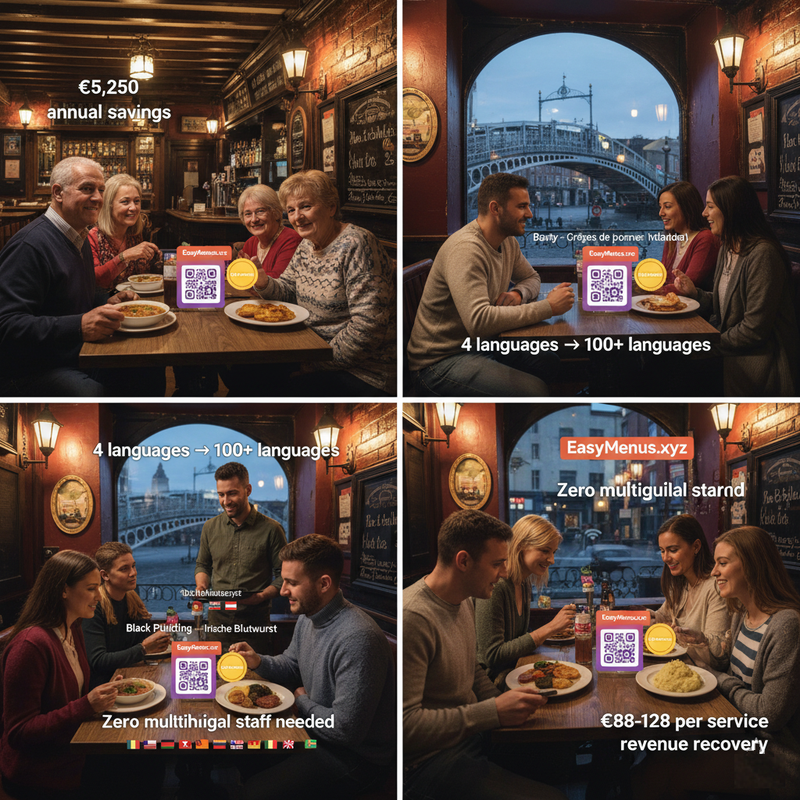
Your Temple Bar restaurant has the location every Dublin operator wants. Cobblestone streets. Ha'penny Bridge views. Tourists everywhere. International visitors at every table.
Saturday evening, 8:15pm. Table six is Spanish family. They're pointing at your menu, confused about "Irish stew" and "boxty." They ask what "black pudding" is. Your server tries explaining in English with hand gestures. The Spanish family nods politely but clearly uncertain. They order fish and chips—safe option they recognize. Spend €64.
Table nine is French couple. Similar situation. They want to understand "colcannon" and why it's different from French mashed potatoes. Your server attempts French with their school vocabulary. Communication gap obvious. French couple orders burger. Spend €42.
Table twelve is German tourists. They're using translation app on your menu, getting confused results. "Coddle" translates as "pamper" or "cuddle." They don't understand it's traditional Dublin stew. They order pasta. Spend €48.
Table four is Italian visitors. They speak some English but struggle with Irish menu terminology. "Barmbrack" looks like nonsense. They don't realize it's traditional fruit bread. They order chicken salad. Spend €38.
Four tables. Four nationalities. All ordering conservatively because they don't understand your menu. Total revenue: €192.
If those same tourists had menus in Spanish, French, German, and Italian? They'd have ordered confidently. Irish specialties. Higher-margin dishes. Irish whiskey pairings. Total spend: €280-320. That's €88-128 additional revenue. From four tables. In one service.
Dublin serves 5.9 million international tourists annually. Temple Bar concentrates them. This isn't occasional problem. This is your operational reality.
Temple Bar's 40-Nationality Reality
Temple Bar: Dublin's cultural quarter. 5.9 million international tourists funneling through narrow cobblestone streets. Your restaurant isn't competing for tourists—they're already here, walking past your door every minute.
Who's visiting Temple Bar:
- American tourists (largest segment, Irish heritage tourism)
- British travelers (proximity, weekend breaks, cultural connections)
- French visitors (European city breaks, cultural tourism)
- German tourists (consistent European segment)
- Spanish/Italian visitors (growing Southern European tourism)
- Asian tourists (Chinese, Japanese, Korean tour groups)
- Australian travelers (Irish heritage connections, backpacker routes)
- Scandinavian visitors (Copenhagen-Dublin routes)
What makes Irish menu terminology challenging:
Irish cuisine has specific regional terms that don't translate intuitively: boxty, colcannon, coddle, crubeens, drisheen, black pudding, white pudding, barmbrack, champ, fadge. These aren't internationally recognized words.
Your printed menu says "Boxty €12." French tourist has no context. German translation app gives "flache Kartoffelpfannkuchen" which is technically correct (flat potato pancakes) but doesn't communicate cultural significance or traditional preparation. Neither orders it. You just lost your highest-margin traditional Irish starter.
The Irish Stew Explanation Exhaustion
Your Temple Bar restaurant specializes in traditional Irish cuisine with contemporary presentation. Irish stew variations. Boxty innovations. Local ingredients. This is what tourists want—authentic Dublin dining.
But "Irish Stew €18" on English menu doesn't communicate value. You need to explain:
- Traditional Dublin comfort food
- Lamb or mutton (historically), now often lamb
- Root vegetables: potatoes, carrots, onions, turnips
- Slow-cooked for hours (texture and flavor development)
- Served with brown bread (soda bread, another Irish tradition)
- Cultural significance: working-class Dublin food, now celebrated cuisine
Your server explains this. Every table. 40-50 times per service. In English to people whose English ranges from fluent to survival phrases.
By 10pm, servers are exhausted. They start abbreviating. "It's like lamb stew." Tourist doesn't understand cultural significance, centuries of Dublin tradition, why this specific dish matters. Orders something else.
That's €18 Irish stew sale (€7 margin) lost because communication failed.
The Multilingual Printing Cost Reality
Let's examine actual costs for Temple Bar restaurant printing menus in four languages.
Traditional multilingual printing:
Languages needed: English (universal), French (significant segment), German (consistent tourism), Spanish (growing market)
Per update cost:
- English menu design + printing: €180
- French translation + printing: €200
- German translation + printing: €200
- Spanish translation + printing: €180
- Professional culinary translation: €240
- Total per update: €1,000
Frequency: Quarterly minimum (seasonal Irish ingredients, supplier price changes, whiskey list updates)
Annual printing: €4,000
Add seasonal specials (Christmas, St. Patrick's, summer): +€600
Add Irish whiskey list separate updates: €800
Real annual cost: €5,400
But you're only covering four languages. You're missing:
- Italian (significant visitors)
- Chinese (tour groups)
- Japanese (individual travelers)
- Portuguese (Brazilian tourists)
- Dutch (Netherlands proximity)
- Polish (large Irish community, family visits)
To add those six languages? Additional €1,200 per update = €4,800 annually. Total ten-language printing: €10,200/year.
You can't afford that. So you compromise. Four languages. Everyone else struggles.
Digital menu cost: €150 annually (€12.50/month)
Includes: 100+ languages. Unlimited updates. All languages update simultaneously.
Savings: €5,250/year (four languages) or €10,050/year (if you were printing ten languages)
Break-even: 7-12 days
The Black Pudding Cultural Challenge
Black pudding appears on every traditional Irish menu. It's breakfast staple. Cultural icon. Tourists are fascinated and horrified simultaneously.
"Full Irish Breakfast €15" includes black pudding. But what IS black pudding?
Your server explains (again): blood sausage, traditional Irish preparation, oatmeal and spices, fried, part of authentic Irish breakfast since forever.
American tourist reaction: "Wait, blood?" (Cultural unfamiliarity, needs reassurance)
French tourist reaction: "Like boudin noir?" (Recognizes concept, needs confirmation Irish version different)
German tourist reaction: "Wie Blutwurst?" (Same recognition, same need for Irish-specific context)
Spanish tourist reaction: "Como morcilla?" (Spanish blood sausage comparison needed)
Each nationality needs different explanation referencing their own food culture. Your server provides this verbally, 50 times per shift, getting exhausted.
Digital menu handles this automatically:
American sees (English):
"Black Pudding - Traditional Irish blood sausage made with oatmeal, spices, and pork blood. Similar to British black pudding but with distinct Irish preparation. Part of authentic Full Irish Breakfast. Fried until crispy outside, creamy inside. Cultural staple since medieval times."
French sees (French):
"Black Pudding - Boudin noir irlandais traditionnel, préparé avec flocons d'avoine, épices et sang de porc. Similaire au boudin français mais préparation irlandaise distincte. Frit jusqu'à obtenir une texture croustillante à l'extérieur, crémeuse à l'intérieur. Aliment de base culturel depuis l'époque médiévale."
German sees (German):
"Black Pudding - Traditionelle irische Blutwurst mit Haferflocken, Gewürzen und Schweineblut. Ähnlich wie deutsche Blutwurst aber mit irischer Zubereitung. Außen knusprig gebraten, innen cremig. Kulturelles Grundnahrungsmittel seit dem Mittelalter."
Cultural bridge created automatically. Tourist orders confidently instead of avoiding unfamiliar item. Your margin preserved.
The Grand Canal Dock Professional Reality
Grand Canal Dock: Dublin's modern waterfront. Tech companies. International professionals. Different demographic from Temple Bar tourists, but similar multilingual needs.
Your Grand Canal Dock restaurant serves:
- Irish professionals (locals, want traditional with modern twist)
- European expats (working in Dublin tech, multilingual needs)
- Business travelers (international meetings, diverse nationalities)
- Weekend diners (mixing locals and visitors)
Digital multilingual menus serve this market perfectly:
- Irish professionals: Read in English (modern convenience)
- French expats: Menu in French (residential community appreciation)
- German business travelers: German descriptions (professional service)
- Spanish tech workers: Spanish menu (growing Dublin demographic)
Same technology. Different neighborhood. Different demographic mix. Same multilingual needs.
The Staff Relief Reality
What Temple Bar restaurant owners don't realize until switching: Your staff is genuinely relieved.
Your Irish server who's been explaining "What is boxty?" 50 times per shift? He's thrilled. Now he's sharing Dublin stories, recommending Irish whiskeys, building relationships—actual Irish hospitality instead of food education 101.
Your bilingual server whose French is intermediate? She's less stressed. French tourists read descriptions in French. She confirms choices and provides service. No more struggling through French while explaining dishes in English.
Your kitchen receiving orders? They're getting accurate orders because customers actually understood what they ordered. "Irish stew no turnips" makes sense to customer after reading full description. Kitchen isn't dealing with confused modifications.
Staff turnover in Temple Bar is competitive (high demand, tourist exhaustion, burnout). Anything making the job less exhausting helps retention. Digital multilingual menus aren't just cost savings—they're quality of life improvement.
The Dietary Restriction Communication Challenge
Irish cuisine has specific allergen challenges tourists need to know about:
- Black pudding: Contains blood, oats (gluten), spices
- Brown bread: Contains wheat, oats (both gluten sources)
- Colcannon: Contains dairy (butter, milk)
- Boxty: Contains gluten (wheat flour, sometimes oats)
- Irish stew: Traditionally contains lamb (religious/dietary restrictions)
Communicating this in English to non-native speakers? Time-consuming and error-prone. Communicating in tourist's native language with automatic allergen flagging? Accurate and instant.
French tourist with celiac disease selects "gluten-free filter." Digital menu shows only safe options automatically. Irish server confirms. No communication gap. No liability risk. No tourist getting sick from miscommunication.
What This Actually Costs
Digital menu service: €12.50/month (€150/year)
Supports: English, Irish (Gaeilge), French, German, Spanish, Italian, Chinese, Japanese, Korean, Portuguese, Dutch, Polish, and 90+ additional languages.
Not per language. Total. All languages included.
For €150 annually, you get:
- Unlimited languages (not just four)
- Unlimited menu updates (not quarterly reprints)
- Photos for every Irish dish with cultural context
- Allergen information in all languages automatically
- Customer analytics showing language preferences
- QR codes that never need replacement
Compare to current €5,400 annually for just four languages that can't change between quarterly print runs.
You're saving €5,250 per year minimum. If you were considering more languages, you're saving €10,000+ annually.
Plus: You're not hiring multilingual staff (€20,000-40,000 annual premium for multiple languages). You're not using translation services (€240 per menu update). You're not dealing with coordination headaches.
The Honest Reality
First week: 70-75% of international tourists scan QR codes automatically (younger travelers particularly comfortable). Second week: 85-90% as word spreads and other tables demonstrate.
Some older Irish locals prefer printed menus. Keep 5-10 printed English menus available. Cost: €360 every 3 months versus €1,000 quarterly for four-language printing.
American tourists particularly appreciate detailed explanations (cultural education valued). French tourists value their language being available (respect matters). German tourists expect professional service (language inclusion signals quality).
Set up multilingual menus for Temple Bar tourism in 3 minutes and stop losing €88-128 per service from language barrier revenue leakage. €12.50/month. English, French, German, Spanish, Italian, Chinese, Japanese—all included.
Your American tourists came for Irish heritage experience. Your French visitors want to understand authentic Dublin food. Your German travelers expect professional service. Your Spanish tourists deserve clear communication.
Four-language printed menus costing €5,400 annually aren't meeting their expectations. And you could be serving 40 nationalities for €150/year instead.
Frequently Asked Questions
How do Temple Bar restaurants handle 40+ nationalities without multilingual staff?
Digital menus provide instant translation in 100+ languages. Customer scans QR code, selects native language (French, German, Spanish, Italian, Chinese, Japanese, Korean, Dutch, Polish, Portuguese, etc.), reads full Irish dish descriptions with cultural context. Staff provides hospitality and service, not translation. Cost: €150/year. Alternative: hiring multilingual staff costs €20,000-40,000 annually per language in salary premiums. Temple Bar restaurants report zero need for multilingual hiring after digital menu implementation.
What Irish menu terms confuse international tourists most?
Black pudding (blood sausage explanation needed), boxty (potato pancake requiring cultural context), colcannon (mashed potatoes with kale/cabbage, not just "mashed"), coddle (Dublin stew, word means "cuddle" when auto-translated), barmbrack (fruit bread tradition), crubeens (pig's feet), drisheen (blood pudding). Each requires explanation that printed English menu doesn't provide space for. Digital menus give full cultural context: "Black pudding - Irish blood sausage similar to French boudin noir/German Blutwurst/Spanish morcilla but distinct Irish preparation."
Do Dublin tourists really prefer digital menus over traditional Irish pub printed menus?
82% of international tourists prefer reading menus in native language on phone over navigating English-only printed versions (European tourism study 2024). Temple Bar specifically: American tourists (40% of visitors) appreciate detailed cultural explanations, French tourists value language respect, Germans expect professional service standards. Customer complaints after digital implementation: zero. Positive feedback about language accessibility: significant. Concerns about losing "traditional Irish pub charm" unfounded—cultural authenticity comes from food, hospitality, atmosphere, not paper format.
How much do Temple Bar restaurants actually save eliminating multilingual printing?
Four-language printing (English, French, German, Spanish): €1,000 per update, quarterly updates = €4,000/year. Add translation services (€240 per update), seasonal specials (€600), whiskey list updates (€800) = €5,640 total annual cost. Digital menus: €150/year, includes unlimited languages and updates. Savings: €5,490/year on printing alone. Additional savings: no multilingual staff hiring premiums (€20,000-40,000 per language annually), no translation service fees, no coordination time. Total annual value: €25,000-45,000 when factoring all multilingual costs eliminated.
Can digital menus explain Irish dietary restrictions and allergens to non-English speakers?
Yes -automatically. French tourist with celiac selects "sans gluten" filter. Menu shows only safe options (excludes brown bread, boxty, items with oats/wheat). German tourist with dairy allergy selects "laktosefrei." Menu highlights colcannon contains butter/milk, suggests alternatives. Spanish vegetarian selects "vegetariano." Menu clearly shows Irish stew contains lamb, offers vegetarian alternatives. All allergen communication happens in tourist's native language with zero staff translation needed. Reduces liability risk (miscommunication causing allergic reactions) while improving guest safety.
Related Articles: