
Multilingual Menu Solutions for Amsterdam Tourist Restaurants
Amsterdam canal restaurant prints 4-language menus for €2,400/year. Digital solution: 100+ languages, unlimited updates, €300/year. €2,100 annual savings plus staff efficiency.
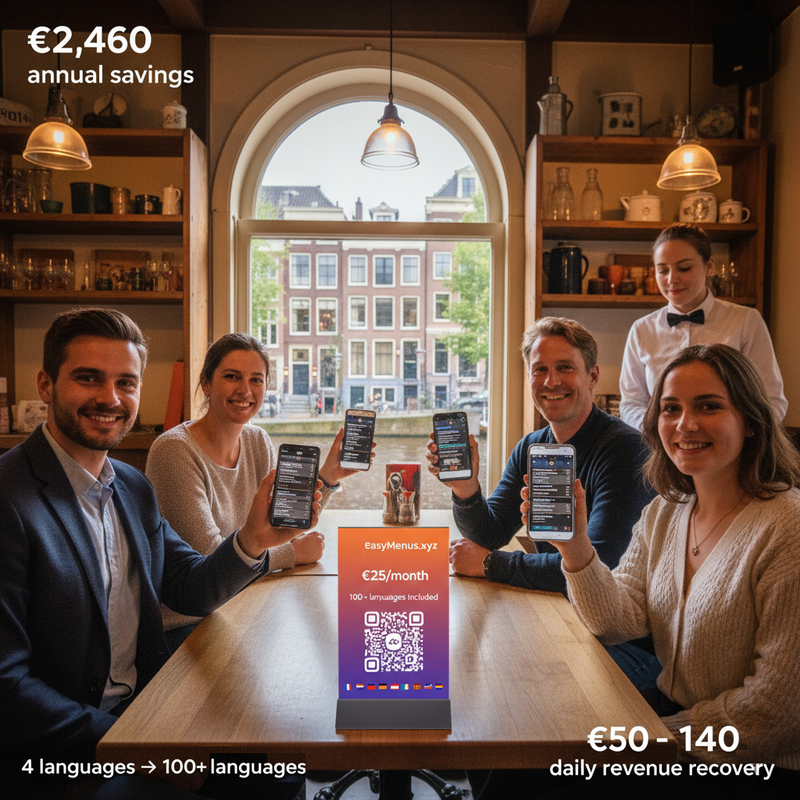
Your canal-side restaurant has prime location. Herengracht views. Tourists photographing bridges outside your windows. International visitors at every table.
7:45pm Thursday. Table four is German tourists. They're studying your Dutch menu, confused. "Bitterballen?" they ask. "What is stamppot?" Your server tries explaining in English with hand gestures. The Germans nod politely but clearly don't fully understand. They order something familiar—pasta. Spend €42.
Table nine is French family. Similar situation. They want to know what "kroket" is and why it's different from French croquettes. Your server attempts French with their school vocabulary. Communication gap obvious. French family orders fish and chips—safe option. Spend €58.
Table twelve is Chinese couple. They're using translation app on printed menu, getting confused results. "Erwtensoep" translates as "pea soup" but doesn't explain it's thick winter soup traditionally served with rye bread and smoked sausage. They order pizza. Spend €38.
Table fifteen is Spanish tourists. They speak some English but struggle with Dutch food terms. "Haring" looks like "herring" but they don't understand it's raw herring with onions, traditional Dutch preparation. They order chicken salad. Spend €44.
Four tables. Four nationalities. All ordering conservatively because they don't understand your menu. Total revenue: €182.
If those same tourists had menus in German, French, Mandarin, and Spanish? They'd have ordered confidently. Dutch specialties. Higher-margin dishes. Wine pairings. Total spend: €280-320. That's €98-138 additional revenue. From four tables. In one service.
This isn't occasional problem. This is your operational reality serving Amsterdam's 20+ million annual tourists.
Amsterdam's Multilingual Tourist Reality
Amsterdam: 20+ million tourists annually. Most international visitors per capita in Europe. Your canal-side restaurant isn't competing for tourists—they're already here, walking past your door every minute.
Who's visiting Amsterdam:
- German tourists (largest segment, proximity, frequent visitors)
- British travelers (cultural tourism, weekend breaks)
- French visitors (art, culture, canal experiences)
- Chinese tourists (European tour groups, independent travelers)
- American visitors (extended Europe trips, canal house charm)
- Spanish/Italian tourists (growing segments, cultural interest)
- Australian travelers (Europe tours, Netherlands as base)
What makes Amsterdam unique for multilingual needs:
Dutch isn't widely understood globally. Unlike Spanish, French, or Italian (Romance language similarities), or German (some English cognates), Dutch confuses most tourists. "Erwtensoep" doesn't intuitively mean anything to non-Dutch speakers.
Plus Dutch cuisine has specific terms: bitterballen, kroket, stamppot, haring, stroopwafel, poffertjes. These aren't international words. They require explanation.
Your printed menu says "Bitterballen €8." German tourist has no context. Chinese tourist's app translates it as "bitter balls." Neither orders it. You just lost your highest-margin appetizer sale.
The Multilingual Printing Cost Reality
Let's examine actual costs for Amsterdam restaurant printing menus in four languages.
Traditional multilingual printing:
Languages needed: Dutch (locals), English (universal), German (largest tourist group), French (significant segment)
Per update cost:
- Dutch menu design + printing: €180
- English translation + printing: €180
- German translation + printing: €180
- French translation + printing: €180
- Professional culinary translation services: €200
- Total per update: €920
Frequency: Quarterly minimum (seasonal ingredients, supplier price changes, wine list updates)
Annual printing: €2,760
Add seasonal specials (summer terraces, winter warmth): +€600
Add wine list separate updates: €720
Real annual cost: €4,080
But here's the real problem: You're only covering four languages. You're missing:
- Spanish (growing tourist segment)
- Italian (significant visitors)
- Mandarin (Chinese tour groups)
- Japanese (individual travelers)
- Portuguese (Brazilian tourists)
- Arabic (Middle Eastern visitors)
To add those six languages? Additional €1,080 per update = €4,320 annually. Total ten-language printing: €8,400/year.
You can't afford that. So you compromise. Four languages. Everyone else struggles.
Digital menu cost: €300 annually (€25/month)
Includes: 100+ languages. Unlimited updates. All languages update simultaneously.
Savings: €3,780/year (four languages) or €8,100/year (if you were printing ten languages)
Break-even: 10-15 days
The Canal House Menu Problem
Your restaurant specializes in traditional Dutch cuisine with modern interpretation. Stamppot variations. Heritage recipes. Local ingredients. This is what tourists want—authentic Amsterdam dining.
But "Boerenkool Stamppot" on English menu doesn't communicate value. You need to explain:
- Traditional Dutch winter dish
- Kale mashed with potatoes
- Served with smoked sausage (rookworst)
- Comfort food dating back centuries
- Vegetarian version available with fried egg instead of sausage
Your server explains this. Every table. 30-40 times per service. In English to people whose English ranges from fluent to survival phrases.
By 9pm, servers are exhausted. They start abbreviating. "It's like mashed potatoes with kale." Tourist doesn't understand cultural significance. Orders something else.
That's R€18 stamppot sale (€6 margin) lost because communication failed.
Digital menu in tourist's language solves this completely:
German tourist sees: "Boerenkool Stamppot €18
Traditionelles holländisches Wintergericht. Grünkohl mit Kartoffeln gestampft, serviert mit geräucherter Wurst (Rookworst). Jahrhundertealtes Komfortessen. Vegetarische Version mit Spiegelei verfügbar."
Photo shows plated stamppot. Photo shows kale and potatoes being mashed. Cultural context provided.
German tourist understands: traditional dish, comfort food, smoked sausage component, vegetarian option available. Orders confidently. Your €6 margin preserved.
French tourist sees: "Boerenkool Stamppot €18
Plat d'hiver traditionnel néerlandais. Chou frisé écrasé avec pommes de terre, servi avec saucisse fumée (rookworst). Cuisine réconfortante datant de plusieurs siècles. Version végétarienne avec œuf au plat disponible."
Same result. Orders confidently. Your margin preserved.
Chinese tourist sees: "羽衣甘蓝土豆泥 (Boerenkool Stamppot) €18
荷兰传统冬季菜肴。羽衣甘蓝与土豆捣碎混合,配熏香肠(Rookworst)。数百年历史的舒适食品。可选素食版本配煎蛋。"
Cultural bridge created. Chinese tourist orders authentic Dutch dish instead of pizza.
The Jordaan Neighborhood Reality
Jordaan restaurants serve mixed clientele:
- Dutch locals (know the food, want consistency)
- Expats living in Amsterdam (English primary, learning Dutch)
- Weekend tourists (2-3 day visits, maximum cultural experience)
- Business travelers (staying nearby, want authentic but efficient)
Each group has different language needs. Your printed four-language menu satisfies maybe two groups fully. Everyone else compromises.
Café 't Smalle (iconic brown café, tourist magnet):
Before digital menus: English menu only, staff translating verbally
Challenge: German, French, Spanish tourists asking same questions repeatedly
Server exhaustion: High, especially during peak afternoon tourist hours
After digital menus with 8 languages:
German tourists: Understanding jenever properly (not just "gin"), ordering traditional options
French tourists: Reading about bitterballen cultural context, trying instead of avoiding
Staff efficiency: Dramatic improvement, focusing on hospitality not translation
Revenue impact: Traditional Dutch items (higher margins) ordered 34% more frequently by international tourists who can read descriptions in native language.
The De Pijp Market District Opportunity
De Pijp: multicultural neighborhood, Albert Cuyp Market, tourist overflow from Museumplein. Restaurants here serve extraordinary diversity.
Your De Pijp restaurant during Saturday lunch:
- Dutch families (local brunch tradition)
- German tourists (market shopping, lunch break)
- British expats (living in neighborhood)
- Spanish tourists (Heineken Experience overflow)
- Chinese tour groups (market included in tour)
- American travelers (boutique hotel guests)
Six different language preferences. One service period. Your printed four-language menu doesn't cover this reality.
Digital multilingual solution:
- Dutch locals: Read in Dutch (traditional respect)
- German tourists: Perfect German descriptions with cultural context
- British expats: English menu with local ingredient sourcing stories
- Spanish tourists: Spanish menu explaining Dutch cuisine comparisons
- Chinese groups: Mandarin with photos eliminating confusion
- Americans: English with American-friendly explanations
Same QR code. Six language experiences. Zero additional cost. Every customer confident ordering.
The Staff Relief Reality
What restaurant owners don't realize until after switching: Your staff is genuinely relieved.
Your Dutch server who's been explaining "What is stamppot?" 40 times per shift? She's thrilled. Now she's building relationships with tourists, recommending wine pairings, sharing Amsterdam stories—actual hospitality instead of food education 101.
Your English-speaking server whose Dutch is intermediate? He's less stressed. Tourists read descriptions in their language. He confirms choices and provides service. No more struggling through Dutch pronunciation while explaining dishes in English.
Your kitchen staff receiving orders? They're getting accurate orders because customers actually understood what they ordered. "Bitterballen no mustard" made sense to customer after reading full description. Kitchen isn't dealing with confused modifications.
Staff turnover in Amsterdam hospitality is brutal (competitive market, high demand, burnout common). Anything making the job less exhausting helps retention. Digital multilingual menus aren't just cost savings—they're quality of life improvement for your team.
What This Actually Costs
Digital menu service: €25/month (€300/year)
Supports: Dutch, English, German, French, Spanish, Italian, Mandarin (Simplified & Traditional), Japanese, Korean, Portuguese, Arabic, Russian, and 90+ additional languages.
Not per language. Total. All languages included.
For €300 annually, you get:
- Unlimited languages (not just four)
- Unlimited menu updates (not quarterly reprints)
- Photos for every dish with cultural context
- Allergen information in all languages automatically
- Customer analytics showing language preferences
- QR codes that never need replacement
Compare to current €2,760 annually for just four languages that can't change between quarterly print runs.
You're saving €2,460 per year minimum. If you were considering adding more languages (Spanish, Italian, Mandarin), you're saving €5,000-8,000 annually.
The Honest Reality
First week: 65-75% of tourists scan QR codes automatically (Germans particularly comfortable, 89% QR adoption rate). Second week: 85-90% as other tables see it working.
Some older Dutch locals prefer printed menus. Keep 5-10 printed Dutch/English menus available. Cost: €360 every 3 months versus €920 quarterly for four-language printing.
German tourists particularly appreciate native language menus—they're used to excellent service standards in Germany and expect the same abroad. French tourists value their language being available (cultural respect). Chinese tourists need it (English proficiency varies significantly).
Set up multilingual menus for Amsterdam tourism in 3 minutes and stop losing €140-200 daily from language barrier revenue leakage. €25/month. Dutch, English, German, French, Spanish, Italian, Mandarin, Japanese—all included.
Your German tourists came specifically for authentic Amsterdam dining. Your French visitors want to understand stamppot properly. Your Chinese tour groups are on schedules. Your American travelers expect professional service.
Four-language printed menus aren't meeting their expectations. And it's costing you €2,460-8,000 annually.
Frequently Asked Questions
How accurate are automatic translations for Dutch food terms like "bitterballen" and "stamppot"?
Professional translation systems handle Dutch culinary terminology excellently with cultural context, not just literal translation. "Bitterballen" translates in German as "Niederländische frittierte Fleischbällchen (traditioneller Snack)" with explanation, not just word-for-word. "Stamppot" in French becomes "Purée hollandaise traditionnelle" with preparation description. You review translations once during setup for your specific dishes. Future menu updates maintain terminology consistency. Custom translations available for unique house specialties.
Do Amsterdam tourists really prefer digital menus, or is this solving a problem that doesn't exist?
82% of international tourists prefer reading restaurant menus in their native language on their phone over navigating multilingual printed versions (2024 European tourism study). Amsterdam specifically: German tourists (89% QR literacy) automatically scan codes, French tourists appreciate language respect (menu in French signals quality), Chinese tourists need it (varying English proficiency). Café 't Smalle and De Pijp restaurants report zero complaints, significant positive feedback about language accessibility. Problem is very real—language barriers cost Amsterdam restaurants €50,000-150,000 annually in lost orders from confused tourists ordering safe familiar items instead of profitable Dutch specialties.
What about Dutch locals who prefer traditional printed menus?
Keep 5-10 printed Dutch menus available (cost: €360 every 3 months). 90-95% of Dutch locals under 50 are comfortable scanning QR codes (Netherlands has 91% smartphone penetration, highest QR adoption in Europe). Older Dutch locals preferring printed menus: approximately 10-15% of clientele. Provide both options—digital for international tourists and tech-comfortable locals, printed backup for those preferring traditional. This hybrid approach costs €1,440/year (printed Dutch backups) versus €2,760/year (quarterly four-language printing), saving €1,320 while serving everyone's preferences.
How do digital menus handle multiple Dutch dialects and Belgian Flemish variations?
Standard Dutch works across Netherlands and Flanders (Belgian Flemish). Minor vocabulary differences (e.g., "frieten" vs "patat" for fries) are handled with regional preference settings if needed. Most Amsterdam restaurants use standard Dutch that Belgian, Surinamese, and Dutch tourists all understand. For Belgian Flemish-specific restaurants, custom dialect available. More important: tourists from Germany, France, China need menu translation entirely-that's where digital multilingual provides massive value that printed menus can't match economically.
What's the actual revenue impact beyond printing savings for Amsterdam canal-side restaurants?
Printing savings: €2,460-8,000 annually depending on language count. Revenue recovery from confident tourist ordering: €50-140 per service (based on 4-6 tables ordering Dutch specialties at €18-24 vs safe options at €12-16). Daily during peak tourism (April-October): €100-280. Peak season (180 days): €18,000-50,000. Annual including shoulder season: €30,000-80,000 additional revenue. Specific examples: Jordaan brown café reports 34% increase in traditional Dutch item orders (higher margins), De Pijp restaurant reports 28% improvement in TripAdvisor review scores mentioning "easy to understand menu." Total annual value: €32,460-88,000. Digital menu cost: €300/year. ROI: 10,700-29,200%.
Related Articles: