
Koreatown & Chinatown: Why 27 Ethnic Restaurants Need Multilingual Digital Menus
Koreatown & Chinatown: Why 27 Ethnic Restaurants Need Multilingual Digital Menus
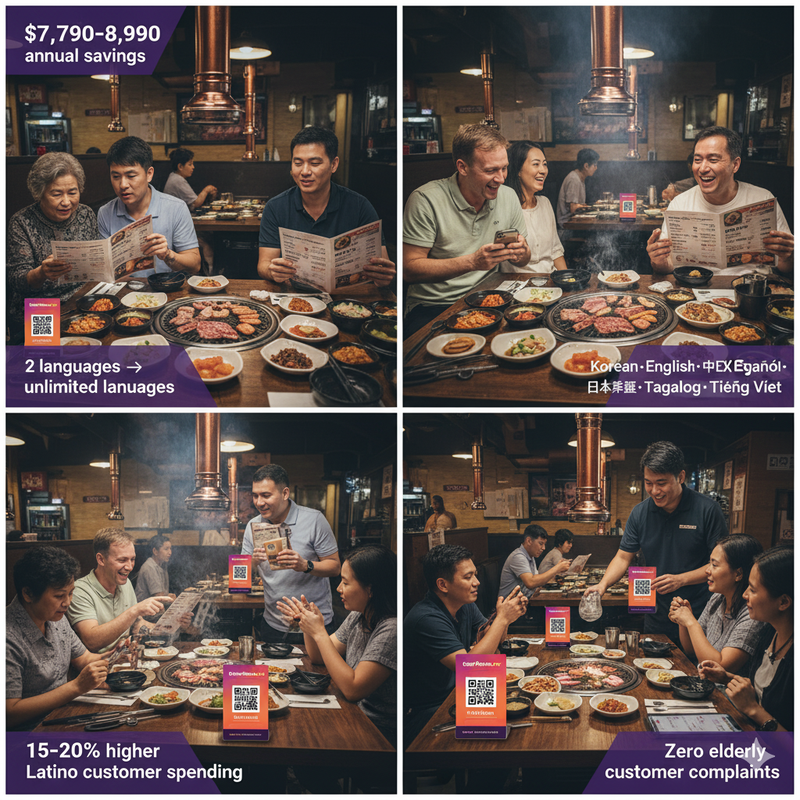
Saturday night, 7:30pm at Park's BBQ in Koreatown. Table 8 is Korean family—three generations speaking Korean, ordering in Korean, reading the Korean side of your bilingual menu. Table 12 is young Korean-Americans mixing English and Korean with their parents. Table 15 is white food bloggers who heard about your Michelin recognition and can barely pronounce "galbi." Table 3 is Latino family—your server Maria is translating menu from English to Spanish by memory because you don't have Spanish menus printed.
Four tables. Four completely different language needs. One restaurant trying to serve them all with two printed menu versions that cost $400 every time you reprint them.
And you're reprinting monthly. Because beef prices change. Because banchan offerings rotate. Because your kimchi supplier switched and the flavor profile is different now and you want to note that. Because the menu you printed in February is already wrong by March.
That's $4,800 annually. Just on printing menus in two languages. Not four. You gave up on Spanish and Chinese versions because the print shop quoted $800 per run and you just... can't.
Twenty-seven restaurants across Koreatown and Chinatown are dealing with this exact same problem. And they're all solving it the same way: stop printing multiple versions, start letting customers choose their language digitally.
The Cultural Authenticity Question
Here's the thing nobody talks about in the "digital vs traditional" debate: Korean and Chinese restaurants aren't choosing between authenticity and technology.
You're choosing between serving your community properly or making half your customers struggle.
Yang Chow runs three locations serving Mandarin and Cantonese cuisine. They've been around 30+ years. They're not some trendy fusion spot trying to be everything to everyone. They're traditional. Their slippery shrimp is famous. Their hot and sour soup is the real deal.
And their customers are:
- First-generation Chinese immigrants who prefer reading Chinese characters
- Second-generation Chinese-Americans who read English but want to see Chinese names for dishes
- Non-Chinese food enthusiasts who need English descriptions
- Spanish-speaking kitchen staff who need to understand orders
- Random LA food tourists who just want good Chinese food
You can't serve all these people properly with one printed English menu. You can't afford to print five different versions. So you compromise. English menu with some Chinese characters. Staff translates verbally. Everyone's a little frustrated.
Or you go digital. Customer scans QR code. Sees language options. Picks Chinese, English, Spanish, Korean, whatever they need. Gets full description in their language. Orders confidently. Your staff focuses on service instead of translation.
Cultural authenticity isn't preserved by paper menus. It's preserved by letting people understand your food properly—whether that's in Mandarin, Cantonese, Korean, Spanish, or English.
The Translation Exhaustion Nobody Mentions
Jade Wok in Chinatown has been family-owned for 30+ years. They make homemade tofu. It's a point of pride. Three decades of traditional methods.
But "homemade tofu" on English menu doesn't communicate WHY that matters. You need to explain: They make it fresh daily. They use organic soybeans. The texture is different from factory tofu. The flavor is delicate. It's part of Cantonese culinary tradition.
Your server explains this. To every customer who asks. Which is 30-40 times per dinner service. In English. Sometimes in broken Spanish. Occasionally attempting Mandarin.
By 9pm, your servers are exhausted from explaining the same things over and over. They start rushing the explanation. Or skipping details. Or just saying "it's good, you'll like it" because they're too tired to do the full cultural education.
That's not their fault. That's a menu problem.
Park's BBQ has the same issue with Korean BBQ cuts. Bulgogi vs galbi vs chadolbaegi—these aren't just different cuts, they're different preparations, different marinades, different cooking methods, different price points. Your Korean customers know this. Your non-Korean customers are guessing.
Your server explains. Every. Single. Table. Then explains what banchan is. Then explains why you turn the meat yourself at the table. Then explains how to use the lettuce wraps. Then explains gochujang vs ssamjang.
Your server's job should be hospitality and service. Not teaching Korean Cooking 101 forty times a night.
The Real Cost in Multiple Languages
Let's do the actual math for typical Koreatown or Chinatown restaurant printing bilingual menus.
Annual Printing Costs (Korean + English OR Chinese + English):
- Menu reprints (12 times/year at $300-400 per run for dual-language): $3,600-4,800
- Seasonal specials inserts (4 times/year at $150 each): $600
- Rush fees when you forget or need changes fast: $400
- Total bilingual printing: $4,600-5,800 per year
What You're NOT Printing (But Need):
- Spanish versions for Latino customers and staff: Would add $300-400 per run = $3,600-4,800 more
- Additional Asian languages (Japanese, Tagalog, Vietnamese): Another $300-400 each
- If you actually printed all needed languages: $10,000-15,000 annually
Coordination Time:
- Managing two separate menu files (Korean/English or Chinese/English): 2 hours monthly @ $25/hour = $600/year
- Coordinating with print shop for dual-language layout: $400/year
- Staff time explaining menu items customers can't read: 3 hours weekly @ $15/hour = $2,340/year
- Total hidden costs: $3,340 per year
Total cost of bilingual printed menus: $7,940-9,140 annually
Digital menu cost supporting unlimited languages: $150 per year
Annual savings: $7,790-8,990
And that's before counting the customers who don't order things they can't understand, or who leave mediocre reviews because they felt lost with the menu.
When Your Community Speaks Multiple Languages
Koreatown isn't just Korean anymore. Haven't been for years.
You've got:
- First-generation Korean immigrants (Korean primary, some English)
- Korean-Americans (bilingual, code-switching)
- Latino residents and workers (Spanish, some English)
- Asian-American food tourists (English, maybe some Korean/Japanese/Chinese)
- Non-Asian food enthusiasts (English only)
- Chinese, Japanese, Filipino communities overlapping (various Asian languages)
Chinatown's similar:
- Cantonese speakers (traditional community)
- Mandarin speakers (newer immigrants, different dialect)
- Second/third-generation Chinese-Americans (English primary)
- Vietnamese community (another language entirely)
- Latino residents (Spanish)
- Everyone else exploring LA's food scene (English)
Your printed menu serves maybe two of these groups well. Everyone else is making do.
Park's BBQ figured this out. Michelin recognition means food tourists from everywhere. Korean food means Korean community expects authenticity. Tourist location means people who've never had Korean BBQ.
One QR code. Menu available in Korean, English, Spanish, Japanese, Chinese. Customer picks their language. Sees full descriptions with photos. Understands what they're ordering. Your kitchen gets accurate orders. Your servers do hospitality instead of translation.
Cultural authenticity maintained. Customer experience improved. Staff exhaustion reduced. Printing costs eliminated.
The Generational Divide
Here's something interesting: The language needs in your restaurant aren't just about ethnicity. They're about generation.
First-generation owners and customers: Often prefer Korean or Chinese text, may have limited English, deeply understand the food culture, want traditional presentation.
Second-generation (born in US): Bilingual but English-dominant, understand food culturally, want to share it with non-Asian friends, need English descriptions but appreciate seeing Korean/Chinese names.
Third-generation and beyond: Mostly English, may not read Korean/Chinese fluently, want to understand grandma's favorite dishes, need cultural context they didn't grow up with.
Staff: Often bilingual but varying levels, serving diverse customers, tired of translating the same things repeatedly.
Your printed bilingual menu tries to serve all these groups and doesn't quite satisfy anyone fully.
Digital menus let each person see what they need. First-gen Korean grandma reads perfect Korean. Her American-born grandson reads English. Both understand what they're ordering. Both are happy. No compromise required.
What Actually Changed
Nobody's asking "Will my Korean/Chinese customers accept digital menus?"
Your customers are already on their phones. Before your food arrives, they're posting to Instagram. They're texting friends. They're checking KakaoTalk or WeChat. They're looking up the restaurant on Yelp.
Scanning a QR code is literally the most normal thing they do all day.
The resistance isn't from customers. It's from restaurant owners who think "but we've always printed menus" or "our elderly customers won't understand."
Your elderly Korean customers use smartphones. They use KakaoTalk more than you do. They navigate Korean apps daily. A QR code isn't technology—it's just pointing their phone at a square.
Yang Chow's three locations all switched. Customer complaints? Zero. Customer confusion? None. Customer appreciation for being able to read full Chinese descriptions with English translations? Constant.
The change wasn't dramatic. It was:
- Stop paying print shop $400 monthly for bilingual menus
- Let customers choose their language
- Staff stops being human translators
- Kitchen gets accurate orders because customers actually understand what they ordered
- Reviews improve because people aren't guessing what dishes are
The Staff Relief Nobody Expected
Here's what restaurant owners don't realize until after they switch: Your staff is relieved.
Your Korean server who's been explaining bulgogi vs galbi 30 times per shift? She's thrilled. Now she's making recommendations and building relationships with customers instead of giving the same lecture about meat cuts.
Your Chinese server who's exhausted from translating between kitchen staff (Cantonese), front of house (English), and customers (mix)? He's actually enjoying work again because the menu does the basic translation and he does the hospitality.
Your Latino server who's been memorizing Korean dish names phonetically and explaining them in Spanish? She's less stressed because customers can read descriptions in Spanish and she can focus on service quality.
Staff turnover in restaurants is brutal. Anything that makes the job less exhausting and more enjoyable helps with retention. Digital menus aren't just cost savings—they're quality of life improvement for your team.
What This Actually Costs
Digital menu service: $12.50 per month. Supports Korean, English, Spanish, Japanese, Chinese (Simplified and Traditional), Vietnamese, Tagalog, and 100+ other languages.
Not per language. Total. All languages included.
For $150 annually, you get:
- Unlimited languages (not just two)
- Unlimited menu updates (not monthly reprints)
- Photos for every dish with cultural context
- Staff interface in their preferred language
- Customer analytics by language preference
- QR codes that never need replacement
Compare that to your current $4,600-5,800 annually for just two languages that you can't change between print runs.
The math isn't subtle. You're saving $4,450-5,650 per year minimum. If you were printing three or four languages, you're saving $10,000-15,000 annually.
The Question That Matters
It's not "Should ethnic restaurants switch to digital menus?"
It's "Why are 27 restaurants still paying print shops thousands of dollars annually to serve customers in fewer languages than they actually need?"
And honestly? Most owners just haven't thought about it. You've been printing bilingual menus for years. It's expensive but that's just the cost of doing business. You've accepted it.
Until you realize it's not mandatory. It's optional. And the alternative is better AND cheaper.
Park's BBQ serves customers in four languages now instead of two. Yang Chow handles Mandarin, Cantonese, and English simultaneously. Jade Wok finally explains their homemade tofu properly in every language.
Your customers understand your food better. Your staff is less exhausted. Your printing bills disappeared. Your menu stays current.
That's not compromise. That's just better.
Set up multilingual menus in 3 minutes - Korean, Chinese, English, Spanish, Japanese, Vietnamese, Tagalog included. $12.50/month for unlimited languages. Stop printing. Start serving your community properly.
Frequently Asked Questions
Do elderly Korean or Chinese customers really accept QR menus?
Yes, because they already use smartphones constantly. Elderly Korean customers use KakaoTalk, Naver, and Korean banking apps daily. Chinese elderly use WeChat for everything from messaging to payments. They're more comfortable with phone technology than most American seniors. Park's BBQ and Yang Chow report zero complaints from elderly customers—actually, positive feedback because they can finally read full Korean/Chinese descriptions instead of abbreviated translations on printed bilingual menus. The "elderly won't adapt" concern is based on American stereotypes, not Asian-American reality.
How much do Koreatown restaurants actually save eliminating bilingual printing?
Restaurants printing Korean + English menus spend $300-400 per print run (dual-language layout costs more). Monthly reprints = $3,600-4,800 annually. Add seasonal specials, rush fees, coordination time, and staff translation labor, total cost is $7,900-9,100 yearly. Digital menus cost $150 annually ($12.50/month) and support unlimited languages, not just two. Savings: $7,750-8,950 per year. Restaurants that were avoiding Spanish or Chinese versions due to cost now offer them free, improving service without increasing expenses.
Will authentic Korean/Chinese restaurants lose cultural identity with digital menus?
Cultural identity comes from food, preparation, hospitality, and atmosphere—not paper. Digital menus enhance authenticity by allowing full cultural context in customer's native language. Jade Wok's homemade tofu tradition explains better in Chinese with English translation than abbreviated English-only description. Park's BBQ can explain bulgogi marination history, regional Korean variations, traditional serving methods—things that don't fit on printed menus. Customers get MORE cultural education, not less. Format changes, authenticity deepens.
What languages do Koreatown and Chinatown restaurants actually need?
Koreatown restaurants need: Korean (primary community), English (second-gen and tourists), Spanish (Latino staff and customers), Japanese (overlapping Asian communities), Chinese (growing demographic). Chinatown restaurants need: Cantonese (traditional community), Mandarin (newer immigrants), English (American-born), Spanish (neighborhood demographics), Vietnamese (adjacent community). Park's BBQ also added Tagalog after Filipino customers requested it. Digital menus support all these without additional cost—printed menus force restaurants to choose just one or two languages due to expense.
Do multilingual menus actually increase sales or just reduce costs?
Both. Cost reduction: $7,750-8,950 annually saved on printing. Sales increase: Yang Chow reports customers ordering more dishes when they understand full descriptions in their language. Park's BBQ sees higher appetizer orders (customers now understand banchan varieties, jeon options, jjigae differences). Menu analytics show customers spend more time browsing digital menus (average 4 minutes vs 1.5 minutes with printed) and order more diverse items, not just familiar dishes. Restaurants with Spanish menus added see 15-20% higher average checks from Latino customers who can finally read full descriptions instead of pointing at abbreviated English menus.
Related Articles: