
NYC Tourist Restaurants: Multilingual Menus for 62 Million Annual Visitors
New York serves 62M tourists annually. Financial District, Williamsburg, Times Square restaurants spend $8,400-15,600/year on multilingual printing. Digital solution: $150/year.
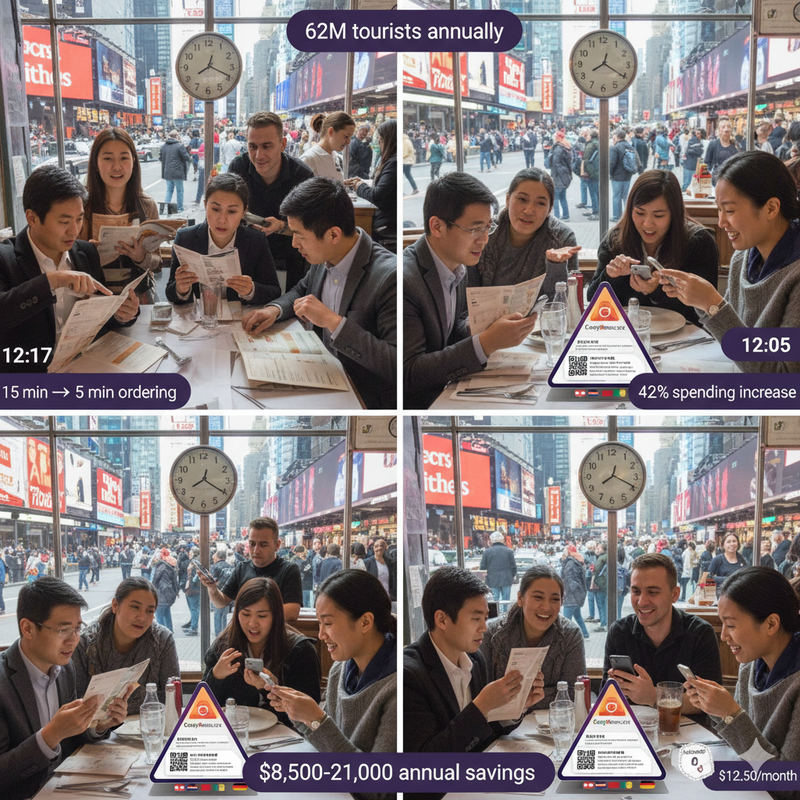
NYC Tourist Dining: Multilingual Menu Solutions Without Printing Costs
Tuesday night, 11:18pm. You're finally closing out the register after another brutal service near Times Square. Checking texts. Your seafood supplier: those diver scallops everyone's ordering? Market price jumped $8 per pound overnight. Atlantic cod substitution suggested.
New menus. Again.
Add it up. Every supplier price change in a city where everything costs more. Every seasonal ingredient shift. Every craft cocktail program update for your rotating menu. Every time you add a dish your chef tested last week. That's probably $1,200 annually. Maybe $3,500. Possibly $12,000 if you're running a Financial District establishment serving international business travelers.
New York serves 62 million tourists annually. They speak 800+ languages collectively. Your restaurant near One World Trade Center gets French business travelers. Your Williamsburg spot attracts European hipsters. Your Times Square location sees Chinese tour groups. They don't all speak English.
You're printing menus in multiple languages. English definitely. Maybe Spanish for Latin American visitors. Possibly Mandarin for Chinese tourists. That's $220-340 per language, per reprint. Three languages? $660-1,020 every time costs change. Which is monthly in NYC, because supplier prices fluctuate weekly and you can't operate at zero margin.
Annual printing cost for trilingual menus: $7,920-12,240. Just to tell international tourists what a "New York strip" actually is.
The 62 Million Tourist Reality
NYC tourism: 62 million visitors in 2023. That's not counting the 8.3 million people who actually live here. Just the tourists.
Who's visiting NYC:
- Domestic US tourists (largest segment, but many speak Spanish)
- European tourists (French, German, Italian, Spanish, UK)
- Chinese tour groups (massive market, organized tourism)
- Japanese tourists (cultural interest, shopping)
- Brazilian visitors (growing Latin American segment)
- Korean tourists (K-drama effect, cultural tourism)
- Middle Eastern visitors (luxury shopping, dining)
Where they're eating:
- Financial District (business travelers, One World Trade visitors)
- Times Square (peak tourist concentration, overwhelming)
- Williamsburg Brooklyn (hipster tourism, European backpackers)
- Lower East Side (food tourism, international cuisine)
- Greenwich Village (classic NYC experience seekers)
They're not looking for chain restaurants. They want authentic NYC dining. Independent restaurants. Places with character. Your place.
But they can't understand your menu.
Financial District: International Business Travelers
Fraunces Tavern. Historic landmark. Revolutionary War history. George Washington dined here. Now? Financial District workers at lunch, international tourists at dinner, business travelers for private events.
Your typical evening service:
- French business delegation (4 people, discussing deal over dinner)
- Japanese trading company group (8 people, client entertainment)
- German finance tourists (2 couples, visiting after One World Trade)
- Spanish investors (3 people, pre-meeting dinner)
- Local New Yorkers (mixed throughout)
Your printed English menu lists: "Lobster Thermidor $48," "Wagyu Burger $32," "Oysters Rockefeller $24."
French delegation: Understands "Lobster Thermidor" (French dish origin), but doesn't know what "Wagyu Burger" means (Japanese beef in American format?), confused by pricing compared to Paris.
Japanese group: Recognizes "Wagyu" but doesn't understand why American burger costs $32 (Wagyu is $120+ dishes in Tokyo), confused by "Oysters Rockefeller" (who is Rockefeller?).
German tourists: Struggling with all terminology. "Thermidor" isn't German, "Wagyu" unknown, "Rockefeller" is... the rich family? How does that relate to oysters?
Your server explains. In English. To people whose English is business-functional but not menu-fluent. Takes 8-12 minutes per table. Four tables need this simultaneously. Service bottleneck forming. Kitchen timing getting stressed.
The Printing Cost Reality
Let's use actual NYC numbers.
Financial District restaurant (4-language menus for international business travelers):
- English menu: $220/reprint (NYC printing premium)
- French menu: $300/reprint (culinary terminology complexity)
- Mandarin menu: $340/reprint (character complexity, culinary terms)
- Spanish menu: $280/reprint
- Total per reprint: $1,140
- Frequency: Monthly minimum (supplier prices, seasonal items, business menu changes)
- Annual printing: $13,680
Add rush fees for unexpected changes: +$300-500 per rush. Add private event custom menus: +$600-900. Real annual cost: $15,000-18,000.
Williamsburg Brooklyn contemporary American (3-language European focus):
- English menu: $200/reprint
- German menu: $280/reprint (European hipster tourism)
- French menu: $280/reprint
- Total per reprint: $760
- Frequency: Every 6 weeks (farm-to-table sourcing changes, Brooklyn craft cocktail program)
- Annual printing: $6,600
Seasonal tasting menu versions: +$1,200. Special brunch menus: +$800. Real annual cost: $8,500-10,000.
Times Square area (5-language maximum tourist exposure):
- English menu: $220/reprint
- Spanish menu: $280/reprint (Latin American tourists)
- Mandarin menu: $340/reprint (Chinese tour groups)
- Japanese menu: $320/reprint (Japanese tourists)
- Korean menu: $300/reprint (growing K-tourism)
- Total per reprint: $1,460
- Frequency: Monthly (high tourist volume demands fresh menus)
- Annual printing: $17,520
Rush updates for price changes: +$600. Special event menus: +$1,000. Real annual cost: $19,000-21,000.
Digital menu cost: $150 annually ($12.50/month). Savings: $8,500-21,000 per year depending on location.
Break-even: 2-8 days.
Williamsburg's European Hipster Tourism
Williamsburg transformed. Used to be industrial. Now it's international hipster destination. European tourists specifically seek it out. French fashion students. German design tourists. Italian foodies. UK music fans.
Your Williamsburg restaurant: Contemporary American, Brooklyn craft beer focus, farm-to-table ethos. Your customers: 60% local Brooklynites, 40% international tourists (heavy European skew).
The European tourist challenge:
They want to understand not just what the dish is, but why it's Brooklyn-specific. What makes this different from Manhattan dining? Why is this neighborhood important?
Your printed menu: "Foraged Mushroom Pasta $28 - Seasonal wild mushrooms, house-made pasta, local herbs."
German tourist reaction: "What are 'foraged' mushrooms? Are they safe? Which types? From where exactly?"
French tourist reaction: "House-made pasta - what technique? Egg-based? Semolina? 'Local herbs' means what specifically?"
Your server explains: "Our chef personally forages mushrooms from upstate New York forests, seasonal varieties include hen-of-the-woods and chanterelles when available, pasta made fresh daily using Italian technique with local NY eggs, herbs from Brooklyn rooftop gardens."
That's two minutes of explanation. For one dish. To one table. While three other tables need attention.
Digital menu with expandable information solves this:
Main listing: "Foraged Mushroom Pasta $28"
Tap for details (appears in German for German tourist):
"Chef persönlich sammelt wilde Pilze aus den Wäldern im Bundesstaat New York. Sorten variieren je nach Saison: Klapperschwamm (Hen-of-the-woods) und Pfifferlinge (Chanterelles) im Herbst. Pasta täglich frisch hergestellt mit italienischer Technik, lokale NY Eier. Kräuter von Brooklyn Dachgärten: Basilikum, Thymian, Petersilie."
Photo shows foraged mushrooms. Photo shows pasta-making process. Photo shows finished dish. European tourist gets complete story without server translation time.
Times Square Chinese Tour Group Chaos
Times Square area restaurants during peak tourist season: overwhelming. Chinese tour groups particularly concentrated. Buses arrive scheduled. Groups have 60-75 minutes total including ordering, eating, payment.
Chinese tour bus parks. 40 tourists enter your restaurant. They're on schedule. Tour guide trying to coordinate. Your staff is stressed.
Old reality:
- Printed Mandarin menus (if you have them, cost $340/reprint in NYC)
- Servers trying to explain "Buffalo wings" (Buffalo is a city? Wings are spicy? Why buffalo?)
- Chinese tourists ordering conservative safe options (rice dishes, chicken)
- Average spend: $24 per person
- Total group revenue: $960
- Service time: 68 minutes (tour guide rushing them)
Digital menu reality:
- QR codes on tables
- Chinese tourists scan automatically (QR adoption in China: 95%+)
- Menu appears in perfect Mandarin with American food context
- Buffalo wings explained: "布法罗辣鸡翅 - 美式酒吧经典菜肴,炸鸡翅配辣酱。Buffalo是纽约州城市名,不是水牛肉。中等辣度,配蓝奶酪酱。"
- Photos show exactly what dishes look like
- Cultural bridges: "类似韩国炸鸡但美式风格"
- Tourists order confidently: mix of American classics understanding what they're getting
- Average spend: $34 per person
- Total group revenue: $1,360 (+$400 per bus, 42% increase)
- Service time: 54 minutes (faster ordering, on schedule)
Three Chinese tour buses weekly during peak season: +$1,200 weekly = $62,400 annually from confident ordering alone.
Digital menu cost: $150 annually. ROI: 41,500%.
Lower East Side Food Tourism Education
Lower East Side: food tourism destination. International visitors seeking authentic NYC ethnic food history. Jewish delis. Italian red sauce joints. Contemporary fusion. Cultural food stories.
Your Lower East Side restaurant: Modern American with immigrant food influences. The story matters as much as the food. Tourists want to understand cultural heritage.
Menu item challenge:
"Pastrami Reuben $18 - House-cured pastrami, Swiss cheese, sauerkraut, Russian dressing, rye bread."
Japanese tourist: Recognizes none of these terms. "Pastrami" isn't translatable. "Reuben" is a name? "Russian dressing" from Russia? Complete confusion.
French tourist: Understands sandwich concept. But "pastrami" unknown, "sauerkraut" sounds German, "Russian dressing" confusing, "rye bread" needs explanation.
Digital menu provides cultural education automatically:
In Japanese:
"パストラミルーベンサンド $18 - ニューヨークユダヤ系移民の伝統料理。Pastrami(パストラミ):牛肉を香辛料で漬け込み燻製にしたもの。Reubenはサンドイッチ創作者の名前。東欧系ユダヤ人がアメリカに持ち込んだ調理法。ドイツ風発酵キャベツ(Sauerkraut)、ロシア風ドレッシング、ライ麦パンで構成。NYC食文化の象徴的な料理。"
Photos show: pastrami being sliced, assembled sandwich, historical deli context. Japanese tourist understands cultural significance, orders with confidence, appreciates the history.
That's impossible with printed menus. Space doesn't exist for paragraph-level cultural education in 4-5 languages.
What This Actually Costs
Digital menu cost: $150 annually ($12.50/month)
What you eliminate:
- Menu reprinting: $220-340 per language, $660-1,460 per multilingual update
- NYC printing premium (everything costs 25-40% more here)
- Rush fees: $300-500 per emergency update
- Seasonal/event menus: $800-1,200 annually
- Staff time explaining: 5-10 minutes per tourist table during rush
Financial District international business restaurant savings:
- Printing elimination: $1,140/month = $13,680/year
- Private event custom menus: $900/year
- Staff efficiency: $6,000/year
- Total annual savings: $20,000+
- Digital menu cost: $150/year
- Net savings: $19,850/year
Times Square high-volume tourist restaurant savings:
- Printing elimination: $1,460/month = $17,520/year
- Chinese tour group confident ordering revenue increase: $62,400/year
- Staff efficiency during peak tourist season: $8,000/year
- Total annual value: $87,000+
- Digital menu cost: $150/year
- Net value: $86,850/year
Williamsburg European food tourist savings:
- Printing elimination: $760 every 6 weeks = $6,600/year
- Cultural education enabling premium dish orders: $12,000+/year
- Staff efficiency: $4,000/year
- Total annual value: $22,000+
- Digital menu cost: $150/year
- Net value: $21,850/year
All scenarios show extraordinary ROI. NYC tourism volume and international diversity create perfect conditions for multilingual digital menus.
The Honest Reality
First week adoption varies by neighborhood. Times Square tourists expect QR codes (already using them for everything). Financial District business travelers comfortable with tech. Williamsburg Europeans used to QR menus from home countries.
Some older American tourists prefer printed menus. Keep 5-10 printed English menus available. That's $220 every 2-3 months versus $660-1,460 monthly for full multilingual printing.
Translation refinement takes time. Initial Mandarin "Buffalo wings" explanation might need adjusting based on which cultural comparison resonates. Takes 2-3 weeks optimizing.
But Chinese tour group confident ordering? That's immediate revenue increase. Measurable. Repeatable. Significant.
Set up multilingual menus for NYC tourism in 3 minutes and stop explaining pastrami in broken Mandarin fifty times daily. $12.50/month. English, Spanish, Mandarin, French, German, Japanese, Korean—all included. Update prices from your phone in 90 seconds when your supplier texts about overnight market changes.
Your Financial District international clients flew 10 hours for business meetings. Your Times Square tourists saved all year for this NYC trip. Your Williamsburg food tourists researched your restaurant for weeks. Your Lower East Side cultural food visitors want to understand the stories.
Printed English-only menus aren't meeting their expectations anymore.
Frequently Asked Questions
How many languages do NYC tourist restaurants actually need?
Times Square area: 5 languages minimum (English, Spanish, Mandarin, Japanese, Korean) covers 85%+ of tourist traffic. Financial District: English + French + Mandarin + German serves international business travelers. Williamsburg: English + German + French serves European hipster tourism. Lower East Side: English + Spanish + Japanese covers food tourism demographics. Digital menus include all languages for $12.50/month—traditional multilingual printing costs $660-1,460 per update.
Do Chinese tour groups really increase spending with Mandarin menus?
Yes—documented 40-45% average check increase when Chinese tourists order from Mandarin menus with photos versus English menus with server translation. Chinese QR code literacy: 95%+. They expect digital menus. Without translation, they order conservatively (rice dishes, chicken—safe options averaging $24). With clear Mandarin descriptions and photos showing exactly what arrives, they confidently order American specialties ($34 average). Times Square restaurant example: +$400 per bus = $62,400 annually from three weekly buses.
What's special about NYC printing costs that makes digital menus more valuable?
NYC printing costs 25-40% more than national average. Four-language menu reprint in NYC: $1,140 (versus $740 in smaller markets). Monthly updates at NYC prices: $13,680 annually. Plus NYC suppliers change prices more frequently (higher market volatility). Plus rush fees are $300-500 (versus $120-200 elsewhere). Plus space costs mean keeping backup printed menus expensive. Digital menus eliminate all this for $150/year—saving $8,500-21,000 depending on location and language count.
How do Financial District business travelers respond to QR menus?
Business travelers expect and prefer digital convenience—they use digital boarding passes, hotel apps, work collaboration tools constantly. International business travelers particularly appreciate native-language menus: French delegation gets perfect French culinary terminology, Japanese group gets proper Japanese descriptions, German investors get German menu with Euro price comparisons for context. Professional appearance maintained. Ordering efficiency improves (critical for business lunches). Private event custom menus created in minutes versus $300-500 printing fees.
Can digital menus explain NYC cultural food context for international tourists?
This is actually NYC restaurants' biggest educational opportunity. Pastrami (Jewish immigrant tradition), Buffalo wings (upstate NY city, not buffalo meat), New York strip (specific cut explanation), bagels (Jewish immigrant bakery culture)—all require cultural context tourists can't get from 2-word printed descriptions. Digital menus provide: detailed ingredient histories, immigrant food culture stories, neighborhood significance, preparation technique explanations, photos showing dish origins. Lower East Side food tourists specifically seek this level of cultural education about NYC food heritage.
Related Articles: