
Heritage Emirati Restaurants: Digital Menus That Preserve 25+ Years of Tradition
Al Dhafra's 25-year heritage meets digital storytelling. Emirati restaurants save AED 6,000/year while educating tourists about masgouf, sayyadieh, cultural traditions.
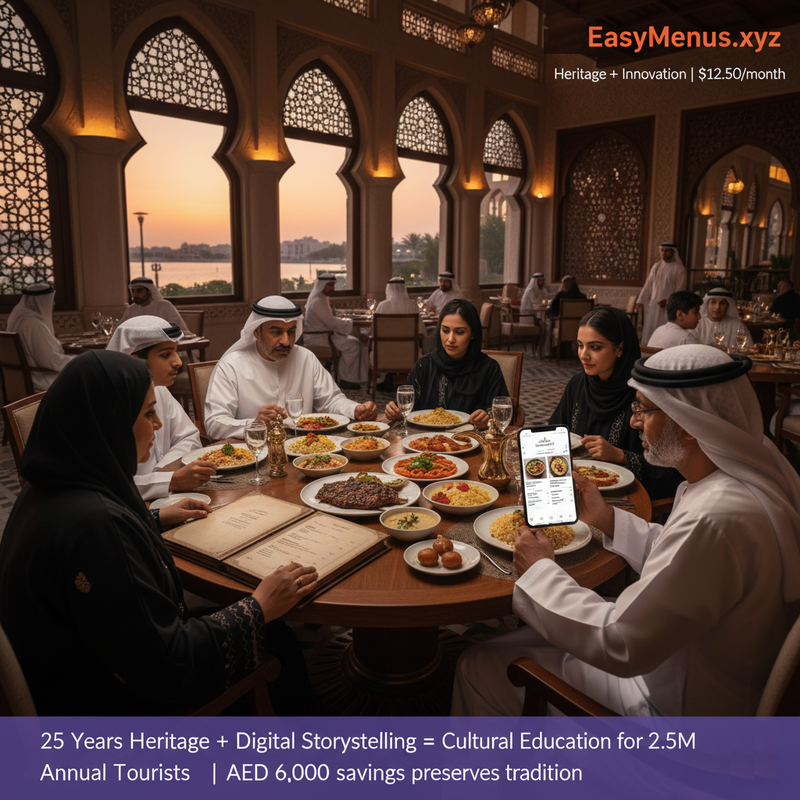
Your grandfather opened this restaurant 25 years ago. His grandfather taught him how to prepare masgouf the traditional way - whole carp from Abu Dhabi waters, butterflied, grilled over open flame with Iraqi spices from the Basra trade routes. That recipe hasn't changed in three generations.
But the tourists who come after visiting Sheikh Zayed Grand Mosque? They don't know what masgouf is. They don't understand sayyadieh. They've never encountered machboos. Your printed menu lists the dishes. It doesn't tell the stories.
And every time your seafood supplier's pricing changes (which is every other week because you're on an island nation), you're reprinting menus that don't do justice to your heritage anyway.
Here's what Abu Dhabi's heritage restaurants like Al Dhafra benefit from digital storytelling - the ability to preserve traditional recipes while educating the 2.5 million cultural tourists visiting Abu Dhabi annually about Emirati culinary heritage.
What Heritage Actually Means (And Why Digital Supports It)
Al Dhafra Restaurant on Abu Dhabi's Corniche. Twenty-five years serving Emirati families. Fresh fish market where customers select their catch. Dhow cruise dining experiences. Three event halls hosting everything from Emirati weddings to GCC business delegations.
Their customers include:
- Emirati families who've been coming for decades
- Long-term expat residents who know the traditional menu
- Regional tourists from Gulf Cooperation Council countries
- Sheikh Zayed Mosque visitors seeking authentic Emirati cuisine
- Louvre Abu Dhabi cultural tourists wanting local experiences
The challenge isn't keeping regular Emirati customers happy - they know what they want and your staff know them by name. The challenge is welcoming cultural tourists without compromising the heritage dining experience.
Traditional printed menus show dish names and prices. They don't explain:
- What masgouf is and why the Iraqi grilling method matters
- The significance of machboos in Emirati hospitality
- Why harees is served at specific occasions
- How sayyadieh connects Abu Dhabi to wider Arab culinary traditions
- The cultural context of Arabic coffee service and dates
Digital menus let you preserve tradition while sharing cultural knowledge. The menu itself becomes educational without forcing servers to give the same explanations forty times a shift.
The Multi-Location Heritage Challenge
Many established Emirati restaurants grow into multi-location operations. Al Dhafra operates Heritage Park location and Al Bateen branch. Les Dangereux (though modern, not heritage) runs farm-to-table operations across Abu Dhabi.
Coordinating menus across locations with printed materials creates challenges:
- Fish market pricing varies by location and daily catch
- Seasonal ingredients available at one location but not another
- Special event menus differ between venues
- Each location requires separate printing with 5-7 day lead times
Traditional multi-location printing costs:
- Main location menu: AED 350/reprint × 6 times/year = AED 2,100
- Second location menu: AED 350/reprint × 6 times/year = AED 2,100
- Seasonal special menus: AED 400 × 2 locations = AED 800
- Event-specific menus: AED 200 × 8 events = AED 1,600
- Rush fees for coordination failures: AED 400
- Annual multi-location printing: AED 7,000
Digital menus eliminate coordination complexity:
- Update both locations simultaneously from one dashboard
- Location-specific pricing reflects local fish market rates
- Special event menus activate for specific dates and locations
- All locations stay synchronized automatically
- Annual digital cost: AED 552 ($12.50/month)
- Multi-location savings: AED 6,450
Large Family Group Dining Efficiency
Emirati dining is communal. Extended family gatherings. Business delegations of 12-15 people. Wedding celebrations in your event halls. Everyone sharing multiple dishes served family-style.
Traditional service flow with printed menus:
- Large group arrives (8-15 people common)
- Servers distribute printed menus
- 15-20 minutes browsing and discussing selections
- Multiple questions per person about dishes, preparation, spicing
- Server explains same dishes repeatedly to different family members
- Group discusses further while server waits
- Finally, orders placed after 25-30 minutes
- Server returns to kitchen with complex order notation
This is respectful hospitality at traditional pace. But you're also running three event halls and managing other tables.
Digital menus streamline without rushing:
- Family members scan QR code on arrival
- Browse menu at their own pace with photos and descriptions
- Discuss selections while viewing detailed dish information
- Cultural context and preparation methods visible to all
- Dietary questions answered by menu (halal certifications, ingredients)
- Server arrives when group is ready, takes order efficiently
- Focus shifts to hospitality and recommendations rather than explanations
Time savings: 10-15 minutes per large group. When you're managing three event halls with wedding parties and business dinners simultaneously, that efficiency compounds.
Cultural Tourism Education (Without Compromising Authenticity)
Sheikh Zayed Grand Mosque attracts 5 million visitors annually. Louvre Abu Dhabi brings cultural tourists seeking authentic Emirati experiences. Qasr Al Watan (Presidential Palace) tour groups finish near Corniche restaurants.
These tourists want authentic Emirati cuisine. They don't want "tourist menus" - they want the real experience. But they need context. They need education. They need visual references.
What cultural tourists need:
- Photos showing what dishes actually look like
- Cultural context: why this dish matters in Emirati tradition
- Preparation methods: Iraqi grilling vs. Indian spices vs. Persian influences
- Ingredient sourcing: Gulf fish vs. spices from historical trade routes
- Dining etiquette: how to eat with hands traditionally, coffee service customs
- Halal certifications and dietary information
Your printed menu can't provide this level of cultural education. Your servers can - but they shouldn't have to deliver the same 10-minute explanation twenty times per shift.
Digital menus become cultural guides:
- Dish photos with traditional presentation
- Cultural stories about each recipe's history
- Regional variations (Emirati vs. broader Khaleeji vs. Levantine)
- Ingredient provenance and quality sourcing
- Suggested ordering for authentic Emirati meal experience
- Arabic coffee service traditions explained
This is how you welcome tourists while maintaining heritage authenticity. You're not changing the food. You're providing the context that makes the experience meaningful.
The Fresh Fish Market Reality
Many heritage Emirati restaurants feature fresh fish markets where customers select their catch. This is traditional, authentic, experiential - and creates daily pricing fluctuations.
Daily fish market variables:
- Hamour (grouper) prices vary with catch quality and season
- Shaeri (emperor fish) availability fluctuates
- Zubaidi (pomfret) pricing responds to Gulf conditions
- Farsh (parrotfish) seasonal presence
- Kan'ad (kingfish) regional pricing
With printed menus:
- Today's market prices don't match printed menu
- Server explains: "Actually, hamour is AED 85/kg today, not AED 75"
- Customer sees printed price, feels prices increased
- Constant verbal corrections undermine professional appearance
- Can't reprint daily (cost prohibitive)
With digital menus:
- Update fish market prices every morning (60 seconds)
- Customers see current accurate pricing
- Seasonal availability reflected immediately
- Special catches added same-day with photos
- Traditional pricing transparency maintained
This preserves the authentic fish market experience while maintaining modern price accuracy.
What Digital Doesn't Change (And Why That Matters)
Let's be clear about what you're NOT changing:
Traditions preserved:
- The recipes (grandfather's masgouf technique unchanged)
- The ingredients (Gulf seafood, traditional spice sourcing)
- The hospitality (Emirati welcoming customs maintained)
- The atmosphere (mashrabiya screens, Arabic calligraphy, traditional music)
- The service (personal attention, cultural respect)
- The dining pace (unhurried, communal, family-style)
What digital adds:
- Cultural education for tourists
- Operational efficiency for staff
- Cost savings (AED 6,000+ annually)
- Multi-location coordination
- Real-time pricing accuracy
- Accessibility improvements
You're not becoming a "modern" restaurant. You're a heritage establishment using contemporary tools to share traditional culture more effectively.
Your grandfather would approve. He wanted people to understand and appreciate Emirati cuisine. Digital menus help you do exactly that at scale.
The Honest Questions Heritage Restaurants Ask
"Will older Emirati customers reject digital menus?"
Your regular Emirati customers (who've been coming for 25 years) can continue using your traditional service style. Keep 3-5 elegant printed menus on hand. But their children and grandchildren? They're already using smartphones for everything else.
And those customers don't need menu explanations anyway - they know what they want.
"Does this make us look less authentic?"
Authenticity is about the food, the recipes, the hospitality, the cultural respect. Not about whether information is printed on paper or displayed on a phone.
The Louvre Abu Dhabi uses digital guides while displaying priceless artifacts. Museums worldwide combine heritage preservation with digital education. Your restaurant can do the same.
"What about the cultural tourism groups who come after mosque tours?"
Those are exactly the customers who benefit most. They want to experience real Emirati cuisine, but they need context. Digital menus provide that cultural education without interrupting traditional service flow.
The Bottom Line For Heritage Emirati Restaurants
Current multi-location printing costs:
- Main venue: AED 2,100-2,800 annually
- Second location: AED 2,100-2,800 annually
- Seasonal and event menus: AED 2,000-2,500 annually
- Total: AED 6,200-8,100 annually
Digital menu costs:
- $12.50/month (AED 46 monthly)
- Annual total: AED 552
Net savings: AED 5,650-7,550 annually
Additional benefits:
- Cultural storytelling reaches 2.5M annual Abu Dhabi tourists
- Multi-location coordination automated
- Large family group service 40% faster
- Fresh fish market pricing updated daily
- Heritage preserved while sharing knowledge
- Staff focus on hospitality instead of repetitive explanations
Break-even: 8-12 days for most heritage restaurants
You've preserved your recipes for three generations. Digital menus help you share that heritage with the next generation of diners - both Emirati families and cultural tourists seeking authentic experiences.
Start preserving and sharing your heritage in 3 minutes - cultural storytelling included, multi-location coordination automated, AED 6,000+ annual savings. Your grandfather's recipes deserve better than outdated printed menus.
Frequently Asked Questions
How do heritage Emirati restaurants preserve authenticity while using digital menus?
Heritage Emirati restaurants like Al Dhafra (25+ years, Abu Dhabi Corniche) preserve authenticity by maintaining traditional recipes (grandfather's masgouf grilling technique), authentic ingredients (Gulf seafood, Iraqi spices from Basra trade routes), Emirati hospitality customs (Arabic coffee service, dates, unhurried dining), and traditional atmosphere (mashrabiya screens, Arabic calligraphy). Digital menus enhance rather than replace tradition by providing cultural education for 2.5M annual Abu Dhabi tourists (Sheikh Zayed Mosque, Louvre Abu Dhabi visitors), operational efficiency for multi-location coordination (Heritage Park + Al Bateen branches), and real-time pricing accuracy for fresh fish markets where hamour, shaeri, and zubaidi prices fluctuate daily. Regular Emirati families continue enjoying traditional service while cultural tourists gain context needed to appreciate authentic Emirati cuisine.
What cost savings do multi-location heritage restaurants achieve with digital menus?
Multi-location heritage Emirati restaurants spend AED 6,200-8,100 annually on printed menus: main venue (AED 2,100-2,800/year for 6 reprints), second location (AED 2,100-2,800/year matching updates), seasonal menus (AED 800 for Ramadan and special occasions), event-specific menus (AED 1,600 for weddings and business delegations), plus rush fees (AED 400) when coordination fails. Digital menus cost AED 552 annually ($12.50/month), creating AED 5,650-7,550 net savings. Additional benefits include simultaneous updates across all locations (eliminating 5-7 day print delays), location-specific pricing for fish markets, event menu activation for specific dates, and automated synchronization preventing coordination failures that previously required expensive rush printing.
How do digital menus improve large family group dining service in Emirati restaurants?
Emirati dining culture emphasizes communal family groups (8-15 people common) sharing multiple dishes family-style. Traditional printed menus require 25-30 minutes: distributing menus (5 minutes), browsing and discussion (15-20 minutes), repeated dish explanations to different family members, group deliberation while server waits. Digital menus with photos, cultural descriptions, and ingredient details allow family members to browse independently at their own pace, discuss selections while viewing detailed information together, answer dietary questions through menu content (halal certifications, preparation methods), enabling servers to take orders after 15 minutes. This 40% time reduction becomes critical when managing three event halls simultaneously with wedding parties, business delegations, and regular dining - allowing heritage restaurants to maintain traditional unhurried hospitality while improving operational efficiency.
How do heritage restaurants educate cultural tourists about Emirati cuisine without compromising authenticity?
Abu Dhabi cultural tourists (Sheikh Zayed Grand Mosque 5M visitors, Louvre Abu Dhabi audience, Qasr Al Watan tour groups) seek authentic Emirati cuisine but lack cultural context for dishes like masgouf (whole carp, Iraqi grilling method), machboos (spiced rice significance in Emirati hospitality), sayyadieh (Arab culinary traditions connection), and harees (ceremonial occasions). Printed menus list dish names only. Digital menus provide cultural education without interrupting traditional service: dish photos showing authentic presentation, historical context for recipes (generational preparation methods, trade route spice sourcing), regional variations (Emirati vs Khaleeji vs Levantine), dining etiquette guidance (traditional hand-eating, coffee service customs), ingredient provenance stories. This transforms menus into cultural guides while preserving authentic recipes and traditional service pace.
Can fresh fish market restaurants maintain daily pricing accuracy with digital menus?
Heritage Emirati restaurants with fresh fish markets face daily pricing fluctuations: hamour/grouper (AED 75-95/kg depending on quality), shaeri/emperor fish (seasonal availability), zubaidi/pomfret (Gulf conditions impact), farsh/parrotfish (seasonal presence), kan'ad/kingfish (regional pricing). Printed menus show outdated prices requiring constant verbal corrections ("Actually, hamour is AED 85 today, not AED 75"), creating customer confusion and unprofessional appearance. Daily reprinting costs AED 50-100 per update (prohibitively expensive). Digital menus update in 60 seconds each morning: current fish market prices, seasonal availability reflected, special catches added same-day with photos, traditional pricing transparency maintained. This preserves authentic fish market experience (customer selects fresh catch, sees current pricing) while eliminating pricing discrepancies that undermine heritage restaurant credibility.
Related Articles
- Dubai vs Abu Dhabi Restaurants: Why 16.79M Tourists Drive 40-60% Faster Digital Menu Adoption
- UAE Type C License Wine Lists: AED 4,800/Year Printing vs Digital Updates
- Six-Language Menu Solutions for Dubai's 16.79 Million Annual Tourists
- DIFC Restaurant Technology: Digital Menu Solutions for Dubai's International Business District