
NZ Tourism Restaurants: Multilingual Menus for 368,000 Queenstown Visitors
Queenstown serves 368,000 international visitors. Rotorua hosts Chinese tour groups. Auckland gets Asian tourists. Digital menus eliminate $8,000+ multilingual printing costs.
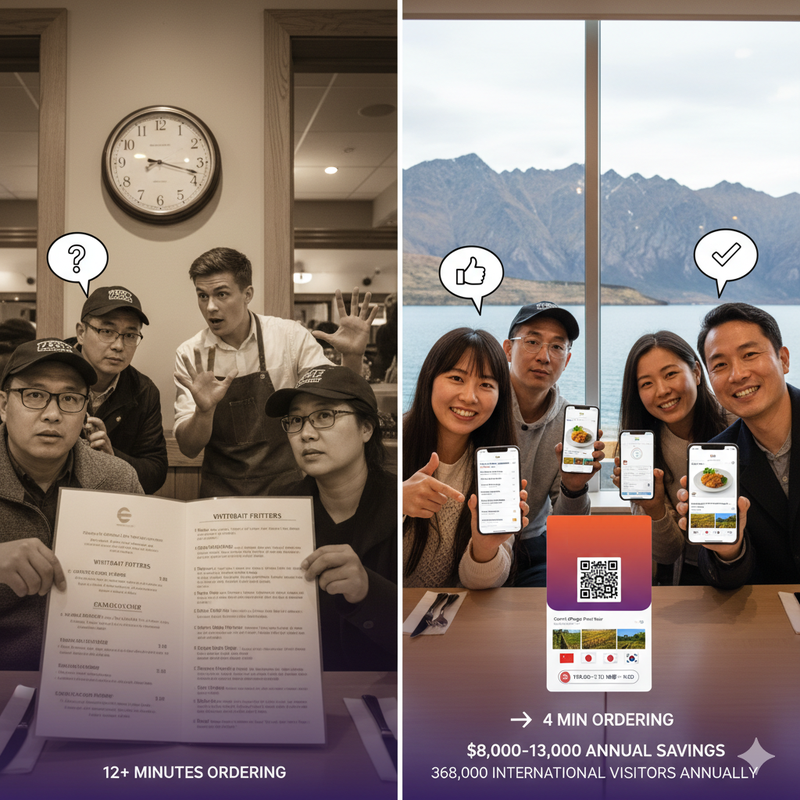
Multilingual Menu Solutions for New Zealand's Tourism Hotspots
Thursday night, 9:35pm. You're finally off your feet after another slammed service in Queenstown. Checking phone. Wine supplier: that Central Otago Pinot Noir everyone's ordering? Last vintage sold out. New one costs $18 more per bottle.
New wine lists. Again.
Add it up. Every supplier price change. Every seasonal menu adjustment. Every time lamb prices shift. Every craft beer that sells out after one weekend. That's probably $1,200 annually. Maybe $2,500. Possibly $8,000 if you're lakefront Queenstown with daily changing specials.
Queenstown restaurants serve 368,000 international arrivals annually. Rotorua hosts massive Chinese tour groups. Auckland gets steady Asian tourism. Wellington attracts sophisticated food tourists. They don't all speak English.
You're printing menus in multiple languages. English definitely. Maybe Mandarin for Chinese tourists. Possibly Japanese for the growing market. That's $180-280 per language, per reprint. Three languages? $540-840 every time prices change. Which is monthly, because NZ produce is seasonal and exchange rates affect everything.
Annual printing cost for trilingual menus: $6,480-10,080. Just to tell tourists what whitebait fritters are.
Queenstown's 368,000 International Visitor Challenge
Queenstown isn't big. Population 16,000 permanent residents. But tourism? 368,000 international arrivals annually. That's 23 international tourists for every local resident.
Who's visiting Queenstown:
- Chinese tourists (massive market, tour groups)
- Australian weekenders (closest international market)
- American adventure tourists (Queenstown brand strong in US)
- UK tourists (working holiday visa holders, long-stay travelers)
- Asian tourists: Singapore, Malaysia, Indonesia (growing markets)
- European backpackers (gap year, extended travel)
What they're ordering:
- Local lamb (Merino, high-country lamb)
- Venison (wild game, unfamiliar to many)
- Whitebait fritters (NZ delicacy, tourists have no idea what it is)
- Bluff oysters (seasonal, premium, requires explanation)
- Hokey pokey ice cream (sounds like joke to international tourists)
- Central Otago wines (world-class Pinot Noir, education opportunity)
Your printed English menu: "Whitebait fritters $24." Chinese tourist: confused. American tourist: "Is that fish?" Japanese tourist pulls out phone, tries Google Translate, still confused.
Your server explains. Tiny juvenile fish, delicate flavor, New Zealand delicacy, caught in spring rivers, traditionally served as fritters with lemon. Takes five minutes. Three other tables waiting.
The Printed Multilingual Menu Cost Problem
Let's use real Queenstown numbers.
Blue Kanu (Queenstown lakefront restaurant, 3-language menus):
- English menu: $180/reprint
- Mandarin menu: $280/reprint (specialized food translation)
- Japanese menu: $280/reprint (character complexity)
- Total per reprint: $740
- Frequency: Monthly minimum (seasonal ingredients, wine changes, price adjustments)
- Annual printing: $8,880
Add rush fees when supplier prices jump suddenly: +$150-250 per rush. Add winter ski season special menus: +$400-600. Real annual cost: $10,000-12,000.
Momentos by the Lake (seasonal NZ cuisine, 4-language approach):
- English menu: $200/reprint
- Mandarin menu: $280/reprint
- Japanese menu: $280/reprint
- Korean menu: $260/reprint (growing K-drama tourism market)
- Total per reprint: $1,020
- Frequency: Every 6 weeks (highly seasonal sourcing)
- Annual printing: $8,840
Special Christmas/New Year menus: +$1,200. Winter festival menus: +$800. Real annual cost: $11,000-13,000.
Park's BBQ Queenstown (Korean BBQ for Asian tourists, 2-language focus):
- English menu: $180/reprint
- Korean menu: $240/reprint
- Total per reprint: $420
- Frequency: Monthly (meat sourcing changes, seasonal sides)
- Annual printing: $5,040
Add Japanese menu expansion: +$3,360 annually. Total: $8,400.
Digital menu cost: $195 annually ($12.50 USD = ~$19.50 NZD monthly). Savings: $8,000-13,000 per year.
Break-even: 2-5 days.
The Central Otago Wine Education Problem
Queenstown sits next to Central Otago—one of world's southernmost wine regions. Pinot Noir here is world-class. International wine critics rave about it. But tourists don't know this.
Your wine list: "Central Otago Pinot Noir 2022 - Mt Difficulty $58."
Chinese tourist sees price, sees "Pinot Noir" (familiar from French wines), doesn't understand why NZ wine costs $58. Chooses $32 house wine instead. You just lost $26 margin opportunity.
American tourist knows Pinot Noir, doesn't know Central Otago reputation. "Is this good?" they ask. Server tries explaining: "Central Otago is New Zealand's premium Pinot region, similar climate to Burgundy, minerality from schist soils, this specific vineyard..." Tourist glazes over. Orders beer instead.
Printed menu can't educate. Space limitations. Can't include regional context, vineyard stories, tasting notes, pairing suggestions.
Digital menu in tourist's language with full context:
"Mt Difficulty Pinot Noir 2022 - Central Otago $58
Central Otago produces New Zealand's finest Pinot Noir in one of the world's southernmost wine regions. Similar climate to Burgundy, France. This vineyard sits on schist soils creating distinctive minerality. Elegant wine with cherry, spice, and earthy notes. Perfect with our local lamb dishes.
Wine critics score: 94/100 points. This price exceptional value compared to similar-quality Burgundy ($150-200)."
Photo shows vineyard landscape. Tourist understands value. Orders confidently. Your $26 margin preserved.
Wine list updates: Bottle sells out? Remove instantly. New vintage arrives? Update tasting notes in 30 seconds. All languages update automatically.
Rotorua's Chinese Tour Group Reality
Rotorua: geothermal wonderland, Māori cultural tourism, massive Chinese tour group market.
Chinese tour bus arrives. 45 tourists. They have 60 minutes for lunch (scheduled tour). Your restaurant seats 50. You're now 90% Chinese tourists who speak limited English.
Old reality:
- Printed Mandarin menus (if you have them, cost $280/reprint)
- Servers try explaining Hangi (traditional Māori earth oven cooking) in English
- Chinese tourists order safest options (chicken, rice)
- Average spend: $28 per person
- Total group revenue: $1,260
- Service time: 55 minutes (cutting it close for tour schedule)
Digital menu reality:
- QR codes on tables
- Chinese tourists scan automatically (QR literacy in China: 95%+)
- Menu appears in perfect Mandarin with cultural explanations
- Hangi description makes sense: "传统毛利地炉烹饪法 - 食物在地下蒸煮数小时"
- Photos show how Hangi works, what it looks like
- Cultural context included (Māori cooking traditions)
- Tourists order confidently: Hangi meats, local fish, native vegetables
- Average spend: $42 per person (premium items, confidence ordering)
- Total group revenue: $1,890 (+$630 per bus, 50% increase)
- Service time: 47 minutes (faster ordering, no explanation delays)
Four Chinese tour buses weekly: +$2,520 weekly = $130,000+ annually. Just from confident ordering.
Digital menu cost: $195 annually. ROI: 66,600%.
Auckland's Asian Tourism Mix
Auckland: New Zealand's largest city, main international gateway, diverse Asian tourism (Chinese, Japanese, Korean, Singapore, Malaysia, Indonesia).
Your Auckland restaurant serves contemporary NZ cuisine. Farm-to-table. Seasonal ingredients. Local seafood. But your customers come from six different Asian countries, each with different food culture and language.
Printed multilingual solution: Impossible. You can't print six different Asian language menus. Cost: $1,680 per reprint (6 languages × $280). Monthly updates: $20,160 annually. That's entry-level chef salary.
Digital multilingual solution: One QR code. Six languages automatically available. Tourist selects language preference. Menu appears in perfect translation with photos.
Auckland restaurant example—Depot Eatery (upscale casual, high tourist traffic):
Before digital menus:
- English menu only
- Asian tourists struggling with colloquial names ("Pork Belly Bites," "Fish of the Day")
- Servers explaining repeatedly
- Conservative ordering from Asian tourists (familiar items only)
- Average Asian tourist spend: $38
After digital menus with Asian language support:
- Mandarin, Japanese, Korean, Indonesian automatically available
- Detailed explanations: "Pork Belly Bites - 脆皮五花肉 - Crispy pork belly with apple sauce, traditional NZ-style preparation"
- Photos showing exactly what arrives
- Cultural bridges: "Similar to Chinese 红烧肉 but different preparation"
- Confident ordering from Asian tourists (trying local specialties)
- Average Asian tourist spend: $51 (+$13 per customer, 34% increase)
Asian tourists represent 35% of Auckland restaurant traffic in tourist areas. That revenue increase compounds rapidly.
Wellington's Sophisticated Food Tourist
Wellington: craft beer capital, specialty coffee culture, sophisticated dining scene. Tourists coming here are food-focused. They want to understand what makes NZ cuisine unique.
Your Wellington restaurant: Seasonal NZ ingredients, native botanicals, innovative techniques. Your customers: international food tourists who read food blogs, follow chefs on Instagram, planned this meal weeks ago.
They want information. Lots of it. Where did this ingredient come from? How was it prepared? What makes it uniquely New Zealand? What's the story?
Printed menu can't provide this. Physical space limitations. You'd need paragraph per dish.
Digital menu with expandable information:
Dish listing:
"Horopito-Crusted Venison $42"
Tap to learn more:
"Wild venison from South Island high country, crusted with horopito (native NZ pepper leaf, used by Māori for centuries). Horopito has peppery, slightly minty flavor unique to NZ. Venison is wild-harvested, not farmed—leaner and more flavorful than farmed venison. Served with kumara (NZ sweet potato) and seasonal greens. Recommended wine pairing: Central Otago Pinot Noir."
Photo shows plated dish. Photo shows horopito plant. Photo shows South Island high country landscape.
Food tourist gets complete story. Understands cultural significance. Appreciates sourcing. Orders confidently. Posts detailed Instagram story about the experience. Tags your restaurant. Free marketing to 4,000 food-interested followers.
That's impossible with printed menus.
What This Actually Costs
Digital menu cost: $195 annually ($12.50 USD = ~$19.50 NZD monthly)
What you eliminate:
- Menu reprinting: $180-280 per language, $540-1,020 per trilingual update
- Seasonal updates: 8-12 times yearly for tourism restaurants
- Wine list changes: Monthly minimum
- Rush printing: $150-250 per emergency update
- Staff time explaining: 3-6 minutes per tourist table
Queenstown tourism-heavy restaurant savings:
- Printing elimination: $740/month = $8,880/year
- Wine education enabling premium sales: $8,000+/year
- Staff efficiency: $4,000/year
- Total annual savings: $20,000+
- Digital menu cost: $195/year
- Net savings: $19,800/year
Rotorua Chinese tour group restaurant savings:
- Printing elimination: $560/month = $6,720/year
- Confident ordering revenue increase: $130,000+/year (based on four buses weekly)
- Staff translation efficiency: $3,000/year
- Total annual value: $139,000+
- Digital menu cost: $195/year
- Net value: $138,800/year
Both scenarios show extraordinary ROI. Tourism creates pain points that digital menus solve immediately.
The Honest Reality
First week feels different. Queenstown tourists are QR-comfortable (young adventure tourists, Asian tourists with high QR adoption). Adoption rate: 85%+ immediately.
Some older tourists prefer printed menus. Keep 3-5 printed English menus for them. That's $180 every 2-3 months versus $740-1,020 monthly for full multilingual printing.
Wine list education takes refinement. Initial Central Otago descriptions might need adjusting based on which details tourists actually care about. Takes 2-3 weeks to optimize.
But Chinese tour group confident ordering? That's immediate revenue increase, measurable, repeatable.
Set up multilingual menus for NZ tourism in 3 minutes and stop explaining whitebait fritters in broken Mandarin forty times daily. $19.50/month NZD. English, Mandarin, Japanese, Korean, Indonesian—all included. Update prices from your phone in 30 seconds.
Your Queenstown tourists flew 12 hours to try your food. Your Rotorua tour groups are on tight schedules. Your Auckland Asian visitors want to understand NZ cuisine. Your Wellington food tourists demand detailed information.
Paper menus aren't meeting their expectations anymore.
Frequently Asked Questions
How many languages do New Zealand tourism restaurants actually need?
Queenstown minimum: English + Mandarin + Japanese (covers 70%+ of international tourism). Auckland adds Korean, Indonesian, Malay (diverse Asian markets). Rotorua prioritizes Mandarin (Chinese tour groups dominate). Wellington focuses English + Mandarin + Japanese (sophisticated food tourists). Digital menus include all languages for $19.50/month NZD—no per-language printing costs ($280/language/reprint traditionally).
Do Chinese tourists actually prefer QR menus in New Zealand?
QR literacy in China: 95%+ (highest globally). Chinese tourists expect digital everything—payments, menus, information. They find printed English menus frustrating. Digital menus in Mandarin with photos let them: understand dishes before ordering, see cultural context (how NZ food relates to Chinese cuisine), order confidently without language barrier, complete transactions faster (important for tour group schedules).
What's the ROI for Queenstown restaurants serving international tourists?
Queenstown restaurants save $8,000-10,000 annually on printing elimination alone. But bigger value: wine education enabling premium sales (+$8,000+/year), confident tourist ordering of local specialties (higher margins), reduced staff explanation time during peak season. Total annual value: $20,000-25,000. Digital menu cost: $195/year. ROI: 10,000%+. Break-even: 2-5 days during peak tourism season.
Can digital menus explain NZ native ingredients that tourists don't recognize?
This is actually digital menus' biggest advantage. Horopito (native pepper leaf), kawakawa (native herb), whitebait, kūmara, pāua—all require explanation tourists can't get from two-word printed descriptions. Digital menus provide: detailed ingredient descriptions, cultural significance (Māori food traditions), photos showing what ingredient looks like, preparation method explanations, taste comparisons to familiar foods. Wellington food tourists specifically request this level of detail.
How do Rotorua restaurants handle tight tour group schedules with digital menus?
Chinese tour groups operate on rigid schedules (60-90 minutes including ordering, eating, payment). Digital menus accelerate: ordering time (3-5 minutes vs 12-15 minutes with translation), menu comprehension (photos + Mandarin eliminate confusion), payment processing (integrated if desired). Result: groups complete meals 15-20 minutes faster, restaurant can serve more groups daily, tourists less stressed, better reviews, higher spending from confident ordering.
Related Articles: