
Dubai's 16.79M Tourists Need Menus in 6 Languages: Here's the Math
Dubai's 88% expat + 16.79M tourists mean restaurants print menus in 6 languages. AED 2,400 per language × 6 = AED 14,400/year. Digital: AED 552. That's the math.
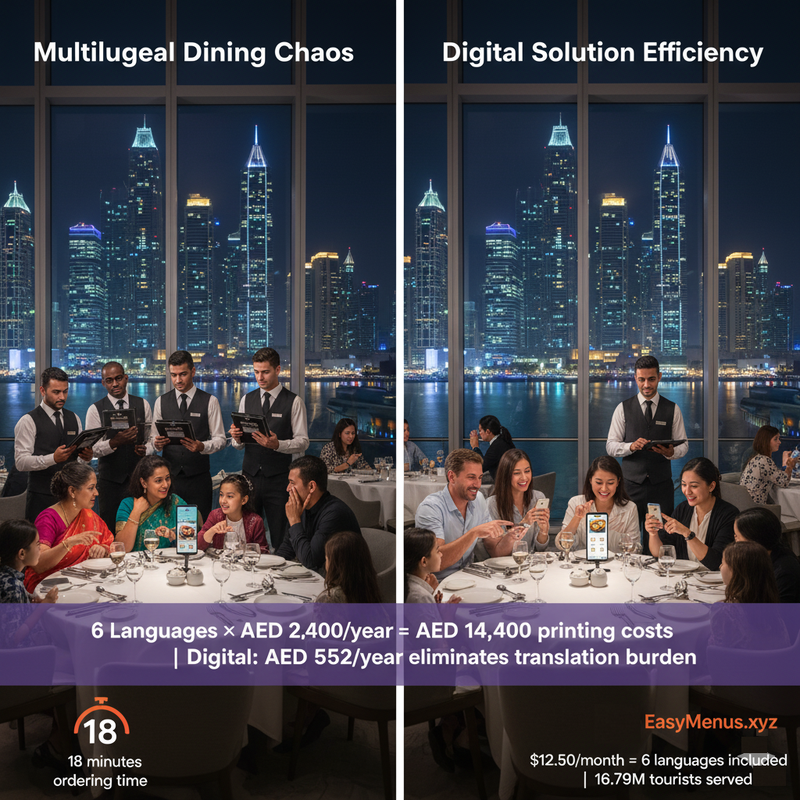
It's Thursday night at Asia Asia on Pier 7, Dubai Marina. Table 12: Indian family speaking Hindi. Table 15: Filipino group speaking Tagalog. Table 18: Chinese tourists speaking Mandarin. Table 21: Arab locals speaking Arabic. Table 24: European tourists speaking English. Table 27: French business delegation.
Your section. All at once. All during ladies' night promotion. With the live band playing.
And every single table needs menu explanations in a different language.
Your printed English menu doesn't help the Chinese tourists who've never seen Thai tom yum. Your Arabic menu doesn't explain Japanese yakitori to the Filipino family. The Indian customers want to know spice levels. The French delegation needs wine pairings.
This is every Thursday. This is every shift. This is Dubai.
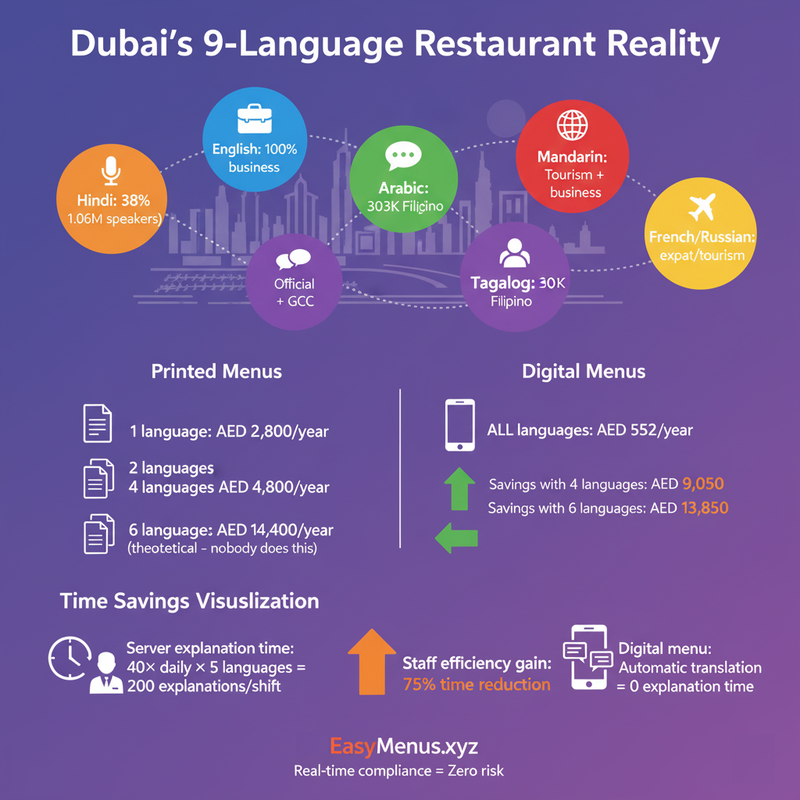
Here's the reality: serving 88% expat population requires Arabic, English, Hindi, Urdu, Malayalam, and Tagalog support as baseline. Add French, Russian, Mandarin for the 16.79 million annual tourists. That's nine languages minimum in tourist-heavy areas.
You can't staff for this. You can't print for this. But you can digitize for this.
The Real Math of Multilingual Printing
Let's stop with the theory and talk actual costs from actual Dubai restaurants.
Asia Asia baseline printing (English only):
- Pan-Asian menu: AED 400/print × 6 times/year = AED 2,400
- Cocktail menu updates: AED 150 × 12 months = AED 1,800
- Ladies' night specials: AED 200 × 12 months = AED 2,400
- Weekend brunch variations: AED 200 × 12 months = AED 2,400
- English-only annual total: AED 9,000
If they add Arabic translation:
- Double all printing costs = AED 18,000
If they add Hindi + Tagalog + Mandarin (4 languages total):
- 4× printing costs = AED 36,000 annually
They're not doing this. Instead, your servers are translating manually. Forty times a shift. In three different languages. While the section is slammed. While the band is playing. While managing ladies' night promotions.
Digital menus alternative:
- Upload menu once: 20 minutes
- Add Arabic translation: Auto-translate + review = 30 minutes
- Add Hindi, Urdu, Malayalam, Tagalog, Mandarin, French, Russian: 2-3 hours total setup
- Updates in all languages simultaneously: 2 minutes
- Annual cost: AED 552 ($12.50/month)
- Savings vs 4-language printing: AED 35,450
That's the math. That's why Dubai restaurants with tourist exposure are evaluating digital menus at rates 40-60% higher than Abu Dhabi.
What "88% Expat Population" Actually Means
Dubai's population breakdown creates operational complexity no printed menu can handle:
Major language groups:
- Hindi: 1.06M speakers (38% Indian population)
- English: Universal business language
- Arabic: Official language, UAE nationals, regional visitors
- Tagalog: 303K Filipino expats
- Urdu: Pakistani community (second-largest South Asian group)
- Malayalam/Tamil: South Indian expats
- Mandarin: Chinese business and tourism
- French: European expats and tourists
- Russian: Tourism and residential expats
Long Teng Seafood in Business Bay? Five-floor Cantonese fine dining. Live seafood aquarium. 200+ banquet capacity. Extensive dim sum menu.
Their customer languages on any given weekend:
- Mandarin (Chinese nationals, Hong Kong expats)
- Cantonese (different dialect, different expectations)
- English (business crowd, international expats)
- Arabic (GCC high-net-worth clientele)
Right now they're managing with multilingual staff. But training servers to explain 50+ dim sum varieties in four languages? That's expensive. That's time-consuming. That's prone to inconsistency.
The Tourist Discovery Problem (That Instagram Created)
Dubai's 16.79 million annual tourists don't discover restaurants through printed guides anymore. They discover through:
Instagram: GAIA (86K followers), Orfali Bros (95K followers), BKRY (82K TikTok followers), Asia Asia (56K followers)
Google Maps: Reading reviews from people who speak their language, looking at photos from previous visitors
TripAdvisor: Filtering by cuisine type, reading English reviews they can translate
Here's what happens: Chinese tourist sees BKRY's miso croissant on Xiaohongshu (Chinese Instagram). Flies to Dubai specifically for it. Arrives at Alserkal Avenue. Printed English menu lists "fermented miso croissant with cultured butter."
They don't know what "fermented" means in this context. They don't know what "cultured butter" is. They just want the croissant from the photo. Your server is explaining fermentation science to someone whose English is limited.
Or: Indian family sees Orfali Bros' Instagram. Books weeks in advance (they're World's 50 Best #37). Contemporary Middle Eastern tasting menu arrives. What's freekeh? How spicy is muhammara? Is the kibbeh similar to keema?
Your printed menu can't answer these questions in Hindi. Your server can - but they're managing eight tables, and three other tables have similar questions in Tagalog and Mandarin.
Digital menus solve this by making Instagram discoverable dishes immediately understandable:
- Dish photos match what they saw on social media
- Ingredients explained in their language
- Preparation methods described with cultural context
- Spice levels indicated clearly
- Allergen information accessible
The Staff Burden Nobody Talks About
You know what your servers hate most? It's not the long hours. It's not the demanding customers. It's explaining the exact same dish forty times in three different languages while their section is underwater.
Bait Maryam at Damac Lake Terrace. Michelin One Star 2024. MENA's 50 Best #15. Palestinian home cooking. Generational family recipes.
Every table includes customers who've never encountered Palestinian cuisine. They need to understand:
- What makes musakhan different from other chicken dishes
- Why maqluba is cooked and served upside-down
- How knafeh differs from other Middle Eastern desserts
- The cultural significance of these recipes
Your server is a hospitality professional, not a full-time translator and cultural educator. But with printed menus, that's exactly what they become.
Server time breakdown with printed English-only menus:
- Explaining dishes to non-English speakers: 5-8 minutes per table
- Translating special requests: 2-3 minutes per table
- Clarifying allergens and ingredients: 3-4 minutes per table
- Total per table: 10-15 minutes before taking order
- Across 8-table section: 80-120 minutes of explanation time per shift
Server time with multilingual digital menus:
- Customer browses in their language before server arrives
- Dish explanations already visible with photos
- Ingredients and allergens listed clearly
- Server takes order efficiently: 3-5 minutes per table
- Across 8-table section: 24-40 minutes, saving 60-80 minutes per shift
That time saving doesn't go to waste. It goes to hospitality. To recommendations. To making customers feel welcome. To the things good servers actually want to do.
The Palestinian Heritage Example (When Storytelling Matters)
Bait Maryam isn't just serving food. They're sharing Palestinian culinary heritage with customers from 200+ countries who've never encountered these dishes.
Printed menus list:
- "Musakhan - AED 95"
- "Maqluba - AED 110"
- "Knafeh - AED 45"
Digital menus tell stories:
- Musakhan: "Traditional Palestinian dish dating to Ottoman times. Sumac-marinated chicken on taboon bread with caramelized onions and pine nuts. The bread absorbs the sumac-infused chicken oils, creating layers of flavor. Typically served during olive harvest season in Palestinian villages."
- Maqluba: "Literally means 'upside-down.' Rice, vegetables, and meat cooked in pot, then dramatically flipped onto serving platter. Each family has their version passed through generations. MENA Best Female Chef 2022 Faten Saleh's grandmother's recipe."
- Knafeh: "Shredded phyllo pastry with cheese, soaked in sugar syrup, topped with pistachios. Nablus city in Palestine is famous for this dessert. Our version uses Akkawi cheese from traditional sources."
This level of cultural education doesn't fit on printed menus. But it's exactly what Michelin-starred Palestinian restaurants need to share with international audiences.
And it needs to be available in Hindi for the Indian business executives, in Mandarin for the Chinese tourists, in Arabic for the GCC visitors, in English for everyone else.
The DIFC Business Lunch Reality
DIFC Gate Village. Tuesday lunch. Investment bankers. Corporate lawyers. International executives. They've got 60-75 minutes between meetings.
Table languages:
- Arabic (Emirati client meeting)
- English (international firm)
- Hindi (Indian expat executives)
- Mandarin (Chinese banking delegation)
Everyone needs to order quickly. Everyone needs to understand exactly what they're getting. Nobody has time for lengthy menu explanations.
GAIA's Greek-Mediterranean menu. Cipriani's Italian classics. Hutong's Northern Chinese Sichuan. The Guild's five-concept coordination.
With printed English menus, non-English speakers slow down table turns. With multilingual digital menus, everyone browses simultaneously in their language while discussing business. Orders flow efficiently. Service maintains DIFC standards.
This is why business district restaurants adopt digital menus faster than neighborhood cafes. Time literally is money in DIFC lunch service.
What About The "Older Customers" Question?
The objection: "But our older Emirati customers prefer printed menus."
The reality: Your older Emirati customers use smartphones for everything else. Banking. Government services. Booking flights. Shopping. Their entire life is on that phone.
And they're not the challenge anyway - they know your menu. They've been coming for years. They order the same things.
The challenge is the first-time international customer who needs extensive explanation. That customer is typically younger, tech-savvy, and expects digital options.
Also: Dubai's smartphone penetration is essentially universal. People arrive at your restaurant using:
- Airline apps for flight booking
- E-visa systems for entry
- Google Maps for navigation
- OpenTable/Zomato for reservations
- TripAdvisor for reviews
- Instagram for discovery
If they can do all that, they can scan a QR code.
But if you're genuinely concerned: keep 3-5 printed menus on hand. That's still 95% less printing cost than maintaining current multilingual inventory.
How This Actually Works
Initial setup (one-time, 2-3 hours):
- Upload English menu (your current version)
- Add Arabic translations (required by UAE law)
- Add Hindi, Urdu, Malayalam, Tagalog, Mandarin, French, Russian
- Review auto-translations, adjust for accuracy
- Add photos for dishes tourists typically question
- Generate QR codes
Ongoing operation (2-5 minutes per update):
- Price changes: Update once, reflects in all 9 languages automatically
- New dishes: Add with photo and description, translates instantly
- Seasonal items: Turn on/off with single click
- Sold-out items: Remove in 15 seconds across all languages
Staff training (10 minutes):
- "Table asks for menu, point to QR code"
- "If customer can't scan, open menu on your phone and hand to them"
- "For older customers who prefer printed, offer the 3-5 backup menus"
- Done
This is why "complicated software" objections don't hold up. If you can post on Instagram, you can manage this.
The Bottom Line For Tourist-Heavy Restaurants
Current multilingual printing costs:
- English + Arabic: AED 4,800/year minimum
- English + Arabic + Hindi + Tagalog: AED 9,600/year
- Full tourist coverage (6-9 languages): AED 14,400-21,600/year (theoretical - nobody actually does this)
Reality: Most restaurants print English-only or English + Arabic, then rely on server translation for 16.79M tourists and 88% expat population
Digital menu costs:
- All languages included: AED 552/year ($12.50/month)
- Unlimited updates: Included
- No per-language charges: Included
Net savings: AED 4,250-21,000 annually depending on current approach
Additional benefits:
- Staff time reduction: 60-80 minutes per shift
- Zero translation errors
- Cultural education included
- Instagram-to-table journey completed
- DIFC business lunch efficiency
- Tourist satisfaction increased
Break-even: 8-12 days for most tourist-heavy restaurants
You're serving 16.79 million annual tourists in a city that's 88% expat. Your customers speak nine languages. Your printed menus speak one, maybe two.
That gap costs you AED 4,250-14,400 annually in printing. More importantly, it costs you in staff time, customer experience, and operational efficiency.
Start serving 16.79M tourists in their languages in 3 minutes - all nine languages included, zero per-language fees, one month of four-language printing costs more than one year of digital menus serving everyone.
Frequently Asked Questions
How do multilingual digital menus work for Dubai's 88% expat population and 16.79M tourists?
Dubai's demographic reality requires serving customers speaking Hindi (1.06M speakers, 38% Indian population), English (universal business), Arabic (official language + GCC visitors), Tagalog (303K Filipino expats), Mandarin (Chinese tourism + business), French/Russian (European expats), Malayalam/Tamil/Urdu (South Asian communities). Digital menus detect phone language settings or allow manual selection, displaying menu content, dish descriptions, ingredient lists, and allergen warnings in chosen language. Restaurants like Asia Asia (Pier 7 Dubai Marina) serve six language groups simultaneously in Pan-Asian dining, Long Teng Seafood (Business Bay) requires Mandarin/Cantonese/English/Arabic for five-floor dim sum operations, and Bait Maryam (Damac Lake Terrace) educates international tourists about Palestinian culinary heritage in their native languages. This eliminates 40× daily server explanations in multiple languages while maintaining hospitality standards.
What are actual multilingual printing costs for Dubai tourist-area restaurants?
Dubai Marina and DIFC restaurants printing English-only menus spend AED 2,400-9,000 annually (menu reprints, cocktail updates, special events, weekend brunch variations). Adding Arabic doubles costs to AED 4,800-18,000. Four languages (English/Arabic/Hindi/Tagalog) quadruple costs to AED 9,600-36,000. Six-language coverage theoretically costs AED 14,400-54,000 but restaurants don't do this due to expense, instead relying on staff translation. Digital menus serve all nine languages (Arabic, English, Hindi, Urdu, Malayalam, Tagalog, Mandarin, French, Russian) for AED 552 annually ($12.50/month), creating AED 4,250-35,450 savings depending on current multilingual approach. Updates reflect across all languages simultaneously (2 minutes), eliminating coordination complexity and 5-7 day print shop delays.
How much server time do multilingual digital menus save in tourist-heavy restaurants?
Tourist-heavy restaurants with printed English-only menus require servers to explain dishes repeatedly in multiple languages: 5-8 minutes per table for dish descriptions, 2-3 minutes for special request translation, 3-4 minutes for allergen clarification, totaling 10-15 minutes before order-taking. Across 8-table sections, this equals 80-120 minutes explaining rather than serving. Digital menus with photos, cultural descriptions, and ingredient details in customer's language reduce this to 3-5 minutes per table (24-40 minutes per section), saving 60-80 minutes per shift. Staff time redirects to hospitality, recommendations, and service excellence rather than repetitive translation. Restaurants like Orfali Bros Bistro (World's 50 Best #37) benefit from explaining contemporary Middle Eastern techniques once digitally rather than 40× daily verbally.
Can heritage restaurants maintain cultural storytelling while using multilingual menus?
Heritage restaurants like Bait Maryam (Michelin One Star, Palestinian generational recipes) use digital menus for cultural education beyond what printed menus allow. Traditional printed menu: "Musakhan - AED 95" (name and price only). Digital multilingual menu: Full cultural context about Ottoman-era origins, sumac preparation significance, taboon bread traditional methods, olive harvest seasonal connection, MENA Best Female Chef Faten Saleh's grandmother's recipe provenance - all available in Hindi for Indian executives, Mandarin for Chinese tourists, Arabic for GCC visitors, English for international audiences. This preserves authentic recipes while educating 16.79M annual tourists about cultural heritage. Al Dhafra Restaurant (25 years Abu Dhabi Corniche heritage) explains masgouf Iraqi grilling, sayyadieh Arab traditions, machboos Emirati hospitality significance across languages, turning menus into cultural guides.
How do DIFC business lunch restaurants use multilingual menus for efficiency?
DIFC Gate Village restaurants serve international executives with 60-75 minute meeting windows requiring rapid ordering: Arabic (Emirati client meetings), English (international firms), Hindi (Indian expat executives), Mandarin (Chinese banking delegations). Printed English menus slow non-English speakers, delaying table turns and creating service bottlenecks. Multilingual digital menus allow simultaneous browsing in preferred languages during business discussions, enabling efficient ordering without lengthy explanations. GAIA (Greek-Mediterranean, 86K Instagram), Hutong DIFC (Northern Chinese Sichuan), The Guild (five-concept venue coordination) maintain business district standards by eliminating 10-15 minute menu explanation delays. Digital efficiency supports AED 150-300 average checks where time-is-money clientele expect seamless service regardless of language preference.
Related Articles
- Dubai vs Abu Dhabi Restaurants: Why 16.79M Tourists Drive 40-60% Faster Digital Menu Adoption
- UAE Type C License Wine Lists: AED 4,800/Year Printing vs Digital Updates
- Heritage Emirati Restaurant Digitization: Al Dhafra and Traditional UAE Dining
- DIFC Restaurant Technology: Digital Menu Solutions for Dubai's International Business District