
DIFC Restaurant Tech: When 60-Minute Business Lunches Can't Wait for Menus
DIFC business executives have 60-75 minute lunch windows. Menu delays cost table turns. Digital menus serve multilingual clients instantly. AED 150-300 checks demand efficiency.
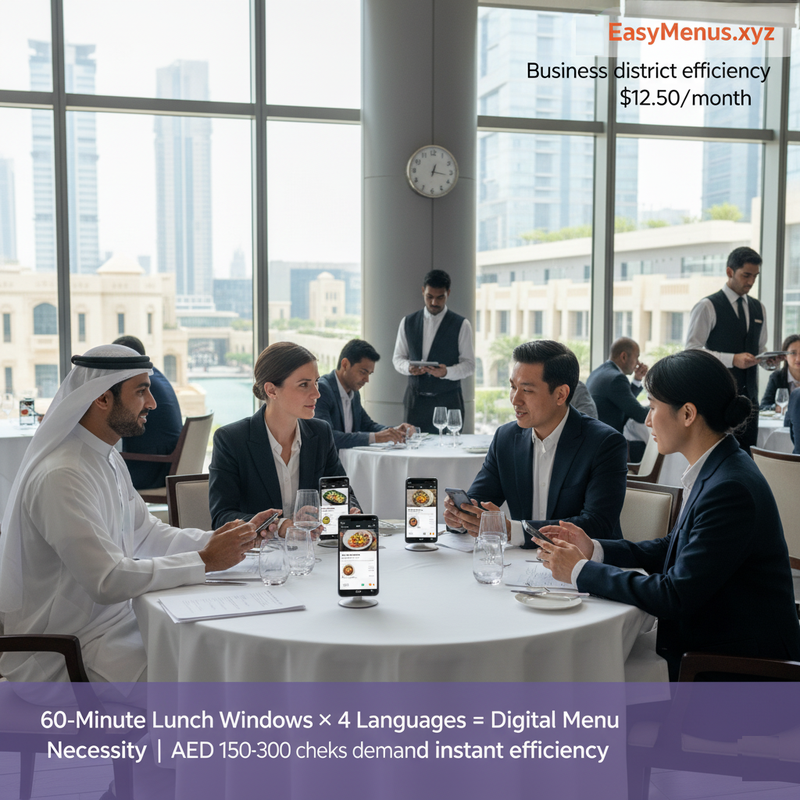
It's 12:30 PM Tuesday at GAIA in DIFC Gate Village. Table 8: Emirati property developer meeting UK investment fund. Arabic and English. Table 12: Indian tech executives discussing acquisition. Hindi and English. Table 16: Chinese banking delegation reviewing documents. Mandarin. Table 21: French consulting firm client lunch. French and English.
Every table is international business. Every table has exactly 60-75 minutes between meetings. Every table expects seamless service despite language differences. Your printed English menu just became a bottleneck.
This is DIFC lunch service. Where DIFC restaurants serve international business executives requiring multilingual efficiency because time literally equals money in contracts being negotiated over hamachi carpaccio and Greek wine.
Your operational challenge isn't cooking the food. It's delivering flawless service to customers who bill their time at AED 1,500-3,000 per hour and expect restaurant efficiency to match.
The 60-Minute Reality
DIFC business lunch operates under different rules than dinner service or weekend brunch. Here's what you're managing:
Time constraints:
- Customer arrives: 12:15-12:45 PM (staggered based on meeting schedules)
- Must be back at office: 1:30-2:00 PM
- Actual dining window: 60-75 minutes including ordering, service, eating, paying, leaving
- Zero flexibility (next meeting starts precisely at 2:00 PM)
Service expectations:
- Order taken within 5 minutes of seating
- Food delivered within 20 minutes
- Professional service without rushing
- Bill presented proactively without asking
- Payment processed immediately
Menu complexity:
- Sophisticated cuisine requiring explanation (Northern Chinese Sichuan, contemporary Indian, Greek-Mediterranean)
- Wine pairings for AED 150-300 meals
- Dietary restrictions (halal requirements, vegetarian, allergies)
- Business expense documentation needed
With printed menus, here's what actually happens:
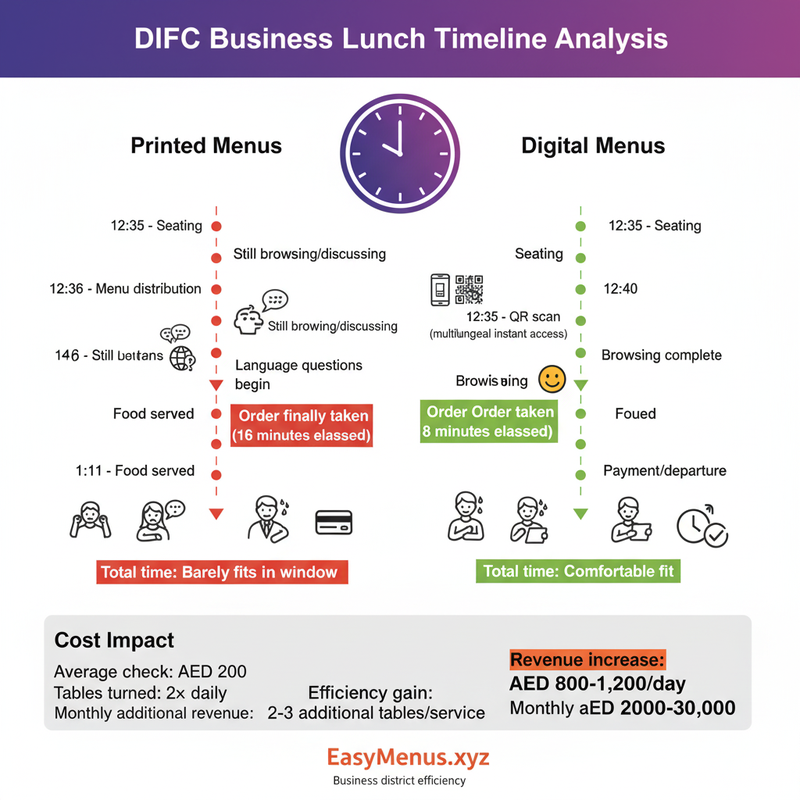
Printed menu timeline:
- Seat customers: 12:35 PM
- Distribute printed English menus: 1 minute
- Customers browse while discussing business: 5-7 minutes
- Non-English speakers ask questions: 3-4 minutes
- Server explains dishes, answers dietary questions: 4-5 minutes
- Group discusses options further: 3-4 minutes
- Order finally taken: 12:51 PM (16 minutes after seating)
You've consumed 16 minutes just getting an order. In DIFC lunch service, that's unacceptable.
How Digital Menus Actually Work in Business Context
Digital menu timeline:
- Seat customers: 12:35 PM
- Point to QR code: "Scan for menu in your language"
- Customers browse immediately in Arabic/English/Hindi/Mandarin while discussing business
- Dish photos eliminate language barriers
- Dietary information visible instantly
- Group discusses selections informed by photos and descriptions
- Server takes order: 12:43 PM (8 minutes after seating)
Time saved: 8 minutes per table. Across a 40-table lunch service turning twice, that's 320 minutes of operational efficiency daily. That's five additional hours of productive service time.
More importantly: your customers aren't frustrated. They're browsing sophisticated menus in their language while continuing business discussions. Service feels seamless, not rushed.
The Multilingual Business Reality
DIFC Gate Village hosts international financial services. Your lunch customers include:
Language breakdown:
- Emirati nationals and GCC clients: Arabic
- UK/US/European firms: English
- Indian expat executives: Hindi/English
- Chinese banking operations: Mandarin
- French consulting groups: French
- Korean financial firms: Korean
- Japanese trading companies: Japanese
Hutong DIFC. Northern Chinese Sichuan. Business lunch unlimited dim sum. Michelin Hong Kong pedigree.
Table 14: Korean financial services team. They see your printed English menu. They understand "dumpling" and "soup" but need to know:
- Which dumplings have pork (halal concerns)
- Sichuan spice levels (Korean palates differ)
- Portion sizes for sharing
- What "ma la" sensation means
Your server spends 10 minutes explaining. The Korean team is polite but this wasn't in their 60-minute budget.
With digital menus in Korean:
- Spice levels indicated clearly with visual scale
- Halal/non-halal labeled explicitly
- Photos show portion sizes
- "Ma la" explained in Korean culinary context
- Server takes order efficiently after 5 minutes
This is why business district restaurants adopt digital solutions faster. The operational cost of language barriers is measured in lost table turns and customer frustration.
The Professional Presentation Standard
DIFC restaurants compete with ICD Brookfield Place, Gate Village fine dining, and downtown Dubai Michelin listings. Your presentation standards matter.
What "professional" means in DIFC context:
- Menu accuracy (prices current, dishes available)
- Visual sophistication (photography quality matters)
- Brand consistency (reflects your restaurant's positioning)
- Information completeness (allergens, origins, preparation methods)
- Technical reliability (menus load instantly, zero downtime)
The Guild DIFC. Five concepts under one roof: Nurseries, Potting Shed, Rockpool, Salon, Aviaries. Michelin Guide Opening 2024.
Their challenge: coordinating five separate menus for business lunch while maintaining unified brand experience. Each concept targets different business lunch segments:
- Rockpool: Seafood-focused executives
- Potting Shed: Casual business meetings
- Nurseries: Private dining for negotiations
- Salon: Wine-focused client entertainment
- Aviaries: Contemporary business casual
Printing five separate menus daily? That's AED 500-750 per update. Multiple updates weekly? AED 2,000-3,000 monthly minimum.
Digital menus handle this elegantly:
- Five concepts, one QR code system
- Each concept menu branded individually
- Updates across all concepts simultaneously
- Special business lunch pricing by concept
- Private dining menus for Nurseries bookings
Cost: AED 46 monthly. Professional execution that matches DIFC standards.
When Wine Lists Matter More Than Food Menus
DIFC business lunches frequently include wine. Not weekend indulgence drinking - professional client entertainment requiring sophisticated wine programs.
Cipriani Dubai. 300-capacity operations. Legendary Venetian heritage. Classic Italian wine program with vintage variations.
Business lunch wine challenges:
- Italian Veneto focus (Soave, Valpolicella, Prosecco) with vintage differences
- By-the-glass programs changing based on availability
- Business lunch selections different from dinner
- Client entertainment requiring sommelier expertise
- Pricing transparency for corporate expense reporting
Printed wine lists in DIFC context:
- Reprinting: AED 400-500 monthly across two levels
- Vintage transitions: Bottles sell out, replacements differ
- By-the-glass updates: Weekly changes not reflected
- Business lunch specials: Separate printing required
- Annual cost: AED 4,800-6,000 just for wine lists
Digital wine lists solve professional service requirements:
- Current vintage accuracy prevents "sorry, we're out" situations
- By-the-glass programs update throughout service
- Business lunch wine pairings separate from dinner
- Sommelier notes accessible to all customers
- Corporate expense documentation easier (clear pricing, descriptions)
When your average business lunch check is AED 200-300 including wine, accuracy matters. Credibility matters. Professional execution matters.
The "Sorry, We're Out" Credibility Problem
You're serving international business executives who chose your restaurant specifically for certain dishes they researched on Instagram or read about in reviews.
Amazónico DIFC. Three-floor Latin American. Rooftop Paraiso. Resident DJ. Tropical rainforest theme.
Business lunch customer researched your menu online last night. They saw the Peruvian ceviche. They planned their client lunch around showing sophisticated culinary knowledge. They arrive. Order the ceviche.
"Sorry, that's off the menu as of this morning."
Your printed menu still shows it. Your website still lists it. Instagram post from three days ago features it. But supply chain disruption means it's unavailable.
That customer looks uninformed in front of their client. That's not just a service failure - it's a professional embarrassment that costs relationships.
Digital menus eliminate this:
- Dish unavailable? Remove it in 30 seconds
- Replacement dish? Add it immediately
- Special business lunch item? Turn on for specific dates
- Supply chain issues? Reflect instantly
Professional business district service means your menu shows current reality, not historical aspirations.
The Real Cost Mathematics
DIFC fine dining restaurant baseline costs:
- Seasonal menu printing: AED 400 × 8 times/year = AED 3,200
- Business lunch specials: AED 250 × 12 months = AED 3,000
- Wine list updates: AED 400 × 12 months = AED 4,800
- Private dining menus: AED 200 × 24 events = AED 4,800
- Multi-concept coordination (if applicable): Additional AED 3,000-6,000
- Annual printing: AED 15,800-21,800
Digital menu costs:
- All menus, all concepts, all languages: AED 552/year ($12.50/month)
- Net savings: AED 15,250-21,250 annually
Additional business benefits:
- Time savings: 8 minutes per table × 80 daily covers = 640 minutes (10.5 hours) daily
- Revenue opportunity: 2-3 additional table turns = AED 20,000-30,000 monthly
- Professional credibility: Zero "sorry, we're out" situations
- Multilingual service: Arabic/English/Hindi/Mandarin/French without multilingual staff at every table
- Corporate client confidence: Professional presentation matching DIFC standards
Break-even: 9-14 days for most DIFC restaurants
What DIFC Restaurants Are Actually Doing
Zuma DIFC. Contemporary Japanese. Three floors. Michelin-listed. They're evaluating digital menus because coordinating sake programs and sushi selections across multiple floors during business lunch requires better tools than printed materials.
Hutong DIFC. Northern Chinese Sichuan. Michelin Hong Kong pedigree. Business lunch unlimited dim sum. They need real-time menu accuracy for international business clientele who research specific dishes before arriving.
The Guild. Five-concept venue. Michelin Guide Opening 2024. Coordinating Nurseries, Potting Shed, Rockpool, Salon, and Aviaries menus for business lunch while maintaining brand consistency demands digital efficiency.
These aren't future scenarios. These are DIFC restaurants evaluating solutions right now because serving international business executives in 60-minute windows with printed English-only menus creates operational friction they can't sustain.
The Bottom Line For Business District Restaurants
You're serving customers who bill their time at AED 1,500-3,000 hourly. Menu inefficiency that wastes 8 minutes per table isn't just poor service - it's costing your customers money.
Professional business district service requires:
- Instant multilingual access (Arabic/English/Hindi/Mandarin minimum)
- Current menu accuracy (zero "sorry, we're out" situations)
- Visual sophistication (photos matching Instagram-researched expectations)
- Wine program precision (vintage and availability transparency)
- Operational efficiency (orders taken within 5 minutes)
Printed menus can't deliver this. Digital menus can.
Cost: AED 552 annually vs AED 15,800-21,800 printing Efficiency: 8-minute savings per table = 10.5 hours daily across 80 covers Revenue: 2-3 additional table turns = AED 20,000-30,000 monthly opportunity Professional standard: Matches DIFC client expectations for AED 150-300 average checks
Start serving DIFC business executives with professional efficiency in 3 minutes - multilingual menus for international firms, real-time accuracy for credibility, operational efficiency for 60-minute lunch windows. One month of DIFC printing costs more than two years of digital menus.
Frequently Asked Questions
Why do DIFC business lunch restaurants need different menu solutions than casual dining?
DIFC restaurants serve international business executives with 60-75 minute lunch windows between meetings (must return to office by 1:30-2:00 PM precisely). Operational requirements include order-taking within 5 minutes of seating (versus 10-15 minutes casual), multilingual business clientele (Arabic Emirati clients, English international firms, Hindi Indian executives, Mandarin Chinese banking delegations), AED 150-300 average checks demanding professional presentation, sophisticated cuisine requiring explanation (Northern Chinese Sichuan at Hutong, contemporary Indian at Carnival by Tresind, Greek-Mediterranean at GAIA), and wine programs for client entertainment. Printed English-only menus require 16 minutes for order-taking (browsing, language questions, dish explanations), consuming 27% of available lunch window. Digital menus reduce this to 8 minutes through instant multilingual access and visual dish references, enabling efficient service while customers continue business discussions.
How much do DIFC fine dining restaurants save switching from printed to digital menus?
DIFC Gate Village restaurants spend AED 15,800-21,800 annually on printed menus: seasonal updates (AED 3,200/year for 8 reprints), business lunch specials (AED 3,000/year monthly updates), wine list management (AED 4,800/year for vintage accuracy), private dining events (AED 4,800/year for 24 customized menus), plus multi-concept coordination for venues like The Guild (additional AED 3,000-6,000/year managing five separate concepts). Digital menus cost AED 552 annually ($12.50/month), creating net savings of AED 15,250-21,250. Additional revenue opportunity from operational efficiency: 8-minute time savings per table × 80 daily business lunch covers = 2-3 additional table turns possible, generating AED 20,000-30,000 additional monthly revenue at AED 200 average lunch checks. Break-even occurs in 9-14 days for most DIFC restaurants.
What multilingual capabilities do DIFC business district restaurants require?
DIFC hosts international financial services creating diverse language requirements: Emirati nationals and GCC clients (Arabic), UK/US/European firms (English), Indian expat executives (Hindi), Chinese banking operations (Mandarin), French consulting groups (French), Korean financial firms (Korean), Japanese trading companies (Japanese). Business lunch service requires professional efficiency regardless of client language. Hutong DIFC's Northern Chinese Sichuan menu needs Mandarin for authenticity, English for international business, Arabic for GCC clients, and Hindi for Indian executives. Cipriani Dubai's Italian classics require multilingual wine program descriptions for client entertainment contexts. The Guild's five-concept coordination (Nurseries, Potting Shed, Rockpool, Salon, Aviaries) demands consistent multilingual access across different business dining segments. Digital menus provide instant language selection without requiring multilingual servers at every table during compressed 60-minute lunch windows.
How do digital menus maintain professional presentation standards for fine dining?
DIFC restaurants compete with Michelin-listed establishments and ICD Brookfield Place fine dining, requiring professional menu presentation: photography quality matching Instagram-researched expectations (customers pre-select dishes based on social media), brand consistency reflecting restaurant positioning (The Guild's five concepts each maintain individual identity), current accuracy preventing credibility damage (Amazónico's supply chain updates reflected immediately), complete information for business expense documentation (allergens, preparation methods, ingredient origins), and technical reliability (instant loading, zero downtime during business lunch rush). Printed menus become outdated the moment reprinted (5-7 day turnaround creates accuracy gaps). Digital menus update in 30 seconds, maintaining professional DIFC standards where AED 150-300 checks demand flawless execution and international business clients expect sophistication matching their corporate environments.
What wine list management challenges exist specifically in DIFC business dining?
DIFC business lunch wine service involves client entertainment requiring sophisticated programs: Cipriani Dubai's 300-capacity Venetian wine focus with vintage variations, Zuma DIFC's sake program across three floors, GAIA's Greek wine pairings for business executives. Challenges include vintage accuracy (bottles sell out, replacements differ vintages/prices), by-the-glass programs changing daily (availability-based rotation), business lunch selections differing from dinner (price-conscious corporate expense limits), and corporate documentation requirements (clear pricing, origin transparency). Printed wine lists cost AED 4,800-6,000 annually with monthly reprints across multiple service levels. Updates lag 5-7 days creating "sorry, we're out" situations damaging credibility when clients selected specific wines for business impressions. Digital wine lists update in 30 seconds, reflect current availability instantly, provide sommelier notes accessible to all customers, and maintain pricing transparency for expense reporting.
Related Articles
- Dubai vs Abu Dhabi Restaurants: Why 16.79M Tourists Drive 40-60% Faster Digital Menu Adoption
- UAE Type C License Wine Lists: AED 4,800/Year Printing vs Digital Updates
- Heritage Emirati Restaurant Digitization: Al Dhafra and Traditional UAE Dining
- Six-Language Menu Solutions for Dubai's 16.79 Million Annual Tourists