
The Text That Filled 19 Tables: The Galway Secret
Róisín's Wednesday nights were dead. Empty tables, staff standing idle, kitchen running at 30%. Then she sent one text at 4 PM. Everything changed.
The Text That Filled Nineteen Tables (And Why Wednesday Night Changed Everything)
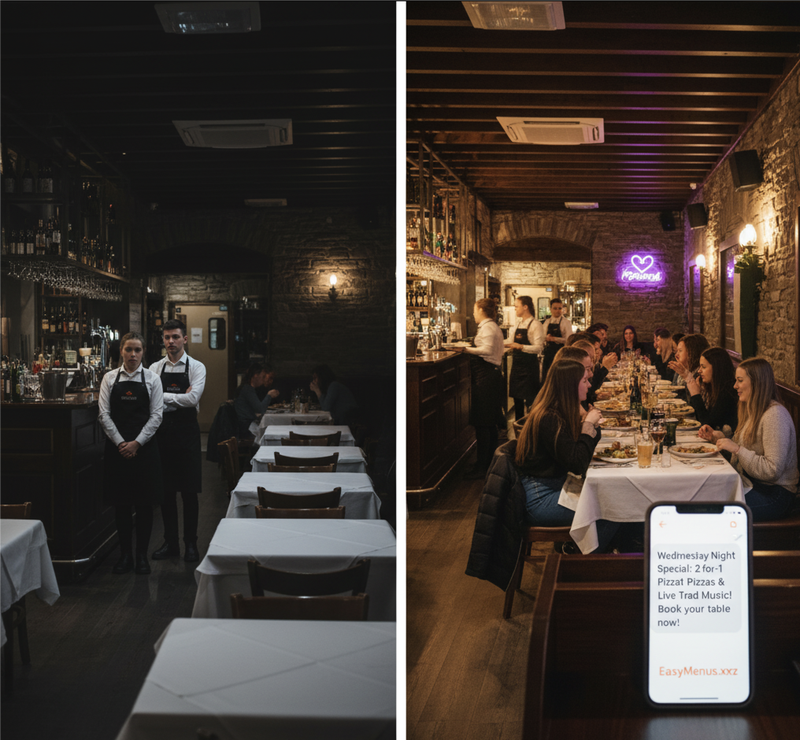
Róisín had run her Galway restaurant for eight years. She knew her patterns. Friday nights? Packed. Saturday? Queue out the door. Sunday lunch? Solid. Monday through Wednesday? Dead.
Wednesday was the worst. By six PM, she'd have maybe four tables. Eight at most. Her restaurant seated seventy. Staff standing around. Kitchen prep wasted. Fixed costs eating her alive while two-thirds of her restaurant sat empty.
She'd tried everything. Wednesday specials on printed menus. Staff mentions. Posters in the window. Nothing worked. Wednesday nights were just dead. Accept it. Survive it. Make it back on weekends.
Except her rent didn't understand "dead Wednesdays." Her staff wages didn't care about patterns. Her supplier bills came regardless of which nights were busy. Wednesday losses were real money leaving her business every week.
Then she went to an Irish Restaurant Association meeting in Dublin. Met a restaurant owner from Cork. They got talking about slow nights. The Cork guy mentioned something casual. "We just text our student list when we've got empty tables. Fill twelve to fifteen most Wednesdays."
Text the students? Róisín had email addresses from her loyalty cards. She'd sent emails twice. Terrible response. Maybe one booking from two hundred emails. She'd assumed digital communication with customers didn't work.
But texting was different. Students actually read texts. Students responded to texts. Email was for job applications and university notices. Texts were for making plans tonight.
The Cork restaurant owner explained his system. Collected phone numbers at the till. Simple question: "Want to hear about Wednesday specials? What's your mobile?" Built a list of four hundred numbers over six months. Students mostly. Some young professionals. People who actually lived in Cork and came back regularly.
Wednesday at four PM, he'd send one text: "Tonight only - €15 steak and chips. Book before 6 PM." Twenty to twenty-five bookings would come in within ninety minutes. Empty Wednesday transformed into decent Wednesday. Not full. But viable. Profitable instead of loss-making.
"How much does the text service cost?" Róisín asked.
"It's included in the menu system. Twelve fifty a month total. Unlimited texts. I send maybe two a week."
Twelve fifty monthly. Versus losing money every Wednesday for eight years.
Róisín signed up the following week. The setup took fifteen minutes. She uploaded her menu. Configured the customer communication features. Printed new QR code cards for her tables with "Join our list for Wednesday specials" messaging.
She started collecting numbers at the till. "Want to hear about our Wednesday deals? Pop your number here." Students gave numbers freely. Young professionals too. People who wanted to know when she had offers. Within six weeks, she had three hundred eighty-two numbers.
First test was a Wednesday in late February. Dead season. University midterms. Weather cold. Wednesdays especially brutal during February.
Tuesday afternoon, Róisín decided to try it. She created a simple offer: "Wednesday special - €12 burger and pint. Text BOOK with number of people to reserve."
Sent the text Wednesday at 3:45 PM. To all three hundred eighty-two numbers.
By 4:30 PM, she had eleven booking responses. By 5:15 PM, nineteen responses. Twenty-three people total. Nineteen tables because several were couples.
Róisín had never seen nineteen tables book for a Wednesday in February. Ever. In eight years.
Service that night was bizarre. Actually busy. Staff actually working. Kitchen actually cooking at capacity. The restaurant felt alive on a Wednesday. She'd forgotten Wednesday could feel like Saturday.
Revenue that Wednesday: one thousand one hundred euros. Previous Wednesday: three hundred twenty euros. Difference: seven hundred eighty euros.
Cost of the text message: zero euros. Time to create and send it: four minutes.
Seven hundred eighty euros from four minutes' work and zero cost. That was better ROI than any marketing Róisín had ever attempted.
But what really surprised her was Thursday morning. Six new customers came in for lunch. Asked if they could join the Wednesday text list. They'd heard from friends who'd gotten the offer. Wanted to be included next time.
The text message had become word of mouth. Students told other students. "Oh you need to join Róisín's list, they do great Wednesday deals." The list grew organically. Four hundred numbers. Five hundred. Six hundred.
By May, Róisín was sending Wednesday texts to seven hundred thirty-eight numbers. Response rate averaged eighteen to twenty-two bookings. Fifty to sixty people. Not enough to fill the restaurant. But enough to make Wednesday profitable instead of disastrous.
More importantly, those Wednesday customers came back on other nights. Students who'd discovered her restaurant through Wednesday specials would return Friday with friends. Saturday with dates. Sunday with family visiting. The Wednesday offer was customer acquisition that paid for itself immediately and generated ongoing value.
Róisín tracked it properly over three months. Wednesday texts were bringing in thirty-seven new customer relationships monthly - people who'd never visited before, came for the Wednesday offer, then returned for regular-price visits. Customer acquisition cost: zero euros. Just the Wednesday special pricing she was offering anyway to fill empty tables.
But the biggest change wasn't Wednesday. It was Tuesday.
Six months into sending Wednesday texts, Róisín had a realisation. Tuesday nights were nearly as bad as Wednesdays. Why was she only texting Wednesdays?
So she started texting Tuesdays too. Different offer. "Tuesday special - €14 pasta and wine." Sent at 2 PM Tuesday. Same response. Fifteen to eighteen bookings. Tuesday transformed from dead to viable.
Then she realised something else. When Tuesday or Wednesday was actually busy - bank holiday weekends, end of term, special events - she didn't need to send the text. She could just... not send it. Save the special for when she actually had empty tables to fill.
This was targeting. Real targeting. Not demographic marketing or Facebook ads or expensive consultants talking about customer personas. Just: when you have empty tables tonight, tell people who might fill them. When you don't have empty tables, don't text.
Simple. Effective. Free.
Nine months after starting, Róisín calculated her actual impact. Wednesday and Tuesday nights, previously losing roughly five hundred euros weekly combined, were now generating about four hundred euros combined. Swing of nine hundred euros weekly. Forty-seven weeks operating annually. Forty-two thousand euros in recovered revenue.
From collecting phone numbers and sending texts twice weekly. No printing cost. No advertising cost. No marketing agency. Just direct communication with people who wanted to hear from her.
She met with other Galway restaurant owners periodically. Small group who'd share strategies. She explained the Wednesday text system. Three of them signed up immediately. Two more within a month.
But the moment that meant most to Róisín came on a Wednesday in October. University freshers' week. Wednesday texts were working brilliantly. She'd sent the usual offer. Got twenty-one responses. Was preparing for busy service.
Then at 5:30 PM, a group of eight walked in without booking. Big table. Good spending potential. But she was nearly full from the text responses.
Previous situation? She'd have turned them away. Apologised. Lost the revenue. Eight people at forty euros average was three hundred twenty euros walking out the door.
Current situation? She added them to a waiting list. Texted her Wednesday list: "Running full tonight - if you haven't left yet, can we move your booking to 8 PM instead of 7 PM?" Got four responses willing to move. Seated the walk-in group at 7 PM. Seated the text bookings at 8 PM. Kept everyone happy.
That was the flexibility Róisín had never had before. The ability to actually communicate with customers who'd booked. To manage capacity in real-time. To not lose walk-ins because she finally had Wednesday bookings worth protecting.
The text list wasn't just filling empty tables. It was giving her control over her capacity management. Tuesday and Wednesday nights were no longer just hoping enough people showed up. They were actively managed services where she could fill gaps, manage flow, communicate with customers who actually wanted to hear from her.
Eight years of dead Wednesdays. Eight years of losing money on slow nights. Eight years of accepting that some nights were just economically unviable.
All solved by collecting phone numbers and sending two texts weekly. No cost beyond the twelve fifty monthly. No time beyond four minutes per text. No complexity beyond "We've got empty tables, want to fill them?"
Róisín still had her printed menus. Still beautiful. Still professional. Still showed her regular offerings. But now she had something else - a direct line to seven hundred people who actually lived in Galway, actually came back regularly, actually wanted to know when she had space and specials.
That was better than any printed menu, any Facebook ad, any marketing consultant's strategy. It was just honest communication. We've got empty tables tonight. Want to fill them? Here's an offer that makes it worth your while.
Wednesday nights weren't dead anymore. They were managed. And Róisín was keeping forty-two thousand euros annually that used to vanish into empty tables and wasted capacity.
That was real money. That was her business surviving instead of struggling. That was the difference between acceptable losses and actual profit.
And it came from one simple idea: when you've got empty tables, tell people who might fill them. Stop accepting losses. Start filling tables.
FREQUENTLY ASKED QUESTIONS
How do restaurants actually fill empty mid-week tables?
Restaurants with repeat local customers fill slow mid-week tables by building mobile number lists and texting specific offers when capacity is available. Students and young professionals respond quickly to text messages about same-day specials. Wednesday text messages sent at 3-4 PM typically generate fifteen to twenty-five table bookings within ninety minutes. This approach works in university towns, residential neighbourhoods, and business districts where customers live locally rather than visit once as tourists. Empty tables cost money through wasted fixed costs - filling them even at reduced margins improves profitability dramatically.
Why do students respond better to texts than emails?
Students check text messages immediately but often ignore promotional emails. University students receive hundreds of emails weekly for coursework, deadlines, and campus notifications, causing promotional restaurant emails to be overlooked or deleted. Text messages are personal communication channels students associate with making social plans and immediate decisions. Response rates for restaurant special texts average eighteen to twenty-five percent among student populations versus three to eight percent for promotional emails. Texts suit last-minute decision-making for same-evening dining plans.
How many customers do you need on a text list to fill tables?
Restaurants typically need between three hundred and five hundred phone numbers to reliably generate fifteen to twenty-five bookings per text. Response rates vary between fifteen and twenty-eight percent depending on offer quality, frequency of messaging, and customer base composition. Building lists of this size takes four to six months collecting numbers at point of sale. Lists grow organically through word-of-mouth as customers tell friends about special offers. Larger lists enable better targeting and can fill more tables or support multiple slow nights weekly.
Can this approach work outside university towns?
Yes, anywhere customers live locally rather than visit once. Office districts with lunch crowds, residential neighbourhoods with regular diners, and business areas with after-work customers all support this approach. The requirement is repeat customers who return regularly and respond to same-day offers. Tourist-heavy areas see poor response because visitors leave town after eating. Local customer bases enable ongoing relationships where special offers drive repeated visits over months and years rather than single transactions.
What's the actual cost-benefit of filling slow nights?
Empty restaurant tables represent pure loss - rent, utilities, staff wages, and kitchen prep costs continue regardless of covers served. Wednesday nights generating three hundred euros revenue versus one thousand two hundred euros capacity represent nine hundred euros weekly loss. Filling those tables even at reduced margins through specials improves profitability dramatically. Annual impact of converting two slow nights weekly from loss-making to break-even often exceeds forty thousand euros. This recovered revenue requires minimal time investment and zero ongoing marketing costs beyond standard operating expenses.
Related Operational & Cost Stories:
- - The Tuesday Morning Email That Cost €4,000
- - Howth Seafood Special: Managing Daily Catch Menus Without Reprinting
- - The Seasonal Special That Broke the Bank: Why Printing Kills Flexibility
Related Compliance & Documentation:
- - The Health Inspector Who Smiled: Audit Trails That Actually Work
- - The Butter Crisis: How One Change Nearly Cost €87,500