
The Tourist Who Couldn't Read: €800 Translation Fix
Antonio's Italian family couldn't understand his Dublin menu. He'd printed four languages for €800. Then a regular showed him what his competitor was doing.
The Tourist Who Couldn't Read the Menu (And Why It Cost Antonio €800 to Fix)
Antonio ran an Italian restaurant in Temple Bar for seven years. Tourists, mostly. Germans. French. Spanish. Americans. Japanese couples taking photos. Brazilian families looking confused. And every single day, the same problem at table six or table nine or table twelve.
Someone couldn't read the menu.
His servers had learned to spot it. The polite confusion. The pointing at other tables' food. The apologetic "Do you speak German?" or "Parlez-vous français?" Antonio's staff spoke English and Italian. That was it. Everyone else got gestures and Google Translate on their phones and a lot of patience.
It worked. Sort of. But Antonio knew he was losing tables. Tourists who glanced at the English-only menu and walked out looking for somewhere easier. Families who spent ten minutes translating when they should've been enjoying their meal. Elderly couples who gave up and ordered whatever looked safest instead of what they actually wanted.
Antonio did what every restaurant owner eventually does. He rang his printer.
"Four languages," he told them. "English, German, French, Spanish. Full menu."
The quote came back at eight hundred euros. Design work. Four separate printings. Quality paper. Professional translation services.
Eight hundred euros to tell tourists what food he had. And that was just the initial print. When prices changed or seasonal items arrived, he'd need to update four menus instead of one. The cost would multiply with every supplier increase, every menu modification, every correction needed.
But what choice did he have? Temple Bar was tourist territory. English-only menus were costing him business.
The day before he approved the printing quote, one of his regulars came in. Michael. Irish guy who worked nearby, came for lunch twice a week. Michael sat at the bar waiting for his table and watched a German couple struggle with the menu for five minutes before giving up and leaving.
"You know Enzo's place around the corner?" Michael said. "They sorted that problem last month."
Antonio knew Enzo. They'd started in Dublin around the same time. Competed for the same tourist crowds. Occasionally complained to each other about suppliers and staff shortages and the impossible economics of restaurant ownership.
"He got one of those QR code things," Michael continued. "But not like COVID. Different. The menu's in forty languages or something mental like that. Germans scan it, menu's in German. French scan it, menu's in French. Same QR code for everyone."
Antonio had tried QR codes during COVID. His tourists hated them. Couldn't get them to work. WiFi problems. Phone problems. The whole experience felt cheap and confusing. He'd gone back to printed menus the moment he could.
But forty languages from one QR code? That sounded different.
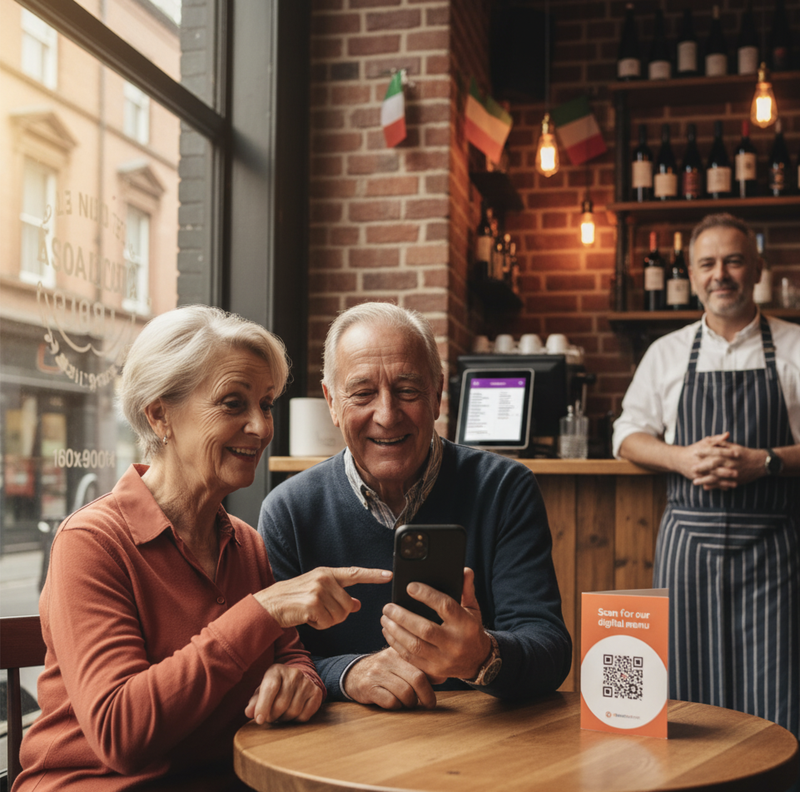
He visited Enzo's that evening after service. Watched how it worked. Each table had beautiful printed menus in English. Nothing had changed there. But tucked beside the salt was a small card. One QR code. And text in six languages: "Scan for menu in your language."
Antonio watched a Japanese couple scan the code. Their phone showed the menu in Japanese. Perfect translation. Prices in euros. Photos of dishes. Allergen information. Everything they needed. They ordered in thirty seconds without saying a word to the server.
"How much?" Antonio asked, because this was always the question that mattered.
"Twelve fifty a month," Enzo said. "Translation's automatic. Included. Forty-three languages. Updates instantly when I change prices."
Antonio did the maths. Twelve fifty a month. Hundred fifty a year. Versus eight hundred euros just for the initial four-language printing. And every time he updated prices, he'd be paying for four reprints instead of one. Over a year, printed multilingual menus would cost him well over two thousand euros.
Hundred fifty versus two thousand. The maths was obvious.
But what sold Antonio completely was watching Enzo update a price in real time. A supplier had texted about tonight's special. Enzo pulled out his phone, adjusted the price on his dashboard, hit publish. Done. Every language updated automatically. German menu, French menu, Spanish menu, Japanese menu. All of them showed the new price immediately.
No translator coordination. No four separate design files. No four separate printing jobs. Thirty seconds. Zero euros.
Antonio signed up that night. The setup was simpler than expected. He photographed his English menu. The system extracted everything. He verified the dishes and prices. Fifteen minutes. The system translated it automatically into forty-three languages. He printed new QR code cards for his tables. By the next morning, tourists were scanning codes and reading menus in Mandarin and Portuguese and Dutch and languages Antonio had never even heard of.
The first real test came on a Saturday afternoon. A Brazilian family of six came in. Grandparents, parents, two teenagers. The grandmother didn't speak English. She scanned the QR code. Her face lit up. The menu was in Portuguese. Complete. Clear. She could read every ingredient, every description, every price. She ordered confidently. No confusion. No gestures. No translating for her.
They left a five-star review specifically mentioning how welcome the grandmother had felt. How unusual it was to find a restaurant in Dublin that thought about Brazilian visitors. How impressed they were that an Italian restaurant made the effort.
But what surprised Antonio most wasn't the tourist response. It was the business impact.
Before the multilingual menus, Antonio estimated he lost three to five tables daily. Tourists who glanced at the English menu and walked out. Groups who came in, struggled, and left. Families who took one look and decided somewhere else would be easier. Three to five tables. Call it four on average. Twenty-eight tables a week. Hundred twelve tables a month.
Average spend per table was forty-five euros. That was over five thousand euros in monthly revenue walking out the door because tourists couldn't read his menu.
After the multilingual system, those walkouts stopped. Not completely. But dramatically. Tourists came in, saw their language on the QR code card, sat down. Groups didn't struggle and leave. Families ordered confidently. Antonio estimated he was keeping an extra seventy to eighty tables monthly that previously would've walked.
That was thirty-five hundred euros in recovered revenue. Every month. From a twelve-fifty monthly investment.
Six months after switching, Antonio met Enzo for a pint. They compared notes. Antonio had saved over seven hundred euros in printing costs by not doing the four-language print job. He'd recovered roughly twenty thousand euros in tourist tables that previously walked out. His TripAdvisor reviews increasingly mentioned "easy to order in our language" and "finally a restaurant that thinks about international visitors."
But the moment that meant most came from an unexpected place. An elderly French couple had been coming to Temple Bar for twenty years. Always the same weekend every September. They'd tried Antonio's restaurant once, years ago. Struggled with the English menu. Never came back.
This September, they came in again. The husband was cautious. Ready to leave if it was still English-only. Then he saw the QR code card. Scanned it. The menu appeared in French. Perfect translation. He looked at his wife. She smiled. They stayed.
After dinner, he told Antonio this was the first time in twenty years of visiting Dublin that a restaurant had made them feel genuinely welcome. Not tolerated. Not accommodated with patience and gestures. Actually welcome. Like the restaurant wanted them there.
Antonio printed that review. Not because it was about technology. Because it was about hospitality. About serving people properly. About competing in a global tourism market without abandoning what made Italian hospitality special.
The printed English menus were still on every table. Still beautiful. Still the first thing customers saw. But now they were backed by something that could speak forty-three languages in thirty seconds, something that cost less than one printed menu update, something that made every tourist feel like someone had actually thought about them.
Antonio never printed those four-language menus. The eight hundred euros stayed in his business. The recovered tables added hundreds of euros weekly. And every time he saw a tourist's face light up when the menu appeared in their language, he remembered why he'd opened a restaurant in the first place.
To feed people. To make them feel welcome. To give them a good meal in a place that treated them like guests, not problems to be managed with gestures and patience.
Eight hundred euros had seemed expensive. But thirty-five hundred euros in recovered monthly revenue? That wasn't expensive. That was the cheapest marketing Antonio had ever done.
FREQUENTLY ASKED QUESTIONS
How much does multilingual menu printing actually cost?
Professional multilingual menu printing typically costs between six hundred and one thousand euros for initial setup covering four languages. This includes translation services, design work for each language version, and printing costs. Every menu update requires translating and reprinting all versions, multiplying costs by the number of languages. Annual costs for maintaining four-language printed menus typically exceed two thousand euros when accounting for seasonal updates, price changes, and corrections.
How many languages can digital menus support?
Digital menu systems typically support between forty and fifty languages with automatic translation included in standard pricing. Common languages include Spanish, French, German, Italian, Portuguese, Dutch, Polish, Russian, Arabic, Mandarin, Cantonese, Japanese, Korean, and Vietnamese. Translations update automatically when menu content changes, requiring no additional translation costs or coordination. All languages are accessible from a single QR code.
Do tourists actually use QR code menus?
Research shows tourists are significantly more likely to use QR code menus than local customers, particularly when menus are available in their native language. International visitors typically carry smartphones for navigation and translation, making QR scanning familiar behaviour. The key success factor is clear visual communication through multilingual signage on QR code cards indicating language availability. Tourists who see "Menu in your language" messaging in multiple languages scan at high rates.
What about tourists without smartphones or who can't scan QR codes?
Successful restaurants maintain printed menus in their primary language while offering QR codes as supplementary options. Staff can also access the multilingual menu dashboard on tablets or computers to help customers who cannot scan codes themselves. Approximately eighty-five percent of international tourists carry smartphones, but hybrid approaches ensure all customers receive appropriate service regardless of technology access.
How accurate are automatic menu translations?
Modern translation systems provide accurate menu translations for standard dishes and common ingredients. Accuracy is highest for mainstream cuisines and established dishes. Restaurants should verify translations for unusual items, regional specialties, or dishes with cultural significance. Most systems allow manual translation override for specific items requiring cultural context or explanation beyond direct translation. The system learns and improves translations based on corrections.
Related Compliance & Cost Stories:
- - The Butter Crisis: How One Change Nearly Cost €87,500
- - The Tuesday Morning Email That Cost €4,000
- - The Health Inspector Who Smiled: Audit Trails That Actually Work
Related Operational Challenges:
- - The Seasonal Special That Broke the Bank: Why Printing Kills Flexibility
- - Howth Seafood Special: Managing Daily Catch Menus Without Reprinting