
The €4,500 Season: Six Months, Three Menu Prints, Waste
Fergal's Killarney restaurant opened May to October. Three menu prints for six months: €1,200. Leftover menus in November: 280. Pure waste.
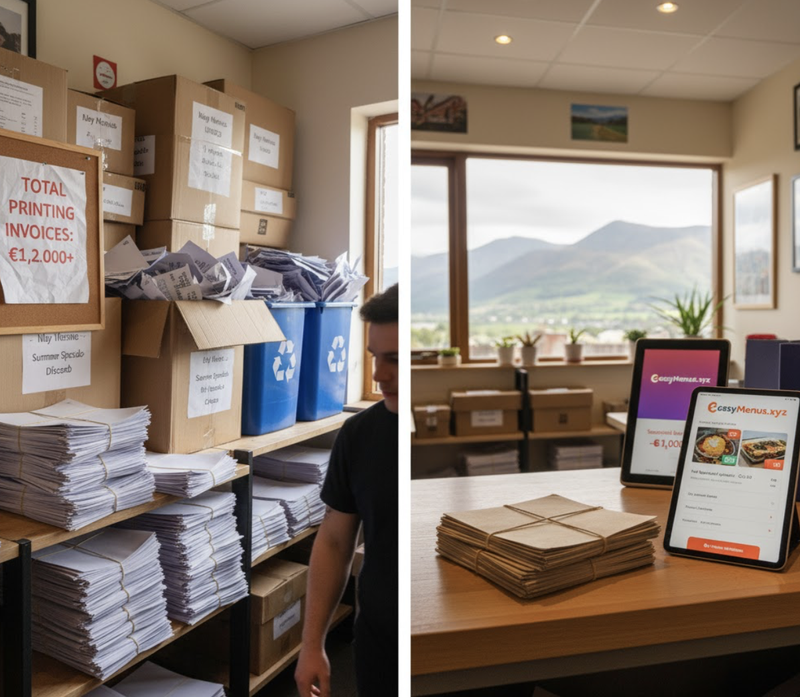
The Six-Month Season That Cost €4,500 in Menus (And Why 280 Menus Went Straight to Recycling)
Fergal ran a restaurant in Killarney. Open May through October. Closed November through April. Six-month season serving tourists who came for the lakes, the mountains, the Ring of Kerry.
This was standard for Killarney. The town doubled in population during summer. Tourists everywhere. Coaches. Rental cars. Families. Elderly couples. International visitors who came once and never returned. Seasonal operations were just how Killarney restaurants worked.
Every April, Fergal prepared for opening. Order supplies. Hire seasonal staff. Train servers. And print menus.
The first print order went in late April. Five hundred menus. Premium tourist season ahead. Professional quality. Full colour. Fergal's restaurant catered to coach tour groups and premium tourists. The menus needed to look excellent. Four hundred euros for the initial May opening batch.
By mid-June, prices had changed. Suppliers increased costs. Beef up. Seafood up. Vegetables up. The May menus showed prices from April supplier quotes. Not viable anymore. Absorb the losses or reprint with current pricing.
Fergal reprinted. Another five hundred menus. Current prices. Four hundred euros. July through September, these would be accurate.
September brought another problem. Seasonal items. August's menu featured summer berries and seasonal vegetables. October tourists wanted autumn game and root vegetables. Different dishes. Different seasonality. Different tourist expectations.
Fergal reprinted again. Four hundred menus. Autumn menu. Another four hundred euros.
Three printing runs. Total: twelve hundred euros. For six months of operation.
But the actual waste was worse than the cost. On closing day in late October, Fergal counted leftover menus. May batch: eighty menus never used because June prices changed. September batch: two hundred menus left over because October season was shorter than expected. Total waste: two hundred eighty menus at roughly four euros fifty each printing cost. Twelve hundred sixty euros in printed paper going straight to recycling.
Plus storage. Fergal's storage wasn't infinite. Winter storage meant keeping boxes of menus that might be outdated by next May anyway. Last year's September menus? Useless this year because suppliers changed and prices shifted. Into recycling. More waste.
Over six months, between printing costs and waste, Fergal's menu expenses exceeded forty-five hundred euros. For a six-month operation. That was seven hundred fifty euros per operating month just telling tourists what food he had.
This was year fourteen of the same pattern. Accept it. Part of seasonal operations. Everyone did it. Waste was just built into Killarney restaurant economics.
Then Fergal went to Dublin for his daughter's graduation. Took her to dinner in Temple Bar. Tourist area. Similar clientele to Killarney. International visitors. One-time customers. The restaurant had beautiful printed menus. But also QR codes on tables with "Menu in your language" messaging in six languages.
His daughter scanned it. The menu appeared in French. She was studying French. She showed Fergal. Perfect translation. All the dishes. All the prices. Allergen information. Even photos of some items.
Fergal asked the owner on the way out. "How much does multilingual setup cost for a seasonal operation?"
"Twelve fifty a month," the owner said. "I run it year-round. But if you're only open six months, you could probably pause it off-season. Save the winter months."
Fergal did the maths. Twelve fifty times six months. Seventy-five euros for the season. Versus forty-five hundred euros in printing and waste.
But there was more. "How often can you update it?" Fergal asked.
"Whenever. I update prices weekly when suppliers change. Add seasonal items. Remove things. Takes thirty seconds. No cost per update."
Fergal drove back to Killarney thinking about this. May opening with April prices that would be wrong by June. June reprint because prices changed. September reprint because seasons changed. All of that could be avoided if he could just update prices without reprinting.
He signed up the following week. April. Before season started. The setup took twenty minutes. Uploaded his planned May menu. Verified dishes and prices. Created his printed QR code cards. Ordered one batch of printed menus - the May opening set - but kept the descriptions generic. "Seasonal Market Vegetables" instead of "June Asparagus." "Fresh Local Fish" instead of "Summer Mackerel." Prices left off some items marked "Market Price - check QR menu."
The printed menus became permanent for the season. Beautiful. Professional. They showed his restaurant's character, the core dishes, the Irish hospitality. But for specific prices, seasonal items, and daily specials? The QR code showed current information.
May opened. Fergal set his prices in the digital menu based on actual May supplier costs. Opening week went smoothly. Tourists scanned codes. Saw prices. Ordered. No problems.
Second week of June, his beef supplier increased prices eight percent. In previous years, this would've meant: absorb the loss until the next menu reprint, or pay four hundred euros for updated menus three weeks into the season.
Current year, Fergal updated four beef dishes in his digital menu. Thirty seconds. Zero euros. Tourists who scanned the code saw current prices. Tourists who just used the printed menu saw the permanent dishes without specific prices, heard prices from servers who knew the current digital menu pricing.
No loss absorbed. No mid-season reprint. Problem solved in thirty seconds.
But what surprised Fergal most was the multilingual aspect. Killarney got coach tours from everywhere. Germany. France. Spain. Netherlands. Italy. Asia. He'd never printed multilingual menus because the cost would've been insane. Eight hundred euros for four languages times three seasonal prints would've been twenty-four hundred euros just for translations.
Now? Every language was included. German tourists scanned the code, got German menus. French tourists got French. Spanish got Spanish. Forty-three languages from one QR code. Cost: zero additional euros.
Fergal watched an elderly Italian couple struggle with his printed English menu one July evening. Server noticed, showed them the QR code. The husband scanned it. Menu appeared in Italian. His face lit up. They ordered confidently. Left a five-star review specifically mentioning how welcome they'd felt at a restaurant that provided Italian menus in Ireland.
That review was worth more than any printing cost. But it came free. Included in the system that cost less than one menu print.
August brought another test. Fergal's chef wanted to feature local wild mushrooms. Available for ten days maximum. Beautiful premium item. Should be on the menu to sell properly. But ten days didn't justify a menu reprint. Previous years, wild mushrooms would've been a verbal special that sold okay but not great.
Current year, Fergal added wild mushrooms to the digital menu Monday morning. Photo. Description. Price. By Monday lunch, tourists were ordering them. They sold out by Wednesday. Fergal removed them from the digital menu Wednesday evening. Total cost: zero euros. Total time: three minutes to add, thirty seconds to remove.
Revenue from those wild mushrooms: eight hundred forty euros over three days. Previous years when they'd been verbal specials only? Maybe three hundred euros. The difference was five hundred forty euros that came from being able to properly feature a ten-day item without printing economics killing it.
September came. Typical year would've meant autumn menu reprint. Four hundred euros. Switch from summer items to autumn items. Different dishes. Different season.
Current year, Fergal updated his digital menu over three days. Removed summer items gradually. Added autumn dishes as they launched. No single big reprint. No cutover day where half the menu suddenly changed. Just gradual natural transition as ingredients shifted with seasons. Zero cost. No waste.
Season ended in late October. Fergal closed up. Counted his printing costs for the six-month season.
Previous year: twelve hundred euros in three seasonal menu prints, plus twelve hundred sixty euros in waste from unused menus. Total: twenty-four hundred sixty euros.
Current year: four hundred euros for one permanent printed menu batch, plus seventy-five euros for six months of digital system. Total: four hundred seventy-five euros.
Savings: nineteen hundred eighty-five euros. On a six-month operation.
But the real savings went deeper. Fergal tracked what hadn't cost him money this season. June price changes: zero cost instead of four hundred. August wild mushrooms: zero cost instead of being too expensive to feature properly. September seasonal transition: zero cost instead of four hundred. Multilingual tourist service: zero cost instead of eight hundred.
Every update that would've required reprinting or been too expensive to do properly: all free. All instant. All professional.
Opening day the following May, Fergal counted his leftover menus from last season. The permanent batch he'd printed. He had three hundred forty-seven menus left. Still usable. Still accurate for core dishes. Still professional. Prices were on the digital menu. Seasonal items were on the digital menu. But the printed menus? Still good.
Previous year at this point, he'd have had two hundred eighty menus in recycling as complete waste, plus needed to reorder five hundred new menus for four hundred euros. Current year? He ordered one hundred fifty menus to top up his existing stock. One hundred twenty euros. That would last the entire season.
Year two costs: one hundred twenty euros printing, plus seventy-five euros digital. One hundred ninety-five euros total. Year one of savings had paid for three years of the new system.
Fergal met with other Killarney restaurant owners in February during the off-season. Small group that met occasionally. He explained his system. Three of them signed up before spring. Two more by May opening.
But the moment that meant most to Fergal came in late June. A German coach tour company emailed him. They'd read reviews mentioning German menus. Could he accommodate a forty-person tour group?
Forty people. Premium pricing. Guaranteed booking. Fergal confirmed immediately. The coach arrived. Elderly German tourists. Everyone scanned the QR code. Everyone got German menus. Everyone ordered confidently. Zero confusion. Zero translation problems. Zero stress.
The tour company booked him for three more groups that season. One hundred sixty total tourists. All because he could provide German menus that he'd never paid to print.
Revenue from those coach tours: sixty-four hundred euros. Direct result of having multilingual capability that cost him zero euros to implement. That was eleven times his total annual menu costs.
Seasonal operations weren't supposed to be efficient. Too much uncertainty. Too many changes. Too much tourist variation. Menus that worked May wouldn't work October. Prices that worked June wouldn't work August. Waste was just part of running a six-month restaurant.
Except it wasn't. Not anymore. Seasonal operations could be efficient. Updates could be free. Waste could be eliminated. Multilingual could be standard. All for less than one traditional menu print.
Fergal still had his beautiful printed menus. Still showed his core dishes. Still represented Irish hospitality and Killarney character. But now they lasted full seasons instead of six weeks. Now they were backed by something that made seasonal changes simple instead of expensive.
Forty-five hundred euros had felt normal. Waste had felt inevitable. Six-month operations had felt inherently inefficient.
But nineteen hundred euros in annual savings for a six-month operation? That was thirty-eight hundred euros every two years. That was equipment upgrades. That was staff bonuses. That was money staying in Killarney instead of going to Dublin print shops.
That was seasonal efficiency finally working the way it should've worked all along.
FREQUENTLY ASKED QUESTIONS
How much do seasonal restaurants actually spend on menu printing?
Seasonal restaurants operating six to eight months annually typically spend between three thousand five hundred and five thousand five hundred euros on menu printing across the season. This includes opening season prints, mid-season reprints for price changes, late-season reprints for seasonal menu shifts, and multilingual versions for tourist markets. Additionally, seasonal operations generate substantial waste from unused menus when seasons end shorter than expected or prices change mid-print. Total menu costs including waste often exceed five thousand euros for six-month operations, averaging over eight hundred euros per operating month.
Why do seasonal operations have such high menu waste?
Seasonal restaurants print menus based on projected season length and estimated demand, but actual tourist volumes vary significantly. Weather changes, economic conditions, and booking patterns make accurate menu quantity forecasting difficult. Printing too few means running out mid-season. Printing too many means substantial waste when seasons end. Mid-season price changes and seasonal ingredient shifts render printed menus obsolete before being used. Seasonal restaurants commonly waste two hundred to four hundred menus annually at four to five euros per menu printing cost, representing pure loss.
Can digital menus work in tourist-heavy areas where customers visit once?
Digital menus work exceptionally well in tourist markets for different reasons than local markets. Tourists seek multilingual translations, allergen information, and current pricing - all digital menu strengths. Unlike local customers who may resist QR codes preferring traditional service, international tourists already use smartphones for navigation, translation, and information. Hybrid approaches work best: printed menus showing core dishes while QR codes provide current prices, multilingual translations, seasonal specials, and allergen filters specifically meeting tourist needs.
How do seasonal restaurants handle mid-season price changes without reprinting?
Digital menu systems allow seasonal restaurants to update prices instantly when suppliers modify costs mid-season. Common June and July supplier price increases no longer require four hundred euro menu reprints or absorbed margin losses. Updates take thirty seconds and cost nothing. Seasonal restaurants report updating prices three to seven times during operating seasons without any printing costs. For items with volatile pricing, restaurants use "market price" on printed menus while showing specific current prices on digital menus, maintaining professional appearance while enabling price flexibility.
What about seasonal items that only last days or weeks?
Digital menus make short-term seasonal specials economically viable for the first time. Wild mushroom availabilities lasting ten days, premium fish catches, berry seasons, and other limited ingredients can be properly featured without printing cost considerations. These short-term premium items often generate the highest margins but historically couldn't be effectively promoted because printing economics made them unviable. Digital systems enable restaurants to add and remove items in minutes, turning previously unprofitable seasonal opportunities into revenue generators.
Related Seasonal & Cost Stories:
- - The Seasonal Special That Broke the Bank: Why Printing Kills Flexibility
- - The Tuesday Morning Email That Cost €4,000
- - Howth Seafood Special: Managing Daily Catch Menus Without Reprinting
Related Tourist Market Challenges:
- - The Tourist Who Couldn't Read the Menu: €800 Translation Fix
- - The Butter Crisis: How One Change Nearly Cost €87,500