
The Cruise Ship Crisis: 2,000 Tourists, Zero Languages
Sylvie's Port Louis restaurant seats 80. Norwegian Epic docked with 2,800 passengers. 300 came for lunch. She had English menus. They spoke Mandarin.
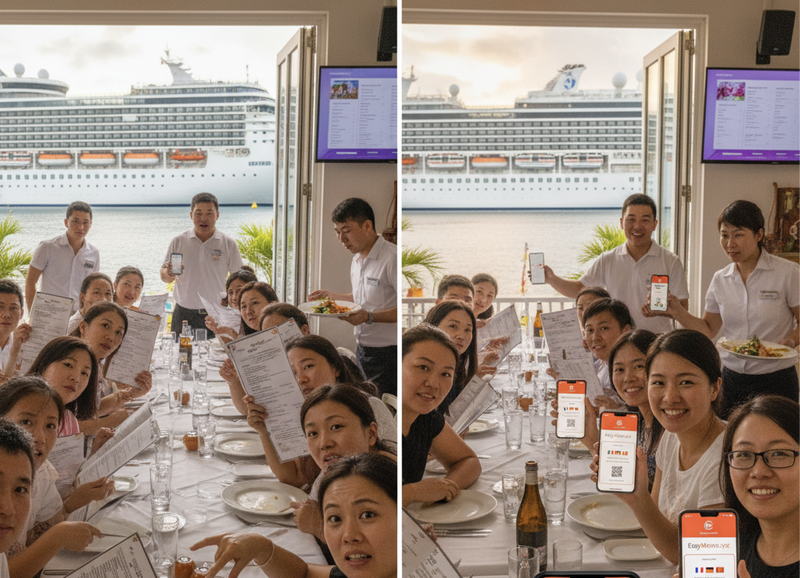
The Cruise Ship Crisis That Lost €8,000 in Two Hours (And Why 2,000 Tourists Couldn't Read One Menu)
Sylvie ran a Creole restaurant in Port Louis, Mauritius. Two hundred meters from the cruise terminal. Her location was strategic. When ships docked, tourists walked straight past her entrance. Some stopped. Most didn't.
She'd been there eleven years. Watched the cruise industry grow. Celebrity Cruises. Norwegian. MSC. Costa. Princess. Each ship brought fifteen hundred to three thousand passengers. Six to eight ships monthly during peak season. October through April was cruise season. That was when Sylvie made sixty percent of her annual revenue.
Tuesday, March fourteenth. Norwegian Epic docked at seven AM. Twenty-eight hundred passengers. The ship stayed until six PM. Eleven hours. Tourists flooded Port Louis. Shopping. Restaurants. Tours. Beach trips.
By eleven-thirty AM, three hundred Chinese tourists from a ship excursion group arrived at Sylvie's restaurant for lunch. Three hundred people. Seventy-nine tables needed. Her restaurant seated eighty.
This should have been the best lunch service of the year. Three hundred tourists. Average spend thirty-five euros per person. That was ten thousand five hundred euros in revenue from one group.
The tour guide spoke Mandarin and broken English. He explained the group wanted lunch. Sylvie confirmed she could accommodate them. Two sittings. First group one hundred fifty. Second group one hundred fifty. Perfect.
She handed out menus. English menus. The only language she had. Her staff spoke English, French, and Creole. Nobody spoke Mandarin.
The problems started immediately. Three hundred tourists looking at English menus. No Mandarin. No pictures. Just English text describing Creole dishes most Chinese tourists had never heard of. Rougaille. Vindaye. Daube. Cari poulet. Mine frit.
The tour guide tried translating menus verbally. One hundred fifty people asking questions simultaneously. "What is rougaille?" "Does vindaye have pork?" "Is cari poulet spicy?" "What vegetables in mine frit?"
Forty-five minutes to take orders for the first seating. Forty-five minutes of chaos. Tourists pointing at random menu items hoping for something familiar. Ordering chicken because it was safe. Avoiding anything they couldn't identify.
The kitchen was overwhelmed. Orders came in confused. Staff had misunderstood pointing and gestures. Wrong dishes arrived. Tourists were polite but frustrated. Some didn't eat what came. Some asked for different items. Some just paid and left hungry.
Ninety minutes for first seating. Normally lunch service was sixty minutes. The second seating was the same chaos. More pointing. More confusion. More wrong orders. More frustrated tourists.
By three PM, the group left. Sylvie counted the damage. Three hundred tourists. Six hours of service. Actual revenue: twenty-four hundred euros.
Expected revenue: ten thousand five hundred euros. Lost revenue: eighty-two hundred euros.
The tour guide apologized on his way out. "Next time, maybe Chinese menu?" he said politely. Sylvie watched him lead the group toward a restaurant down the street. That restaurant had pictures on their menu. Not Chinese text. Just pictures. But pictures were enough. The tour guide was already booking his next Port Louis visit there.
Sylvie sat in her empty restaurant at three-thirty PM. She'd lost eighty-two hundred euros because three hundred tourists couldn't read her menu. The biggest potential service of the year had been a disaster. And Norwegian Epic would be back in two weeks.
This was the impossible mathematics of island cruise tourism. Port Louis got ships from everywhere. Norwegian carried Americans and Canadians. MSC brought Italians and Germans. Costa brought Spanish and French. Celebrity brought British. Princess brought Australians. And increasingly, Asian cruise lines brought Chinese, Japanese, and Korean tourists.
Every ship was a different language mix. Every stop was six to eight hours. Tourists wanted quick service. Easy decisions. Simple ordering. Restaurants that made it difficult lost business to restaurants that made it easy.
Sylvie knew the solution. Print menus in ten languages. Chinese. Japanese. Korean. Italian. German. Spanish. French. English. Maybe Russian. Maybe Arabic for Middle Eastern cruise lines.
She called her printer. Asked for quote. Ten languages. Eighty menus per language. Eight hundred total menus. The quote: forty-eight hundred euros. Plus three-week shipping delay from Johannesburg.
Forty-eight hundred euros to maybe recover eighty-two hundred euros in lost revenue. And that assumed the next Chinese group was the same size. What if the next ship brought Germans? What if she printed Chinese but the following month brought Japanese tourists? What if she spent forty-eight hundred euros printing ten languages and only four languages ever arrived?
The mathematics didn't work. She couldn't print every language for every possible cruise ship. So she did what every port restaurant did. Printed English and French. Hoped for the best. Lost money when ships brought other languages.
Her friend Rashid ran a restaurant in Malé, Maldives. Same problem. Cruise ships brought Russians, Chinese, Germans, British. He had English menus. Lost money on non-English groups. Printing eight languages would cost him six thousand euros and take four weeks.
Restaurants in St. Lucia faced identical challenges. Bridgetown, Barbados. Basseterre, St. Kitts. Philipsburg, St. Maarten. Every Caribbean cruise port. Ships brought mixed nationality passengers. Restaurants gambled on which languages to print. Usually printed English and Spanish. Lost revenue on European and Asian passengers.
Santorini port restaurants serving cruise ships had the same crisis. Ships brought British, German, French, Italian, Chinese, American tourists. Printing seven languages: economically impossible. Mediterranean cruise routes through Malta and Cyprus created identical challenges.
Southeast Asian cruise ports were worse. Phuket restaurants received Chinese mega-ships with four thousand passengers, European ships with mixed nationalities, Australian ships, and American ships. Printing menus for every possible language group would cost eight thousand euros and cover only half the possible combinations.
Sylvie was complaining about this to her accountant the following week. Her accountant's sister lived in Singapore. Ran a restaurant near the cruise terminal. Handled the same language chaos. Had found some solution.
The call got transferred. The sister explained. Digital menus. Not replacing printed menus. Supplementing them. Printed menus stayed on tables in English showing restaurant character. QR codes gave tourists menus in their own language. Forty-three languages. All from one QR code. Cost: twelve fifty euros monthly.
"How many languages do cruise ships actually bring?" Sylvie asked.
"We get fifteen regularly," the Singapore sister said. "Chinese, Japanese, Korean, English, German, French, Italian, Spanish, Russian, Arabic, Thai, Hindi, Bahasa Indonesia, Tagalog, Vietnamese. The QR code covers all of them. We haven't had a language we couldn't serve in three years."
Sylvie did the mathematics. Twelve fifty monthly. One hundred fifty euros annually. Versus forty-eight hundred euros to print ten languages that might not even cover the next ship's passenger mix.
She signed up that day. Setup took twenty minutes. Uploaded her English menu. The system translated automatically to forty-three languages. She verified the Creole dish translations made sense. Printed small QR code cards for her tables: "Menu in your language / Menu dans votre langue / 菜单 / メニュー / 메뉴 / Menü / Menù" with flags showing available languages.
Two weeks later, Norwegian Epic returned. Twenty-seven hundred passengers. Different tour groups. One German group. One British group. One Chinese group. The Chinese group was two hundred people this time. They arrived at noon.
Sylvie handed out her English printed menus. Pointed to the QR codes. The tourists scanned them. Menus appeared in Mandarin. Perfect translations. Photos of dishes. Allergen information. Prices in euros.
The tour guide looked at Sylvie with surprise. "Chinese menu?" he said.
"Forty-three languages," Sylvie replied. "Whatever your group speaks."
Orders came quickly. Thirty minutes for two hundred people. No confusion. No pointing. No wrong dishes. Tourists ordered confidently. Kitchen received clear orders. Food arrived correctly. Tourists were happy. Service was smooth.
The German group later that afternoon was the same. Scanned codes. Got German menus. Ordered schnitzels and rougaille they could actually read about. British group got English, which was fine because Sylvie already had printed English menus, but the QR showed photos and allergen filters they appreciated.
End of day revenue: eighty-nine hundred euros. Time per seating: sixty-five minutes. No chaos. No confusion. No lost revenue.
The tour guide booked three more visits for next month's Norwegian Jade arrival. "Your restaurant only one in Port Louis with Chinese menus," he explained. "I bring my groups here now."
But what surprised Sylvie most was the following week. MSC Virtuosa docked. Italian ship. Two thousand passengers. A group of sixty Italian tourists came for lunch. Scanned codes. Got Italian menus. Ordered in fifteen minutes.
One elderly Italian woman approached Sylvie after lunch. Spoke no English. Used translation app on her phone to show Sylvie a message: "First restaurant in three ports where I could read menu in Italian. Thank you."
That moment was worth more than the revenue. It was the realization that cruise tourism wasn't just about feeding tourists quickly. It was about making them feel welcome in a foreign port where nothing was in their language. Where everything was confusing and foreign and overwhelming. A menu in their language was hospitality. Recognition. Welcome.
Six months after implementing the system, Sylvie tracked her cruise ship revenue. Previous year same period: forty-two thousand euros from cruise ship tourists. Current year: seventy-eight thousand euros.
Revenue increase: thirty-six thousand euros. From one hundred fifty euros in digital menu costs.
The difference wasn't magic. It was mathematics. Previously, Sylvie captured maybe thirty percent of potential cruise ship tourists. The seventy percent who couldn't read English menus went to restaurants with pictures or other visual solutions. Now, she captured seventy-five percent. Any tourist who could scan a QR code could read her menu.
Tour operators noticed. Started booking her restaurant for groups. Chinese tours. Japanese tours. German tours. Korean tours. Russian tours from occasional cruise lines. Every group could read menus. Every group had smooth service. Every group came back.
Other Port Louis restaurants watched Sylvie's cruise ship traffic increase. Four signed up for the same system. Then eight. Within a year, most restaurants near the cruise terminal offered multilingual QR menus. Port Louis developed reputation among tour operators as cruise-friendly port.
The pattern repeated across island cruise ports globally. Bridgetown, Barbados restaurants implemented fifteen-language menus for Caribbean cruise diversity. Malé, Maldives resort restaurants served Russian, Chinese, and European cruise tourists in their native languages. Santorini port restaurants captured German, French, Italian, and British cruise traffic. Valletta, Malta restaurants handled Mediterranean cruise language diversity. Phuket, Bali, and Langkawi restaurants served Chinese mega-ships, European tours, and Australian cruises in appropriate languages.
Philipsburg, St. Maarten restaurants discovered they could serve Dutch, English, Spanish, French, and German cruise tourists without five separate printed menus. Oranjestad, Aruba operations handled trilingual ABC island expectations. Charlotte Amalie, St. Thomas establishments served American mainstream cruises plus European luxury lines.
Pacific island cruise ports saw dramatic changes. Suva, Fiji restaurants served Australian, American, and Asian cruise traffic. Rarotonga, Cook Islands operations handled New Zealand and American ships. Papeete, Tahiti restaurants served French cruise lines plus American luxury expeditions.
But across every island cruise port, the fundamental challenge was identical: cruise ships brought language diversity that traditional printing couldn't economically address. Restaurants that solved language accessibility captured tourist traffic. Restaurants that didn't lost revenue to competitors who did.
Sylvie never printed multilingual menus. The forty-eight hundred euro cost never made sense. But the twelve fifty monthly cost made perfect sense. Especially when it generated thirty-six thousand euros in additional annual revenue.
Norwegian Epic returned every two weeks during season. The Chinese tour guide always brought his groups to Sylvie's restaurant. Because in Port Louis, Mauritius, in a port with sixty restaurants, Sylvie's was the only one where his tourists could read the menu in Mandarin.
That competitive advantage cost her one hundred fifty euros annually. And it generated seventy-eight thousand euros in cruise ship revenue.
The mathematics of island cruise tourism had been broken for decades. Ships brought language diversity. Restaurants printed two or three languages. Tourists who spoke other languages were underserved. Revenue was lost.
The fix wasn't printing more languages. It was recognizing that tourists carried the solution in their pockets. Smartphones. Already used for currency conversion. Already used for translation. Already used for navigation.
All restaurants needed to do was give tourists menus in languages their phones could display. Forty-three languages from one QR code. Zero printing multiplication cost. Zero three-week shipping delays. Just instant hospitality in whatever language walked off the cruise ship.
Eight thousand euros lost in two hours because three hundred tourists couldn't read one menu. That was the old mathematics of cruise tourism.
Thirty-six thousand euros gained in six months because every tourist could read every menu. That was the new mathematics.
And it started with one simple question: Why were island restaurants printing languages when tourists already carried computers capable of displaying any language?
The answer was: they shouldn't be. And now they weren't.
FREQUENTLY ASKED QUESTIONS
How many different nationalities do cruise ships actually bring to island ports?
Major island cruise ports regularly serve ten to twenty nationality groups. Caribbean ports (St. Thomas, Aruba, Barbados, St. Lucia) receive American, Canadian, British, German, Italian, Spanish, French, and Dutch tourists. Indian Ocean ports (Mauritius, Seychelles) serve British, French, German, South African, Chinese, Indian, and Middle Eastern passengers. Mediterranean island ports (Santorini, Malta, Corsica) receive German, British, French, Italian, Spanish, Russian, and American tourists. Southeast Asian ports (Phuket, Bali) serve Chinese, Japanese, Korean, Australian, European, and American passengers. Each cruise line has different passenger demographics - Asian cruise lines bring predominantly Chinese passengers while European lines bring mixed European nationalities.
Why can't island restaurants just print menus in multiple languages?
Printing costs multiply linearly with language count. Single-language menus cost six hundred to one thousand euros for island printing. Four languages cost twenty-four hundred to four thousand euros. Ten languages cost six thousand to ten thousand euros. Caribbean and Indian Ocean islands face three-week printing delays from offshore facilities. Restaurants cannot predict which nationalities will arrive on future cruise ships. Chinese mega-ships require Mandarin. German ships need German. Russian luxury lines need Russian. Italian ships need Italian. Printing all possible languages costs eight thousand to fifteen thousand euros covering maybe seventy percent of possibilities. Menu updates require reprinting all languages. Economics make comprehensive multilingual printing impossible for most island restaurants.
What about cruise ship tourists who don't have smartphones or can't scan QR codes?
Approximately ninety-two percent of cruise ship tourists carry smartphones for communication, photos, currency conversion, and navigation during port visits. Tourists who cannot scan codes receive service through printed menus plus staff assistance. Many island restaurants maintain pictorial menu boards or photo displays as backup. Tour guides typically carry tablets or smartphones to assist elderly group members. For organized tour groups, guides pre-translate digital menus before arriving at restaurants. The hybrid approach (printed core menus plus digital multilingual options) ensures all tourists receive appropriate service regardless of technology access.
How do tour operators choose restaurants for cruise ship groups?
Cruise tour operators prioritize restaurants offering smooth, fast service for large groups within short port windows. Language accessibility is critical - operators avoid restaurants requiring extensive translation or causing ordering confusion. Capacity matters - restaurants must handle fifty to three hundred person groups efficiently. Location matters - proximity to cruise terminal or tour bus access. Price matters - tour margins require per-person pricing within budget ranges. Restaurants offering multilingual menus, group capacity, fast service, and confirmed pricing receive preferential bookings. Single language-barrier restaurants lose group bookings to competitors offering better language accessibility even if food quality is equal.
Which cruise ports have the most language diversity challenges?
Southeast Asian ports face maximum diversity. Phuket, Thailand receives Chinese mega-ships (four thousand passengers, ninety percent Chinese speaking), European cruise lines (mixed German, British, French, Italian), Australian lines, and American luxury cruises - requiring Thai, Chinese, Mandarin, Cantonese, English, German, French, Italian, Spanish, Japanese, and Korean. Singapore similarly serves massive diversity. Caribbean ports like St. Maarten and Aruba serve Dutch, English, Spanish, German, French, and Italian tourists. Mediterranean islands serve regional European diversity. Mauritius and Seychelles serve European, African, Asian, and Middle Eastern tourists. Each port requires eight to fifteen languages to serve cruise traffic comprehensively. Traditional printing cannot economically address this diversity.
Other Island Restaurant Operations:
- - The Three-Week Wait: Why Island Menus Cost 3x Mainland
- - The Yellowfin That Disappeared: Fresh Catch Pricing on Islands
- - The Resort with Five Menus and Forty Languages
Related Multilingual & Tourist Service:
- - The Tourist Who Couldn't Read the Menu: €800 Translation Fix
- - The Butter Crisis: How One Change Nearly Cost €87,500