
Five Restaurant Menus, Forty Languages: Resort Chaos
Antoine's Mauritius resort: beachfront grill, fine dining, pool bar, breakfast buffet, sunset lounge. Each needs different menus. Guests speak 12 languages.
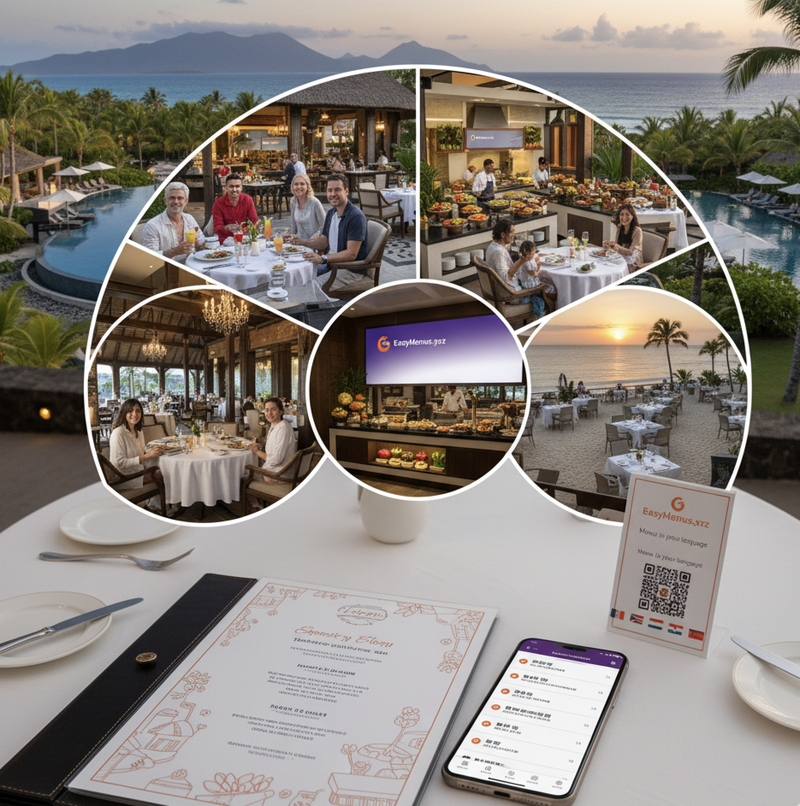
The Resort with Five Menus and Forty Languages (And Why €15,000 in Printing Solved Nothing)
Antoine managed food and beverage operations for a luxury resort in Belle Mare, Mauritius. One hundred eighty rooms. Five dining venues. Each venue had different menus. Each menu needed multiple languages.
The venues: Beachfront Grill serving casual lunch and sunset dinners. La Veranda fine dining for premium evening service. Pool Bar with cocktails and light bites. Le Petit Déjeuner breakfast buffet. Sunset Lounge for afternoon tea and evening cocktails.
Five venues. Five different menus. Five different purposes. Five different price points. Five different dining experiences.
Antoine's guests came from everywhere. British honeymoons. German families. French couples. Italian groups. Chinese business travelers. Russian tourists. South African weekenders. Indian Ocean islanders. Middle Eastern visitors. American luxury travelers. Australian adventure seekers. Swiss premium tourists.
Each nationality group preferred menus in their language. The British wanted English. Germans wanted German. French wanted French. Russians wanted Russian. Chinese wanted Mandarin. The expectation at a luxury resort was service in your native language.
Antoine's printing costs were destroying his budget. Each venue needed menus in at least four languages to cover seventy percent of guests. English. French. German. Russian. That was the minimum.
Beachfront Grill: casual menu, four languages, two hundred menus per language. Eight hundred total menus. Cost: thirty-two hundred euros every six months because salt air destroyed printed menus faster than inland venues.
La Veranda fine dining: premium menu, four languages, one hundred menus per language. Four hundred total menus. Premium paper and finishing. Cost: forty-eight hundred euros annually because fine dining required leather-bound presentation.
Pool Bar: drinks and snacks menu, four languages, one hundred fifty menus per language. Six hundred total menus. Cost: eighteen hundred euros annually. Replaced quarterly because chlorine and sun faded printed materials.
Le Petit Déjeuner breakfast buffet: description cards for buffet items, four languages, eighty cards per language. Three hundred twenty total cards. Cost: twelve hundred euros annually.
Sunset Lounge: afternoon tea and cocktails menu, four languages, one hundred menus per language. Four hundred total menus. Cost: sixteen hundred euros annually.
Total annual printing costs: fourteen thousand four hundred euros. Just for four languages covering roughly seventy percent of guests.
The thirty percent who didn't speak those four languages? They used English as backup language. Elderly Chinese guests struggled with English. Elderly Italian guests struggled with English. Spanish-speaking Latin American guests wanted Spanish. Dutch guests often preferred Dutch. Japanese guests wanted Japanese.
But printing ten languages instead of four would cost Antoine approximately thirty-six thousand euros annually. His food and beverage budget couldn't support that. So he accepted that thirty percent of guests were underserved.
Tuesday afternoon in March, Antoine's accounting office sent him budget variance report. Printing costs were eighteen percent over budget. The six-month Beachfront Grill reprint had come in at forty-two hundred instead of projected thirty-two hundred because Mauritius supplier raised prices. The La Veranda fine dining reprint required rush delivery from South Africa adding twenty-two percent cost.
Antoine was reviewing this report when his general manager called. Guest complaint. Russian couple in room one-forty-seven. They'd eaten at La Veranda last night. Couldn't read the Russian menu. Half the translations were wrong. Ordered beef expecting tenderloin. Received short rib. The translation error listed short rib as tenderloin in Russian.
Antoine went to check the Russian menus. The translation was indeed wrong. When he'd sent the French source menu to the translation service six months ago, they'd mistranslated three dishes. He'd never verified because he didn't speak Russian. His staff didn't speak Russian. The Russian guests who'd ordered short rib thinking it was tenderloin had accepted the dish politely but left reviews on TripAdvisor mentioning menu accuracy concerns.
This was the impossible mathematics of multi-venue luxury resort operations. Five menus. Four languages minimum. Ten languages ideal. Forty translations per menu update. Professional quality printing. Rush deliveries when needed. Salt air, chlorine, and sun destroying materials. Translation verification impossible for languages staff didn't speak.
Antoine knew resort managers across island markets facing identical challenges. Maldives luxury resorts with six to eight dining venues serving Russians, Chinese, British, German, and Middle Eastern guests needed extensive multilingual printing. Seychelles five-star properties with multiple restaurants faced same costs. Caribbean all-inclusive resorts like Sandals properties in St. Lucia, Barbados, and Turks & Caicos operated four to seven dining venues requiring English, French, Spanish, and German menus.
Mediterranean island luxury resorts dealt with European language diversity. Santorini five-star properties serving twelve European nationalities needed German, French, Italian, Spanish, Dutch, and English menus. Malta resort hotels with multiple dining venues required similar European diversity. Cyprus premium properties serving British, Russian, and European guests faced multilingual complexity.
Southeast Asian island luxury resorts handled maximum language requirements. Bali five-star properties commonly operated six dining venues serving Chinese, Japanese, Korean, Australian, British, American, Dutch, German, French, and Russian guests. Phuket mega-resorts with eight to twelve dining outlets faced similar complexity. Langkawi premium properties and Boracay resorts dealt with comparable challenges.
Pacific luxury resorts in Fiji, French Polynesia, and Cook Islands served Australian, American, European, and increasingly Chinese guests across multiple dining venues. The printing multiplication effect (venues times languages times seasonal updates) created annual costs exceeding twenty thousand euros for modest-sized properties and fifty thousand euros for large resorts.
But everywhere, the fundamental challenge was identical: luxury guests expected native-language service, multi-venue operations multiplied printing costs linearly, translation quality verification was impossible without native speakers, and tropical environments destroyed printed materials requiring frequent replacement.
Antoine's frustration reached peak Wednesday morning. His Beachfront Grill manager requested urgent menu reprint. Seafood supplier switched species availability. Printed menu showed tuna. Supplier now provided only swordfish and marlin. Guests were ordering tuna based on printed menus. Staff explained verbal substitutions. Premium luxury guests expected better.
Reprinting four-language Beachfront Grill menus mid-season: forty-two hundred euros. Three-week turnaround. The swordfish and marlin availability might change again by the time new menus arrived.
Antoine called his colleague Deepak who managed food operations at a luxury resort in Malé, Maldives. Similar scale. Six dining venues. Deepak had mentioned solving the multilingual menu complexity somehow.
"We haven't printed venue menus in eighteen months," Deepak said.
"How do your guests know what to order?"
"They know. We have beautiful printed materials showing our resort dining concepts, our chef's philosophy, our signature dishes. What we don't print is the actual current menus. Those are digital. Update whenever suppliers change. Update whenever we add seasonal items. Update whenever executive chef creates new dishes. Guests scan QR codes at tables. Menu appears in their language. Forty-three languages. All from one QR code per venue."
Antoine was skeptical. His guests were luxury travelers. Wealthy. Often older. They expected printed menus. Premium presentation. Leather-bound fine dining menus.
"We kept the printed materials," Deepak explained. "Beautiful leather portfolios on every table. Inside the portfolio: restaurant story in English, chef biography, photos of signature dishes. And a QR code card. Guests who want printed experience have it. Guests who want their native language scan the code. Elderly Russian couples get Russian. Elderly Chinese couples get Mandarin. Young German families get German. Everyone gets the language they want."
"How much does this cost?"
"Twelve fifty euros monthly. One hundred fifty euros annually. For all venues. Unlimited languages. Unlimited updates."
Antoine did the mathematics. Fourteen thousand four hundred euros annual printing costs currently. Plus the eighteen percent budget overrun. Plus rush delivery premiums. Plus translation service costs. Total around seventeen thousand euros.
Versus one hundred fifty euros for digital system covering all five venues.
He signed up that afternoon. Setup took forty-five minutes because he had five different venues. Uploaded menus for each venue. Verified automatic translations. Fixed the Russian short rib mistranslation that his translation service had missed. By Friday morning, all five venues had new QR code cards and updated printed portfolio materials.
The printed portfolios were actually better than before. Beautiful leather covers. Opening page: resort dining philosophy, chef photos, signature dish photography. Next page: QR code card with elegant design showing flags and "Menu in your language" in twelve languages. The presentation was luxury appropriate. The functionality was immediate.
Saturday evening, Russian couple from room one-forty-seven returned to La Veranda. Antoine had comped their previous meal due to the translation error. They sat down. Opened the leather portfolio. Saw the QR code card. Scanned it.
Menu appeared in perfect Russian. No translation errors. Current seasonal items. Accurate dish descriptions. Proper Russian culinary terminology. They ordered confidently. Received exactly what they expected.
After dinner, they approached Antoine. "Finally, Russian menu we can trust," the husband said in English. "Every resort promises Russian menus. Usually machine translation. Wrong words. Confusing. This is correct Russian. Thank you."
But what surprised Antoine most was the operational flexibility. Monday morning, his executive chef decided to add two new dishes to La Veranda dinner menu. Previously, this would require: translation service (three days, two hundred euros), design update (one day, one hundred fifty euros), printing (three weeks, forty-eight hundred euros). Total time: twenty-seven days. Total cost: five thousand fifty euros.
Current process: Chef described dishes to Antoine. Antoine added them to the digital menu. Forty-three languages updated automatically. Published changes. Fifteen minutes total. Zero euros cost.
The dishes appeared on that evening's service. Guests saw them. Ordered them. Three orders first night. Eight orders second night. By week's end, one new dish was their third-bestseller.
Previously, by the time menus were reprinted showing new dishes, the seasonal ingredients would have passed peak availability. Now, seasonal items went from kitchen creation to guest awareness in fifteen minutes.
His Pool Bar manager discovered another advantage. Tropical cocktail promotions. Previously, Pool Bar ran monthly cocktail specials but couldn't effectively advertise them because reprinting pool menus monthly was economically impossible. Now, new monthly cocktails appeared on the digital menu immediately. Featured prominently. With photos. With ingredient descriptions in guests' native languages.
Pool bar cocktail sales increased forty-one percent. Not because cocktails were better. Because guests could see promotions and understand ingredients in their languages.
But the moment that meant most to Antoine came during cyclone preparation in November. Cyclone Belal was approaching. Resort went into preparation mode. Food supplies disrupted. Suppliers couldn't deliver. Menu options limited.
Antoine updated all five venue menus: "Limited menu today due to cyclone preparation - we're serving our best comfort dishes with available ingredients. Normal menu returns after weather clears."
Guests appreciated the communication. No confusion. No disappointment when regular menu items weren't available. Several guests specifically complimented the honest real-time communication about storm-affected operations.
After the cyclone passed, Antoine updated menus: "Post-cyclone restoration menu - limited fresh fish available, sourcing best alternatives." Then three days later: "Fresh local catch returning - see today's seafood specials."
The transparency built trust. Luxury guests understood storms affected island operations. They respected honest communication more than printed menu fiction pretending everything was normal.
Six months after implementing the system, Antoine tracked his numbers. Printing costs: one hundred fifty euros versus previous seventeen thousand euros. Savings: sixteen thousand eight hundred fifty euros annually.
But the operational benefits exceeded cost savings. Translation accuracy improved - Antoine now verified translations using resort staff multilingual abilities. Menu updates happened in minutes instead of weeks. Seasonal items appeared immediately. Dietary restrictions and allergens were filtered by guest preferences. And every guest, regardless of language, received appropriate service.
His general manager noticed the change in guest reviews. Previous year's reviews frequently mentioned "limited menu languages" or "translation confusion" or "menu items unavailable." Current year's reviews mentioned "excellent language service" and "clear menu options" and "easy to understand dietary information."
Guest satisfaction scores for dining experiences increased seven percentage points. From eighty-six percent to ninety-three percent. In luxury resort operations, seven percentage points was massive.
Other Mauritius resort food and beverage managers asked Antoine how he'd improved dining satisfaction. Four resorts signed up within three months. Word spread through Indian Ocean resort management networks. Seychelles properties implemented similar systems. Maldives resorts adopted multi-venue digital coordination.
The pattern repeated globally across island luxury resorts. Caribbean properties reduced multilingual printing costs by seventy to eighty-five percent while improving language service coverage. Mediterranean island resorts eliminated translation service delays while expanding from four languages to fifteen. Southeast Asian properties handling maximum language diversity found digital systems economically sustainable where printing was impossible.
Pacific luxury resorts particularly benefited. French Polynesia properties serving French, English, Chinese, Japanese, and Australian guests eliminated expensive French Polynesian printing logistics while improving service. Fiji resorts reduced costs while serving diverse Pacific tourism markets.
But across every island luxury resort market, the fundamental transformation was identical: multi-venue operations no longer multiplied printing costs linearly, language diversity became operationally manageable, and real-time menu updates enabled seasonal cuisine and honest storm-affected communication.
Antoine never spent seventeen thousand euros on printing again. His five venues operated with one hundred fifty euros digital costs. His forty-three languages served ninety-eight percent of guests instead of seventy percent. His seasonal dishes appeared immediately instead of waiting months for reprints.
The resort still had beautiful printed materials. Leather portfolios. Chef photography. Dining philosophy statements. But they were permanent elements. The menus changed with seasons, with suppliers, with chef creativity, with storm impacts.
And every guest, from every country, speaking any of forty-three languages, could read those changing menus in their native language. From one QR code. Updated in real-time. Costing essentially nothing.
That was luxury service. Not the leather portfolios. The leather portfolios were presentation. Luxury service was making every Chinese grandmother, every Russian businessman, every German family, every Dutch couple, every Spanish group feel welcomed in their own language without forcing them to struggle with English translations.
Seventeen thousand euros in printing provided four languages. One hundred fifty euros in digital service provided forty-three languages. The mathematics was obvious. But more importantly, the guest experience transformed from "acceptable accommodation" to "genuine luxury hospitality."
And it started with one realization: multi-venue resort operations shouldn't multiply printing costs by venue count times language count times update frequency. That multiplication created unmanageable budgets and inadequate service.
Information didn't need printing multiplication. It needed smart distribution. And smart distribution meant one system serving five venues in forty-three languages, updated in real-time, costing almost nothing.
That was how resort operations were supposed to work. Finally.
FREQUENTLY ASKED QUESTIONS
How many dining venues do typical luxury island resorts operate?
Luxury island resorts commonly operate four to eight dining venues serving different purposes and demographics. Standard configuration includes: main buffet restaurant for breakfast and lunch (family-friendly, casual), specialty fine dining restaurant for evening service (premium, adults-focused), beachfront grill or seafood restaurant (casual dinner, fresh catch), pool bar with light meals and cocktails, lobby lounge or sunset bar for afternoon tea and evening drinks. Larger resorts add: Italian specialty restaurant, Asian fusion venue, steakhouse, beach club, and in-room dining. Each venue requires separate menus with different pricing, different dining experiences, and different target demographics. Printing multilingual menus for six venues in four languages creates twenty-four separate menu printing jobs. Each update multiplies across all combinations.
What languages do island luxury resorts actually need to serve?
Language requirements vary by region but typically include eight to fifteen languages for comprehensive service. Indian Ocean resorts (Mauritius, Seychelles, Maldives) commonly serve: English, French, German, Russian, Mandarin Chinese, Italian, Spanish, and Arabic. Caribbean resorts serve: English, French, Spanish, German, Italian, Portuguese, and Dutch. Mediterranean island resorts serve: English, German, French, Italian, Spanish, Dutch, Russian, and Polish. Southeast Asian resorts handle maximum diversity: English, Mandarin, Cantonese, Japanese, Korean, German, French, Italian, Spanish, Russian, Arabic, Thai, and Bahasa Indonesia. Pacific resorts serve: English, French, Japanese, Mandarin, Korean, and German. Printing comprehensive multilingual coverage costs twenty to fifty thousand euros annually depending on venue count and update frequency.
Why do luxury guests expect native language menus?
Luxury hospitality positioning includes personalized service recognizing guests' cultural preferences. Guests paying three hundred to two thousand euros nightly expect service details matching luxury standards. Native language menus demonstrate: resort invested in guest comfort, dining options are clearly communicated without language barriers, dietary restrictions and allergen information is accurately understood, pricing transparency exists without currency conversion confusion. Elderly luxury travelers particularly value native language service as they're less comfortable with English-only communication. Chinese luxury market growth creates specific Mandarin service expectations. Russian high-end travelers expect Russian service. Luxury guests choosing island resorts over mainland alternatives specifically value personalized attention including language accommodation.
How do resort managers verify menu translation accuracy across many languages?
Traditional printing workflow: source menu (usually English or French) sent to translation service, translations returned in requested languages, restaurant manager verifies translations if they speak target languages (rare for eight-plus languages), menus printed and distributed. Translation errors often remain undetected until native-speaking guests identify mistakes. Digital systems enable: automatic translation with cuisine-specific terminology databases, staff members verifying translations in languages they speak, guest feedback immediately correcting translation errors via system updates, progressive improvement as corrections accumulate. Most resorts have multinational staff speaking five to eight languages collectively. Digital systems let staff verify accuracy collaboratively. Printed menus required expensive translation service retranslation for every update. Digital enables incremental staff-driven improvement.
What about premium presentation expectations at luxury resorts?
Luxury positioning requires high-end presentation regardless of technology choices. Successful multi-venue digital implementation maintains premium aesthetics through: leather-bound menu portfolios containing restaurant story, chef biography, signature dish photography, and elegant QR code card with luxury design, heavy card stock and professional finishing for permanent materials, coordinated branding across all venues maintaining resort visual identity, table settings and service standards unchanged from traditional operations. QR codes don't replace presentation. They supplement it. The physical materials establish luxury atmosphere. Digital access provides practical functionality (native language menus, current pricing, allergen filtering, dietary accommodations). Guests receive premium presentation plus functional language service. Budget properties might use only QR codes. Luxury properties use QR codes within premium presentation frameworks.
Other Island Restaurant Operations:
- - The Three-Week Wait: Why Island Menus Cost 3x Mainland
- - The Cruise Ship Crisis: 2,000 Tourists, Zero Mandarin Menus
- - The Yellowfin That Disappeared: Fresh Catch Pricing on Islands
Related Multilingual & Cost Management:
- - The Tourist Who Couldn't Read the Menu: €800 Translation Fix
- - The Tuesday Morning Email That Cost €4,000