
The Three-Week Wait: Why Island Menus Cost 3x Mainland
Marcel's Mauritius restaurant needs menu reprints. Shipping from South Africa: 3 weeks. Cost: triple mainland prices. Then cyclone season hit everything.
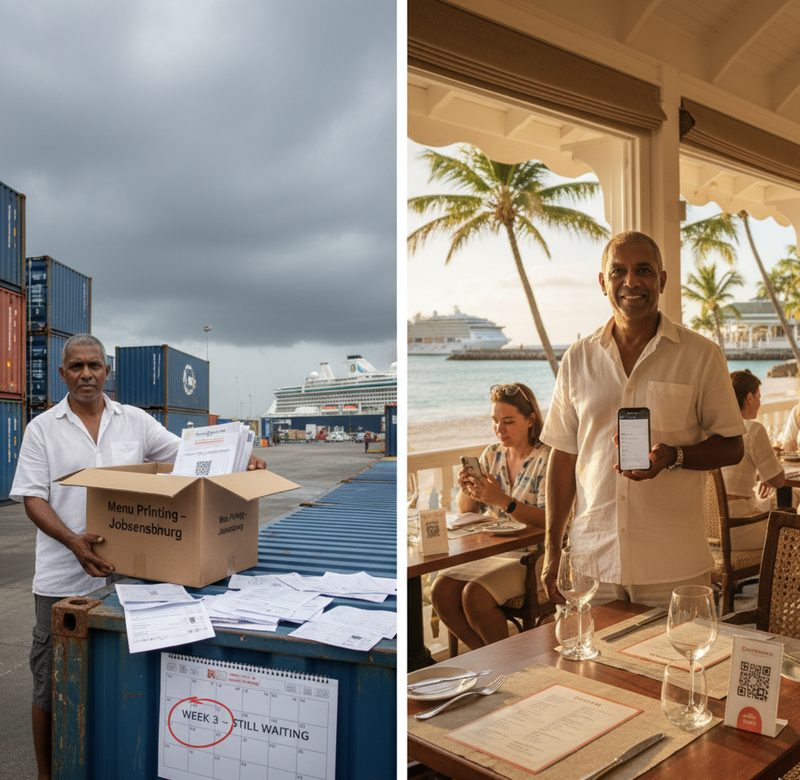
The Three-Week Wait That Cost €7,200 (And Why Island Restaurant Printing is Different)
Marcel ran a beachfront restaurant in Grand Baie, Mauritius. Twenty-three years. Through cyclones. Through tourism booms and crashes. Through currency swings and supplier nightmares. He'd seen everything.
Except this. His beef supplier changed pricing structure in June. Imported cuts from South Africa were up eighteen percent. His printed menus showed May prices. Every steak sold was losing money.
He did what he'd always done. Rang his printer in Port Louis. Got the quote. Four hundred menus. Professional quality. The price: eighteen hundred euros.
"When can you deliver?" Marcel asked.
"Three weeks," the printer said. "We're sending the job to Johannesburg. Shipping container comes back in twenty-one days if customs is smooth."
Three weeks. Twenty-one days of serving steaks at prices that lost him twelve euros per dish. He sold forty steaks weekly. That was over two thousand euros in losses just waiting for menus to arrive.
But what choice did he have? Port Louis had two printers. Neither had the quality tourists expected. Neither had the colour accuracy. Neither had the paper stock that survived tropical humidity for more than a month before curling and fading. So like every restaurant owner in Mauritius, Marcel sent his work to South Africa and waited.
The menus arrived twenty-four days later. Customs had been slower than expected. In that twenty-four days, Marcel had lost twenty-six hundred euros on underpriced steaks. Plus the eighteen hundred euro printing cost. Total damage: forty-four hundred euros.
He unpacked the boxes. Beautiful menus. Professional. Exactly what he'd ordered. He distributed them to tables that evening.
Three days later, his seafood supplier texted. Yellowfin tuna prices dropping. Good news. Red snapper prices up. Bad news. The carefully printed menus were already obsolete.
This was year twenty-three of the same cycle. Print menus. Wait three weeks. Prices change. Menus obsolete. Print again. Wait again. Bleed money while waiting.
Marcel's situation was identical to restaurants across every island market. In the Maldives, resort restaurants shipped printing to Colombo or Dubai and waited four weeks. In Seychelles, the wait was three weeks from South Africa or Mauritius. Caribbean islands like St. Lucia and Barbados sent work to Miami or Trinidad, waiting two to three weeks. Fiji sent to Auckland. Bali sent to Singapore or Jakarta. Cyprus and Malta were better positioned near European printers but still faced week-long delays. Every island paid double or triple mainland printing costs and waited weeks for delivery.
The economics got worse during cyclone season. November through March in Mauritius meant weather delays. Shipping containers sat in ports. Flights cancelled. One cyclone could add ten days to printing turnaround. Marcel had once waited six weeks for menus during Cyclone Batsirai. Six weeks of serving food with outdated prices, outdated items, outdated everything.
His daughter Camille had moved to Lyon for university. She worked part-time at a French bistro. When she came home for Christmas, Marcel complained about the printing situation over dinner.
"Papa, they don't print menus anymore," Camille said. "They use their phones."
"QR codes?" Marcel had tried those during COVID. His European tourists hated them. Older visitors especially. WiFi problems. Phone problems. The whole experience felt cheap for a beachfront restaurant where dinner cost eighty euros per person.
"Not like COVID," Camille explained. "The restaurant keeps beautiful printed menus on tables. But prices and specials are digital. When suppliers change prices, the chef updates it on his phone. Takes thirty seconds. No printing. No waiting. No shipping containers."
Marcel was sceptical. But Camille showed him her restaurant's system on her phone. Digital dashboard. Menu items. Prices. Instant updates. The printed menus showed the restaurant's character and core dishes. The digital version showed current prices and seasonal specials.
"How much does this cost?" Marcel asked.
"Twelve fifty euros monthly," Camille said. "The restaurant saves about four thousand euros yearly in printing costs. And they never serve food at wrong prices."
Marcel did the maths. He spent approximately seventy-two hundred euros annually on menu printing. Four printing runs yearly. Three-week waits. Customs delays. Cyclone disruptions. Plus the thousands lost serving food at incorrect prices while waiting for reprints.
He signed up the following week. The setup took eighteen minutes. He uploaded his existing menu. Created his core printed version showing restaurant character and permanent dishes. Set up the digital pricing and specials section. By the weekend, his tables had beautiful printed menus plus small cards with QR codes for current pricing and daily specials.
The first real test came three weeks later. His wine supplier in South Africa raised prices on twelve bottles. Previously, this would have meant: decide whether to reprint immediately for eighteen hundred euros or absorb losses until the next scheduled printing. Current situation: Marcel updated twelve wine prices in four minutes on his phone. Published changes. Every customer who scanned the QR code saw accurate current pricing. Zero printing cost. Zero customs delay. Zero cyclone risk.
But what surprised Marcel most was the cruise ship solution. Grand Baie got regular cruise ship visits. Norwegian Cruise Line. MSC. Costa. Each ship brought fifteen hundred to three thousand day visitors. Mixed nationalities. Germans. French. British. Italian. Chinese. South African. Indian. Each group wanting menus in their language.
Previously, Marcel had printed English and French menus only. That was fifty percent of his potential cruise ship customers served properly. The other fifty percent struggled, pointed at pictures, asked servers for translations, or sometimes just left for easier restaurants.
Now? The QR code offered fifteen languages. German tourists scanned it, got German menus. Chinese tourists got Mandarin. Italian tourists got Italian. Every language from one QR code that cost zero euros to implement and zero euros to maintain.
The first major cruise ship arrival after implementing the system was Norwegian Epic. Twenty-eight hundred passengers. Marcel's restaurant sat sixty-five. He normally got maybe thirty cruise passengers because language barriers and confusion reduced traffic.
That Tuesday, he served ninety-three cruise passengers across two lunch sittings. They scanned codes. Got menus in their languages. Ordered confidently. Paid quickly. Several left reviews specifically mentioning "easy to order in German" and "finally a restaurant with Chinese menus."
Revenue from that single cruise ship: forty-eight hundred euros. Previous best from cruise ship day: eighteen hundred euros. The difference was language accessibility that had cost him zero euros to implement.
But the moment that meant most to Marcel came during Cyclone Freddy in February. The storm hit hard. Power outages. Flooding. Port Louis closed for eight days. Shipping containers delayed three weeks.
Marcel's supplier prices fluctuated wildly during recovery. Imported beef up. Local fish down. Vegetables up then down then up again. With printed menus, he would have been trapped serving food at whatever prices were printed six weeks ago, bleeding money on every dish while waiting for shipping containers to move.
With digital menus, he updated prices twice daily as suppliers confirmed availability and costs. His restaurant stayed profitable through the cyclone recovery when half the other Grand Baie restaurants were hemorrhaging money on outdated printed pricing.
Eight months after switching, Marcel met with other Mauritius restaurant owners. Small group. They met periodically to discuss supplier issues and tourism patterns. Marcel explained his system. The three-week waits eliminated. The cyclone resilience. The cruise ship revenue increase. The seventy-two hundred euros in annual printing costs reduced to one hundred fifty euros.
Four restaurant owners signed up that week. Two more the following month. Word spread through the Mauritius restaurant association.
The same pattern was repeating across island markets globally. Maldives resort restaurants were eliminating four-week printing waits and implementing fifteen-language guest service. Seychelles beachfront restaurants were solving the same shipping container delays Marcel had faced. Barbados and St. Lucia establishments were cutting printing costs in half while serving cruise ship tourists in eight languages. Aruba and Turks & Caicos resorts were coordinating multi-venue menu systems without printing multiplication costs.
In the Pacific, Fiji restaurants discovered they could update cyclone-affected pricing instantly instead of waiting for Auckland printing shipments. Cook Islands establishments eliminated New Zealand shipping dependencies. French Polynesia resorts reduced printing costs by seventy percent while improving service quality.
Mediterranean islands benefited differently but equally. Malta and Cyprus restaurants still waited a week for European printing but faced the same currency fluctuation challenges with tourist euros versus local currencies. Santorini seasonal operations discovered they could eliminate mid-season reprint waste. Corsica establishments serving French and Italian tourists implemented bilingual service without double printing costs.
Southeast Asian islands saw the most dramatic adoption. Bali restaurants serving Chinese, Australian, European, and domestic Indonesian tourists needed six-language service. Printing that was economically impossible. Digital implementation cost one hundred fifty euros annually for unlimited languages. Phuket restaurants serving massive cruise ship traffic increased passenger conversion by forty percent with Thai, Chinese, English, and Russian menu accessibility. Langkawi and Boracay establishments solved similar multilingual tourism challenges.
But across every island market, the fundamental challenge was identical to Marcel's: shipping delays multiplied printing costs, weather disrupted logistics, tourist language diversity required expensive multilingual printing, and currency fluctuations made static printed pricing economically risky.
Marcel never got another three-week printing delay. Supplier prices changed weekly. He updated them in minutes. Cyclone Freddy didn't disrupt his pricing accuracy. Cruise ships brought multilingual tourists who could actually read his menus. His seventy-two hundred euros in annual printing costs became one hundred fifty euros in digital system costs.
The three-week wait that had cost him seven thousand two hundred euros annually for twenty-three years was over. And with it ended the accepting that island restaurant operations just cost more, just took longer, just had more complications than mainland restaurants.
Island restaurants didn't need to accept logistics nightmares and triple costs anymore. They needed to stop shipping menus across oceans and start updating them across WiFi.
Marcel's printed menus were still beautiful. Still showed his beachfront character. Still impressed tourists. But now they were backed by something that didn't require shipping containers, customs clearance, or three-week waits.
Seven thousand two hundred euros annually. Twenty-three years. That was over one hundred sixty-five thousand euros spent telling tourists what food he had, when he could have been spending that money on better ingredients, better service, better equipment.
The mathematics of island restaurant operations had finally changed. And it started with one simple realization: information shouldn't require shipping containers.
FREQUENTLY ASKED QUESTIONS
Why do island restaurants face such high printing costs?
Island restaurants typically lack local high-quality printing facilities, requiring offshore printing from nearest mainland cities. Mauritius sends to South Africa (3 weeks), Maldives to Dubai or Colombo (4 weeks), Caribbean islands to Miami or Trinidad (2-3 weeks), Pacific islands to Auckland or Singapore (3-4 weeks). Shipping costs add one hundred to two hundred percent markup over mainland prices. Small island markets can't support professional printing equipment investment, creating permanent dependency on import logistics. Container shipping delays, customs clearance, and weather disruptions routinely extend turnaround times by additional weeks.
How do cyclones and weather affect island menu printing?
Tropical cyclone seasons disrupt shipping schedules across Indian Ocean (Mauritius, Seychelles, Réunion November-March), Pacific islands (Fiji, Cook Islands November-April), and Caribbean (June-November peak). Single cyclones can delay container shipments three to six weeks. Restaurants printing menus during cyclone season face extended waits. Additionally, tropical humidity destroys printed menus faster than temperate climates, requiring more frequent reprinting. High-quality laminated menus resist humidity but cost double standard printing. Digital systems eliminate weather dependency entirely - prices update via internet regardless of cyclone disruptions.
Which island markets have the worst printing logistics?
Most isolated island markets face severe challenges. Maldives resorts (26 atolls, 1,192 islands) must consolidate printing through Malé or offshore, creating four-week minimum turnarounds. Remote Pacific islands (Cook Islands, French Polynesia) depend on Auckland or Papeete printing with monthly shipping schedules. Small Caribbean islands (St. Lucia, Dominica) lacking international airports face maritime-only shipping. Zanzibar depends on Dar es Salaam with unreliable ferry logistics. Relatively better: Cyprus and Malta near European printing, Bali near Singapore, Phuket near Bangkok. But even "better" island markets face week-long delays impossible on mainland.
How do island restaurants handle multiple tourist languages?
Most island tourism destinations serve five to ten nationality groups requiring language diversity. Maldives resorts serve Chinese, Russian, German, British, and Middle Eastern guests. Caribbean islands serve American, Canadian, British, French, and Latin American tourists. Southeast Asian islands (Bali, Phuket) serve Chinese, Australian, European, and domestic tourists. Printing multilingual menus costs two hundred to four hundred percent more than single-language versions. Most island restaurants compromise by printing English-only or English plus one additional language, limiting market reach. Digital systems provide ten to forty languages from single QR code at zero additional cost.
What about island restaurants that lose power or internet frequently?
Power and connectivity challenges affect many island markets. Backup solutions include: maintaining printed core menus showing all dishes without prices (prices on digital menu only), restaurant tablets/phones with downloaded menu data working offline, mobile hotspots using cellular data when WiFi fails, and hybrid approach where staff access digital dashboard to verbally communicate current pricing if guests cannot scan codes. Most island tourism areas maintain stable connectivity in commercial zones where restaurants operate. Remote resort islands (Maldives, Seychelles, Pacific) typically have satellite internet backup. Power outages affect printed menu lighting equally, making digital systems no worse than existing operations.
Other Island Restaurant Operations:
- The Cruise Ship Crisis: 2,000 Tourists, Zero Mandarin Menus
- The Yellowfin That Disappeared: Fresh Catch Pricing on Islands
- The Resort with Five Menus and Forty Languages
Related Mainland Printing & Cost Stories:
- The Tuesday Morning Email That Cost €4,000
- The Seasonal Special That Broke the Bank: Why Printing Kills Flexibility
- Killarney's Seasonal Challenge: €4,500 Menu Costs for Six-Month Operations